RSS

Daily Archives: June 28, 2023

It’s John Wesley’s Birthday!

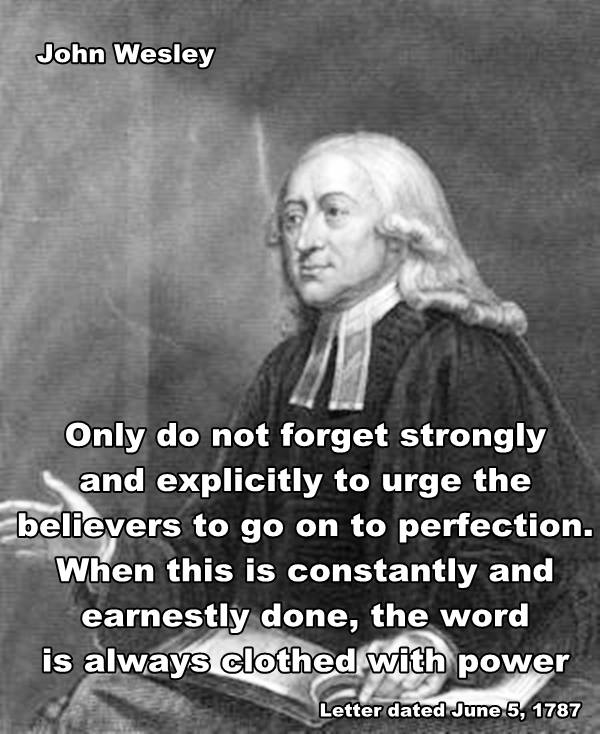
wesley-quote1787

A UMNS Commentary by the Rev. Robert J. Williams

As John Wesley, the founder of the Methodist movement, grew older, he frequently commented on his birthday how he was still in good health and this was largely due to the way God had blessed him.Wesley was born on June 17, 1703, while England was still using the Julian calendar. England adopted the Gregorian calendar in 1752 and thus Wesley’s birth date became June 28.His birthday reflections give us a glimpse into how he viewed his life, health and ministry. On June 28, 1770, he wrote:I can hardly believe that I am this entered into the sixty-eighth year of my age! How marvelous are the ways of God! How has he kept me, even from a child! From ten to thirteen or fourteen, I had little but bread to eat, and not great plenty of that. I believe this was so far from hurting me that it laid the foundation to lasting health. When I grew up, in consequence of reading Dr. Cheyne, I chose to eat sparingly and drink water. This was another great means of continuing my health, till I was about seven and twenty…; (He then speaks of various ailments.); Since that time, I have known neither pain nor sickness, and am now healthier than I was forty years ago! This hath God wrought!

He started to set a pattern for indicating his age and his good health. One year later, he wrote:

This day I entered the sixty-ninth year of my age. I am still a wonder to myself. My voice and strength are the same as at nine and twenty. This also hath God wrought.

In 1774, he wrote:

This being my birthday, the first day of my seventy-second year, I was considering. How is this, that I find just the same strength as I did thirty years ago? That my sight is considerably better now and my nerves firmer than there were then? That I have none of the infirmities of old age and have lost several I had in my youth? The grand cause is the good pleasure of God, who doth whatsoever pleaseth him. The chief means are: (1) My constantly rising at four, for about fifty years. (2) My generally preaching at five in the morning, one of the most healthy exercises in the world. (3) My never travelling less, by sea or land, than four thousand five hundred miles in a year.

In the intervening 10 years, he repeated these sentiments numerous times, and even in 1784, he wrote:

Today I entered on my eighty-second year and found myself just as strong to labour, and as fit for any exercise of body or mind, as I was forty years ago. I do not impute this to second causes, but to the sovereign Lord of all…; I am as strong at eighty-one, as I was at twenty-one, but abundantly more healthy, being a stranger to the head-ache, tooth-ache, and other bodily disorders which attended me in my youth. We can only say ‘The Lord reigneth’ While we live, let us live to him!

In 1788, after praising God “for a thousand spiritual blessings,” Wesley listed as questions what may be some of the “inferior means” for achieving such good health into old age.

To my constant exercise and change of air? To my never having lost a night’s sleep, sick or well at land or at sea, since I was born? To my having sleep at command, so that whenever I feel myself almost worn out, I call it and it comes, day or night? To my having constantly, for above sixty years, risen at four in the morning? To my constant preaching at five in the morning for above fifty years? To my having had so little pain in my life and so little sorrow or anxious care?

Finally, on June 28, 1790, less than a year before his death, he wrote:

This day I enter into my eighty-eighth year. For above eighty-six years, I found none of the infirmities of old age: my eyes did not wax dim, neither was my natural strength abated. But last August, I found almost a sudden change. My eyes were so dim that no glasses would help me. My strength likewise now quite forsook me and probably will not return in this world. But I feel no pain from head to foot, only it seems nature is exhausted and, humanly speaking, will sink more and more, till ‘The weary springs of life stand still at last.’

As this remarkable man aged, he reflected on God’s blessings and how his lifestyle contributed to his good health. This is but a brief glimpse into his humanity and can call on us to do likewise on our birthdays.

Editor’s Note: This story was first published on June 25, 2012.

*Williams is the top executive of the United Methodist Commission on Archives and History in Madison, N.J.

From http://www.umc.org/news-and-media/marking-john-wesleys-birthday-in-his-words


Leave a comment

Posted by on June 28, 2023 in Posts of Interest


Tags: , ,

All about Liturgical Colors

  • Purple, representing both royalty and penitence, is traditionally used during Advent and Lent.
  • Blue symbolizes hope and may also be used during Advent.
  • White and gold are used at Christmas and Easter to symbolize joy and festivities.
  • Red symbolizes the color of fire to represent the Holy Spirit on the Day of Pentecost and times when the work of the Holy Spirit is emphasized. During Holy Week it represents the blood of Christ. Red is also used for ordinations, church anniversaries and civil observances such as Memorial Day and Thanksgiving.
  • Green represents growth and is used during Ordinary Time (the season after Epiphany and the season after Pentecost.)

Let’s start with a word about liturgical colors. You can see listed here that the official color of the long season of Ordinary Time is green. This makes sense for lots of reasons: Ordinary Time is about growing in our faith, about accepting the gifts that we’ve been given, and producing the fruit not just as individual Christians but as the body of Christ. Green is the color of growth and of fruitfulness. There are other reasons why the season claims the color green. Perhaps you and your team can come up with some more and use them to inform the congregation who may never have given thought to why the green paraments are used throughout this season.

We started here, however, because there are those who get bored with a single color in this long season that runs from Pentecost through Reign of Christ/Christ the King Sunday at the end of November. There are so many colors, so much beauty in worship art and God’s creation, why use only one color for this long season? Isn’t this the season after Pentecost? Why can’t we use red for at least a part of the season?

The season of Ordinary Time (or the Sundays after Pentecost—there is no “Pentecost Season”) calls for creativity and artistry. Even if you are using green as a foundational color, there is no reason why you can’t bring in a host of other colors over the season. Green represents life, and life is colorful. So, use more colors; use both/and; use a whole palette of colors to bring to life the worship in Ordinary Time. Think ahead for changing series or themes and find ways to enhance the liturgy with visual expressions of color, not just in paraments, but in banners, worship centers, projected or posted images, and colors. There are ways to move beyond the plain green altar or pulpit fall. Call on artists of all sorts to enhance the space.

Adapted from https://www.umcdiscipleship.org/worship-planning/living-the-spirit-life/second-sunday-after-pentecost-year-c-lectionary-planning-notes

Chuck Knows Church — Episode 1 – LITURGICAL COLORS. Ever walk into your Sunday morning worship service and realize the colors have changed around the sanctuary? That’s why Chuck is talking about Liturgical Colors on his FIRST SHOW!


Tags: , , , , , , , , , , , , , , , , , , , , , ,