Cushing's and kidney cancer (renal cell carcinoma) patient, founder, owner and webmaster of Cushing's Help and Support, web designer, piano teacher and mom.
I am a Cushing's patient who has dealt with Cushing's symptoms since 1983 (or earlier) and the aftereffects of pituitary surgery since 1987.
Because I had very little support for my symptoms, diagnosis and surgery, I decided to try to make things a little better for other patients and started a support site called Cushing's Help and Support in 2000. The site has grown to astronomical numbers. This disease isn't as rare as doctors have told us!
In 2006, I was also diagnosed with kidney cancer (renal cell carcinoma). My left kidney and adrenal gland were removed. Having an adrenal gland removed complicates my post-Cushing's symptoms.
I am not planning to have any more rare and unusual diseases.
My entire bio to date can be found here: http://www.cushings-help.com/maryos_story.htm
But, enough of that - it's not always about Cushing's, or even Cancer. This one is about Life!
Global Ministries launches emergency food grants to support U.S. churches and food pantries combating hunger.
To address a growing U.S. hunger crisis, the General Board of Global Ministries is making Feeding Our Neighbors food ministry grants available, offering up to $2,000 in emergency food funding for United Methodist congregations with food ministries, pantries and ministry partners across the United States. United Methodist churches seeking to participate in the program can learn more and apply here. Applications are open and will be accepted through Dec. 15, 2025. Learn more about the program here.
These grants are intended to inspire acts of compassion at this time, in answer to Jesus’ call in Matthew 25:35: “For I was hungry and you gave me food, I was thirsty and you gave me something to drink.”
As the U.S. government shutdown continues, more than 40 million people are expected to lose food assistance benefits beginning Nov. 1.
“Already, community-based organizations and food ministries are reporting surges in requests for assistance, as individuals and families face critical decisions about daily living expenses,” said Roland Fernandes, general secretary of Global Ministries and UMCOR. “The further loss of food assistance benefits will have devastating consequences for millions of families. We pray that these grants will help local churches respond quickly and compassionately in their congregations and communities.”
Dr. Dana Lyles, who serves as director and team lead for Global Ministries’ Multiethnic Ministries, added, “Families are already struggling with inflation, job losses and cuts to safety-net programs that provide medical, food and financial support. These grants will allow United Methodists to stand together to protect the most vulnerable in our communities.”
Feeding Our Neighbors grants have been made available through the United Methodist Voluntary Service Program. Designed to operate at a community level, the grants directly support local church food ministries and pantries. Global Ministries is also working on a large grant with an established partner, Feeding America, to address broader U.S. needs. This grant will come to the board of directors for approval in the coming weeks.
Approved grants will be dispersed within three weeks of approval to provide immediate support for local food ministries during this critical time.
To provide financial support for hunger relief efforts, give to the World Hunger Poverty.
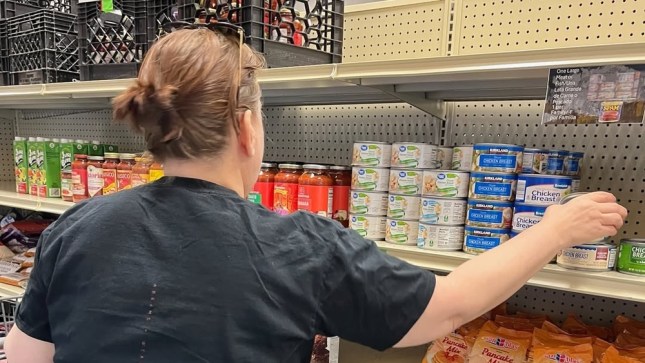
Did you know that anytime you shop at Wegmans thru November 29, you can participate in “Checkout Hunger” and your donations at checkout will benefit WFCM and the families we serve.
WFCM clients select groceries by appointment in our markets, but we also offer pre-bagged emergency food with no appointment needed for families in our community.
Need diapers for your baby or toddler (under age 3)? We are also a diaper hub (in partnership with Greater DC Diaper Bank) at our Chantilly location for families in western Fairfax County.
Pick up groceries at our markets during the month of November:
Chantilly @4511 Daly Drive Suite J:
Monday-Friday 11 am-1 pm and Monday, Tuesday and Thursday 4:30 pm-6:30 pm
Centreville @5948 Centreville Crest Lane:
Monday 3-6pm
Tuesday and Wednesday 11 am-1 pm and 4:30 pm-6:30 pm
Questions? 703-988-9656 / wfcmva.org
Please note: We are closed in observance of Veterans Day, Thanksgiving Day and the day following Thanksgiving.
November 1 is All Saints Day, a sometimes-overlooked holy day in United Methodist congregations. It is not nearly as well known as the day before, All Hallows’ (Saints’) Eve, better known as Halloween, but is far more important in the life of the church.
John Wesley, founder of the Methodist movement, enjoyed and celebrated All Saints Day. In a journal entry from November 1, 1767, Wesley calls it “a festival I truly love.” On the same day in 1788, he writes, “I always find this a comfortable day.” The following year he calls it “a day that I peculiarly love.”
This may sound odd. United Methodists don’t believe in saints. Right?
Well, yes… and no.
Wesley cautioned against holding saints in too high regard.The Articles of Religion that he sent to the Methodists in America in 1784, include a statement against “invocation of saints” (Article XIV—Of Purgatory, Book of Discipline ¶104). Wesley did not see biblical evidence for the practice and discouraged Methodists from participating.
However, he also advised against disregarding the saints altogether.
In an All Saints Day journal entry dated Monday, November 1, 1756, Wesley writes, “How superstitious are they who scruple giving God solemn thanks for the lives and deaths of his saints!” If your 18th century English is as rusty as mine, it might help to know that the word scruple means, “to be unwilling to do something because you think it is improper, morally wrong, etc.” (Merriam-Webster.com).
All Saints Day is an opportunity to give thanks for all those who have gone before us in the faith. It is a time to celebrate our history, what United Methodists call the tradition of the church.
From the early days of Christianity, there is a sense that the Church consists of not only all living believers, but also all who have gone before us. For example, in Hebrews 12 the author encourages Christians to remember that a “great cloud of witnesses” surrounds us encouraging us, cheering us on.
Charles Wesley, John’s brother, picks up on this theme in his hymn that appears in our United Methodist Hymnal as “Come, Let Us Join our Friends Above,” #709. In the first verse, he offers a wonderful image of the Church through the ages:
Let saints on earth unite to sing, with those to glory gone,
for all the servants of our King in earth and heaven, are one.
On All Saints Day we remember all those—famous or obscure—who are part of the “communion of saints” we confess whenever we recite The Apostles’ Creed. We tell the stories of the saints “to glory gone.”
Alongside the likes of Paul from the New Testament, Augustine, Martin Luther, and John and Charles Wesley, we tell stories of the grandmother who took us to church every Sunday. We remember the pastor who prayed with us in the hospital, and the neighbor who changed the oil in the family car. We give thanks for the youth leader who told us Jesus loved us, the kindergarten Sunday school teacher who showered us with that love, and the woman in the church who bought us groceries when we were out of work.
Retelling these stories grounds us in our history. These memories teach us how God has provided for us through the generosity and sacrifice of those who have come before us. The stories of the saints encourage us to be all God has created us to be.
Charles Wesley’s hymn tells us those “to glory gone” are joined by the “saints on earth,” whom we also celebrate on All Saints Day. We think of the inspirational people with whom we worship on Sunday, and those across the world we will never meet. We celebrate fellow United Methodists who inspire us, and those of other denominations whose lives encourage us. We give thanks for those with whom we agree, as well as those whose views we do not share.
Additionally, we remember and pray for our sisters and brothers in Christ who faithfully follow Jesus in places where being labeled a Christian puts them in harm’s way.
On All Saints Day, we recognize that we are part of a giant choir singing the same song. It is the song Jesus taught his disciples; a tune that has resonated for more than 2,000 years; a melody sung in glory and on the earth. Our great privilege is to add our voices to this chorus.
The last verse of “Come, Let Us Join our Friends Above” encourages us to sing faithfully while on earth, so we might join the heavenly chorus one day.
Our spirits too shall quickly join, like theirs with glory crowned,
and shout to see our Captain’s sign, to hear His trumpet sound.
O that we now might grasp our Guide! O that the word were given!
Come, Lord of Hosts, the waves divide, and land us all in heaven.
On All Saints Day, let us give thanks for both the saints in glory and those on earth, who have led us to Jesus. As they have shared the gospel with us, may we add our voices so someone else may hear about the grace and love of our Lord and Savior Jesus Christ.
November 1 is All Saints Day, a sometimes-overlooked holy day in United Methodist congregations. It is not nearly as well known as the day before, All Hallows’ (Saints’) Eve, better known as Halloween, but is far more important in the life of the church.
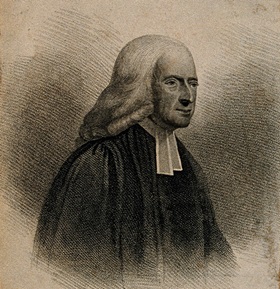
John Wesley was fond of All Saints Day. “John Wesley. Stipple engraving by J. Posselwhite” licensed under CC BY 4.0 via Wikimedia Commons.
John Wesley, founder of the Methodist movement, enjoyed and celebrated All Saints Day. In a journal entry from November 1, 1767, Wesley calls it “a festival I truly love.” On the same day in 1788, he writes, “I always find this a comfortable day.” The following year he calls it “a day that I peculiarly love.”
Wesley cautioned against holding saints in too high regard. The Articles of Religion that he sent to the Methodists in America in 1784, include a statement against “invocation of saints” (Article XIV—Of Purgatory, Book of Discipline ¶104). Wesley did not see biblical evidence for the practice and discouraged Methodists from participating.
However, he also advised against disregarding the saints altogether.
In an All Saints Day journal entry dated Monday, November 1, 1756, Wesley writes, “How superstitious are they who scruple giving God solemn thanks for the lives and deaths of his saints!” If your 18th century English is as rusty as mine, it might help to know that the word scruple means not doing something because you think it’s wrong.
All Saints Day is an opportunity to give thanks for those who have gone before us in the faith. It is a time to celebrate our history, what United Methodists call the tradition of the church.
From the early days of Christianity, there is a sense that the Church consists of not only all living believers, but also all who have gone before us. For example, in Hebrews 12 the author encourages Christians to remember that a “great cloud of witnesses” surrounds us encouraging us, cheering us on.
Charles Wesley, John’s brother, picks up on this theme in his hymn that appears in our United Methodist Hymnal as “Come, Let Us Join our Friends Above,” #709. In the first verse, he offers a wonderful image of the Church through the ages:
Let saints on earth unite to sing, with those to glory gone,
for all the servants of our King in earth and heaven, are one.
On All Saints Day we can remember all those who are part of the “communion of saints” we confess whenever we recite The Apostles’ Creed. We share stories of those “to glory gone.”
Retelling these stories grounds us in our history. These memories teach us how God has provided for us through the generosity and sacrifice of those who have come before us. The stories of the saints encourage us to be all God has created us to be.
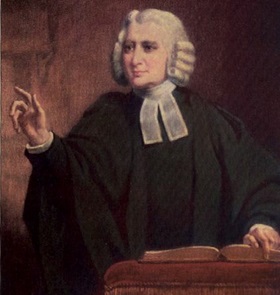
Charles Wesley wrote hymns that express his theology. “Charles-Wesley-preaching” by William Gush, public domain, via Wikimedia Commons.
Saints on earth
Charles Wesley’s hymn tells us those “to glory gone” are joined by the “saints on earth.” We think of the inspirational people with whom we worship on Sunday, and those across the world we will never meet. We celebrate fellow United Methodists who inspire us, and those of other denominations whose lives encourage us. We give thanks for those with whom we agree, as well as those whose views we do not share.
Additionally, we remember and pray for our sisters and brothers in Christ who faithfully follow Jesus in places where being labeled a Christian puts them in harm’s way.
One song
On All Saints Day, we recognize that we are part of a giant choir singing the same song. It is the song Jesus taught his disciples; a tune that has resonated for more than 2,000 years; a melody sung in glory and on the earth. Our great privilege is to add our voices to this chorus.
The last verse of “Come, Let Us Join our Friends Above” encourages us to sing faithfully while on earth, so we might join the heavenly chorus one day.
Our spirits too shall quickly join, like theirs with glory crowned,
and shout to see our Captain’s sign, to hear His trumpet sound.
O that we now might grasp our Guide! O that the word were given!
Come, Lord of Hosts, the waves divide, and land us all in heaven.
On All Saints Day, let us give thanks for both the saints in glory and those on earth, who have led us to Jesus. As they have shared the gospel with us, may we add our voices so someone else may hear about the grace and love of our Lord and Savior Jesus Christ.
Thanks be to God for the lives of his saints.
Q&A with Liturgy Man is a series of 3-5 minute videos in which Taylor Burton-Edwards answers questions about United Methodist Worship that he receives in a variety of ways from United Methodists around the connection.





 News and Views