This simple mandate for cultivating gratitude and thanksgiving is the opening line in the catchy chorus of “Count Your Blessings,” a church music staple first published more than a century ago.
All these years later, the four verses and chorus can be summed up this way: Counting your blessings may be the antidote to feeling disheartened.
The remaining line of the chorus implores you to, after counting and naming the blessings, to “see what God has done.”
The faithful act of assessing blessings and acknowledging what God has provided in your life may give perspective when challenges and conflicts occur, as the four verses detail (see sidebar).
The author of these song lyrics acknowledges that you can feel burdened and life can seem unfair. So can counting your blessings really help when turmoil swirls around you and discouragement weighs heavy on your mind?
Such was the case for Jacob, who, in Genesis 28, is fleeing from his angry brother, Esau. When Jacob stopped for the night at a place he would later name “Bethel,” Jacob was in the midst of a bad situation. He was alone, scared and had nowhere to go. He also had no idea about how his circumstances might turn out. That night in a dream, God reassured Jacob that He was with him, that He had a plan for Jacob’s life and that He would not leave him. Jacob awoke the next morning with a change of heart and life didn’t seem so bad. “Surely the Lord is in this place,” Jacob said, “and I did not know it.” (Genesis 28:16)
Numerous stories in the Bible remind you to look beyond your circumstances to see you are not alone, that “the Lord is in this place,” providing anecdotal evidence of the importance of gratitude.
In addition to the anecdotal proof, the virtues of gratitude have been proven by science.
In a study published in the Journal of Personality and Social Psychology, the test group was asked to daily write down five things for which they were thankful. After doing this every day for one week, the test group reported better sleep patterns and a more positive emotional outlook than the control group.
Members from Perryville United Methodist Church in Perryville, Kentucky, perform “Count Your Blessings.”
Whether the song’s author was battling tough times when he wrote the lyrics is unknown. What we do know is that Johnson Oatman Jr., the lyricist, was a Methodist Episcopal minister who had a penchant for songwriting. “Count Your Blessings,” intended as a song for youth, first appeared in “Songs for Young People,” which was published in 1897 by the Methodist Book Concern, a precursor to The United Methodist Publishing House. Over Oatman’s life, he penned more than 5,000 songs, including the classic hymn “No, Not One.”
For “Count Your Blessings,” Oatman partnered with E.O. Excell, who put Oatman’s words to music. Excell operated a Chicago-based publishing business specializing in Sunday School materials and collaborated with the Methodists for numerous projects. Fun fact about Excell is that he is the same person who wrote the arrangement of “Amazing Grace” that is most often sung throughout the world today.
But back to “Count Your Blessings.”
Once “Songs for Young People” was published, “Count Your Blessings” became a favorite, quickly gaining popularity throughout the world.
One account from a London daily newspaper says that when the famous British evangelist Gipsy Smith presided over a meeting, he announced a hymn, saying, “Let us sing ‘Count Your Blessings.’ Down in South London, the men sing it, the boys whistle to it, and the women rock their babies to sleep to the tune.”
In addition to the upbeat, simple tune that people have found easy to remember, its message has been uplifting folks for generations.
“Like a beam of sunlight,” wrote J.H. Hall, Oatman’s biographer, in “Biography of Gospel Song and Hymn Writers, “(’Count Your Blessings’) has brightened up the dark places of the earth.”
Crystal Caviness works for UMC.org at United Methodist Communications. Contact her by email or at 615-742-5138.
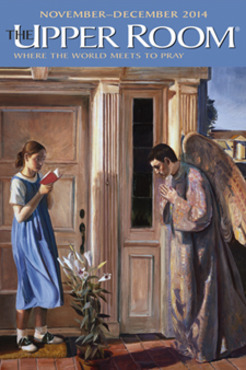
Get your copy or The Upper Room at Pender UMC each month in regular or large print versions.
The Upper Room magazine’s mission is to provide a model of practical Christianity, accessible in varied formats, to help people feel invited and welcomed into God’s presence to:
listen to scripture as God’s personal message, linking their stories to God’s story;
commune with God in prayer;
see their daily choices and small acts of obedience as part of God’s work;
realize our connection through Christ as a universal family of believers;
encounter the living Christ and be transformed into Christ’s likeness.
From Chuck Knows Church. The Upper Room. It’s the place where Jesus had his last meal with his disciples, but it’s also the world’s most widely read daily devotional guide. Chuck explains the significance of this “little book”.
Thank you for your generous support of building the flood buckets. Pender completed 11 buckets and we had extra supplies to donate also.
There was even show and tell with some of the Burke UMC preschoolers. The kids were very interested to see what was inside the buckets and what they were for. You’re never too early to learn about missions.
Pender United Methodist Church is requesting that each family donate ONE item in support of our assisting our neighbors in Florida and Puerto Rico who are working through the devastation and impact of natural disasters, specifically hurricanes. It is our hope that everyone will join with us in assisting to build flood bucket cleaning kits that will assist the families.
All items must be new. All cleaning agents must be in liquid form. No powders can be accepted. Items for donation may not be imprinted with cartoon characters, advertisements, religious, patriotic, military, or camouflage symbols.
Requested Cleaning Kit Materials:
One Five-gallon round bucket with lid (14.35″ h x 12.19″ w x1)
No screw lids
This may be used, but it must be free from all residual product
Advertisements on the outside are acceptable.
No patriotic or religious symbols are to be displayed.
One 32-64 oz. bottle liquid laundry
One 16-40 oz. bottle liquid concentrate household cleaner (please, no spray cleaners)
One 16-34 oz. bottle liquid dish soap
One 4-8 oz. pump spray air freshener
One 6-14 oz. pump spray insect repellent (pack of 10-20 wipes also acceptable)
Pump spray bottles must have protective covers
One scrub brush (with or without handle)
18 re-usable cleaning wipes
No terrycloth, microfiber or paper towels
Remove the packaging
Five scouring pads
No stainless steel or pads with soap on them
Remove from packaging
36-50 clothespins
One 50-100 ft. clothesline (cotton or plastic line)
24 roll of heavy-duty trash bags (33-45 gallon sizes)
Remove from packaging
Five N95 particulate respirator dust masks (1-3 mm thickness)




 News and Views