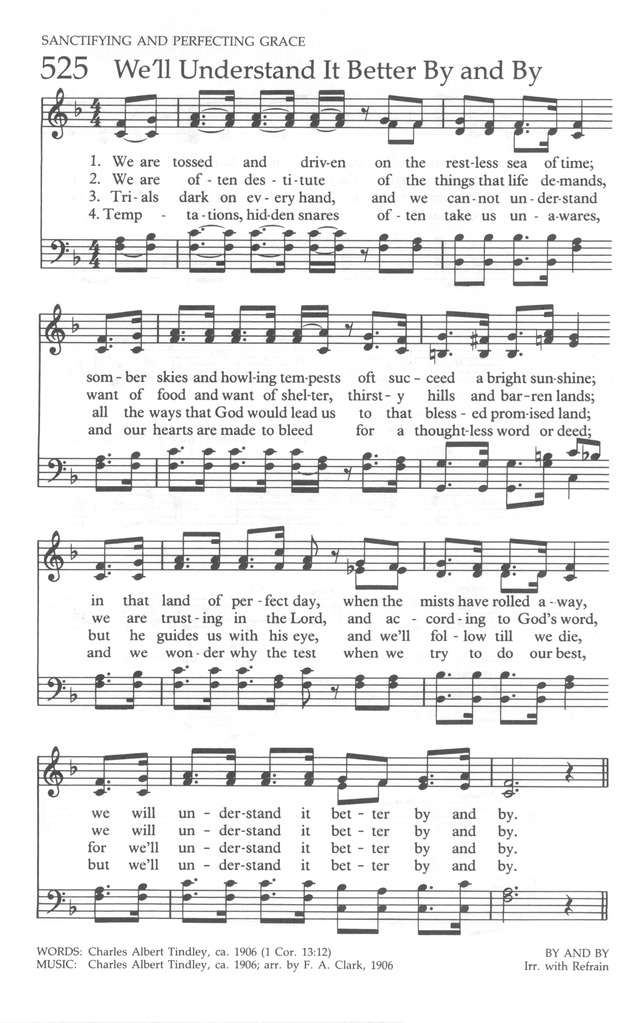
We are tossed and driven
on the restless sea of time;
somber skies and howling tempests
oft succeed a bright sunshine;
in that land of perfect day,
when the mists have rolled away,
we will understand it better by and by.
Charles Albert Tindley (July 7, 1851 – July 26, 1933) was an American Methodist minister and gospel music composer.
Often referred to as “The Prince of Preachers”, he educated himself, became a minister and founded one of the largest Methodist congregations serving the African-American community on the East Coast of the United States.
He was one of the eminent preachers of Methodism at the turn of the twentieth century. Hymnologist James Abbington has called Tindley a “pastor, orator, poet, writer, theologian, social activist, ‘father of African American Hymnody,’ ‘progenitor of African American gospel music’ and ‘prince of preachers.'”
The Rev. Carlton Young notes “We’ll Understand It Better By and By” was “one of eight hymns . . . written during a difficult period in Tindley’s life.”
One can imagine Tindley using this song to punctuate his sermons, offering hope to those assembled not only through exegesis of the biblical text, but also through a lyrical sung theology.
~~
From “The Lawrence Welk Show,” Gail, Rod, and Michael are featured in this great Gospel song found in the United Methodist Hymnal (page 525). Join with them in song as they encourage every Christian: “WE’LL UNDERSTAND IT BETTER BY AND BY”
“Great is the Lord, and greatly to be praised, and His greatness is unsearchable.” Psalm 145:3
“How Great Thou Art” is a Christian hymn based on a Swedish poem written by Carl Gustav Boberg (1859–1940) in Sweden in 1885. The melody is a Swedish folk song. Its popularity is due in large part to its wide use by gospel singers, notably George Beverly Shea of the Billy Graham Evangelistic Team.
The original Swedish text was a poem entitled “O Store Gud.” written by a Swedish pastor, the Reverend Carl Boberg, in 1886. In addition to being one of the leading evangelical preachers of his day. Boberg was also the successful editor of the periodical Sanningsvittnet. His inspiration for this text is said to have come from a visit to a beautiful country estate on the southeast coast of Sweden. He was suddenly caught in a midday thunderstorm with awe-inspiring moments of flashing violence, followed by a clear brilliant sun. Soon afterwards he heard the calm, sweet songs of the birds in nearby trees. The experience prompted the pastor to fall to his knees in humble adoration of his mighty God, He penned his exaltation in a nine-stanza poem beginning with the Swedish words “O Store Gud, nar jag den varld beskader.”
Several years later Boberg was attending a meeting in the Province of Varmland and was surprised to hear the congregation sing his poem to the tune of an old Swedish melody. It is typically characteristic of many other hymn tunes, i.e., “Day by Day” with its lilting, warm, singable simplicity.
With his original English lyrics and his arrangement of the Swedish folk melody, Mr. Stuart K. Hine published what we know today as the hymn “How Great Thou Art.” Assignments of copyrights and publication rights to an American publishing firm in 1954 helped spread the popularity of this hymn. In April of 1974 the Christian Herald magazine, in a poll presented to its readers, named “How Great Thou Art” the No. 1 hymn in America.
How Great Thou Art
Verse 1:
O Lord my God, When I in awesome wonder,
Consider all the worlds Thy Hands have made;
I see the stars, I hear the rolling thunder,
Thy power throughout the universe displayed.
Chorus:
Then sings my soul, My Saviour God, to Thee,
How great Thou art, How great Thou art.
Then sings my soul, My Saviour God, to Thee,
How great Thou art, How great Thou art!
Verse 2:
When through the woods, and forest glades I wander,
And hear the birds sing sweetly in the trees.
When I look down, from lofty mountain grandeur
And see the brook, and feel the gentle breeze.
Chorus
Verse 3:
And when I think, that God, His Son not sparing;
Sent Him to die, I scarce can take it in;
That on the Cross, my burden gladly bearing,
He bled and died to take away my sin.
Chorus
Verse 4:
When Christ shall come, with shout of acclamation,
And take me home, what joy shall fill my heart.
Then I shall bow, in humble adoration,
And then proclaim: “My God, how great Thou art!”
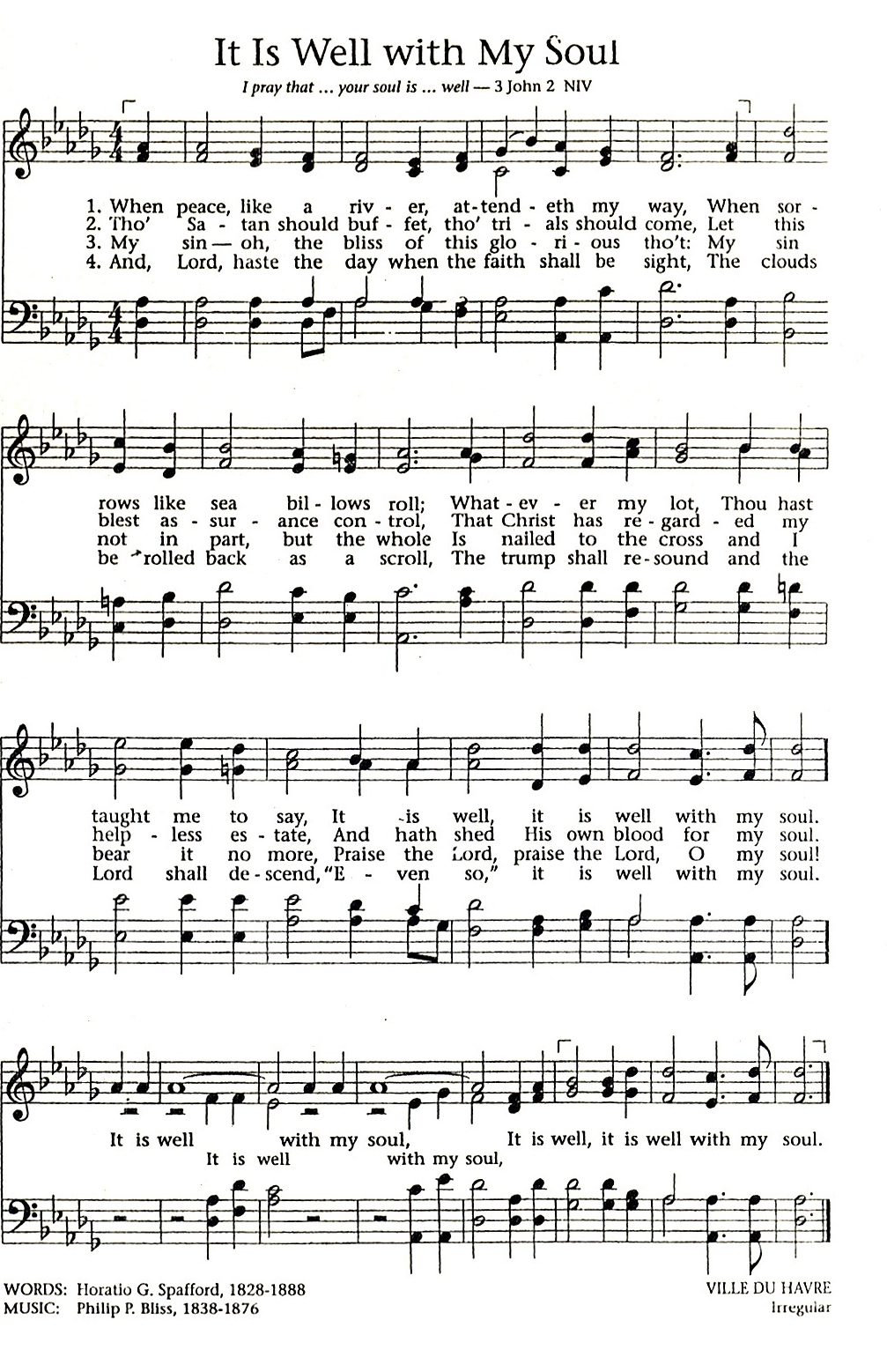
“It Is Well with My Soul” was written by hymnist Horatio Spafford and composed by Philip Bliss. It is possibly the most influential and enduring in the Bliss repertoire and is often taken as a choral model, appearing in hymnals of a wide variety of Christian fellowships.
English: Picture of Horatio Spafford (Photo credit: Wikipedia)
This hymn was written after traumatic events in Spafford’s life. The first was the 1871 Great Chicago Fire which ruined him financially (he had been a successful lawyer and had invested significantly in property in the area of Chicago which was ruined by the great fire).
In 1873 he had planned to travel to Europe with his family on the SS Ville du Havre. At the last minute, he sent the family ahead while he was delayed on business concerning zoning problems following the Great Chicago Fire.
While crossing the Atlantic, the ship sank rapidly after a collision with a sea vessel, the Loch Earn, and all four of Spafford’s daughters died. His wife Anna survived and sent him a telegram, “Saved alone . . .”.
Shortly afterwards, as Spafford traveled to meet his grieving wife, he was inspired to write these words as his ship passed near where his daughters had died.
Bliss called his melody “Ville du Havre”, from the name of the stricken vessel.
1. When peace, like a river, attendeth my way,
When sorrows like sea billows roll;
Whatever my lot, Thou has taught me to say,
It is well, it is well, with my soul.
Refrain:
It is well, with my soul,
It is well, it is well, with my soul.
2. Though Satan should buffet, though trials should come,
Let this blest assurance control,
That Christ has regarded my helpless estate,
And hath shed His own blood for my soul.
Refrain
3. And Lord, haste the day when my faith shall be sight,
The clouds be rolled back as a scroll;
The trump shall resound, and the Lord shall descend,
Even so, it is well with my soul.
Refrain
4. And Lord, haste the day when my faith shall be sight,
The clouds be rolled back as a scroll;
The trump shall resound, and the Lord shall descend,
Even so, it is well with my soul.
Chuck Knows Church — THE HYMNAL. “Turn in your hymnal to page….” Heard that before in church? Chuck digs into the book that’s usually within your reach each Sunday. And he starts it all off with a solo! Smile and learn with Chuck.




 News and Views