Angels we have heard on high
Sweetly singing o’er the plains
And the mountains in reply
Echoing their joyous strains
CHORUS:
Gloria, in excelsis Deo!
Gloria, in excelsis Deo!
Shepherds, why this jubilee?
Why your joyous strains prolong?
What the gladsome tidings be
Which inspire your heavenly song? ChorusCome to Bethlehem and see
Him Whose birth the angels sing;
Come, adore on bended knee,
Christ the Lord, the newborn King. ChorusSee Him in a manger laid
Jesus Lord of heaven and earth;
Mary, Joseph, lend your aid,
With us sing our Savior’s birth. Chorus
This is a traditional French carol (Les Anges dans nos Campagnes) that was translated into English by Bishop James Chadwick.
This carol commemorates the story of the birth of Jesus Christ found in the Gospel of Luke, in which shepherds outside Bethlehem encounter a multitude of angels singing and praising the newborn child.
The Piano Guys, Peter Hollens, David Archuleta, and The Mormon Tabernacle Choir get together to sing “Angels We Have Heard On High”
Isaac Watts wrote the words to “Joy to the World” in 1719, based on Psalm 98 in the Bible. The hymn originally glorified Christ’s triumphant return at the end of the age, rather than a song celebrating His first coming. Only the second half of Watts’ lyrics are still used today.
The music was adapted and arranged to Watts’ lyrics by Lowell Mason in 1839 from an older melody which was then believed to have originated from Handel. The name “Antioch” is generally used for the hymn tune.
As of the late 20th century, “Joy to the World” was the most-published Christmas hymn in North America.
The origins of popular Advent hymn, “O Come, O Come, Emmanuel,” extend back to the 9th century. Photo and Canva illustration by Crystal Caviness, United Methodist Communications
When United Methodists sing “O Come, O Come, Emmanuel,” few likely know this popular Advent hymn’s origins span across 1200 years.
The story of how Latin vespers chanted by monks in the 800s found itself recorded in the 21st century by the likes of Kelly Clarkson and Wynonna Judd follows a circuitous and mysterious history through Europe.
The words
“O Come, O Come, Emmanuel” hearkens back to medieval times when Christmas Vespers were sung, primarily in monasteries, from December 17 to December 23, a tradition which continues to this day in Roman Catholic and Anglican churches. Using hymns called “O” Antiphons, the verses, sung in Latin, all began with “O.” (The word, “antiphon” means psalm or anthem.)
Englishman John Mason Neale first translated the “O” Antiphons from Latin to English in the early 1850s. Neale was an Anglican priest, hymn writer and prize-winning poet who was influenced by the Oxford Movement.
Said to be a high church traditionalist, Neale eschewed the hymns of popular 18th century composer Isaac Watts, who wrote more than 600 hymns, including “Joy to the World.” Neale longed to return the Church to its liturgical roots and was known for translating ancient Greek and Latin hymns into English.
In addition to authoring “O Come, O Come, Emmanuel,” Neal also wrote “Good King Wenceslas,” “Good Christian Men, Rejoice,” and the Palm Sunday hymn, “All Glory, Laud and Honor.”
Fun fact: Neale’s first version of the hymn began with the words, “Draw nigh, draw night, Emmanuel.”
The music
In 1851, Thomas Helmore is credited with pairing the familiar tune we sing today, called “Veni Emmanuel,” with the English translation of the words when he published “Hymnal Noted.” At the time, Helmore attributed the music to “a French Missal in the National Library, Lisbon.” Additional details of the melody’s origins remained a mystery for more than 100 years. In 1966, Mary Berry, a British musicologist, discovered a 15th-century manuscript of the melody at the National Library of France. The original composition, according to Berry’s writings, is a burial processional chant with the words, “Bone Jesu dulcis cunctis.” The author is unknown.
Though the “Veni Emmanuel” tune is the most common, alternative versions exist, particularly in German.
The popularity
When Helmore published “O Come, O Come, Emmanuel” in “Hymnal Noted,” he unknowingly set the song on its trajectory to distinction.
Helmore’s version was included in “Hymns Ancient and Modern,” edited by William Henry Monk, published in 1861 and considered the Church of England’s official hymnal. By the end of the 1800s, more than three-quarters of English churches used the volume, making “O Come, O Come, Emmanuel” part of the Christian church’s tradition.
Across the decades, translators tweaked the verses. The version we sing today, including the one found as no. 211 in the United Methodist Hymnal, combines Neale’s translation with revisions made in 1941 for the Episcopal “Hymnal” and translations by Henry Sloane Coffin, a Presbyterian minister and social activist.
In addition to serving as an Christmastime standard both in Christian and secular society (dozens of popular music acts have recorded versions of the hymn), the verses provide a meaningful devotion for us during the Advent season, a time when we prepare and await the birth of Jesus, Emmanuel, God with us.
Crystal Caviness works for UMC.org at United Methodist Communications. Contact her by email or at 615-742-5138.
In Honor of Charles Wesley ‘s birthday today. Wesley (1707-1788), the younger brother of John Wesley wrote the words to this Christmas Carol.
Charles was a hymn writer and a poet, also known as one of the people who began the Methodist movement in the Church of England. Hark the Herald Angels Sing appeared in 1739 in a book called Hymns and Sacred Poems.
Wesley envisioned this being sung to the same tune as his hymn, Christ the Lord Is Risen Today, and in some hymnals it is included along with the more popular version.
This hymn was regarded as one of the Great Four Anglican Hymns and published as number 403 in “The Church Hymn Book” (New York and Chicago, USA, 1872).
To celebrate the invention of the printing press, Felix Mendelssohn composed a cantata in 1840 called Festgesang or “Festival Song”. The melody of Mendelssohn’s cantata was then used by William H. Cummings and adapted it to the lyrics of Wesley’s “Hark the Herald Angels Sing”.
Hark the herald angels sing
“Glory to the newborn King!
Peace on earth and mercy mild
God and sinners reconciled”
Joyful, all ye nations rise
Join the triumph of the skies
With the angelic host proclaim:
“Christ is born in Bethlehem”
Hark! The herald angels sing
“Glory to the newborn King!”
And, of course, no one can do it better than The Mormon Tabernacle Choir.


 The origins of popular Advent hymn, “O Come, O Come, Emmanuel,” extend back to the 9th century. Photo and Canva illustration by Crystal Caviness, United Methodist Communications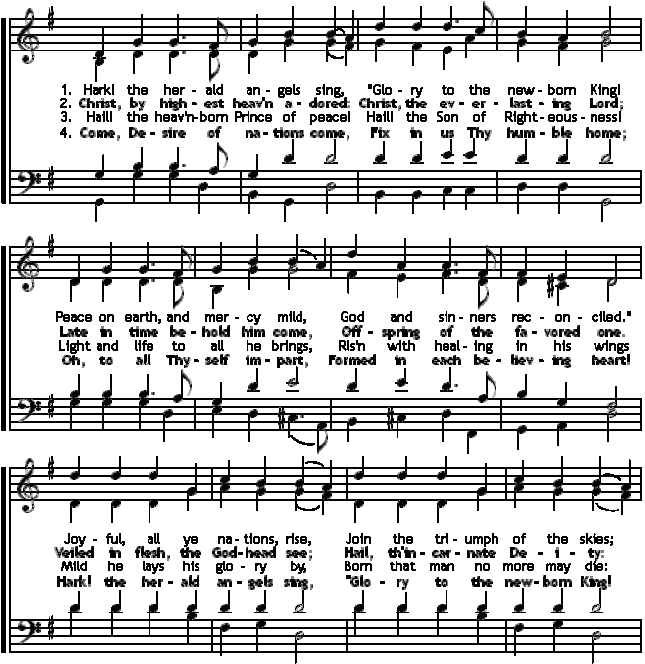


 News and Views