RSS

Tag Archives: Christmas Music

Christmas Music, Part 22 – We Three Kings

we-three

“We Three Kings”, also known as “We Three Kings of Orient Are” or “The Quest of the Magi”, is a Christmas carol written by the Reverend John Henry Hopkins, Jr., who wrote both the lyrics and the music.

We Three Kings

We three kings of Orient are
Bearing gifts we traverse afar
Field and fountain, moor and mountain
Following yonder star

O Star of wonder, star of night
Star with royal beauty bright
Westward leading, still proceeding
Guide us to thy Perfect Light

Born a King on Bethlehem’s plain
Gold I bring to crown Him again
King forever, ceasing never
Over us all to reign

O Star of wonder, star of night
Star with royal beauty bright
Westward leading, still proceeding
Guide us to Thy perfect light

Frankincense to offer have I
Incense owns a Deity nigh
Prayer and praising, all men raising
Worship Him, God most high

O Star of wonder, star of night
Star with royal beauty bright
Westward leading, still proceeding
Guide us to Thy perfect light

Myrrh is mine, its bitter perfume
Breathes of life of gathering gloom
Sorrowing, sighing, bleeding, dying
Sealed in the stone-cold tomb

O Star of wonder, star of night
Star with royal beauty bright
Westward leading, still proceeding
Guide us to Thy perfect light

Glorious now behold Him arise
King and God and Sacrifice
Alleluia, Alleluia
Earth to heav’n replies

O Star of wonder, star of night
Star with royal beauty bright
Westward leading, still proceeding
Guide us to Thy perfect light

From Mannheim Steamroller, Chip Davis gives this song an “Arabian Nights” feel. A classic song that tells the story of the Gentiles who were quicker to recognize the significance of Christ’s birth than were His own people. Enjoy, and Merry Christmas!


Tags: , , , , , , , , , , ,

Christmas Music, Part 21 – The First Noel

first-noel

The First Nowell (also written The First Noël) is a traditional classical English carol, most likely from the 18th century, although possibly earlier.

The word Noel comes from the French word Noël meaning “Christmas”, from the Latin word natalis “birthday”.

The melody is unusual among English folk melodies in that it consists of one musical phrase repeated twice, followed by a refrain which is a variation on that phrase. All three phrases end on the third of the scale.

The first Noel the angel did say
Was to certain poor shepherds in fields as they lay;
In fields where they lay tending their sheep,
On a cold winter’s night that was so deep.

Refrain

Noel, Noel, Noel, Noel,
Born is the King of Israel.

They lookèd up and saw a star
Shining in the east, beyond them far;
And to the earth it gave great light,
And so it continued both day and night.

Refrain

And by the light of that same star
Three Wise Men came from country far;
To seek for a King was their intent,
And to follow the star wherever it went.

Refrain

This star drew nigh to the northwest,
Over Bethlehem it took its rest;
And there it did both stop and stay,
Right over the place where Jesus lay.

Refrain

Then did they know assuredly
Within that house the King did lie;
One entered it them for to see,
And found the Babe in poverty.

Refrain

Then entered in those Wise Men three,
Full reverently upon the knee,
And offered there, in His presence,
Their gold and myrrh and frankincense.

Refrain

Between an ox stall and an ass,
This Child truly there He was;
For want of clothing they did Him lay
All in a manger, among the hay.

Refrain

Then let us all with one accord
Sing praises to our heavenly Lord;
That hath made Heaven and earth of naught,
And with His blood mankind hath bought.

Refrain

If we in our time shall do well,
We shall be free from death and hell;
For God hath prepared for us all
A resting place in general.

Refrain

The First Noel


The University of Utah Singers performed “The First Noel” arr. by Dan Forrest live in concert, December 11th & 12th, 2009 in Libby Gardner concert hall under the direction of Dr. Brady Allred.


Tags: , , , , ,

Christmas Music, Part 20 – O Come, O Come Emmanuel (again)

The origins of popular Advent hymn, “O Come, O Come, Emmanuel,” extend back to the 9th century. Photo and Canva illustration by Crystal Caviness, United Methodist Communications
When United Methodists sing “O Come, O Come, Emmanuel,” few likely know this popular Advent hymn’s origins span across 1200 years.

The story of how Latin vespers chanted by monks in the 800s found itself recorded in the 21st century by the likes of Kelly Clarkson and Wynonna Judd follows a circuitous and mysterious history through Europe.

The words

“O Come, O Come, Emmanuel” hearkens back to medieval times when Christmas Vespers were sung, primarily in monasteries, from December 17 to December 23, a tradition which continues to this day in Roman Catholic and Anglican churches. Using hymns called “O” Antiphons, the verses, sung in Latin, all began with “O.” (The word, “antiphon” means psalm or anthem.)

Englishman John Mason Neale first translated the “O” Antiphons from Latin to English in the early 1850s. Neale was an Anglican priest, hymn writer and prize-winning poet who was influenced by the Oxford Movement.

Said to be a high church traditionalist, Neale eschewed the hymns of popular 18th century composer Isaac Watts, who wrote more than 600 hymns, including “Joy to the World.” Neale longed to return the Church to its liturgical roots and was known for translating ancient Greek and Latin hymns into English.

In addition to authoring “O Come, O Come, Emmanuel,” Neal also wrote “Good King Wenceslas,” “Good Christian Men, Rejoice,” and the Palm Sunday hymn, “All Glory, Laud and Honor.”

Fun fact: Neale’s first version of the hymn began with the words, “Draw nigh, draw night, Emmanuel.”

The music

In 1851, Thomas Helmore is credited with pairing the familiar tune we sing today, called “Veni Emmanuel,” with the English translation of the words when he published “Hymnal Noted.” At the time, Helmore attributed the music to “a French Missal in the National Library, Lisbon.” Additional details of the melody’s origins remained a mystery for more than 100 years. In 1966, Mary Berry, a British musicologist, discovered a 15th-century manuscript of the melody at the National Library of France. The original composition, according to Berry’s writings, is a burial processional chant with the words, “Bone Jesu dulcis cunctis.” The author is unknown.

Though the “Veni Emmanuel” tune is the most common, alternative versions exist, particularly in German.

The popularity

When Helmore published “O Come, O Come, Emmanuel” in “Hymnal Noted,” he unknowingly set the song on its trajectory to distinction.

Helmore’s version was included in “Hymns Ancient and Modern,” edited by William Henry Monk, published in 1861 and considered the Church of England’s official hymnal. By the end of the 1800s, more than three-quarters of English churches used the volume, making “O Come, O Come, Emmanuel” part of the Christian church’s tradition.

Across the decades, translators tweaked the verses. The version we sing today, including the one found as no. 211 in the United Methodist Hymnal, combines Neale’s translation with revisions made in 1941 for the Episcopal “Hymnal” and translations by Henry Sloane Coffin, a Presbyterian minister and social activist.

In addition to serving as an Christmastime standard both in Christian and secular society (dozens of popular music acts have recorded versions of the hymn), the verses provide a meaningful devotion for us during the Advent season, a time when we prepare and await the birth of Jesus, Emmanuel, God with us.

Crystal Caviness works for UMC.org at United Methodist Communications. Contact her by email or at 615-742-5138.

Adapted from https://www.umc.org/en/content/hymn-history-o-come-o-come-emmanuel


Tags: , , , , , , , , , , , , , , , , ,

Charles Wesley: Hark the Herald Angels Sing

Hark the Herald Angels Sing
In Honor of Charles Wesley ‘s birthday today.   Wesley (1707-1788),  the younger brother of John Wesley wrote the words to this Christmas Carol.

Charles was a hymn writer and a poet, also known as one of the people who began the Methodist movement in the Church of England. Hark the Herald Angels Sing appeared in 1739 in a book called Hymns and Sacred Poems.

Wesley envisioned this being sung to the same tune as his hymn, Christ the Lord Is Risen Today,  and in some hymnals it is included along with the more popular version.

This hymn was regarded as one of the Great Four Anglican Hymns and published as number 403 in “The Church Hymn Book” (New York and Chicago, USA, 1872).

To celebrate the invention of the printing press, Felix Mendelssohn composed a cantata in 1840 called Festgesang or “Festival Song”. The melody of Mendelssohn’s cantata was then used by William H. Cummings and adapted it to the lyrics of Wesley’s “Hark the Herald Angels Sing”.

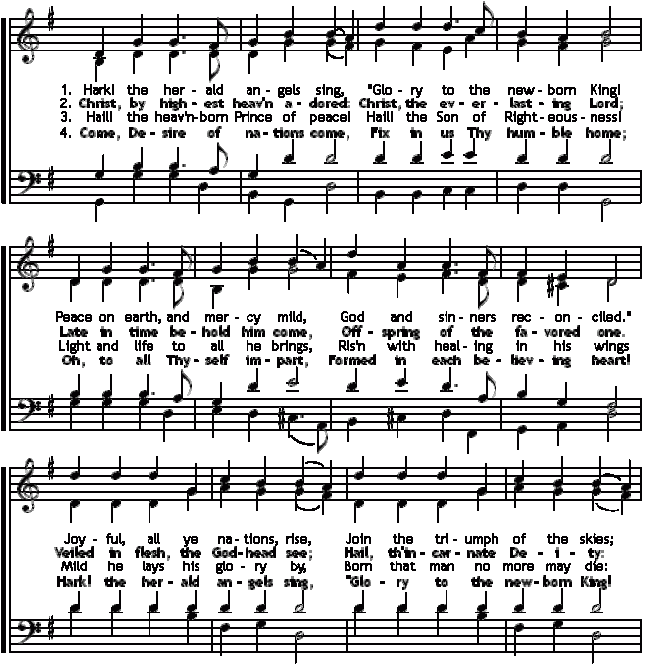
Hark the herald angels sing
“Glory to the newborn King!
Peace on earth and mercy mild
God and sinners reconciled”
Joyful, all ye nations rise
Join the triumph of the skies
With the angelic host proclaim:
“Christ is born in Bethlehem”
Hark! The herald angels sing
“Glory to the newborn King!”

And, of course, no one can do it better than The Mormon Tabernacle Choir.

 
Leave a comment

Posted by on December 18, 2020 in Christmas Music, Holidays, Posts of Interest


Tags: , , , , , , , , , , , , , , ,

Tonight at 5:00 PM ~ Advent Sing ‘n Celebrate

snc-advent-feature


Sing ‘N Celebrate, Celebrating Advent

December 6 at 5-6pm in the Fellowship Hall

As part of our Advent Journey, join us as we focus on another, most difficult journey which brought Mary and Joseph to Bethlehem, where we feature the reaction of an innkeeper and his wife who had nothing but a stable to offer to this special couple. Hope was born in the midst of disappointment.

We are looking forward to hearing the Christmas praise music of the new band which will be auditioning.


Tags: , , , ,