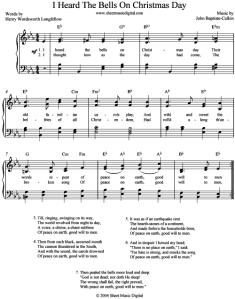
“I Heard the Bells on Christmas Day” is a Christmas carol based on the 1863 poem “Christmas Bells” by American poet Henry Wadsworth Longfellow. The song tells of the narrator’s despair, upon hearing Christmas bells, that “hate is strong and mocks the song of peace on earth, good will to men”. The carol concludes with the bells carrying renewed hope for peace among mankind.
This version is done by Casting Crowns. I chose it because the Pender choir sang this on Christmas Eve with past-Associate Pastor Dan Elmore singing the solo…and I fell in love with this version.
As seen on 2008 TBN Christmas special. “I Heard The Bells On Christmas Day” is available on Casting Crowns’ Christmas album, Peace On Earth.
More traditionally, the Mormon Tabernacle Choir’s version:
I heard the bells on Christmas Day
Their old, familiar carols play,
and wild and sweet
The words repeat
Of peace on earth, good-will to men!
And thought how, as the day had come,
The belfries of all Christendom
Had rolled along
The unbroken song
Of peace on earth, good-will to men!
Till ringing, singing on its way,
The world revolved from night to day,
A voice, a chime,
A chant sublime
Of peace on earth, good-will to men!
Then from each black, accursed mouth
The cannon thundered in the South,
And with the sound
The carols drowned
Of peace on earth, good-will to men!
It was as if an earthquake rent
The hearth-stones of a continent,
And made forlorn
The households born
Of peace on earth, good-will to men!
And in despair I bowed my head;
“There is no peace on earth,” I said;
“For hate is strong,
And mocks the song
Of peace on earth, good-will to men!”
Then pealed the bells more loud and deep:
“God is not dead, nor doth He sleep;
The Wrong shall fail,
The Right prevail,
With peace on earth, good-will to men.”
Angels we have heard on high
Sweetly singing o’er the plains
And the mountains in reply
Echoing their joyous strains
CHORUS:
Gloria, in excelsis Deo!
Gloria, in excelsis Deo!
Shepherds, why this jubilee?
Why your joyous strains prolong?
What the gladsome tidings be
Which inspire your heavenly song? ChorusCome to Bethlehem and see
Him Whose birth the angels sing;
Come, adore on bended knee,
Christ the Lord, the newborn King. ChorusSee Him in a manger laid
Jesus Lord of heaven and earth;
Mary, Joseph, lend your aid,
With us sing our Savior’s birth. Chorus
This is a traditional French carol (Les Anges dans nos Campagnes) that was translated into English by Bishop James Chadwick.
This carol commemorates the story of the birth of Jesus Christ found in the Gospel of Luke, in which shepherds outside Bethlehem encounter a multitude of angels singing and praising the newborn child.
The Piano Guys, Peter Hollens, David Archuleta, and The Mormon Tabernacle Choir get together to sing “Angels We Have Heard On High”
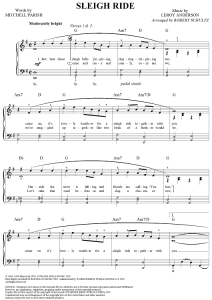
I’ve always liked Leroy Anderson’s Sleigh Ride as a secular Christmas song 🙂 It’s not technically a Christmas song since the words never mention Christmas but it’s often played now so it seems like a way to ease into the season.
Anderson had the original idea for the piece during a heat wave in July 1946; he finished the work in February 1948. Lyrics, about a person who would like to ride in a sleigh on a winter’s day with another person, were written by Mitchell Parish in 1950.
The orchestral version was first recorded in 1949 by Arthur Fiedler and The Boston Pops Orchestra. The song was a hit record and has become the equivalent of a signature song for the orchestra.
“Lift Every Voice and Sing”
James Weldon Johnson The United Methodist Hymnal, No. 519
Pender pianist, Liz Eunji Moon played Lift Every Voice and Sing for the postlude on Martin Luther King Holiday weekend. “Lift Every Voice” began as a hastily-written composition for an unassuming school assembly in 1900, but has become the African-American national anthem.
Lift every voice and sing,
Till earth and heaven ring,
Ring with the harmonies of liberty;
Let our rejoicing rise
High as the listening skies,
Let it resound loud as the rolling sea.
Few hymns have the capacity to define the identity of an entire group. “Lift Every Voice” began as a hastily-written composition for an unassuming school assembly in 1900, but has become the African-American national anthem.
James Weldon Johnson (1871-1938) received degrees in literature from Atlanta University in 1894, with a master of arts in 1904. He had a versatile career as a writer, teacher, diplomat and lawyer, becoming the first African-American to pass the bar in the state of Florida. His diplomatic posts took him in 1906 to Puerto Cabello, Venezuela, and in 1909, to Corinto, Nicaragua, where he served as the American consul.
His most prominent leadership role was as the executive secretary of the National Association for the Advancement of Colored People (NAACP), a position that he assumed in 1920.
His most important published works include The Autobiography of an Ex-Colored Man (1920), The Book of American Negro Poetry (1922), God’s Trombones (1927), and Along This Way (1933).
Johnson had been asked to speak by the principal of a school in Jacksonville, Fla., his hometown, for an observance celebrating the birth of Abraham Lincoln. Rather than make a speech, he decided to write a poem. As the time drew near, his plans changed from a poem to a song. James turned to his brother J. Rosamund Johnson (1873-1954) to compose music for his text.
Even though the Johnsons’ New York publisher did not actively promote the song, children throughout the South kept it alive. The song gathered momentum, as it became known around the country.
Though the brothers wrote over 200 songs together, mostly for the stage, “Lift every voice” had an exceptional place in their musical collaborations. James noted in 1935, “The lines of this song repay me in elation, almost of exquisite anguish, whenever I hear them sung by Negro children.”
Gene Logan, a member of Ebenezer UMC in Jacksonville, Florida, connects the Johnson brothers with the Methodist Church: “James and his brother Rosamond became members of Zion Episcopal Methodist Church where their mother served as choir director and the young men served as musicians. The church was renamed Ebenezer United Methodist Church, which is now located at 9114 Norfolk Blvd in Jacksonville, Florida.” According to columnist Sharon Coon in Florida, their mother, Helen, “was the first Black female public school teacher in Florida. She taught at Old Stanton School on Ashley Street in Jacksonville, FL. His mother taught both James and J. Rosamond music and reading.” After receiving his degree from Atlanta University, James returned to the school where his mother taught as Principal in 1894. The brothers’ connections to the Methodist Church and their rearing by a nurturing and courageous mother surely contributed to their accomplishments.
The NAACP adopted “Lift every voice” as its theme song. Julian Bond, former NAACP chairman, stated that the song holds deep meaning for the Civil Rights Movement: “When people stand and sing it, you just feel a connectedness with the song, with all the people who’ve sung it on numerous occasions, happy and sad, over the 100 years before.”
This hymn, often called the “Negro National Anthem” or “Black National Anthem,” gave hope to many during the Civil Rights Era. Its centrality in African-American life may be illustrated by a childhood memory of Vernellia Randall, a law professor at the University of Dayton, who grew up in Texas. She recalls starting each day in her school in the 1950s and 1960s with The Lord’s Prayer, The National Anthem, and the Negro National Anthem.
Wendell Whalum, the late choral director at Atlanta’s Morehouse College, often spoke of the progression of the three stanzas as that of praise, lament, and prayer. The opening stanza is a resounding hymn of praise full of rich metaphors such as the “harmonies of liberty” and rejoicing “loud as the rolling sea.” The second stanza is a lament that recounts the price of liberty:
Stony the road we trod,
bitter the chastening rod,
felt in the day when hope unborn had died.
The sting of these words echoes Psalm 130, “Out of the depths have I cried unto thee.” Yet the poet does not leave us here long. By the end of the stanza, we are singing with hope,
Out of the gloomy past, till now we stand at last where the white gleam of our bright star is cast.
The final stanza is often referred to as a prayer in the African-American community. This prayer culminates with the petitions, “keep us forever in the path, we pray” and “may we forever stand true to our God, true to our native land.”
Is this a hymn just for African-Americans or is it for all people? Dr. James Abbington, Associate Professor of Music and Worship at Emory University’s Candler School of Theology, Atlanta, Georgia, and a scholar in African American hymnody, provides an answer to this question: “Several years ago, I was invited to organize and conduct a 1,000-voice choir for the annual Detroit Branch NAACP Freedom Fund Dinner at Cobo Hall. It was during the time of the Persian Gulf War and tensions were very high between the Jewish and Arab communities in the city.?rel=0″The 1,000 voice choir, accompanied by the Detroit Symphony Orchestra, was made up of Anglo-Americans, Canadians, Native Americans, Koreans, Italians, Jews, Arabs, African-Americans and others, and ‘Lift Every Voice and Sing’ was one of the selections for that occasion. After the first rehearsal Jewish, Korean, and Native American members of the chorus approached me and said, ‘This song isn’t just for African-Americans and people from Africa, it belongs to all of us who are ‘true to our God and true to our Native land.'”?
On May 20, 2018, the National Association for the Advancement of Colored People (NAACP) attended The Tabernacle Choir’s weekly Music and the Spoken Word broadcast. Members of the National Board of Directors of the NAACP and the NAACP Foundation were in Salt Lake City for their board meetings, which were held in Salt Lake City for the first time. They also met with the First Presidency of The Church of Jesus Christ of Latter-day Saints and made a joint statement to the media calling for “greater civility and racial harmony.”
Messiah (HWV 56) is an English-language oratorio composed in 1741 by George Frideric Handel, with a scriptural text compiled by Charles Jennens from the King James Bible, and from the Psalms. It was first performed in Dublin on 13 April 1742, and received its London premiere nearly a year later. After an initially modest public reception, the oratorio gained in popularity, eventually becoming one of the best-known and most frequently performed choral works in Western music.
Part II of the Messiah covers the Passion, death, resurrection, ascension, and the later spreading of the Gospel, concluded by the “Hallelujah Chorus”.
The Mormon Tabernacle Choir sings the classical and beloved Hallelujah Chorus from Handel’s Messiah.
And also on Nov. 13 2010 unsuspecting shoppers got a big surprise while enjoying their lunch. Over 100 participants in this awesome Christmas Flash Mob.



 News and Views