I’ve been thinking a bit about shoes lately, specifically organ shoes. Many people probably don’t know that organists usually use special shoes to help them play the pedals on an organ.
When I am learning a new piece, I play barefoot to help feel where my feet should go but when playing in church I always have my Organmaster shoes on.
The About Us page of the Organmaster website says in part:
Organmaster Shoes began in 1976 when an organist, Carol Carlson, struggled to find shoes that would work for organ. Organmaster Shoes began in 1976 when an organist, Carol Carlson, struggled to find shoes that would work for organ pedaling. She knew that many organists, like herself, were playing in bare feet or slippers. Normal dress shoes did not allow the organist to FEEL what note the foot was touching and were too slippery on the pedals. After years of searching, she finally decided to design the perfect organ shoes and sell them herself!

Her shoes for Toe-Heel Pedal Technique have a FULL HEEL providing solid contact with the pedals and 1 ¼ inches high to avoid injuring a leg muscle.
The shoes are very secure on the foot while playing the pedals. The women’s shoe has an elasticized strap with a buckle and the men’s shoe is a lace-up dress oxford.
However, it is the SUEDE LEATHER SOLES on the bottom of the shoes which make her shoes so special and which her customers rely on to tell what note the foot is touching. The shoes slide over the pedals, but don’t slip off because the suede provides just the right amount of grip allowing the organist to FEEL his or her way across the pedal board. The shoes also play silently on the pedals.
The shoes were an immediate hit producing an overwhelming response by organists. Very soon the shoes were being shipped all over the world. Many organ teachers tell us they require their students to wear our shoes as well.
Organ legend Virgil Fox took organ shoes to the extreme when he studded the heels with diamonds so that they would sparkle as he was playing Bach’s Gigue Fugue, or as he said “…when I dance the gigue.”
Anyway, shortly after Thanksgiving 2010 our church organist, Bob Chiralo AKA “Mr. Bob” to the kids, learned that he had cancer. During his surgery and treatment, his organ shoes sat neatly behind the organ and I would see them every week at choir rehearsal and Sunday services.
His shoes being there always gave me the hope that he might be back to use them soon.
Tuesday, April 12, 2011, Bob lost his battle with cancer and at choir rehearsal I noticed that his shoes were gone, too. That struck me as so final.
Bob won’t be back with us but I’m sure he’s putting those shoes to good use playing in heaven.
Thanks for all those years of service you provided to our church!

From Bob Chiralo’s online obituary:
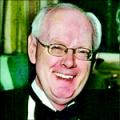 Robert Philip Chiralo died on April 12, 2011 of brain cancer. His wife was at his side, as was Father Alexander Drummond, who administered the Sacraments of the Church and a dear family friend, Jeanne Dalaba.
Bob was born on May 8, 1949 in Reading, Pennsylvania. He was an honor student throughout his school years there and began studying piano at age 8. At age 16, he was certified by the Lutheran Church to serve as an Organist/Choir Director. He continued his organ studies through his undergraduate years and was a lifetime member of the American Guild of Organists, serving in various capacities in that organization. In his deep devotion as a church musician he continuously served at various churches in Pennsylvania, California and most recently as organist at Pender UMC in Fairfax, Virginia.
He was an active Republican grassroots pro-life volunteer, member of the Fairfax County Republican Committee and spent several years as a tour guide at Manassas Battlefield Park. He was a student of world history, particularly military history.
Bob Chiralo had over thirty-five years of technical, management, and business development experience in intelligence and defense with the Federal Government. This began with his early work at the Aerospace Corporation, continued through his employment at Logicon Geodynamics and Logicon Ultrasystems (both now part of TASC, Inc.), and led to his current position at SRI International. Bob established a professional reputation as a pioneer in the area of Measurement and Signature Intelligence, especially in applying the science of sensors to the growing field of overhead sensing systems support for our national security and intelligence communities. This included extensive involvement in the evaluation of new remote sensing and hyperspectral detection technologies and culminating in his role in helping establish the Spectral Information Technology Applications Center (SITAC) to better formalize the evaluation of various new methods in these arenas. Bob’s expertise also led to one of the more interesting assignments of his professional career, his service as a technical advisor on imagery processing in connection with the House of Representatives 1978 investigation of the assassination of President John F. Kennedy.
Bob joined the Washington Office of SRI in 1998 as Intelligence Community Program Development Manager; his responsibilities included support of the company’s business development efforts and Intelligence Community Program Development, including project and program management spanning nearly the entire spectrum of the intelligence and national security communities. He was also quite active professionally. He was a founding member of the Measurement and Signature Intelligence Association, and an officer and past Chairman of the organization, and played a key role in its 2008 reorganization as the Advanced Technical Intelligence Association (ATIA). He was also an active member of the Institute for Electrical and Electronic Engineers (IEEE), the American Society of Photogrammetry and Remote Sensing (ASPRS), the North American Remote Sensing Industries Association (NARSIA) and the National Military Intelligence Association (NMIA). He held a B.A. in Physics from Wittenberg University (1971) and an MS in Electrical Engineering from the University of Pennsylvania (1973) in addition to other ongoing professional studies connected to his work.
He is survived by his wife of 30 years, Monica Dolle Chiralo of Centreville, VA; daughter and son-in-law Monette and Michael Johnstone with grandchildren Melissa Mae and Maxfield Alexander Johnstone of Seattle, WA; parents Anthony Philip and Mary Jane Chiralo of Reading, PA; and brother Joel Anthony Chiralo of Carney, MD.
The Funeral Mass will be held at Saint Andrew the Apostle Catholic Church in Clifton, VA on Monday morning, April 18 at 11:30 with burial following in the Garden of the Blessed Mother at Fairfax Memorial Park. A celebration of his life and music ministry will follow at Pender United Methodist Church in Fairfax. In lieu of flowers, it was his desire that donations be made toThe Jeanne Bussard Center, 555 South Market St., Frederick, MD 21701. This is a facility which serves mentally and physically handicapped adults. It was dear to his heart.
Addendum:
1) Monica says:
“Bob is, indeed, using them (his shoes) – because he is wearing them, with his black cassock, a rosary in his hands and a Phillies’ hat on his head. Sure hope St. Peter isn’t a Yankees fan!”
2) This interview Virgil Fox shows his shoes even better in the first few minutes.
Addendum 2
From http://lis.virginia.gov/cgi-bin/legp604.exe?112+ful+HJ5031
Virginia’s Legislative Information System
2011 SPECIAL SESSION I
11200137D
HOUSE JOINT RESOLUTION NO. 5031Offered April 25, 2011
———-Patron– Hugo———-Unanimous consent to introduce———-WHEREAS, Robert Philip Chiralo of Centreville, a highly respected professional who played a pioneering role in the development of measurement and signature intelligence, died on April 12, 2011; and
WHEREAS, a native of Pennsylvania, Robert “Bob” Chiralo received a bachelor’s degree from Wittenberg University and a master’s degree from the University of Pennsylvania; and
WHEREAS, Bob Chiralo enjoyed a successful career that spanned more than three decades and involved technical, management, and business development work in intelligence and defense with the federal government; and
WHEREAS, Bob Chiralo began his distinguished career at the Aerospace Corporation before moving to Logicon Geodynamics and Logicon Ultrasystems (both now part of TASC, Inc.); in 1998 he joined the Washington Office of SRI International; and
WHEREAS, a brilliant innovator, Bob Chiralo recognized the role that the science of sensors could play in the growing field of overhead sensing systems support for the national security and intelligence communities; and
WHEREAS, Bob Chiralo became actively involved in the evaluation of new remote sensing and hyperspectral detection technologies, eventually helping to establish the Spectral Information Technology Applications Center; and
WHEREAS, highly regarded for his technical expertise, Bob Chiralo proudly served his country in a variety of ways, including working as a technical advisor on imagery processing during the investigation of the assassination of President John F. Kennedy; and
WHEREAS, Bob Chiralo made numerous contributions to his profession through his affiliation with different organizations; he was a founding member of the Measurement and Signature Intelligence Association and played a key role in its 2008 reorganization as the Advanced Technical Intelligence Association; and
WHEREAS, Bob Chiralo was also an active member of the Institute for Electrical and Electronics Engineers, the American Society of Photogrammetry and Remote Sensing, the North American Remote Sensing Industries Association, and the National Military Intelligence Association; and
WHEREAS, Bob Chiralo was a gifted musician who learned to play the organ as a young boy; at the age of 16, he received certification from the Lutheran church as an organist/choir director and continued his organ studies as an undergraduate; and
WHEREAS, a lifetime member of the American Guild of Organists, Bob Chiralo took great pride in serving as a church musician, most recently at Pender United Methodist Church in Fairfax; and
WHEREAS, an active member of the community, Bob Chiralo was a stalwart member of the Fairfax County Republican Committee and spent several years as a tour guide at Manassas National Battlefield Park; and
WHEREAS, a devoted family man, Bob Chiralo will be greatly missed by his wife of 30 years, Monica; daughter, Monette and her family, including two grandchildren; parents, Anthony Philip and Mary Jane; and numerous other family members, friends, and admirers; now, therefore, be it
RESOLVED by the House of Delegates, the Senate concurring, That the General Assembly hereby note with great sadness the loss of a pioneering leader in the intelligence community and respected community supporter, Robert Philip Chiralo; and, be it
RESOLVED FURTHER, That the Clerk of the House of Delegates prepare a copy of this resolution for presentation to the family of Robert Philip Chiralo as an expression of the General Assembly’s respect for his memory.
Addendum 3 Monica Chrialo died on January 6, 2023.
Monica Dolle Chiralo Major completed her journey to Our Lord on Jan 6th, 2023, after a lengthy battle with Carcinoid Cancer and Chronic Lymphocytic Leukemia (CLL) since 1999. She is the daughter of the late John Arnold Dolle and Lova Lea Reynolds Dolle. She is survived by her husband Arthur Major, daughter Monette Claire Northcutt Johnstone and grandson Maxfield Alexander Johnstone of Seattle, Washington, and sister Merrielea Zabia Dolle of Hawaii; also, stepchildren Jason Major, James Major, and Lisa Krebs and step grandson Roland Krebs. She is the widow of Robert Chiralo, who preceded her in death after 31 years of marriage.
She was born in Santa Monica, CA, in 1948 and graduated with a history major from California State University Dominguez Hills and attended Notre Dame Graduate School majoring in theology and eventually settled in Virginia, then later, Arizona. She had hundreds of books, was a voracious reader and was fluent in three languages; was an accomplished flute and guitar player, dancer, singer, and pianist. She taught piano, guitar, and flute lessons to dozens and maintained close friendships with many of her former students and their families. She was a clothing designer, knitter, and seamstress, making many items for friends and family and designed unique patterns and products which she sold under the “Miss Monette” label; and excelled at photography with many framed pictures around her home. Monica had a spirited personality and many fascinating life experiences including a brief time in the USAF, working at the US embassy in Nigeria, and much overseas travel and cruises.
She was a dedicated and determined volunteer in the Virginia Republican Party at the county and state levels, always willing to work for the causes she held dear and sponsoring many events which proved vital to her party’s success. She was an enthusiastic and devout communicant of the Roman Catholic church, had an amazing – comprehensive knowledge of scripture, high standards, and always demonstrated Christian values as a role model. She touched a lot of people, both directly and indirectly by thoughtful contributions and personal interactions with many including countless strangers. This was purposeful on her part – in her 60’s she completed two years of Spanish language lessons at a community college just so she could communicate with, and better help, the immigrant community. She was the dearest of friends, a perceptive listener, and a caring and loving advisor who will be sorely missed by many.
A Mass of Christian Burial will be held at 11 a.m. on Wednesday, January 25, 2023 at St. Benedict Catholic Church, 300 N Sheppard St., Richmond, VA 23221. A reception will follow after Mass at 12:30 p.m. at Bliley’s – Central, 3801 Augusta Ave., Richmond, VA 23230. Interment will be held at 1 p.m. on Thursday, January 26, 2023 at Fairfax Memorial Park, 9900 Braddock Rd., Fairfax, VA 22032. A memorial service will be announced at a later date and time in Sun City, Az.
In lieu of flowers please contribute “In honor of Monica Dolle Major” at “https://www.carcinoid.org/about/contributing-to-our-foundation/”



 News and Views