RSS

Monthly Archives: June 2023

Hymn History: ‘Doxology’

Pender’s current Doxology is “Praise God, from Whom All Blessings Flow”.

On May 28, 2023, Pender Pianist, Heidi Jacobs played a prelude which incorporated the Doxology into a medley of hymns.

In general usage, the Doxology is a short statement of praise, glory, and thanksgiving to God. It is often a short hymn designed to be sung by the worshiping congregation. Pender sings it to give thanks after the offering.

Chuck Knows Church — Doxology.

Chuck sings! Kinda. Bet you can’t guess the name of the most played piece of music in Protestant churches each Sunday? You looked at the title of this episode, didn’t you?

Chuck sings and explains on this his show!

“Praise God, from Whom All Blessings Flow”
by Thomas Ken
The United Methodist Hymnal, 95

Praise God, from whom all blessings flow;
Praise him, all creatures here below;
Praise him above, ye heav’nly host;
Praise Father, Son, and Holy Ghost.

Born in Hertfordshire, Bishop Thomas Ken (1637–1711) was orphaned as a child and raised by his sister Anna and her husband Izaak Walton. They enrolled him in the all-boys school at Winchester College (1651–1656). After his education there, he attended Hart Hall, Oxford, and New College, Oxford (B.A., 1661, M.A., 1664).

Ken was ordained as an Anglican priest in 1662, serving as rector to several parishes and as a chaplain to Princess Mary of Orange (1679–80), King Charles II (1683), and the Tangier Expedition (1683–84). In 1685, he was appointed Bishop of Bath and Wells. During the reign of King James II, he was imprisoned in the Tower of London for refusing to sign the Declaration of Indulgence (1687), a decree designed to promote the king’s Catholic faith. Ken was acquitted of the charge. When, however, King William III ascended to the throne, Ken refused to swear loyalty to him and resigned his office, living the rest of his life at the home of his friend, Lord Weymouth, at Longleat, Wilshire (Doyle, Canterbury Dictionary, n.p.).

The original date of composition by Ken for the text of “Praise God from Whom All Blessings Flow” is unknown. The first mention of the hymn is in 1674 as the presumed final stanza of two longer hymns: “Awake, My Soul and with the Sun” and “Glory to Thee, My God, this Night.” These two hymns were referenced along with a third as Morning, Evening and Midnight Hymns in a later edition of a pamphlet written for his students titled A Manual of Prayers for the Use of the Scholars of Winchester College (1695). The following directive is from the first edition:

. . . be sure to sing the Morning and Evening Hymn in your chamber devoutly, remembering that the Psalmist, upon happy experience, assures you that it is a good thing to tell of the loving kindness of the Lord early in the morning and of his truth in the night season (Ken, 1675, n.p.).

This directive is most often interpreted to mean that the hymns were meant for private devotion, not the gathered assembly, and yet these four lines, often referred to as The Lesser Doxology, have “been sung more often than any other lines ever written” (Gealy, 1993, 200). The hymn texts were published later as an appendix in his 1695 pamphlet as “revised” versions.

Much of the beauty of these four lines lies in its reflection of the joyous outbursts of the psalms. Here we see both the “host” of heaven and the “creatures here below” of earth praising God as in Psalm 96:11-12a and the final jubilant line of Psalm 150:6:

Let the heavens be glad, and let the earth rejoice;
let the sea roar, and all that fills it;
let the field exult, and everything in it. (Psalm 96: 11-12a, NRSV)
Let everything that breathes praise the Lord!
Praise the Lord! (Psalm 150:6, NRSV)

Commonly called “The Doxology,” Ken’s acclamation of praise is actually one of many doxological declarations that appear in many hymns, often in final stanza. See, for example, the last stanzas of the fourth-century hymn “Of the Father’s Love Begotten,” William Draper’s versification (c. 1919) of a thirteenth-century poem by Francis of Assisi, “All Creatures of Our God and King,” and Catherine Winkworth’s translation (1858) of Lutheran pastor Martin Rinkart’s “Now Thank We All Our God” (1647). Though less common now, the pattern for many mainline Protestant congregations has been to sing another doxological acclamation, the “Gloria Patri,” earlier in a worship service, and Ken’s stanza at the time of the offertory. Of note is the cosmic character of Ken’s praise—“all creatures here below” and “above ye heavenly hosts”—calling on the entire cosmos to praise God.

The Trinitarian structure of Ken’s hymn has also led to its common liturgical use. The first line describes the person of God the Father as the source of all blessings (Ephesians 1:3; 2 Corinthians 1:3). The second line, though, speaks to God the Spirit through whom all creatures praise God (Psalm 104:24-30; 1 Corinthians 2:10-13). The third line points to God the Son, who is begotten of the Father, firstborn of heaven and superior to angels and the heavenly host (Hebrews 1:4). The fourth line summarizes the stanza and all of praise in general, since all praise is directed toward God, Father, Son, and Holy Spirit.

The United Methodist Hymnal pairs this text with the hymn tune OLD 100th, which is attributed to John Calvin’s composer, Louis Bourgeois (c. 1510–1559). The first two lines of Ken’s text were later adapted with additional inclusive words by United Methodist pastor Gilbert H. Vieira (b. 1926) to be sung with LASST UNS ERFREUEN from Ausserlesene Catholische, Kirchengesänge (1623), harmonized by Ralph Vaughan Williams. Pastor Vieira’s use of inclusive language reflects his continuing strong stands for inclusive and carefully chosen language (see Vieira, 2020, n.p.).

The hymn tune MORNING HYMN was composed by François Hippolyte Barthélémon (1741–1808) for the text of “Awake, My Soul, and With the Sun.” The appropriateness of the tune works well for this final stanza, where the words of the second phrase, “Praise him, all creatures here below,” are sung by descending stepwise through an entire scale. The third phrase, “Praise him above, ye heav’nly host,” is sung through a similar ascension that returns to the highest note of the tune in the final stanza, acknowledging the Trinitarian nature of God. Sheila Doyle comments on the hymn text saying, “The language is simple and precise, and the opening images of light and rising up, appropriate to morning, pervade the hymn and convey a powerful sense of renewal and aspiration” (Doyle, “Awake, My Soul,” n.p.).

SOURCES:

Sheila Doyle, “Awake, My Soul, and with the Sun,” The Canterbury Dictionary of Hymnology. Canterbury Press, https://hymnology.hymnsam.co.uk/a/awake,-my-soul,-and-with-the-sun (accessed September 27, 2020).

_____, “Thomas Ken,” The Canterbury Dictionary of Hymnology. Canterbury Press, http://www.hymnology.co.uk/t/thomas-ken (accessed September 27, 2020).

Fred D. Gealy, Research Files for the 1970 Companion to the Hymnal [1966] quoted in Young, Carlton R. Companion to the United Methodist Hymnal (Nashville, TN: Abingdon Press, 1993), 200.

Thomas Ken, A Manual of Prayers for the Use of the Scholars of Winchester College
(London: Printed for John Martyn, 1675), http://anglicanhistory.org/ken/manual.html (accessed September 27, 2020).

Gilbert H. Viera, “Let’s Watch Our Language,” United Methodist Insight (February 24, 2020), https://um-insight.net/perspectives/let-s-watch-our-language (accessed September 27, 2020).


From https://www.umcdiscipleship.org/articles/history-of-hymns-praise-god-from-whom-all-blessings-flow
 

Tags: , , , ,

Hymn History: ‘My Eternal King’

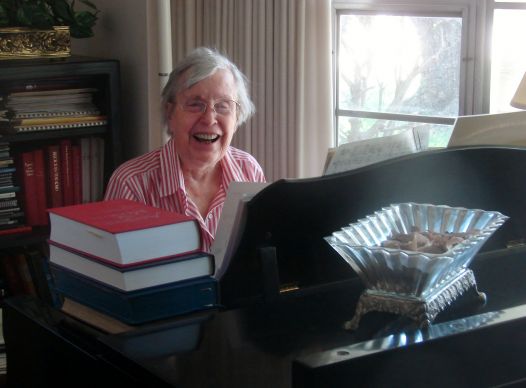
jane-marshall-piano

From 17th Century Latin, translated by Rev. Edward Caswall; set to music by Jane Marshall “My God, I love Thee; not because I hope for heav’n thereby, Nor yet because who love Thee not Must die eternally. Thou, O my Jesus, Thou didst me Upon the cross embrace; For me didst bear the nails, the nails and spear, And manifold disgrace. Why, then why, O blessed Jesus Christ, Should I not love Thee well? Not for the hope of winning heav’n, Or of escaping hell; Not with the hope of gaining aught, Not seeking a reward; But as Thyself hast loved me, O ever-loving Lord! E’en so I love Thee, and will love, And in Thy praise will sing; Solely because Thou art my God, And my Eternal King.”   http://youtu.be/AtvJ4gk9MrM The video above is of My Eternal King as sung by the Reunion Choir of current and former choir members at the celebration of the 10th anniversary of the Reynolds Associates III manual/54 rank pipe organ at Broadway United Methodist Church in Indianapolis. David Morton directs, with Schuyler Brinson at the organ console. ~~~~~

By Sam Hodges July 9, 2014 | DALLAS (UMNS)

Jane Marshall’s name may not be known to people in the pews, but in the choir loft it’s another story.At 89, the Dallas resident is revered by music ministers and choir members for her anthems, hymns and other sacred music compositions.“She’s the consummate Methodist composer of my time,” said the Rev. Carlton Young, editor of The United Methodist Hymnal. One anthem launched Marshall  “My Eternal King.” It was her first, and she wrote it as a 26-year-old homemaker, singing alto in the Highland Park Methodist Church choir. “I just decided to do it,” Marshall recalled at the North Dallas home she shares with husband Elbert Marshall, a retired Texas Instruments engineer. This month (July 2014) marks the 60th anniversary of the anthem’s publication in sheet music. Not only does “My Eternal King” remain in print, it’s a staple for many churches across denominations. “That’s a classic. We’ve done it a million times,” said Sid Davis, director of music and fine arts at St. Luke’s United Methodist Church in Houston. “It’s kind of in our back pocket. … It’s in our DNA.” Meditative at the start, soaring to triple fortissimo at the end, encompassing a range of tone colors and sumptuous harmonies, “My Eternal King” evokes testimonials not just from music ministers, but from fellow composers. “I wish I’d written it,” said Alice Parker, famous in choral circles for her own works as well as collaborations with the legendary choral director Robert Shaw. “It meets my ideal in every way.” While it’s true that Marshall had no record as a sacred music composer when she wrote “My Eternal King,” she didn’t come unprepared. 

Raising the roof

As a small child, attending a Presbyterian church, she stood on the pew and conducted along with the choir director. Marshall’s mother played hymns on the piano and soon had her taking piano with one of Dallas’ top teachers. “Hazel Cobb,” Marshall said. “Boy, was she good. I knew my theory because of her. She encouraged me to practice, which I didn’t want to do because I was lazy, and she said so. But thank goodness I had her.” Marshall was Jane Manton then, and recalls that her family loved words as much as music. She and Elbert met in Latin class at Highland Park Junior High, where she sat one seat ahead of him (“Pulled my hair,” she said); and at Highland Park High School they sang together in Gilbert and Sullivan productions. Also in her teen years, Marshall first tried writing music. She went on scholarship to Dallas’ Southern Methodist University, majoring in music and minoring in organ. She and Elbert married in 1946. By early 1952, they had a toddler daughter, the first of three children, and were singing in the Highland Park Methodist Church Chancel Choir. Neither she nor Elbert recalls many details about her writing of “My Eternal King.” But she chose as its text the Rev. Edward Caswall’s translation of an anonymous 17th century Latin poem. The Caswall translation was in both the Presbyterian and Methodist hymnals of Marshall’s youth. It begins, “My God, I love thee.” Marshall’s music, after establishing the mood with an organ solo, follows the poem’s intensely devotional response to Christ’s sacrifice on the cross. When she took the anthem to the Highland Park Methodist Choir director, Federal Lee Whittlesey, he wanted to do it. But Marshall had no name for it, and Whittlesey himself was perplexed. “Lee didn’t know what the title should be because the normal titles use the first lines, and he didn’t want to call it ‘My God, I love thee,’” Elbert Marshall said. “Thought it was cussing,” Jane said. “Yes, so he called it ‘A Spiritual Contemplation,’” Elbert said. “Sounds like something a banker would come up with,” Jane said. The back page of the March 20, 1952 edition of the Highland Park Methodist newsletter carried a 44-word item noting that the following Sunday, March 23, the Chancel Choir would sing the premiere of “A Spiritual Contemplation.” Raymond Jerome, an 80-year-old retired physician, was then a student singing with the choir. He recalls how surprised everyone was to learn Marshall had written an anthem. That quickly faded. “We were spellbound as we first rehearsed it,” he said. Jerome remembers a gathering excitement, culminating in a first performance — conducted by Jane in which the choir sang with near roof-lifting force at the end.

Getting published

Whittlesey had a contact on the editorial board at Carl Fischer Music company in New York, and sent Marshall’s anthem there. “They didn’t want to publish it because they thought she was just a flash in the pan,” Elbert Marshall recalled. “They said, ‘We’ll publish it if she writes something else.’ So she wrote ‘None Other Lamb.’” Carl Fischer brought out sheet music for “My Eternal King,” renamed for its concluding words, and “None Other Lamb” on July 13, 1954. While the company doesn’t share sales figures, a spokeswoman said “My Eternal King” ranks among its top 15 best-selling anthems of all time. The firm has been going since 1872. A 1976 Dallas Morning News feature on Marshall reported without attribution that “My Eternal King” had sold “hundreds of thousands” of sheet music copies. The Marshalls say they never kept track. While Elbert was the breadwinner, Jane’s royalties on “My Eternal King” didn’t hurt. “It’s paid for a lot of things,” she said.

Long, varied ministry

If Marshall ever lacked confidence, she certainly had it after “My Eternal King.” Philip Baker remembers a story about Whittlesey bringing in a new piece for the Highland Park Methodist choir to try. “It was a light little anthem, kind of a happy thing for church, but a little simplistic,” said Baker, who would later lead the choir. “Jane came up to Whittlesey and said, ‘It’s good to see new stuff, but I can do better than that.’” As the story goes, Marshall went home that night and began to write “Awake My Heart,” perhaps her second-best-known anthem. It won the American Guild of Organists’ 1957 anthem prize. Marshall would compose such enduringly popular works as “He Comes to Us” (inspired by the conclusion of Albert Schweitzer’s book “The Quest for the Historical Jesus”), “Fanfare for Easter” and the hymn, “What Gift Can We Bring,” for which she wrote words and music. She has composed entire books of church music for children, and is one of the best-represented contemporary writers in The United Methodist Hymnal, thanks to her settings of the Psalms. Evidence of Marshall’s breadth of appeal is that she’s been honored by the Southern Baptist Church Music Conference, while also having a work in a British Unitarians’ hymnal. Writing music has been just part of Marshall’s ministry. She served as choir director at Dallas’ Northaven United Methodist Church in its early years. From 1975 to 2010, she led the summer Church Music Summer School at SMU’s Perkins School of Theology. “She was working with conservatory graduates and people who’d never given a downbeat,” said the Rev. John Thornburg, a frequent hymn-writing collaborator of Marshall’s. “You can see her influence on a whole generation of church musicians.” One is Taylor Davis, a popular composer and director of music and worship arts at First United Methodist Church in Fort Worth, Texas. In his early years, he used to take her his compositions-in-progress. “I can hear Jane as I write, asking questions like, ‘Isn’t there a better chord you could use there?’” he said. Throughout Marshall’s long, varied career — which includes writing “Grace, Noted,” a book of sermons and essays on music-making — “My Eternal King” has been the reference point. “Scarcely a month goes by before someone pulls me aside to say, ‘We just sang your mother’s anthem in church last week.’ It’s most often ‘My Eternal King,’” said Peter Marshall, her youngest child and a keyboardist for the Atlanta Symphony. The anthem is sung throughout the year in worship services, and is a favorite at Easter. As people who grew up with it die off, it’s increasingly a choice for funerals and memorial services. Peter Marshall played it on the piano last year for Sue Fowler, his aunt and Jane’s sister, at her request as she spent her last days in hospice care.

‘Gateway anthem’

Some Marshall fans, including son Peter, say that while they admire “My Eternal King,” it is not their favorite of her compositions. “My Eternal King” is, in fact, representative of the big-sound, mid-century Protestant anthem — a style Marshall moved away from. But Sterling Procter sees “My Eternal King” as timeless, and struggles for words to convey its importance to him. He encountered the anthem as a teen singing in a church choir in Dallas. He was so captivated that he learned to play it on the piano, though that wasn’t his instrument. Procter would go on to a long career playing French horn in the Fort Worth Symphony, while also leading brass ensembles and composing and arranging music. He’s still smitten with “My Eternal King.” “I don’t think I write a single piece of music that’s not influenced by something in that brief anthem,” he said. “I would call it a gateway anthem. It’s a portal for musicians and parishioners alike to get drawn in by the power of music.” Told recently of Procter’s endorsement, Marshall did not swell with pride. Whatever vanity she has, she hides. (She also lacks pretension. Carlton Young recalls first meeting her decades ago at SMU, when her star was on the rise. “Howdy!” she greeted him.) But Marshall grows animated when hearing about others’ success in traditional church music. She recently got such a report from Thornburg, who came along to help with an interview. He told her the First United Methodist of Church of Dallas Chancel Choir had sung at the North Texas (annual) Conference, earning ovations. “Hooray!” Marshall cried. Many — if not the composer herself — would say the same about the long life of “My Eternal King.” Hodges, a United Methodist News Service writer, lives in Dallas. Contact him at (615) 742-5470 or newsdesk@umcom.org From http://www.umc.org/news-and-media/my-eternal-king-launched-top-methodist-composer


Leave a comment

Posted by on June 13, 2023 in Hymn History, Posts of Interest


Tags: , , , , , , , , , , , , , , , , , ,

Note from the Pastor: Pender Youth Group Transition

Dear Families of Pender United Methodist Church,

I want to share with you some information regarding our upcoming pastoral transition. I feel it is important that we communicate with you as fully as we can.

Please know that change is never easy, however, if it is done purposefully and prayerfully it can be good. Over the past year our Staff/Pastor-Parish Relations Committee (S/PPRC) has been prayerfully considering appropriate staffing of the youth pastoral position after Rev. Howard M. Fickling-Finley resigned from his post.  I have served as the interim advisor and minister for our youth. Now that I am entering retirement, Pender’s S/PPRC and myself, have decided to appoint Mark Atwood as the interim youth director with Arlether Williams, Chairperson of Staff/Pastor-Parish Relations Committee, and Jane Mckee, Leader of the Grow in God Cluster to serve as co-leads during this period of transition.

Mark Atwood is the Chairman of the Chris Atwood Foundation, which he co-founded in 2013  after the Atwood family lost their son Christopher to an accidental overdose at age 21. The CAF is a 501(c)3 charitable organization that creates recovery ready communities through free harm reduction and recovery support services, resources, and education. They specialize in providing free training to the community on how to administer naloxone to reverse an opioid overdose; they provide free life-saving naloxone,  recovery housing scholarships, as well as free peer recovery support specialists for individuals.

Mark has taught high school Sunday School class at Pender for the past 15 years and worked with Pender’s youth group for the last twenty years. He is currently serving on Pender’s Nominations Committee, and is active in the Men’s Bible Study Group. Previously he served as co-chairperson of Pender’s S/PPRC.

Jane McKee has been a member of Pender for the past eight years, serving as the Superintendent of Sunday Schools, Chairperson of Children Ministries, and Leader of the Grow in God Cluster. Jane is an active singer and soloist in Pender’s Sanctuary Choir, she plays the autoharp in the Common Ground Praise Band, rings bells with the Joy Ringer Handbell ensemble, and is a member of Pender’s flute and wood recorder music groups. She is a worship leader, and is actively engaged in Pender’s Reaching New People and Common Ground Revision Teams. Jane is an educator, teaching in Fairfax County high schools, specifically Robinson High School, in the math discipline for the past twenty years. Prior to teaching math, she taught music in several communities to include overseas in Japan. Jane received a Master of Digital Learning degree from George Mason University and is a longstanding home owner in the Greenbriar Community.

Arlether “Arlet” Williams has been a member of Pender for the past 27 years, serving as a volunteer in our youth program, singing in the Sanctuary Choir and the Common Ground contemporary praise band. She assists in leading monthly worship services at Fairfax Juvenile Detention Center, serving in Pender’s United Women in Faith, our Reaching New People and Common Ground Revision Programs, and is currently the Chairperson of S/PPRC. Arlet retired after serving 32 years at the Central Intelligence Agency as Chief of Staff in the Talent Center and Office of Security. She has three adult children, whom she and her spouse Victor Ugwu raised at Pender in our children and youth ministries. Arlet is a graduate of Clark University in Worcester, Massachusetts.

Mark, Jane, and Arlet are highly committed to educating and guiding our youth.  Please know that with God’s help, we believe this transition plan will serve our youth, the Pender congregation, and most importantly support our new Lead Pastor Robert “Bruce” Johnson in making disciples for Jesus Christ who will go and transform the world.


Yours in Christ,

Lead Pastor William “Will” White

 
Leave a comment

Posted by on June 12, 2023 in Ministries, Pender UMC, Youth


Tags: , ,

Verse of the Day – June 5

My help comes from the LORD, the Maker of heaven and earth.~Psalm 121:1-2 – NIV


Tags: , , , , ,

June 4 is Trinity Sunday


Trinity Sunday is celebrated on the Sunday after Pentecost, reminding us of the three different ways we experience the one God whom we worship. We worship God the Creator; we worship Jesus who experienced the life of a human; and we worship the way that God works within us – the Holy Spirit.

Join Pender in celebrating this special Sunday.

 
Leave a comment

Posted by on June 4, 2023 in Holidays, Pender UMC, Posts of Interest


Tags: