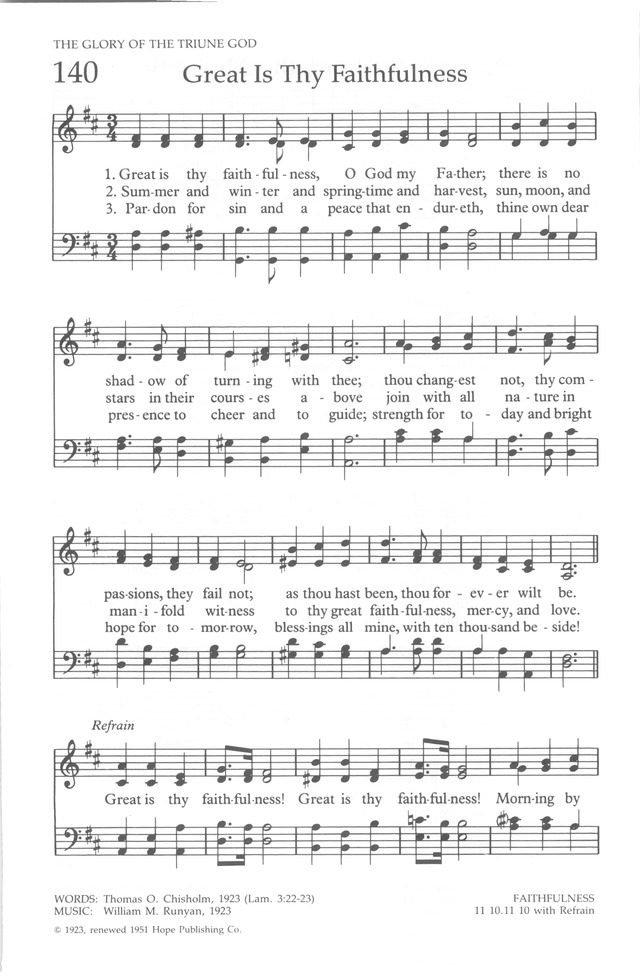
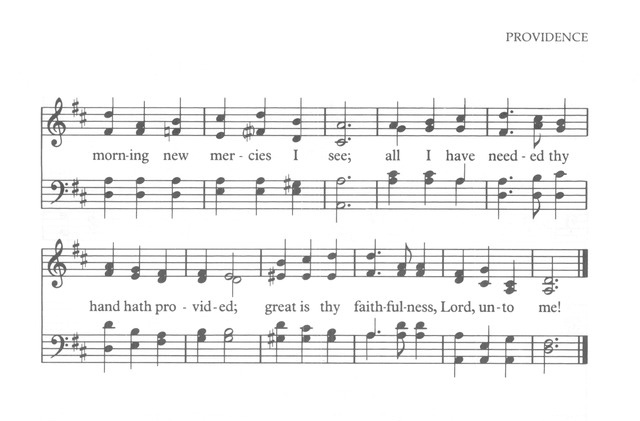
The Pender UMC Traditional Service Prelude “Great is Thy Faithfulness” on Sunday May 14, 2023 was played by Hetty Jacobs on piano. This was Hetty’s first Sunday as Pender’s Pianist.
The Pender UMC Traditional Service Opening Hymn “Great is Thy Faithfulness” on Sunday July 10, 2022 was played by Liz Sellers on piano and sung by the Pender Congregation.
“Great Is Thy Faithfulness”
Thomas O. Chisholm The United Methodist Hymnal, No. 140
A native of the small Kentucky town of Franklin, Thomas Obediah Chisholm (1866-1960) was born in a log cabin. He lacked formal education. Nevertheless, he became a teacher at age sixteen and the associate editor of his hometown weekly newspaper, the Franklin Advocate, at age twenty-one.
In 1893 Chisholm became a Christian through the ministry of Henry Clay Morrison, the founder of Asbury College and Seminary in Wilmore, Kentucky. Morrison persuaded Chisholm to move to Louisville where he became editor of the Pentecostal Herald. Though he was ordained a Methodist minister in 1903, he served only a single, brief appointment at Scottsville, Kentucky, due to ill health. Chisholm relocated his family to Winona Lake, Indiana, to recover, and then to Vineland, New Jersey, in 1916 where he sold insurance. He retired in 1953 and spent his remaining years in a Methodist retirement community in Ocean Grove, New Jersey.
By the time of his retirement, he had written more than 1200 poems, 800 of which were published. They often appeared in religious periodicals such as the Sunday School Times, Moody Monthly, and Alliance Weekly. Many of these were set to music.
Hymnologist Kenneth Osbeck provides the background for “Great Is Thy Faithfulness.” Chisholm had sent a number of his poems to the Rev. William H. Runyan (1870-1957), a musician with the Moody Bible Institute and one of the editors of Hope Publishing Company in Chicago. Runyan wrote of the hymn: “This particular poem held such an appeal that I prayed most earnestly that my tune might carry over its message in a worthy way, and the subsequent history of its use indicates that God answered prayer. It was written in Baldwin, Kansas, in 1923, and was first published in my private song pamphlets.”
George Beverly Shea (1909-2013), the famous Canadian-born singer of the Billy Graham Crusades, introduced this hymn to those attending the evangelistic meetings in Great Britain in 1954. It immediately became a favorite.
A phrase in Lamentations 3:22-23 provides a basis for the refrain: “The steadfast love of the Lord never ceases, his mercies never come to an end; they are new every morning; great is your faithfulness.” Stanza one emphasizes God’s unchanging nature: ” . . . there is no shadow of turning with thee;/thou changest not, thy compassions they fail not.” Perhaps James 1:17 provides the scriptural basis for this concept: “Every good and perfect gift is from above, coming down from the Father of the heavenly lights, who does not change like shifting shadows.”
In stanza two, the natural created order, including the cycle of the seasons, bears witness to the faithfulness of God. The final stanza brings the eternal, unchanging God into contact with humanity. We receive from the presence of God “Pardon for sin and a peace that endures.” Indeed, William Runyan’s tune was the ideal musical complement to the warmth of the text. The subtle changes in harmony and the solemnity of the melody amplify the text, bringing the climax on the word “faithfulness” perfectly at the end of the refrain.
This hymn appeared in many evangelical hymnals and song collections, but was not chosen for an official Methodist hymnal until the current United Methodist Hymnal (1989), even though the author was a Methodist. It was a very popular hymn of the former Evangelical United Brethren Church and had been included in their hymnals.
According to Carlton Young, “Great is thy faithfulness” was second only to “In the garden” as the most requested hymn for inclusion in The United Methodist Hymnal. A survey conducted in 2000 by Dean McIntyre, Director of Music Resources, Discipleship Ministries, revealed that “Great is thy faithfulness” remains one of the favorite hymns among United Methodists.
Dr. Hawn is distinguished professor of church music at Perkins School of Theology. He is also director of the seminary’s sacred music program.
“The Church’s One Foundation”
by Samuel J. Stone, adapted by Laurence Hull Stookey The United Methodist Hymnal, 546
Original text by Samuel J. Stone
“The Holy Catholic Church:
The Communion of saints.”
“He is the Head of the Body, the Church.”
The Church’s One Foundation Is Jesus Christ her Lord, She is His new creation By water and the Word: From Heaven He came and sought her To be His holy Bride, With His Own Blood He brought her And for her life He died.
Adaptation by Laurence H. Stookey
The church’s one foundation is Jesus Christ our Lord; we are his new creation by water and the Word; from heaven he came and sought us that we might ever be his living servant people, by his own death set free.*
Samuel John Stone (1839–1900), then a newly ordained curate at New Windsor Parish Church, wrote “The Church’s One Foundation” in 1866 as a direct lyrical commentary to a controversy in the Church of South Africa, part of the Anglican Communion. The controversy was between Bishop John William Colenso of Natal (an early apologist for the new theory of source criticism) and Bishop Robert Gray of Cape Town (apologist for traditional means of dating and tracing authorship in scripture). Stone’s text was a tribute to Gray’s view. The link between this hymn and the Colenso controversy is well-documented. In C. Michael Hawn’s History of Hymns column on the original hymn, it can be read in more detail: https://www.umcdiscipleship.org/resources/history-of-hymns-the-churchs-one-foundation.
The origins of “The Church’s One Foundation” are found in a lengthier publication titled Lyra Fidelium: Twelve Hymns on the Twelve Articles of the Apostles Creed (1866). The text is constructed around ideas from the ninth article, “The Holy Catholic: The Communion of Saints,” bearing a subtitle from Colossians 1:18, “He is the head of the body, the Church,” and embeds portions of at least 38 scripture passages. H.E.C. Stapleton writes,
The strength of the hymn lies in the simplicity and directness of its message, the vividness of its metaphors, and the deliberate, distinct echoes of words and phrases from scripture. In Lyra Fidelium, there are no less than four biblical quotations annotated to each stanza; in one, seven. It was hailed in Stone’s own time as “the battle-song of the Church” (Stapleton, Canterbury Dictionary).
Including this panoply of scripture was likely a result of Stone’s concern with the orthodox position of the primacy of scripture, one of the central points of the controversy. These passages, as noted by Stone, are as follows:
Two years later, the text was reduced to five stanzas with Stone’s cooperation, resulting in the version most congregations now use. About twenty-two years after its composition, this hymn took its place as a significant lyrical text of the church. Stapleton writes:
The hymn came into its own at the Lambeth Conference in 1888 when it was sung at all the primary services. It is recorded that at St Paul’s Cathedral, its effect was so powerful that the singers were physically overwhelmed: “It made them feel weak at the knees, their legs trembled, and they felt as though they were going to collapse” (Stapleton quoting Wesley Milgate, Songs of the People of God, 1982).
LAURENCE STOOKEY’S ADAPTED TEXT
The adaptation by United Methodist seminary professor and liturgical scholar Laurence Hull Stookey (1937–2016) first appeared in The Upper Room Worshipbook (1983), and then in The United Methodist Hymnal (UMH) following the 1988 General Conference of The United Methodist Church. This was a critical conference concerning the hymnody of the church. The United Methodist Hymnal was adopted at this conference as well as a mandate concerning significantly altered texts, requiring both the original and the altered text to be placed side-by-side. This mandate created space for Stookey’s adaptation, considered to be an “inclusive, ecumenical, and nonsexist” version of the original. This was the only instance in which the mandate of the General Conference was implemented (Young, 1993, p. 629).
Although inclusive language in contemporary hymns is gaining wide acceptance, the adaptation of well-known texts remains controversial and lives in a narrow space, with one side being possible issues of non-equity/non-representation—the other being retention of language that holds to the integrity of the original text. In addition, further divisions arise in churches and church bodies about gendered language, archaic language, and subtle changes of theology from adapted texts. These divisions are far too large a conversation to address in this article. Still, careful reflection on the practice of adaptation does bear on Stookey’s text.
It is interesting to note that Stone’s language, which directly addressed the issues of the 1866 controversy, is largely untouched by Stookey, honoring the original impetus of the text. In stanza three, direct statements align with Stone’s concern when he writes, “by schisms rent asunder, / by heresies distressed.” In stanza 4, there is language that perhaps describes the feeling of the church, saying, “Mid toil and tribulation, / and tumult of our war.” These statements, retained by Stookey, remain faithful to the original wording, though the cultural, historical, ecclesial, and theological contexts differ. Hawn also notes in his article, writing, “The church exists in a constant state of controversy and potential schism. In many ways, this text articulates feelings that are as fresh as ever” (Hawn, “History of Hymns”).
The most noticeable aspect of Stookey’s adaptation concerns Stone’s use of feminine pronouns, drawing on the metaphor of the church as the bride of Christ: “Wives, be subject to your husbands as you are to the Lord. For the husband is the head of the wife just as Christ is the head of the church, the body of which he is the Savior” (Eph 5:22–23, NRSV). The subjugation of women as the context for the ecclesial metaphor is troubling for many Christians. Stone’s text is replete with this metaphor, beginning with the first stanza: “The church’s one foundation / is Jesus Christ her Lord.” This gendering of the church is strongly underscored in the third phrase, “from heaven he came and sought her / to be his holy bride” (emphasis added) and remains present throughout the near entirety of the hymn. It is only in the second half of Stone’s final stanza that we finally sing that “we” are the church referred to in this text.
In Stookey’s adaptation, he replaces feminine pronouns and phrases with “we” language. Often, Stookey is straightforward, substituting “our” and “we” for “her” and “she.” Sometimes, he changes short phrases, such as “one holy name she blesses” to “one holy name professing.” Another short example is the change of text from “and to one hope she presses, / with every grace endued” to “to one hope always pressing, / by Christ’s own Spirit led.” These shorter modifications subtly paraphrase the original—in the first instance, changing the idea of blessing God’s name to professing God’s name. This change shifts us from praising God to making an open declaration of God. In the adaptation, the singers move from being infused with grace to following the leading of the Spirit, both of which are evidence of God’s work within us.
Less frequent are instances of adaptation on a larger scale. The last four lines of the side-by-side texts cited at the beginning of this article exemplify this. This adaptation, quite different in the language used, retains the original ideas of being sought out by Christ and the claim of salvation for the church through the death of Christ but adds the church’s identity as servant people, something not seen in the original text.
Another aspect of Stookey’s adaptation concerns ecumenism and inclusivity in addition to reworking feminine pronouns and images in the text. Stone’s original second stanza begins with “Elect from every nation” (his first draft said, “She is from every nation”). Stookey broadens the meaning in his adaptation— “Called forth from every nation.” The term “elect” may have had its origins in the influence of Calvinism and Reformed doctrine on The Anglican Church at this time. The clause, “from every nation,” may reflect England as a world political and military power at the height of its colonial influence around the world. The Anglican communion was a worldwide catholic (universal) church. The idea of the “elect” of God is a crucial doctrinal distinct from one embraced by the United Methodist Church. By changing “Elect from” to “Called forth,” Stookey reflects the Wesleyan doctrine of free grace and universal availability of prevenient grace to all people.
These are, by far, not the only issues taken up by Stookey in his adapted text that bear further discussion. By changing the perspective from third person (feminine) to the first-person plural, Stookey changes our idea of ecclesiology—the nature of the church. Perhaps we can consider these initial understandings, recognizing Stookey’s offering as a theological reflection that moves our sung faith toward non-binary gendered language and allows for the inclusion of all among Christ’s called. The church’s ministry and our perception of the church in the twenty-first century are changing. Thankfully, we rest on the tradition of the saints but must also sing a faith that is vibrant and efficacious in our time.
Laurence Hill Stookey was a beloved professor of preaching and worship at Wesley Theological Seminary, Washington, D.C., from 1973–2007. Many consider Laurence Stookey to be among the four most influential United Methodist liturgical scholars of the later twentieth and early twenty-first centuries. This list includes Hoyt Hickman (1927–2016), James W. White (1932–2004), and Don Saliers (b. 1937). They worked together to reform Protestant worship following the Second Vatican Council (1962–65) by emphasizing the Revised Common Lectionary. Additionally, they collaborated on the United Methodist Book of Worship (1992) and the Handbook of the Christian Year. Stookey came out of the Evangelical United Brethren tradition, helping United Methodists appreciate the “United” part of their heritage.
Stookey was a native of Illinois, graduating from Swarthmore College, Wesley Theological Seminary, and Princeton Theological Seminary. He was also a gifted musician who enjoyed playing several instruments. His creative and practically written trilogy of texts has proven invaluable to students and pastors. They include: Baptism: Christ’s Acts in the Church (1982), Calendar: Christ’s Time for the Church (1996), and Eucharist: Christ’s Feast with the Church (1993). If you participate in a baptismal liturgy in a United Methodist Church, you will likely hear and speak words by Laurence Stookey.
Carlton R. Young, Companion to The United Methodist Hymnal (Nashville: Abingdon Press, 1993).
Victoria Schwarz is a provisional deacon in the Rio Texas Conference and serves as the Associate Pastor and Minister of Music at Berkeley United Methodist Church in Austin, TX. She is active in the Fellowship of United Methodists in Music and Worship Arts.
“My Hope Is Built”
Edward Mote The United Methodist Hymnal, No. 368
The Pender UMC Traditional Service Closing Hymn “My Hope is Built on Nothing Less” on Sunday January 15, 2023 was played by Uriah Moore on piano, accompanied on guitar by Brian Stevenson and sung the Pender Sanctuary Choir and congregation.
My hope is built on nothing less
Than Jesus’ blood and righteousness.
I dare note trust the sweetest frame,
but wholly lean on Jesus’ name.
On Christ the solid rock I stand,
all other ground is sinking sand.
Edward Mote (1797-1874) falls into the rare category of hymn writers who grew up without religious training and whose parents were pub owners. He was apprenticed at a young age by his parents to a cabinetmaker, but found faith when he heard the preaching of John Hyatt at the Tottenham Court Road Chapel in London at age 15.
Living in Southwark near London, he established a successful cabinet-making enterprise and became a Baptist minister in 1852, at 55 years of age. He ministered for 21 years at Strict Baptist Church in Horsham, Sussex.
Singing hymns was of great interest to him. The master cabinetmaker became a prolific hymn writer, composing more than 100 hymns. He published his hymns with selections by others in 1836 in Hymns of Praise, A New Selection of Gospel Hymns. Hymnologists note that this is the first time the now common term “gospel hymn” appears.
American Methodist hymnologist and hymnal editor Robert Guy McCutchan notes that the hymn was probably written in 1834 and originally began, “Nor earth, nor hell, my soul can move.” The original title was “Jesus, my All in All.” Mr. McCutchan cites the origin of this hymn narrated by the composer as it appeared in a London periodical, The Gospel Magazine:“One morning it came into my mind as I went to labour, to write an hymn on the ‘Gracious Experience of a Christian.’ As I went up to Holborn I had the chorus,
On Christ the solid Rock I stand,
All other ground is sinking sand.
“In the day I had four verses complete, and wrote them off…. On the Sabbath following… by the fireside [I] composed the last two verses… Brother Rees of Crown Street, Soho, brought out an edition of hymns (1836) and this hymn was in it.”
Baptist hymnologist William Reynolds summarizes the rest of the story: “The next Sunday [Mote] visited the home of some fellow church members where the wife was very ill. The husband informed Mote that it was their custom on the Lord’s Day to sing a hymn, read the Bible, and pray together. Mote produced the new hymn from his pocket, and they sang [“The Solid Rock”] together for the first time.”
UM Hymnal editor Carlton Young notes in his Companion that the hymn is of uneven quality. Indeed, the version in our hymnals today is the result of careful editing of the original six stanzas into four, choosing the most coherent lines from the original.
One can quickly see how the best lines of Mote’s two original stanzas were combined to make a much more articulate whole in the stanza cited at the beginning of this article.
Dr. Young comments on the revised product: “[This hymn’s] compelling topic—the parable about the security of building a house on rock, as opposed to sand (Matthew 7:24-27)—and subsequent redaction and setting to a simple, repetitious, foot-stomping tune have merged to form a hymn of faith that over the generations has proved useful and comforting to many in their daily spiritual journey.”
The “foot-stomping” tune was composed by American gospel song composer, William Bradbury (1816-1868), a fellow Baptist, for Mote’s text in 1863 and appeared during the American Civil War in Bradbury’s Devotional Hymn and Tune Book (1864).
The origins of popular Advent hymn, “O Come, O Come, Emmanuel,” extend back to the 9th century. Photo and Canva illustration by Crystal Caviness, United Methodist Communications
When United Methodists sing “O Come, O Come, Emmanuel,” few likely know this popular Advent hymn’s origins span across 1200 years.
The story of how Latin vespers chanted by monks in the 800s found itself recorded in the 21st century by the likes of Kelly Clarkson and Wynonna Judd follows a circuitous and mysterious history through Europe.
The words
“O Come, O Come, Emmanuel” hearkens back to medieval times when Christmas Vespers were sung, primarily in monasteries, from December 17 to December 23, a tradition which continues to this day in Roman Catholic and Anglican churches. Using hymns called “O” Antiphons, the verses, sung in Latin, all began with “O.” (The word, “antiphon” means psalm or anthem.)
Englishman John Mason Neale first translated the “O” Antiphons from Latin to English in the early 1850s. Neale was an Anglican priest, hymn writer and prize-winning poet who was influenced by the Oxford Movement.
Said to be a high church traditionalist, Neale eschewed the hymns of popular 18th century composer Isaac Watts, who wrote more than 600 hymns, including “Joy to the World.” Neale longed to return the Church to its liturgical roots and was known for translating ancient Greek and Latin hymns into English.
In addition to authoring “O Come, O Come, Emmanuel,” Neal also wrote “Good King Wenceslas,” “Good Christian Men, Rejoice,” and the Palm Sunday hymn, “All Glory, Laud and Honor.”
Fun fact: Neale’s first version of the hymn began with the words, “Draw nigh, draw night, Emmanuel.”
The music
In 1851, Thomas Helmore is credited with pairing the familiar tune we sing today, called “Veni Emmanuel,” with the English translation of the words when he published “Hymnal Noted.” At the time, Helmore attributed the music to “a French Missal in the National Library, Lisbon.” Additional details of the melody’s origins remained a mystery for more than 100 years. In 1966, Mary Berry, a British musicologist, discovered a 15th-century manuscript of the melody at the National Library of France. The original composition, according to Berry’s writings, is a burial processional chant with the words, “Bone Jesu dulcis cunctis.” The author is unknown.
Though the “Veni Emmanuel” tune is the most common, alternative versions exist, particularly in German.
The popularity
When Helmore published “O Come, O Come, Emmanuel” in “Hymnal Noted,” he unknowingly set the song on its trajectory to distinction.
Helmore’s version was included in “Hymns Ancient and Modern,” edited by William Henry Monk, published in 1861 and considered the Church of England’s official hymnal. By the end of the 1800s, more than three-quarters of English churches used the volume, making “O Come, O Come, Emmanuel” part of the Christian church’s tradition.
Across the decades, translators tweaked the verses. The version we sing today, including the one found as no. 211 in the United Methodist Hymnal, combines Neale’s translation with revisions made in 1941 for the Episcopal “Hymnal” and translations by Henry Sloane Coffin, a Presbyterian minister and social activist.
In addition to serving as an Christmastime standard both in Christian and secular society (dozens of popular music acts have recorded versions of the hymn), the verses provide a meaningful devotion for us during the Advent season, a time when we prepare and await the birth of Jesus, Emmanuel, God with us.
Crystal Caviness works for UMC.org at United Methodist Communications. Contact her by email or at 615-742-5138.
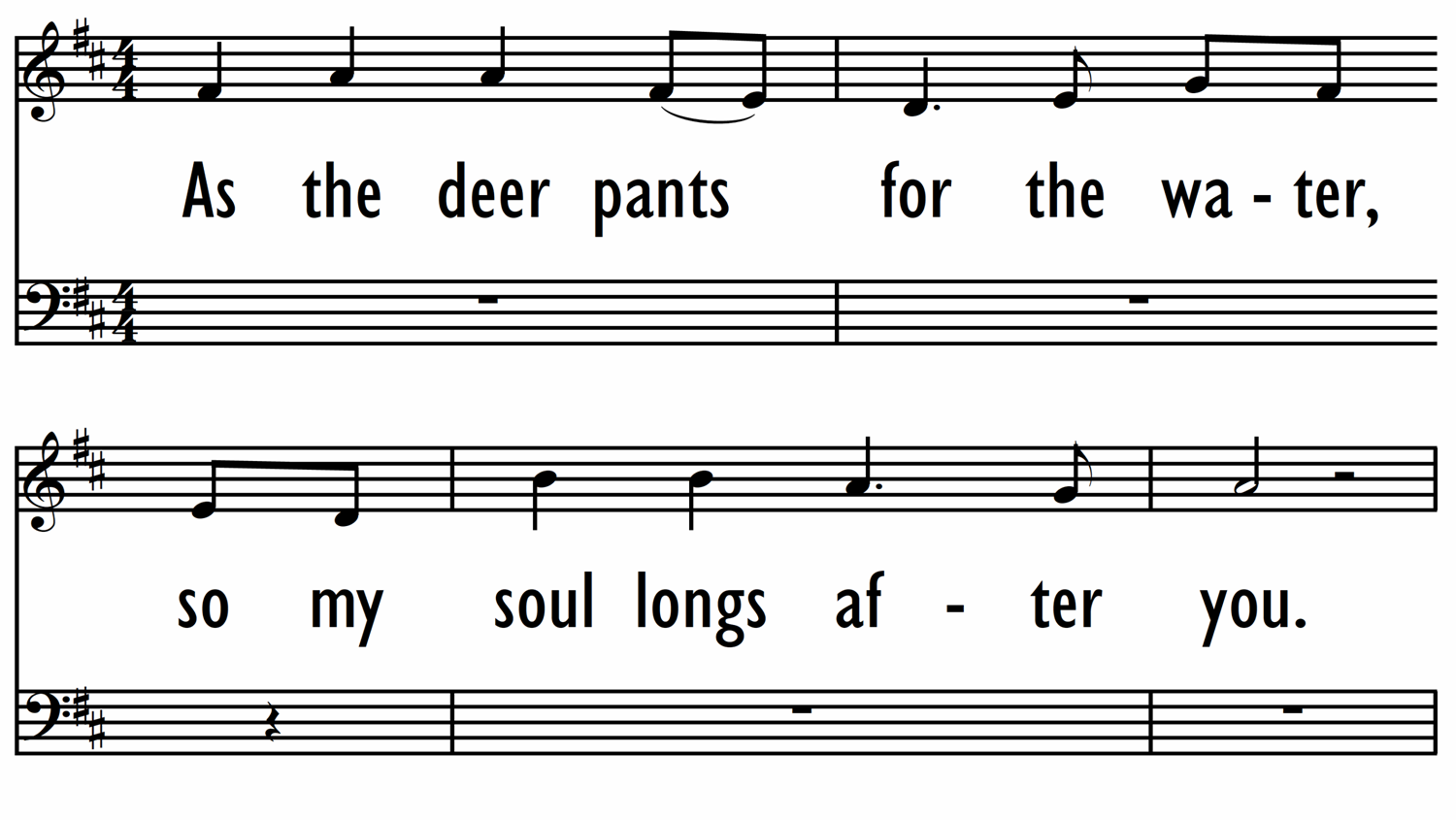
“As the Deer” by Martin Nystrom,
The Faith We Sing, No. 2025
The Pender UMC Traditional Service Middle Hymn “As the Deer” on Sunday September 18, 2022 was played by Liz Eunji Moon on piano, accompanied on guitar by Brian Stevenson and AJ Rios and sung the Pender Sanctuary Choir and congregation.
“As the deer pants for the water brooks,
So pants my soul for You, O God” (Psalm 42:1, NKJV)*
On his website, http://martynystrom.com/, the composer introduces himself in self-effacing terms:
“I am a married father of two sons and live in the Seattle area. My degree is in music education and I have taught music in a wide variety of settings. I have written over 120 songs that have been released by publishers of Christian praise and worship music. My best known song is the worship chorus, ‘As the Deer.’” He notes that, “I seem to write songs when I am not purposefully trying to write one.”
“As the deer,” written in 1981, is one of the most popular songs in the contemporary Christian musical (CCM) genre written in the latter twentieth century. Martin J. Nystrom (b. 1956) is a native of Seattle, Washington. After graduating from Oral Roberts University, Tulsa, Oklahoma (BME, 1979), he served as musical evangelist with Christ for the Nations, Dallas, Texas [www.cfni.org] and produced five praise and worship albums for Hosanna! Music, Mobile, Alabama.
Lindsay Terry, in his book The Sacrifice of Praise: The Stories Behind the Greatest Praise and Worship Songs of All Time(2002), describes the circumstances surrounding the creation of this song:
“Marty was a schoolteacher in Seattle, and since he had the summer off, he decided to go to the summer term of Christ for the Nations Institute in Dallas, Texas. Little did he know what was about to happen to him, especially with all that he would be exposed to and the worship emphasis of the school. . .
He had graduated from Oral Roberts University and, frankly, was a little overwhelmed in ministry. He had been involved in many things at the school, not the least of which was the television ministry of ORU. All of his studies combined with many other activities had caused stress to take its toll on Marty’s spiritual life. . . .
Marty’s roommate at CFNI was a vibrant Christian who challenged Marty to go on a fast, thinking it would help him recover his joy. Marty took up the challenge, and on the nineteenth day of the fast, he found himself sitting at the piano in a room of the school, trying to write a song. He was simply playing chord progressions when he noticed a Bible on the music stand of the piano, open to Psalm 42. His eyes fell on the first verse of that chapter. After reading the verse he began to sing its message, right off the page. He wrote the first verse and the chorus of a song, practically straight through. The entire song was completed in a matter of minutes.”
Though Mr. Nystrom had not intended to perform the song publically, he shared it with a friend at Christ for the Nations before returning to Seattle. His friend introduced it to the others at the Institute, and it became a favorite. Contrary to his website, the composer appears to have written closer to 250 songs. He travels extensively in the United States and Asia, participating in conferences and retreats.
After paraphrasing the first verse of Psalm 42, the song reflects on this passage, continuing in the first person perspective of the psalm:
You alone are my heart’s desire
and I long to worship you.
The second section draws upon the familiar biblical images of “strength and shield,” concluding with the sentence cited above.
Most of Mr. Nystrom’s songs are composed as a single stanza. The compilers of the Canadian United Church hymnal Voices United (1995) asked Lydia Pederson to write two additional stanzas to paraphrase the remainder of the psalm. Pedersen is former music director at Royal York Road United Church in Toronto, and an active member of the Hymn Society in the United States and Canada. An additional attempt at two stanzas appears in the Covenant Hymnal: A Worshipbook(1996).
The editors of the two hymnals that requested additional stanzas noted that the original song felt incomplete when viewed in the context of the entire psalm. Selections of Psalm 42 follow: “My soul thirsteth for God, for the living God: when shall I come and appear before God? My tears have been my meat day and night, while they continually say unto me, Where is thy God? (verses 2, 3, KJV) . . .
“I will say unto God my rock, Why hast thou forgotten me? Why go I mourning because of the oppression of the enemy? As with a sword in my bones, mine enemies reproach me; while they say daily unto me, Where is thy God? Why art thou cast down, O my soul? And why art thou disquieted within me? Hope thou in God: for I shall yet praise him, who is the health of my countenance, and my God” (verses 9, 10, 11, KJV).
On the one hand, the effectiveness of the original song is found in its simplicity; the singer can internalize and memorize the song, offering this sung prayer directly to God. On the other hand, the poignant questions of the remainder of the psalm echo the questions of many worshipers in their lives. Singing additional stanzas, however, changes the experience from a simple prayer to God to the experience similar to singing a multi-stanza hymn. One solution is to retain Mr. Nystrom’s original stanza and insert it between spoken sections of the psalm as a refrain.
Regardless of the approach to incorporating the song into worship, one cannot deny the effectiveness of “As the deer” as sung prayer in myriad settings around the world. Mr. Nystrom attended a conference in Korea in the 1990s that began with 100,000 Korean Christians singing his song – a dramatic witness of its power.


 The origins of popular Advent hymn, “O Come, O Come, Emmanuel,” extend back to the 9th century. Photo and Canva illustration by Crystal Caviness, United Methodist Communications