RSS

Category Archives: Posts of Interest

Hymn History: Count Your Blessings

Count your blessings. Name them, one by one.

This simple mandate for cultivating gratitude and thanksgiving is the opening line in the catchy chorus of “Count Your Blessings,” a church music staple first published more than a century ago.

All these years later, the four verses and chorus can be summed up this way: Counting your blessings may be the antidote to feeling disheartened.

The remaining line of the chorus implores you to, after counting and naming the blessings, to “see what God has done.”

The faithful act of assessing blessings and acknowledging what God has provided in your life may give perspective when challenges and conflicts occur, as the four verses detail (see sidebar).

The author of these song lyrics acknowledges that you can feel burdened and life can seem unfair. So can counting your blessings really help when turmoil swirls around you and discouragement weighs heavy on your mind?

Such was the case for Jacob, who, in Genesis 28, is fleeing from his angry brother, Esau. When Jacob stopped for the night at a place he would later name “Bethel,” Jacob was in the midst of a bad situation. He was alone, scared and had nowhere to go. He also had no idea about how his circumstances might turn out. That night in a dream, God reassured Jacob that He was with him, that He had a plan for Jacob’s life and that He would not leave him. Jacob awoke the next morning with a change of heart and life didn’t seem so bad. “Surely the Lord is in this place,” Jacob said, “and I did not know it.” (Genesis 28:16)

Numerous stories in the Bible remind you to look beyond your circumstances to see you are not alone, that “the Lord is in this place,” providing anecdotal evidence of the importance of gratitude.

In addition to the anecdotal proof, the virtues of gratitude have been proven by science.

In a study published in the Journal of Personality and Social Psychology, the test group was asked to daily write down five things for which they were thankful. After doing this every day for one week, the test group reported better sleep patterns and a more positive emotional outlook than the control group.

Members from Perryville United Methodist Church in Perryville, Kentucky, perform “Count Your Blessings.”

Whether the song’s author was battling tough times when he wrote the lyrics is unknown. What we do know is that Johnson Oatman Jr., the lyricist, was a Methodist Episcopal minister who had a penchant for songwriting. “Count Your Blessings,” intended as a song for youth, first appeared in “Songs for Young People,” which was published in 1897 by the Methodist Book Concern, a precursor to The United Methodist Publishing House. Over Oatman’s life, he penned more than 5,000 songs, including the classic hymn “No, Not One.”

For “Count Your Blessings,” Oatman partnered with E.O. Excell, who put Oatman’s words to music. Excell operated a Chicago-based publishing business specializing in Sunday School materials and collaborated with the Methodists for numerous projects. Fun fact about Excell is that he is the same person who wrote the arrangement of “Amazing Grace” that is most often sung throughout the world today.

But back to “Count Your Blessings.”

Once “Songs for Young People” was published, “Count Your Blessings” became a favorite, quickly gaining popularity throughout the world.

Beginning in 1899, only two years after its debut, “Count Your Blessings” appeared in at least half-dozen or more new hymnals each year, a pace that continued for at least a decade. The song was added to hymnals published by the Methodists, Presbyterians, Disciples and southern gospel publishers. Even into the mid-20th century, the song continued to be a favorite.

The song was especially popular in the United Kingdom. During the 1904-1905 Welsh Revival, the largest Christian revival in Wales during the 20th century, it is told that “Count Your Blessings” was sung at every service.

One account from a London daily newspaper says that when the famous British evangelist Gipsy Smith presided over a meeting, he announced a hymn, saying, “Let us sing ‘Count Your Blessings.’ Down in South London, the men sing it, the boys whistle to it, and the women rock their babies to sleep to the tune.”

In addition to the upbeat, simple tune that people have found easy to remember, its message has been uplifting folks for generations.

“Like a beam of sunlight,” wrote J.H. Hall, Oatman’s biographer, in “Biography of Gospel Song and Hymn Writers, “(’Count Your Blessings’) has brightened up the dark places of the earth.”

Crystal Caviness works for UMC.org at United Methodist Communications. Contact her by email or at 615-742-5138.

This story was first published November 14, 2019. 

From https://www.umc.org/en/content/count-your-blessings-an-antidote-to-despair


Tags: , , , , , ,

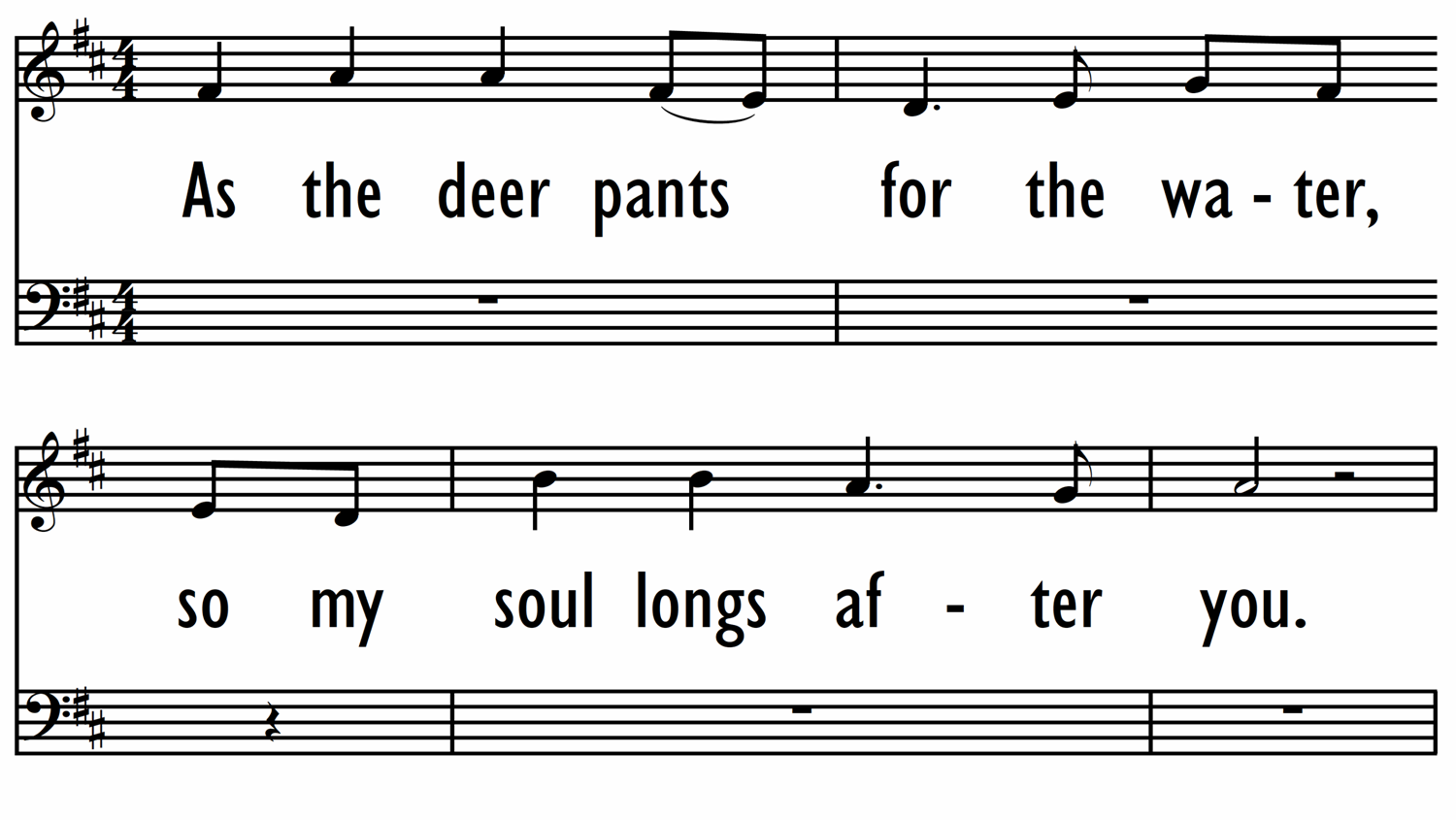
Hymn History: As The Deer

“As the Deer” by Martin Nystrom,
The Faith We Sing, No. 2025

The Pender UMC Traditional Service Middle Hymn “As the Deer” on Sunday September 18, 2022 was played by Liz Eunji Moon on piano, accompanied on guitar by Brian Stevenson and AJ Rios and sung the Pender Sanctuary Choir and congregation.

“As the deer pants for the water brooks,
So pants my soul for You, O God” (Psalm 42:1, NKJV)*

On his website, http://martynystrom.com/, the composer introduces himself in self-effacing terms:

“I am a married father of two sons and live in the Seattle area. My degree is in music education and I have taught music in a wide variety of settings. I have written over 120 songs that have been released by publishers of Christian praise and worship music. My best known song is the worship chorus, ‘As the Deer.’” He notes that, “I seem to write songs when I am not purposefully trying to write one.”

“As the deer,” written in 1981, is one of the most popular songs in the contemporary Christian musical (CCM) genre written in the latter twentieth century. Martin J. Nystrom (b. 1956) is a native of Seattle, Washington. After graduating from Oral Roberts University, Tulsa, Oklahoma (BME, 1979), he served as musical evangelist with Christ for the Nations, Dallas, Texas [www.cfni.org] and produced five praise and worship albums for Hosanna! Music, Mobile, Alabama.

Lindsay Terry, in his book The Sacrifice of Praise: The Stories Behind the Greatest Praise and Worship Songs of All Time(2002), describes the circumstances surrounding the creation of this song:

“Marty was a schoolteacher in Seattle, and since he had the summer off, he decided to go to the summer term of Christ for the Nations Institute in Dallas, Texas. Little did he know what was about to happen to him, especially with all that he would be exposed to and the worship emphasis of the school. . .

He had graduated from Oral Roberts University and, frankly, was a little overwhelmed in ministry. He had been involved in many things at the school, not the least of which was the television ministry of ORU. All of his studies combined with many other activities had caused stress to take its toll on Marty’s spiritual life. . . .

Marty’s roommate at CFNI was a vibrant Christian who challenged Marty to go on a fast, thinking it would help him recover his joy. Marty took up the challenge, and on the nineteenth day of the fast, he found himself sitting at the piano in a room of the school, trying to write a song. He was simply playing chord progressions when he noticed a Bible on the music stand of the piano, open to Psalm 42. His eyes fell on the first verse of that chapter. After reading the verse he began to sing its message, right off the page. He wrote the first verse and the chorus of a song, practically straight through. The entire song was completed in a matter of minutes.”

Though Mr. Nystrom had not intended to perform the song publically, he shared it with a friend at Christ for the Nations before returning to Seattle. His friend introduced it to the others at the Institute, and it became a favorite. Contrary to his website, the composer appears to have written closer to 250 songs. He travels extensively in the United States and Asia, participating in conferences and retreats.

After paraphrasing the first verse of Psalm 42, the song reflects on this passage, continuing in the first person perspective of the psalm:

You alone are my heart’s desire
and I long to worship you.

The second section draws upon the familiar biblical images of “strength and shield,” concluding with the sentence cited above.

Most of Mr. Nystrom’s songs are composed as a single stanza. The compilers of the Canadian United Church hymnal Voices United (1995) asked Lydia Pederson to write two additional stanzas to paraphrase the remainder of the psalm. Pedersen is former music director at Royal York Road United Church in Toronto, and an active member of the Hymn Society in the United States and Canada. An additional attempt at two stanzas appears in the Covenant Hymnal: A Worshipbook(1996).

The editors of the two hymnals that requested additional stanzas noted that the original song felt incomplete when viewed in the context of the entire psalm. Selections of Psalm 42 follow:
“My soul thirsteth for God, for the living God: when shall I come and appear before God? My tears have been my meat day and night, while they continually say unto me, Where is thy God? (verses 2, 3, KJV) . . .

“I will say unto God my rock, Why hast thou forgotten me? Why go I mourning because of the oppression of the enemy? As with a sword in my bones, mine enemies reproach me; while they say daily unto me, Where is thy God? Why art thou cast down, O my soul? And why art thou disquieted within me? Hope thou in God: for I shall yet praise him, who is the health of my countenance, and my God” (verses 9, 10, 11, KJV).

On the one hand, the effectiveness of the original song is found in its simplicity; the singer can internalize and memorize the song, offering this sung prayer directly to God. On the other hand, the poignant questions of the remainder of the psalm echo the questions of many worshipers in their lives. Singing additional stanzas, however, changes the experience from a simple prayer to God to the experience similar to singing a multi-stanza hymn. One solution is to retain Mr. Nystrom’s original stanza and insert it between spoken sections of the psalm as a refrain.

Regardless of the approach to incorporating the song into worship, one cannot deny the effectiveness of “As the deer” as sung prayer in myriad settings around the world. Mr. Nystrom attended a conference in Korea in the 1990s that began with 100,000 Korean Christians singing his song – a dramatic witness of its power.

*Scripture taken from the New King James Version®. Copyright © 1982 by Thomas Nelson, Inc. Used by permission. All rights reserved.

C. Michael Hawn is University Distinguished Professor of Church Music, Perkins School of Theology, SMU.

Adapted from https://www.umcdiscipleship.org/resources/history-of-hymns-as-the-deer

 
Leave a comment

Posted by on November 10, 2022 in Hymn History, hymns, Posts of Interest, Videos


Tags: , , , , , , , , , , ,

Pender UMC Trunk or Treat Slideshow October 29, 2022

Pender UMC Trunk or Treat Slideshow October 29, 2022.  Try to find the Pendersaurus Rex.


Tags: , , , ,

Wonderful Words of Life

I’m acquiring the title of an old hymn for this next post.

After I was finished with the long diagnostic process [of Cushing’s Disease], surgery October 2, 1987 and several post-op visits to NIH, I was asked to give the scripture reading at my church. The man who did the sermon that week was the survivor of a horrific accident where he and his family were hit by a van while waiting at an airport.

i thought I had written down the verse carefully. I practiced and practiced, I don’t like speaking in front of a crowd but I said I would. When I got to church, the verse was different. Maybe I wrote it down wrong, maybe someone changed it. Whatever.

This verse has come to have so much meaning in my life. When I saw at a book called A Musician’s Book of Psalms each day had a different psalm. On my birthday, there was “my” psalm so I had to buy this book!

Psalm 116 (New International Version)

1 I love the LORD, for he heard my voice;
he heard my cry for mercy.

2 Because he turned his ear to me,
I will call on him as long as I live.

3 The cords of death entangled me,
the anguish of the grave came upon me;
I was overcome by trouble and sorrow.

4 Then I called on the name of the LORD:
“O LORD, save me!”

5 The LORD is gracious and righteous;
our God is full of compassion.

6 The LORD protects the simplehearted;
when I was in great need, he saved me.

7 Be at rest once more, O my soul,
for the LORD has been good to you.

8 For you, O LORD, have delivered my soul from death,
my eyes from tears,
my feet from stumbling,

9 that I may walk before the LORD
in the land of the living.

10 I believed; therefore I said,
“I am greatly afflicted.”

11 And in my dismay I said,
“All men are liars.”

12 How can I repay the LORD
for all his goodness to me?

13 I will lift up the cup of salvation
and call on the name of the LORD.

14 I will fulfill my vows to the LORD
in the presence of all his people.

15 Precious in the sight of the LORD
is the death of his saints.

16 O LORD, truly I am your servant;
I am your servant, the son of your maidservant;
you have freed me from my chains.

17 I will sacrifice a thank offering to you
and call on the name of the LORD.

18 I will fulfill my vows to the LORD
in the presence of all his people,

19 in the courts of the house of the LORD—
in your midst, O Jerusalem.
Praise the LORD.

I carry a print out of this everywhere I go because I find it very soothing. “when I was in great need, he saved me.” This print out is in a plastic page saver. On the other side there is an article I found after my kidney cancer. I first read this in Chicken Soup for the Surviving Soul and is posted several places online.

The Best Day Of My Life by Gregory M Lousignont

Today, when I awoke, I suddenly realized that this is the best day of my life, ever! There were times when I wondered if I would make it to today; but I did! And because I did I’m going to celebrate!

Today, I’m going to celebrate what an unbelievable life I have had so far: the accomplishments, the many blessings, and, yes, even the hardships because they have served to make me stronger.

I will go through this day with my head held high, and a happy heart. I will marvel at God’s seemingly simple gifts: the morning dew, the sun, the clouds, the trees, the flowers, the birds. Today, none of these miraculous creations will escape my notice.

Today, I will share my excitement for life with other people. I’ll make someone smile. I’ll go out of my way to perform an unexpected act of kindness for someone I don’t even know.

Today, I’ll give a sincere compliment to someone who seems down. I’ll tell a child how special he is, and I’ll tell someone I love just how deeply I care for her and how much she means to me.

Today is the day I quit worrying about what I don’t have and start being grateful for all the wonderful things God has already given me.

I’ll remember that to worry is just a waste of time because my faith in God and his Divine Plan ensures everything will be just fine.

And tonight, before I go to bed, I’ll go outside and raise my eyes to the heavens. I will stand in awe at the beauty of the stars and the moon, and I will praise God for these magnificent treasures.

As the day ends and I lay my head down on my pillow, I will thank the Almighty for the best day of my life. And I will sleep the sleep of a contented child, excited with expectation because know tomorrow is going to be the best day of my life, ever!

When I’m feeling down, depressed or low, reading my 2 special pages can help me more than anything else.

~This is adapted from a post on another of my blogs at Cushings & Cancer


Tags: , , , , , , , ,

Hymn History: When in Our Music God Is Glorified

“When in Our Music God Is Glorified”
Fred Pratt Green
UM Hymnal, No. 68


“When in Our Music God Is Glorified” was played by Pender’s pianist-organist, Liz Eunji Moon at the Traditional Service Postlude on September 11, 2022

Sometimes a great tune can keep a hymn text alive. Sometimes a great text can revive a neglected tune. The latter is true in this case.

Noted British hymnologist John Wilson (1905-1992) suggested that the Methodist poet and hymn writer Fred Pratt Green write a text to the tune ENGELBERG, composed in 1904 by the famous British composer Charles Villiers Stanford (1852-1924).

Stanford’s tune had been well-known in the earlier 20th century until Ralph Vaughan Williams (1872-1958) composed the immensely popular SINE NOMINE in the same metre (sung to “For All the Saints”) for the English Hymnal (1906).

Hymnologist J.R. Watson records that “Wilson urged Pratt Green to write a text for a Festival of Praise . . . which could be sung to Stanford’s neglected tune.” Pratt Green based his text on Psalm 150 but alluded to Mark 14:26 in stanza four of the hymn, a stanza recalling the hymn sung by the disciples at the Last Supper.

The hymn, composed in 1972, first appeared in New Church Praise (1975) and in the single-author collection The Hymns and Ballads of Fred Pratt Green (1982) with the title, “Let the People Sing!”

The opening line (called the incipit) originally read, “When in man’s music, God is glorified. . . .” Pratt Green reluctantly altered this to the current title for the Lutheran Book of Worship (1978) and this change has universally been accepted in North American hymnals.

The Rev. Carlton Young, editor of the UM Hymnal, notes that the change in text, though an important “social witness” in the area of inclusive language, weakens the theological and aesthetic qualities of the hymn: 1) Theologically, “the change tends to weaken the affirmation that mere mortal musicians and their music may and often do glorify God”; 2) aesthetically, the wonderful alliteration between “man’s” and “music” paralleled by “God’s” and “glorified” is lost.

Dr. Young speculates that this “text has probably been set in anthem form more than any other of the late twentieth century.”

Ministry of music

This hymn is groundbreaking in many ways.

There are numerous examples in the history of hymnody where music is a metaphor for some theological theme or experience. In Babcock’s “This Is My Father’s World,” for example, “all nature sings and round me rings the music of the spheres.” Charles Wesley speaks of “the music of the heart” in his paraphrase of Psalm 150, “Praise the Lord Who Reigns Above.”

However, Pratt Green uses music not just as a metaphor that points us to another idea, but explores music-making as a phenomenon in the Christian’s experience in its own right. The second stanza concludes with the marvelous thought that “making music . . . move[s] us to a more profound Alleluia!”

In this way, Pratt Green seems to agree with Martin Luther who said, “Next to the Word of God, the noble art of music is the greatest treasure in the world.” Luther and Pratt Green seem to ascribe a quasi-sacramental quality to music—music as a means of revelation and grace.

Pratt Green (1903-2000) was born in Roby just outside of Liverpool, England. Following his education, he was ordained in 1924 as a Methodist minister and served in various parishes throughout England well into the 1940s. Although he had a long interest in poetry, he did not focus on hymn writing until his retirement from active ministry.

Eminent British hymnologist Erik Routley (1917-1982) suggested that in Fred Pratt Green, Methodists finally had a successor to Charles Wesley.

* Words by Fred Pratt Green © 1972 Hope Publishing Company; Carol Stream, IL 60188. All rights reserved. Used by permission.

Dr. Hawn is professor of sacred music at Perkins School of Theology, SMU.

Adapted from https://www.umcdiscipleship.org/resources/history-of-hymns-when-in-our-music-god-is-glorified

 
Leave a comment

Posted by on October 27, 2022 in Hymn History, hymns, Posts of Interest, Videos


Tags: , , , , , ,