
Bring your backpacks for a special blessing as we all prepare to start a new school year!
Who: Students of all ages & teachers
What: Back to School Backpack Blessing
When: Sunday, August 30, at all 3 worship services
Bring your backpacks for a special blessing as we all prepare to start a new school year!
Who: Students of all ages & teachers
What: Back to School Backpack Blessing
When: Sunday, August 30, at all 3 worship services
By Laura Buchanan*
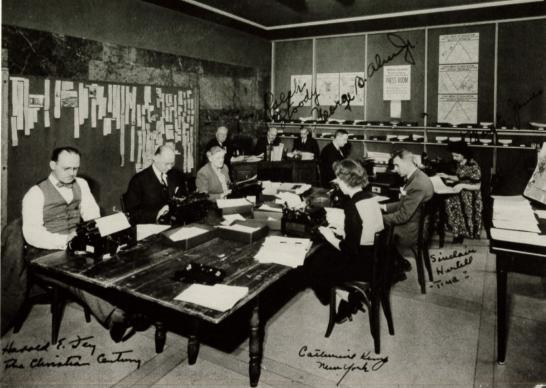
Clattering manual typewriters and the metallic ringing of rotary telephones have given way to ever-evolving communication tools, empowering innovative ministry at United Methodist Communications for 75 years.
75 YEARS OF COMMUNICATING FAITH
View the interactive timeline of United Methodist Communications’ 75 years of telling the church’s story, both within the church and to the world.
In the beginning
Francis Asbury, one of the first two Methodist bishops, said, “The propagation of religion by means of the press is next in importance to the preaching of the gospel.” Methodist Information staff of the 1940s-era took this advice seriously: they would carefully type and mail press information and news story ideas, waiting days for responses from reporters.
Technology restricted the speed with which news traveled, but the Methodist Church had inspirational stories to tell, and hundreds of newspapers and magazines across the country helped spread the good news.
Equipping the local church
In the following years, the agency began to utilize new mediums for their work. Television, radio, public relations, and general communication training sessions were held for local churches and annual conference staff to equip leaders with the skills needed to keep up with the developing tools and the opportunities they afforded.
Agency staff developed ministry tools that utilized the current trends, expanding resources as technology progressed. Motion pictures and filmstrips were produced for church use in the 1950s, which evolved to at-home viewings of video resources with the wide adoption of the VCR in the 1980s, adding a new audience for agency productions.
Picking up the pace
The 1970s brought the beginnings of faster communication methods. News stories could now be composed on electric typewriters, photocopied, and faxed to media outlets, increasing the speed with which news could be shared.
The agency also explored the possibilities of computerization. As soon as computers were wieldy enough to be housed in-office, staff began to utilize them for records management and word processing.
Zona Watkins, who retired in 2014, worked with the first agency computer, used as a service center to support various departments. She reminisced, “I worked on different projects: letters for large mailings, newsletters, forms…it was really something to be able to easily make changes to documents. No more Wite-Out!”

Early desktop computers are utilized at the agency.
Eventually, computers were common throughout the office, beginning with one machine in each department before they became present on numerous desktops. Computer networks, electronic bulletin boards, an online news service and an email system equipped employees to communicate more efficiently so information could be shared quickly with constituents.
Tom McAnally, former executive director of content, said, “News Service had the first portable [computers] that allowed us to see a couple of lines of text at a time and transmit – with great difficulty, using acoustic couplers – stories from the field to the central office. We joked about Bob Lear on our staff driving from one pay phone to another somewhere in the Midwest trying to find a line that would let him file a story.”
The agency wanted local churches to be equipped with computer knowledge as well. United Methodist Communications and the General Council on Ministries sponsored a consultation event in 1983, demonstrating an electronic newsletter for general agency, annual conference, and local church representatives.
In 1987, Sue Couch, a member of the United Methodist Information pilot committee wrote, “Using electronic communication is giving us a heightened sense of communication as caring for people … we have to keep demonstrating practical applications for this medium on all levels.”
Embracing new opportunities

Images of the denomination’s first website, umc.org, appeared in a promotional print piece.
Online communication grew exponentially when the denomination’s first website, umc.org, launched in 1995. Sherri Thiel, chief operations officer, was a member of the team that created the site and she fondly recalls the collaborative, pioneering project. “We were an early non-profit site among a large corporate presence and it was a new tool for the church,” she said. “We saw it as a different avenue for people to dialog with the church as well as a means to deliver information.”
As society began to adopt new technology, reporters and churches could elect to receive information via the postal service, fax, or email and the agency ensured that its tools filled everyone’s needs according to their technological preference.
Connection with the growing online audience became key. The agency offered the Find-A-Church online directory, web-based program publications such as the Interpreter, and an ever-increasing range of tools and materials for local church use.
Going digital
As use of email and other digital tools soared, United Methodist News Service moved to purely digital information delivery.
Tim Tanton, executive director of content, remembers this exciting time in the agency. “The Internet allowed direct-to-audience communication…,” he said. “This was significant, as we now had a direct, instantaneous connection with thousands of people interested in the church who wanted news. They could also send feedback and news tips, allowing for meaningful interaction.”
Communication for a tech-savvy world
Today, United Methodist Communications’ ministry is multifaceted. Offerings include extensive online training courses, social media tools, webhosting, thoughtful technology-centered resources, multi-media marketing campaigns, daily email updates, and UMTV video features.

An historic text message regarding the Ebola outbreak is sent via mobile technology across Liberia. Sending the message from Nashville, Tenn., are Jill Costello (left) and the Rev. Neelley Hicks. Photo by Kathleen Barry, United Methodist Communications
New technology has also enabled global reach to grow. United Methodist Communications is using ICT4D (Information & Communications Technology for Development) to empower some of the most marginalized people in the world with communication tools such as FrontlineSMS text messaging and rugged, solar-powered computer centers, establishing connections that improve communities and save lives.
As technology continues to improve and shift, United Methodist Communications will rise to the opportunities it affords, relying on a pioneering staff whose work is successful, relevant, and progressive – carrying the church’s message of hope into the future.
Some information cited from Keeping up with a Revolution: The Story of United Methodist Communications 1940-1990 by Edwin H. Maynard.
*Laura Buchanan is a PR Specialist for United Methodist Communications.
via Progressing Technology Strengthens an Innovative Agency – United Methodist Communications.
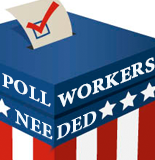
Fairfax County needs Election Officers for upcoming elections. Election officers must be registered voters in Virginia and complete required training and forms. You may choose to accept the $175 stipend for a full day, or volunteer your time.
View the “Become an Election Officer in Fairfax County” video:
For more information, visit the Office of Elections website by clicking on this link.
What if John and Charles Wesley could still visit churches? A unique project led by Discipleship Ministries is finding a way for these founding fathers of the denomination to do just that. More than 700 congregations will participate in a program during the summer of 2015 that brings paper dolls of the brothers to spend two weeks at each host church. We followed the pair to one stop in South Carolina.
Read full transcript.
For more information about the Flat Wesley project, contact Discipleship Ministries.
This video was produced by United Methodist Communications in Nashville, TN.
Media contact is Fran Walsh, 615-742-5458.
This video was first posted in June, 2015.

Independence Day, commonly known as the Fourth of July, is a federal holiday in the United States commemorating the adoption of the Declaration of Independence on July 4, 1776, declaring independence from Great Britain.
Independence Day fireworks are often accompanied by patriotic songs such as the national anthem “The Star-Spangled Banner”, “God Bless America”, “America the Beautiful”, “My Country, ‘Tis of Thee”, “This Land Is Your Land”, “Stars and Stripes Forever”, and, regionally, “Yankee Doodle” in northeastern states and “Dixie” in southern states. Some of the lyrics recall images of the Revolutionary War or the War of 1812.
A bit of audio for your listening pleasure, as played by Vladimir Horowitz…


