RSS

Tag Archives: congregation

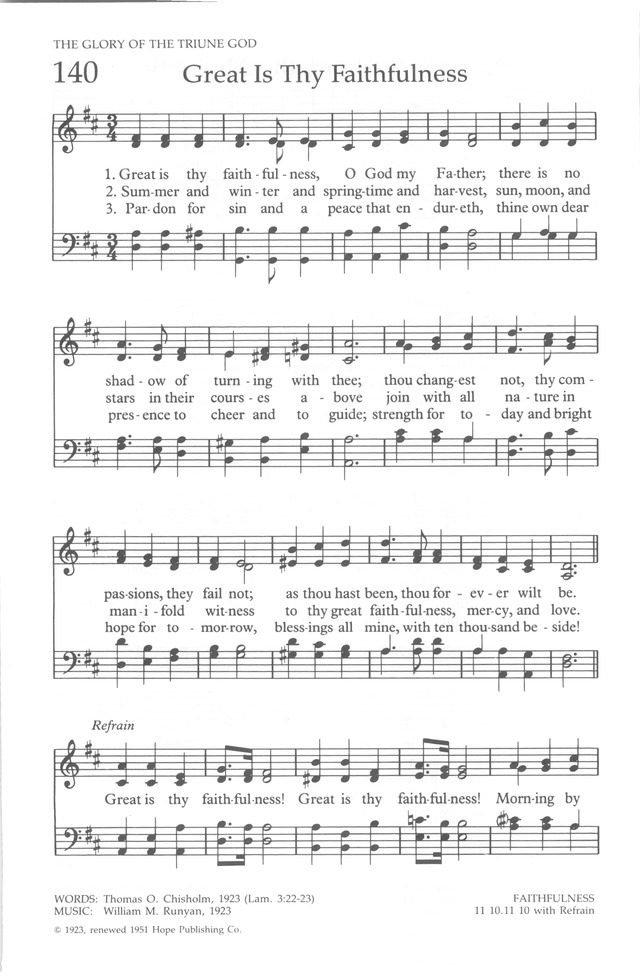
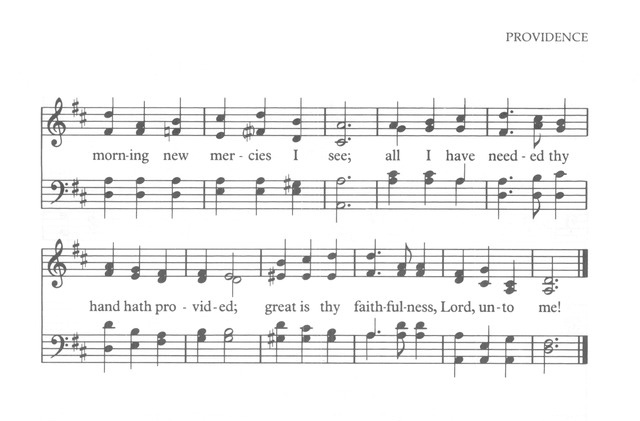
Hymn History: Great is Thy Faithfulness

The Pender UMC Traditional Service Prelude “Great is Thy Faithfulness” on Sunday May 14, 2023 was played by Hetty Jacobs on piano.  This was Hetty’s first Sunday as Pender’s Pianist.


The Pender UMC Traditional Service Opening Hymn “Great is Thy Faithfulness” on Sunday July 10, 2022 was played by Liz Sellers on piano and sung by the Pender Congregation.


“Great Is Thy Faithfulness”
Thomas O. Chisholm
The United Methodist Hymnal, No. 140

A native of the small Kentucky town of Franklin, Thomas Obediah Chisholm (1866-1960) was born in a log cabin. He lacked formal education. Nevertheless, he became a teacher at age sixteen and the associate editor of his hometown weekly newspaper, the Franklin Advocate, at age twenty-one.

In 1893 Chisholm became a Christian through the ministry of Henry Clay Morrison, the founder of Asbury College and Seminary in Wilmore, Kentucky. Morrison persuaded Chisholm to move to Louisville where he became editor of the Pentecostal Herald. Though he was ordained a Methodist minister in 1903, he served only a single, brief appointment at Scottsville, Kentucky, due to ill health. Chisholm relocated his family to Winona Lake, Indiana, to recover, and then to Vineland, New Jersey, in 1916 where he sold insurance. He retired in 1953 and spent his remaining years in a Methodist retirement community in Ocean Grove, New Jersey.

By the time of his retirement, he had written more than 1200 poems, 800 of which were published. They often appeared in religious periodicals such as the Sunday School TimesMoody Monthly, and Alliance Weekly. Many of these were set to music.

Hymnologist Kenneth Osbeck provides the background for “Great Is Thy Faithfulness.” Chisholm had sent a number of his poems to the Rev. William H. Runyan (1870-1957), a musician with the Moody Bible Institute and one of the editors of Hope Publishing Company in Chicago. Runyan wrote of the hymn: “This particular poem held such an appeal that I prayed most earnestly that my tune might carry over its message in a worthy way, and the subsequent history of its use indicates that God answered prayer. It was written in Baldwin, Kansas, in 1923, and was first published in my private song pamphlets.”

George Beverly Shea (1909-2013), the famous Canadian-born singer of the Billy Graham Crusades, introduced this hymn to those attending the evangelistic meetings in Great Britain in 1954. It immediately became a favorite.

A phrase in Lamentations 3:22-23 provides a basis for the refrain: “The steadfast love of the Lord never ceases, his mercies never come to an end; they are new every morning; great is your faithfulness.” Stanza one emphasizes God’s unchanging nature: ” . . . there is no shadow of turning with thee;/thou changest not, thy compassions they fail not.” Perhaps James 1:17 provides the scriptural basis for this concept: “Every good and perfect gift is from above, coming down from the Father of the heavenly lights, who does not change like shifting shadows.”

In stanza two, the natural created order, including the cycle of the seasons, bears witness to the faithfulness of God. The final stanza brings the eternal, unchanging God into contact with humanity. We receive from the presence of God “Pardon for sin and a peace that endures.” Indeed, William Runyan’s tune was the ideal musical complement to the warmth of the text. The subtle changes in harmony and the solemnity of the melody amplify the text, bringing the climax on the word “faithfulness” perfectly at the end of the refrain.

This hymn appeared in many evangelical hymnals and song collections, but was not chosen for an official Methodist hymnal until the current United Methodist Hymnal (1989), even though the author was a Methodist. It was a very popular hymn of the former Evangelical United Brethren Church and had been included in their hymnals.

According to Carlton Young, “Great is thy faithfulness” was second only to “In the garden” as the most requested hymn for inclusion in The United Methodist Hymnal. A survey conducted in 2000 by Dean McIntyre, Director of Music Resources, Discipleship Ministries, revealed that “Great is thy faithfulness” remains one of the favorite hymns among United Methodists.

Dr. Hawn is distinguished professor of church music at Perkins School of Theology. He is also director of the seminary’s sacred music program.

Adapted from https://www.umcdiscipleship.org/resources/history-of-hymns-great-is-thy-faithfulness
 

Tags: , , , , , , , , , , , ,

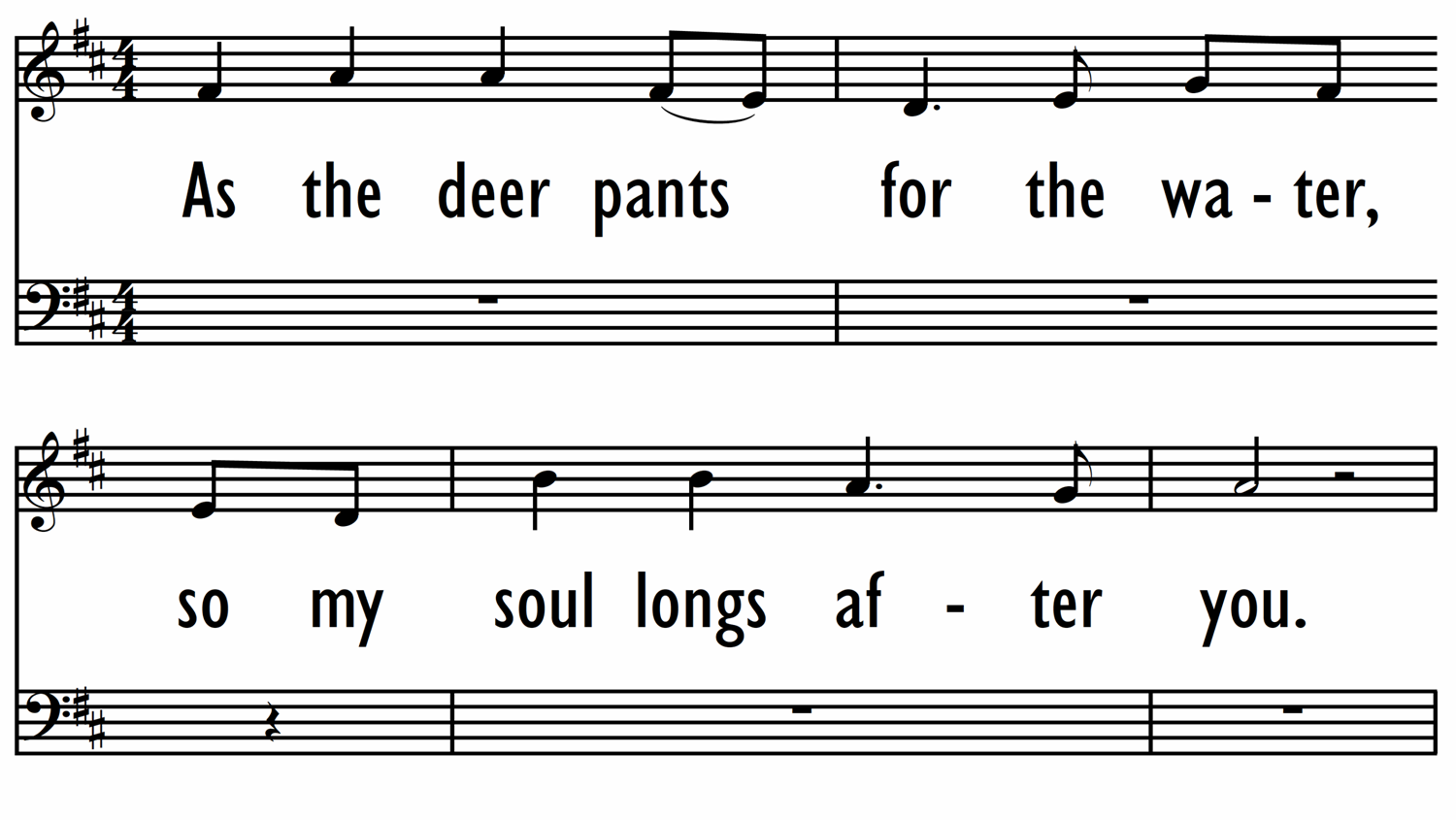
Hymn History: As The Deer

“As the Deer” by Martin Nystrom,
The Faith We Sing, No. 2025

The Pender UMC Traditional Service Middle Hymn “As the Deer” on Sunday September 18, 2022 was played by Liz Eunji Moon on piano, accompanied on guitar by Brian Stevenson and AJ Rios and sung the Pender Sanctuary Choir and congregation.

“As the deer pants for the water brooks,
So pants my soul for You, O God” (Psalm 42:1, NKJV)*

On his website, http://martynystrom.com/, the composer introduces himself in self-effacing terms:

“I am a married father of two sons and live in the Seattle area. My degree is in music education and I have taught music in a wide variety of settings. I have written over 120 songs that have been released by publishers of Christian praise and worship music. My best known song is the worship chorus, ‘As the Deer.’” He notes that, “I seem to write songs when I am not purposefully trying to write one.”

“As the deer,” written in 1981, is one of the most popular songs in the contemporary Christian musical (CCM) genre written in the latter twentieth century. Martin J. Nystrom (b. 1956) is a native of Seattle, Washington. After graduating from Oral Roberts University, Tulsa, Oklahoma (BME, 1979), he served as musical evangelist with Christ for the Nations, Dallas, Texas [www.cfni.org] and produced five praise and worship albums for Hosanna! Music, Mobile, Alabama.

Lindsay Terry, in his book The Sacrifice of Praise: The Stories Behind the Greatest Praise and Worship Songs of All Time(2002), describes the circumstances surrounding the creation of this song:

“Marty was a schoolteacher in Seattle, and since he had the summer off, he decided to go to the summer term of Christ for the Nations Institute in Dallas, Texas. Little did he know what was about to happen to him, especially with all that he would be exposed to and the worship emphasis of the school. . .

He had graduated from Oral Roberts University and, frankly, was a little overwhelmed in ministry. He had been involved in many things at the school, not the least of which was the television ministry of ORU. All of his studies combined with many other activities had caused stress to take its toll on Marty’s spiritual life. . . .

Marty’s roommate at CFNI was a vibrant Christian who challenged Marty to go on a fast, thinking it would help him recover his joy. Marty took up the challenge, and on the nineteenth day of the fast, he found himself sitting at the piano in a room of the school, trying to write a song. He was simply playing chord progressions when he noticed a Bible on the music stand of the piano, open to Psalm 42. His eyes fell on the first verse of that chapter. After reading the verse he began to sing its message, right off the page. He wrote the first verse and the chorus of a song, practically straight through. The entire song was completed in a matter of minutes.”

Though Mr. Nystrom had not intended to perform the song publically, he shared it with a friend at Christ for the Nations before returning to Seattle. His friend introduced it to the others at the Institute, and it became a favorite. Contrary to his website, the composer appears to have written closer to 250 songs. He travels extensively in the United States and Asia, participating in conferences and retreats.

After paraphrasing the first verse of Psalm 42, the song reflects on this passage, continuing in the first person perspective of the psalm:

You alone are my heart’s desire
and I long to worship you.

The second section draws upon the familiar biblical images of “strength and shield,” concluding with the sentence cited above.

Most of Mr. Nystrom’s songs are composed as a single stanza. The compilers of the Canadian United Church hymnal Voices United (1995) asked Lydia Pederson to write two additional stanzas to paraphrase the remainder of the psalm. Pedersen is former music director at Royal York Road United Church in Toronto, and an active member of the Hymn Society in the United States and Canada. An additional attempt at two stanzas appears in the Covenant Hymnal: A Worshipbook(1996).

The editors of the two hymnals that requested additional stanzas noted that the original song felt incomplete when viewed in the context of the entire psalm. Selections of Psalm 42 follow:
“My soul thirsteth for God, for the living God: when shall I come and appear before God? My tears have been my meat day and night, while they continually say unto me, Where is thy God? (verses 2, 3, KJV) . . .

“I will say unto God my rock, Why hast thou forgotten me? Why go I mourning because of the oppression of the enemy? As with a sword in my bones, mine enemies reproach me; while they say daily unto me, Where is thy God? Why art thou cast down, O my soul? And why art thou disquieted within me? Hope thou in God: for I shall yet praise him, who is the health of my countenance, and my God” (verses 9, 10, 11, KJV).

On the one hand, the effectiveness of the original song is found in its simplicity; the singer can internalize and memorize the song, offering this sung prayer directly to God. On the other hand, the poignant questions of the remainder of the psalm echo the questions of many worshipers in their lives. Singing additional stanzas, however, changes the experience from a simple prayer to God to the experience similar to singing a multi-stanza hymn. One solution is to retain Mr. Nystrom’s original stanza and insert it between spoken sections of the psalm as a refrain.

Regardless of the approach to incorporating the song into worship, one cannot deny the effectiveness of “As the deer” as sung prayer in myriad settings around the world. Mr. Nystrom attended a conference in Korea in the 1990s that began with 100,000 Korean Christians singing his song – a dramatic witness of its power.

*Scripture taken from the New King James Version®. Copyright © 1982 by Thomas Nelson, Inc. Used by permission. All rights reserved.

C. Michael Hawn is University Distinguished Professor of Church Music, Perkins School of Theology, SMU.

Adapted from https://www.umcdiscipleship.org/resources/history-of-hymns-as-the-deer

 
Leave a comment

Posted by on November 10, 2022 in Hymn History, hymns, Posts of Interest, Videos


Tags: , , , , , , , , , , ,

Hymn History: Softly and Tenderly Jesus Is Calling

“Softly and Tenderly Jesus Is Calling”
Will Thompson UM Hymnal, No. 348

The Pender UMC Traditional Service Final Hymn “Softly and Tenderly Jesus Is Calling” on Sunday September 11, 2022 was played by Liz Eunji Moon on piano, accompanied on guitar by Brian Stevenson and sung the Pender Sanctuary Choir and congregation.

Undoubtedly, many readers of this column grew up in a revival tradition that included an extended invitation hymn—a congregational hymn at the conclusion of the service that focused on those attending who may be called by the Holy Spirit to make either a profession of faith or a recommitment of one’s life. In services of this nature, the direction of the entire liturgy points to the sermon and this time of commitment. Our hymn is a classic invitation hymn from the 19th-century revival tradition.

Will Lamartine Thompson (1847-1909) was born in Pennsylvania and died in New York City. He attended Mount Union College in Alliance, Ohio, and the New England Conservatory of Music in Boston, before continuing his musical studies in Leipzig, Germany.

In addition to being a composer of secular, patriotic and gospel songs, Thompson was a music publisher. When his songs were rejected by publishers of his day, he formed his own enterprise, Will L. Thompson & Company, with offices in Chicago and East Liverpool, Ohio. By the 1880s the company expanded beyond publishing music and sold pianos, organs and other instruments and supplies.

The words and music for “Softly and Tenderly Jesus Is Calling” first appeared in Sparkling Gems, Nos. 1 and 2, a collection compiled for Thompson’s company in 1880 by singing-school teacher J. Calvin Bushey.

Other well-known gospel songs by Thompson include “Jesus Is All the World to Me” (UM Hymnal, No. 469), and two with strong eschatological leanings, Lead Me Gently Home, Father” and “There’s a Great Day Coming.”

UM Hymnal editor, the Rev. Carlton R. Young, notes: “This is a typical lullaby in the gospel hymn tradition that characterizes Jesus as a mother, gently rocking and comforting a child. This attribute contributes to the continuing popularity of this genre of religious song that presents Jesus as waiting, caring, and forgiving in intimate—and for many, compelling—metaphors.”

Perhaps Revelation 3:20 captures the spirit of the hymn: “Behold, I stand at the door, and knock: if any man hear my voice, and open the door, I will come in to him, and will sup with him, and he with me.” (KJV) This patient Jesus stands “on the portals . . . waiting and watching . . . for you and for me.”

The second stanza takes a different approach: How can we reject the “pleading” one who offers “pardon”? The third stanza increases in urgency: “Time is now fleeting, the moments are passing . . . shadows are gathering, deathbeds are coming. . . .” The final stanza returns to the theme of Jesus who offers “mercy and pardon” for the sinner.

The genius of a gospel song is usually found in the refrain and this one is no exception. The refrain extends the invitation to “come home” four times in the melody, and an additional two times in the accompanying lower voices.

Interestingly, though “Softly and Tenderly” is the quintessential invitation hymn in the revival tradition, the invitation to “come home” may also be seen as the invitation to join Jesus in heaven. Indeed, two examples attest to this: The hymn was used during the memorial service for assassinated civil rights leader Martin Luther King Jr. at Ebenezer Baptist Church in Atlanta on April 8, 1968. It was also a recurring song in The Trip to Bountiful (1985), an Oscar-winning movie about an older woman in the 1940s who wants to return one last time to her girlhood hometown of Bountiful.

Hymnologist Ernest Emurian told a story associated with this hymn: “When the world-renowned lay preacher, Dwight Lyman Moody, lay on his deathbed in his Northfield, Massachusetts, home, Will Thompson made a special visit to inquire as to his condition. The attending physician refused to admit him to the sickroom, and Moody heard them talking just outside the bedroom door. Recognizing Thompson’s voice, he called for him to come to his bedside. Taking the Ohio poet-composer by the hand, the dying evangelist said, ‘Will, I would rather have written “Softly and Tenderly Jesus Is Calling” than anything I have been able to do in my whole life.’”

Adapted from https://www.umcdiscipleship.org/resources/history-of-hymns-softly-and-tenderly-jesus-is-calling


Tags: , , , , , , , , , ,

Hymn History: Savior, Like a Shepherd Lead Us

Savior, Like a Shepherd Lead Us
attributed to Dorothy A. Thrupp;
The United Methodist Hymnal, No. 381

Savior, like a shepherd lead us,
much we need thy tender care;
in thy pleasant pastures feed us,
for our use thy folds prepare.
Blessed Jesus, blessed Jesus!
Thou hast bought us, thine we are.

The Pender UMC Traditional Service Middle Hymn “Savior Like a Shepherd Lead Us” on Sunday September 11, 2022 was played by Liz Eunji Moon on piano, accompanied on guitar by Brian Stevenson and sung the Pender Sanctuary Choir and congregation.

“Savior, Like a Shepherd Lead Us,” attributed to Englishwoman Dorothy A. Thrupp (1779-1847), is found in almost every Christian hymnal. According to the hymnology website, www.hymnary.org, “Savior, Like a Shepherd Lead Us” appears in 1005 hymnals. It is one hymn that most church members can recognize across denominational lines. What may surprise most churchgoers to know, however, is that for such a well-known and loved hymn of the Christian faith, we know little about how it was written or who the true author was. Its past aside, however, we see that whoever penned these words had a deeply theological message to share.

The mystery of the authorship of the words goes back to the 1830s, when the hymn made its first appearances in Thrupp’s Hymns for the Young (c. 1830) and the Fourth Edition in 1836, but without attribution. Rev. William Carus Wilson published a magazine titled The Children’s Friend (June 1838) and ascribed the poem to “Lyte,” possibly Henry Francis Lyte (1793-1847). British hymnologist J. R. Watson notes, “The authorship remains in doubt; all that can be added is that a stylistic analysis of the vocabulary, rhythm and content would suggest that Thrupp, rather than Henry Francis Lyte, was the author” (Canterbury Dictionary).

The penned words were directly applied to children, and the anonymous writer obviously meant to use this four-stanza hymn for teaching. It was more than twenty years later that the tune we presently know was composed by the American musician William Bradbury (1816-1868). His tune, named after himself, has most often been associated with this text, except in the case of the Episcopalian tradition that paired the text with the tune SICIILIAN MARINERS. When Bradbury composed this tune, however, he modified the original words meant for children and broadened the meaning to include all the congregation. Then, with some modernizing of the language, the text was standardized as it appears today. Since about 1830, the hymn has remained largely untouched. In fact, when the Methodist Book of Hymns shortened the refrain in 1966, the publisher received so many complaints, the full Bradbury version was put back into The United Methodist Hymnal (1989).

One has to wonder why this hymn has been so successful for nearly two hundred years. The most likely answer is found in the theology of the hymn. Since the focus of the original composition was for young children, Thrupp would have wanted to encapsulate the essence and message of a caring Christ who loves all his children. In the first stanza, we see Christ portrayed as a shepherd offering care and guidance to his flock as well as preparing for service and Christian life. This is followed by an acknowledgement that we are Christ’s. Thrupp alludes to Psalm 23 – “pleasant pastures” – and draws upon the image of Christ as the Good Shepherd (John 10:1-18).

Likewise, the second stanza picks up with the idea of possession by Christ and the continued picture of Christ as the Good Shepherd. Now, however, the author shows that we are not only possessed by Christ, but we are also in fellowship with Christ. Christ is our defender and guide, and he will hear us when we pray to him and follow in his footsteps. The author also alludes to the lost sheep (Matthew 18:12-14; Luke 15:3-7), especially in the phrase, “seek us when we go astray.”

The third stanza offers a wonderful picture of the salvation message of Christ—that no one is beyond the reach of God’s love and there is no sin too great to keep us separated from God. Underlying this message is an understanding of original sin, the inherent sinful nature of all of God’s children: “Thou hast promised to receive us,/poor and sinful though we be. . .” Although the concept of original sin finds its roots with St. Augustine (354-430), the sixteenth-century reformers Martin Luther and John Calvin assured the continuation of this theological concept among Protestants. The refrain then acknowledges “We will early turn to Thee,” providing an effective segue into the final stanza – a poetic device known as anadiplosis.

Stanza four reminds us that the original focus of the hymn was on children–with references to seeking Christ early in life: “Early let us seek thy favor;/early let us do thy will. . .”. Thrupp advocated for an early and honest following of Christ that leads us to a place of service and following God’s will. There is a plea for the love of God to be shown through us as the body of Christ and that God’s love will always be present, as he has always loved us.

The picture we get from this hymn, and the reason it has been such a defining song of the church, lies in the fact that it presents the fuller theology of Christian life in one song. This picture of the saving love and grace of God, the salvation message of God, God’s fellowship with us, and the continuing service to God gives us the broader perspective of what the Christian life should be. Thrupp attempted to make the hymn accessible to children, and Bradbury has presented it in a way that is applicable to every Christian. Although this song may have had some vague beginnings, it has a certain future in the church because of its message of hope, love, salvation, and Christian living.

Adapted from https://www.umcdiscipleship.org/resources/history-of-hymns-savior-like-a-shepherd-lead-us


Tags: , , , , , , , ,

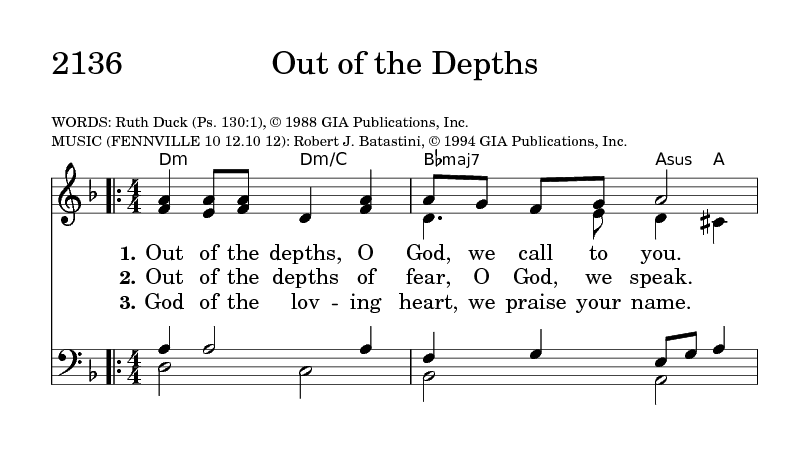
Hymn History: Out of the Depths

“Out of the Depths”
by Ruth Duck
The Faith We Sing, No. 2136.

The Pender UMC Traditional Service Middle Hymn “Out of the Depths” on Sunday September 4, 2022 was played by Eunji Moon on piano and sung by Brian Stevenson, the Pender Sanctuary Choir and congregation.

Central to biblical models of prayer is the practice of lament: crying out to God in pain, anguish, and grief. While examples of prayers of lament are found throughout the biblical witness and are particularly prevalent in the book of Psalms, too often we neglect lament in our worship.1 Bringing all our wounds to God shapes and forms us in honest relationship with our Creator, who loves us when we are far from perfection and is present with us in times of trouble. Hymns such as Ruth Duck’s “Out of the Depths” can help us reclaim lament in our worship.

“Out of the Depths” uses Psalm 130:1 as a springboard to name the things that plunge us into our own depths. While Psalm 130 is often seen as a confessional psalm, with its focus on redemption from iniquities,2 there are many things we hide away—our wounds, our scars, our traumas, our fears—and hiding these from ourselves and God stifles healing. “Out of the Depths” brings them forward through the practice of naming and lamenting in community. The first verse acknowledges the power of “wounds of the past” to affect our daily lives and the need for God’s love when we look at the full scope of our lives. The second verse leads us toward breaking silences that cloud the truth and keep us living in the fear of that which we have been too afraid to name.

While “Out of the Depths” encourages us to do our own individual work toward bringing our laments to God, it also lifts up the value of community in this healing process. While the first two stanzas both begin with “out of the depths,” all three stanzas end with “here in this community,” ensuring that the words most emphasized by repetition are not words of sorrow and isolation, but words of companionship. The second stanza also speaks to the safety and value of sharing difficult emotions among friends.

Almost all psalms of lament live in the tension between lament and praise. In fact, praise and expressions of confidence in God are seen as essential elements to the form of “lament”;3 many lament psalms end in praise (such as Psalm 13), or move back and forth constantly between lament and praise (Psalm 42).4 “Out of the Depths” leads us into praise in the final verse, painting a picture of a dancing God who moves through our lives as light in our darkness, meeting us with grace. The tune, FENNVILLE, is flexible enough to hold both tones—lament and praise—lending a strength and assurance to our words of praise. A bit of creativity in accompaniment can easily turn the final chord to a brighter tone.

The flexibility of this hymn conjures up possibilities for use outside the traditional context of singing the hymn straight-through in a service. Spoken prayer could easily be interspersed within the stanzas: naming specific kinds of pain present to those gathered, asking for assurance of God’s presence even in the depths, and thanking God for being revealed in community. It could easily be paired not only with Psalm 130, but also Psalm 139, in its assurance that there is no place anyone can go out of God’s reach—not even the depths.

While “Out of the Depths” leads us into lament in a way appropriate for many Sunday mornings, it is also a hymn to keep in mind in the unfortunate reality of times of crisis and tragic circumstances. The line, “Wounds of the past remain, affecting all we do,” acknowledges the impact such events have not only in the immediate aftermath, but throughout our lives. As such, this hymn could be particularly powerful when used in services of remembrance acknowledging anniversaries of events that have shaken communities.

“Out of the Depths” also has strong potential for use outside of a Sunday morning worship service. Ruth Duck has written alternate second lines for the first verse; one for those who are seriously ill (“Free us from fear of death, our faith and hope renew…”), and one for those who have been abused (“Words of abuse remain, affecting all we do…”) These reframe the hymn for more specific situations and could be useful in pastoral care situations as an opening or closing song for grief-sharing and support groups.

This is not surprising given the author’s interest in liturgical healing. A professor of worship at Garrett-Evangelical Theological Seminary, a strong presence in the academic liturgical community, and a prolific hymn text writer, Ruth Duck has written many hymns focused on healing and God’s ability to bring wholeness and restoration (such as “Sacred the Body,” “When We Must Bear Persistent Pain,” and “Womb of Life and Source of Being”). 5 “Out of the Depths” offers a way for us to give voice to our too often unspoken pain, celebrate community, and be assured of God’s grace which meets us wherever we are.


1 Duff, Nancy J. “Recovering Lamentation as a Practice in Church”, in Lament: Reclaiming Practices in Pulpit, Pew, and Public Square, ed. Sally A. Brown and Patrick D. Miller. Louisville: Westminster John Knox, 2005. p 4.

2 ed. Martin Tel, Psalms for All Seasons, Grand Rapids: Faith Alive Christian Resources, 2012. p 848.

3 Miller, Patrick D. They Cried to the Lord: the Form and Theology of Biblical Prayer. Minneapolis: Fortress Press, 1994. p 55-133.

4 Psalm 88 is a notable expression of a lament psalm without praise.


Tags: , , , , , , , , , , ,