“God of Grace and God of Glory”
Harry Emerson Fosdick The United Methodist Hymnal, No. 577
God of grace and God of glory,
on thy people pour thy power;
crown thine ancient church’s story;
bring her bud to glorious flower.
Grant us wisdom, grant us courage,
for the facing of this hour.
Pender Opening Hymn “God of Grace and God of Glory” May 22, 2022 accompanied by flute and cello.
“God of grace and God of glory” was written in 1930 by Harry Emerson Fosdick (1878-1969) for the dedication of the famous Riverside Church in New York City.
Fosdick was granted degrees from Colgate University and Union Theological Seminary. He was ordained in 1903 to ministry in the Baptist Church and became pastor of First Baptist Church, Montclair, N.J.
Fosdick served as a chaplain during World War I and then was pastor of First Presbyterian Church in New York City. From this congregation he was called to pastor Park Avenue Baptist Church, which was renamed Riverside Church.
As we sing this hymn, perhaps it is helpful to remind ourselves of the events that shaped the “hour” and the “days” that provide the context for this great hymn.
“God of grace and God of glory” was written while the United States was in the throes of the Great Depression between the two World Wars. Fosdick was a champion of the social gospel, a movement that recognized the plight of the poor, especially in the urban Northeast during the Industrial Revolution.
UM Hymnal editor Carlton Young has noted: “Fosdick’s stirring radio sermons, books, and public pronouncements established Riverside as a forum for the critique of the same wealth and privilege whose gifts had made possible the building of the church.
“Under his leadership Riverside Church was interdenominational, interracial, without a creed, and, astonishingly for Baptists, required no specific mode of baptism. At the center of Fosdick’s ministry was urban social ministry.”
Fosdick was perhaps the most vocal proponent of the social gospel of his time—a position that brought both wide acclaim and broad disdain.
The congregation moved to a $5 million edifice made possible by a gift from John D. Rockefeller Jr. The new building overlooked the Hudson River in what Fosdick called “a less swank district” than Park Avenue, where the congregation had been located near Harlem.
The hymn was written in the summer of 1930. It took shape as he reflected on the construction of the new building, and was first sung as the processional hymn at the opening service on Oct. 5, 1930, and again at the dedication on Feb. 8, 1931.
The language of the hymn is ultimately that of petition. “Grant us wisdom, grant us courage” concludes each stanza with the effect of a refrain. A petition begins stanza three with “Cure thy children’s warring madness,/ bend our pride to thy control.” The final stanza, equally prophetic, begins with “Save us from weak resignation/ to the evils we deplore.”
Fosdick wrote the text to be sung to the stately REGENT SQUARE (usually sung to “Angels from the realms of glory”). Methodist hymnologist and hymnal editor Robert G. McCuthan, however, first paired it with the Welsh tune CWM RHONDDA for the 1935 Methodist Hymnal. It was an immediate success and the new coupling has been almost universally adopted.
Hymnologist William Reynolds says Fosdick disapproved strongly of the new pairing. When Dr. Young asked the poet why he continued to oppose the use of CWM RHONDDA with his text, Fosdick replied, “My views are well known—you Methodists have always been a bunch of wise guys.”
That discussion notwithstanding, I object to the tempo played by many organists who take the hymn much too fast at the beginning, forcing the congregation to race through the prophetic petitions that conclude each stanza. The Welsh tune demands an appropriately stately tempo (think “processional,” not “horse race”) that gives the congregation time to absorb the challenges offered by the poet.
The Pender UMC Traditional Service Middle Hymn “It is Well With My Soul” on Sunday November 13, 2022 was played by Liz Eunji Moon on piano, directed by Brian Stevenson and sung the Pender Sanctuary Choir and congregation.
The hymn “It Is Well With My Soul” was written by a successful Christian lawyer called Horatio Spafford.
His only son died at age 4 in 1871. That year, the Great Chicago Fire wiped out his vast estate, made from a successful legal career.
In 1873 he sent his wife Anna and four daughters over to Europe on a summer trip on the ill-fated SS Ville du Havre. Since he had a lot of work to do, he had planned to travel to England with his family on the SS Ville du Havre, to help with D. L. Moody’s upcoming evangelistic campaigns. In a late change of plan, he sent the family ahead while he was delayed on business concerning zoning problems following the Great Chicago Fire.
On November 22 the ship was struck by an iron sailing vessel killing 226 people, including all four of Spafford’s daughters: Annie, age 12; Maggie, 7; Bessie, 4; and an 18-month old baby. His wife survived the tragedy.
Upon arriving in England, she sent a telegram to Spafford that read “Saved alone.”
Shortly afterwards, as Spafford traveled to meet his grieving wife, he was inspired to write these words as his ship passed near where his daughters had died.;Bliss called his tune Ville du Havre, from the name of the stricken vessel.
It is Well With My Soul
When peace, like a river, attendeth my way,
When sorrows like sea billows roll;
Whatever my lot, Thou hast taught me to say,
It is well, it is well with my soul.
Refrain:
It is well with my soul,
It is well, it is well with my soul.
Though Satan should buffet, though trials should come,
Let this blest assurance control,
That Christ hath regarded my helpless estate,
And hath shed His own blood for my soul.
My sin—oh, the bliss of this glorious thought!—
My sin, not in part but the whole,
Is nailed to the cross, and I bear it no more,
Praise the Lord, praise the Lord, O my soul!
For me, be it Christ, be it Christ hence to live:
If Jordan above me shall roll,
No pang shall be mine, for in death as in life
Thou wilt whisper Thy peace to my soul.
But, Lord, ’tis for Thee, for Thy coming we wait,
The sky, not the grave, is our goal;
Oh, trump of the angel! Oh, voice of the Lord!
Blessed hope, blessed rest of my soul!
And Lord, haste the day when the faith shall be sight,
The clouds be rolled back as a scroll;
The trump shall resound, and the Lord shall descend,
Even so, it is well with my soul.
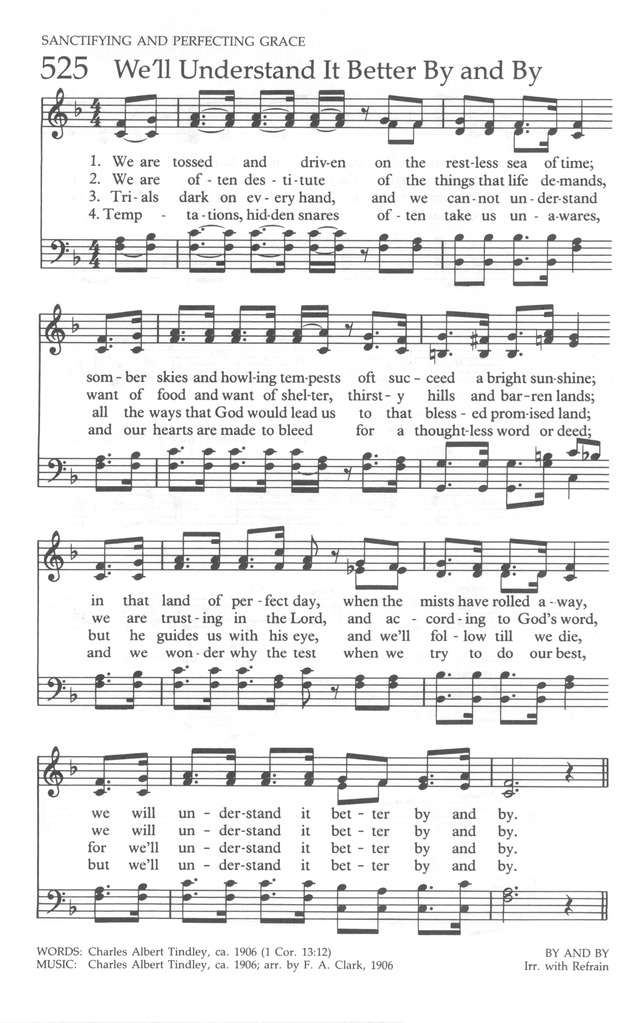
We are tossed and driven
on the restless sea of time;
somber skies and howling tempests
oft succeed a bright sunshine;
in that land of perfect day,
when the mists have rolled away,
we will understand it better by and by.
Charles Albert Tindley (July 7, 1851 – July 26, 1933) was an American Methodist minister and gospel music composer.
Often referred to as “The Prince of Preachers”, he educated himself, became a minister and founded one of the largest Methodist congregations serving the African-American community on the East Coast of the United States.
He was one of the eminent preachers of Methodism at the turn of the twentieth century. Hymnologist James Abbington has called Tindley a “pastor, orator, poet, writer, theologian, social activist, ‘father of African American Hymnody,’ ‘progenitor of African American gospel music’ and ‘prince of preachers.'”
The Rev. Carlton Young notes “We’ll Understand It Better By and By” was “one of eight hymns . . . written during a difficult period in Tindley’s life.”
One can imagine Tindley using this song to punctuate his sermons, offering hope to those assembled not only through exegesis of the biblical text, but also through a lyrical sung theology.
~~
From “The Lawrence Welk Show,” Gail, Rod, and Michael are featured in this great Gospel song found in the United Methodist Hymnal (page 525). Join with them in song as they encourage every Christian: “WE’LL UNDERSTAND IT BETTER BY AND BY”
“I Want to Walk as a Child of the Light” by Kathleen Thomerson,
The United Methodist Hymnal, No. 206
The Pender UMC Traditional Service Opening Hymn “I Want to Walk As a Child of the Light” on Sunday September 18, 2022 was played by Liz Eunji Moon on piano, accompanied on guitar by Brian Stevenson and AJ Rios and sung the Pender Sanctuary Choir and congregation.
I want to walk as a child of the light.
I want to follow Jesus.
God set the stars to give light to the world.
The star of my life is Jesus.
Refrain: In him there is no darkness at all.
The night and the day are both alike.
The Lamb is the light of the city of God.
Shine in my heart, Lord Jesus.*
From time to time, a hymn captures our imagination because of its simplicity and transparency. Such a hymn is “I want to walk as a child of the light.” In singing this hymn, we feel the spirit of Epiphany unfold.
Kathleen Armstrong Thomerson (b. 1934) is a native of Tennessee. She wrote the hymn during the summer of 1966 during a visit to the Church of the Redeemer in Houston, Texas, the location providing the origin for the tune name HOUSTON. Her musical education took place at the University of Texas and Syracuse University, with additional studies at the Flemish Royal Conservatory in Antwerp. She has studied with several of the most noted organists of the twentieth century.
Ms. Thomerson directed music at University United Methodist Church in St. Louis and was on the organ faculties of St. Louis Conservatory and Southern Illinois University in Edwardsville. From 2004 through 2013, she served Mt. Olive Lutheran Church in Austin, Texas. In addition to this hymn, she contributed tunes for hymns by Patricia B. Clark in their joint collection, A Taste of Heaven’s Joys: A Collection of Original Hymns (2005).
“I want to walk as a child of the light” comes to The United Methodist Hymnal by way of the Episcopal Hymnal 1940 supplement, Songs for Celebration (1980). A musician with such a distinguished musical pedigree does not usually compose a gospel hymn of such elegant simplicity. A folk-like melody conveys a text based upon a wide range of scriptural allusions and biblical images. United Methodist Hymnal editor, Dr. Carlton Young notes some biblical passages that support the text: Isaiah 42:6c, “I have given you as a covenant to the people, a light to the nations.”; Malachi 4:2, “But for you who revere my name the sun of righteousness shall rise, with healing in its wings”; Revelation 21:25b, “And there will be no night there,” and 22:5b, “They need no light of lamp or sun.”
“I want to walk as a child of the light” communicates deep conviction and personal sincerity, while avoiding any hint of pretence. The first person perspective invites the singer to join Christ, the Light of the World, in discipleship – a journey of faith. The second line of each stanza deepens this commitment:
Stanza 1: “I want to follow Jesus.”
Stanza 2: “I want to look at Jesus.”
Stanza 3: “I want to be with Jesus.”
From a Wesleyan perspective, the theology of this hymn outlines sanctifying grace, the perspective of the Christians as they move toward perfection in the faith, becoming transformed in the image of Christ. Each stanza adds greater luminosity to this walk. In the first stanza, “God set[s] the stars to give light to the world.” Christ in turn becomes the “star of my life.” References to stars support the hymn’s appropriateness for Epiphany. Stanza two expresses the desire to “see the brightness of God.” The “Sun of Righteousness” illumines “the way to the Father.” The final stanza extends the journey toward the “coming of Christ,” an eschatological direction toward our future hope.
As in most gospel hymns, it is the refrain that carries the essence of its meaning; and indeed it is this refrain, with its scriptural allusions that virtually quote from Revelation 21 and 22, that distinguishes this hymn from many earlier expressions of discipleship. While a deeply personal expression of piety, the poet roots her devotional expression firmly in Scripture, avoiding the maudlin and simplistic notions of some gospel songs.
The simplicity of the music and text does not imply a simplistic faith. “I want to walk as a child” reminds us of one of the paradoxes of our faith, that we need to become as a child to fully understand the realm of God (Matthew 18:2-4).
The Pender UMC Traditional Service Middle Hymn “What a Friend We Have in Jesus” on Sunday October 23, 2022 was played by Liz Eunji Moon on piano, accompanied on guitar by Brian Stevenson and sung the Pender Sanctuary Choir and congregation.
How does a personal poem written to a mother from a despondent son, recently immigrated from England to a relatively remote section of Canada in the mid-nineteenth century, become one of the most widely sung hymns in the world?
Joseph Medlicott Scriven (1819–1886) was born in Seapatrick, Ireland (now Northern Ireland,) and died in Ontario, Canada. After attending classes at Trinity College, Dublin, he pursued a military career, where he trained for service in India; but had to abandon that ambition because of his poor health. He returned to Trinity and graduated in 1842.
SCRIVEN’S LIFE
Scriven’s life was full of tragedy. Following the accidental drowning of his Irish fiancée the evening before their wedding, he moved to Woodstock, Canada West (now Ontario) in 1844, where he led a Plymouth Brethren fellowship and taught. Scriven organized a private school in 1850 in Brantford and preached in the area. Some scholars believe that Scriven may have composed his initial draft of “What a Friend” written during this time.
Moving near Clinton in Huron County in 1855, he read the Bible to railway construction workers who were building the Grand Trunk Railway across the Canada West. By 1857, he relocated to Bewdley, supporting himself as a private tutor to the family of Robert Lamport Pengelly, a retired naval officer. Tragedy struck again when his second fiancée, Eliza Catherine Roach, Pengelly’s niece, died in 1860 of an illness shortly before their wedding. Scriven then returned to ministry among the Plymouth Brethren in Bewdley, near Rice Lake (McKellar and Leask, Canterbury Dictionary, n.d.). Hymnologist Albert Bailey noted that Scriven, a selfless person by nature, was known as “the man who saws wood for poor widows and sick people who are unable to pay” (Bailey, 1950, p. 495).
The Dictionary of Canadian Biography describes what we know about the circumstances surrounding Scriven’s death in October 1886:
His last days were clouded with ill-health and despondency. James Sackville, his friend and fellow-believer, found Scriven ill and brought him to his house. One hot night in 1866, Scriven left his bed without disturbing anyone, probably to drink at a nearby spring: some hours later, presumably having fainted or fallen, he was found dead in the spillway of Sackville’s grist-mill, a few feet from the spring. He was buried in the Pengelly burial-ground in an unmarked grave between Eliza Roach and Commander Pengelly (Macpherson, “Scriven,” n.d.).
A few days before Scriven’s death, Sackville found the dejected Scriven “prostrate in mind and body and heard him say, ‘I wish the Lord would take me home’” (Cleland, 1895, p. 17). It was never determined if his death was accidental or a suicide. A monument was later erected over his gravesite by friends and neighbors. Joseph Medlicott Scriven’s historical marker was placed in Otanabee-South Monaghan, Ontario, Canada, marking his homestead and burial place.
ORIGINS OF ‘WHAT A FRIEND WE HAVE IN JESUS’
Scriven published a collection of his poetic works, Hymns and Other Verses, which included seventy-one hymns “intended to be sung in assemblies of the children of God on the first day of the week and on other occasions when two or three are met together in the Name of our Lord Jesus Christ.” These were followed by thirty-four scriptural paraphrases “not to be sung in the assembly, but to express truth, as well as convey comfort, instruction or reproof to our hearts, in order that we may walk together in obedience” (Scriven, 1869, Preface). “What a Friend,” the hymn for which he is known, does not appear in the collection, however. Why not?
Some writers have noted that the hymn was written for his mother, who was suffering from illness. Musical evangelist Ira D. Sankey (1840–1908) spread this account (cited in Bailey, 1950, pp. 495–496). This assertion is hard to verify, however. A statement from Scriven’s biography (1895) by James Cleland includes the author’s mother in the dissemination of the hymn but does not clarify other details:
When residing at the house of his friend Mr. Sackville, near Rice Lake, he composed this hymn; making two copies, one of which he sent to his mother, in Dublin, and gave the other to Mrs. Sackville, which the old lady, now over eighty years of age values highly. Probably it was through his mother that the hymn was given to the public (Cleland, 1895, p. 13).
If indeed “What a Friend” were composed as a personal poem, it may explain why it did not appear in the collection the author published in 1869. The personal first-person plural perspective contrasts with other hymns by the author. As one author noted, “almost all of his others are more firmly constructed, without emotional softness, and developed from biblical texts” (Macpherson, “Scriven,” n.d.). Carl Daw Jr. has also noted the differences between “What a Friend” and the author’s published works in Hymns and other verses, supporting the hypothesis that the poem was intended for his ailing mother rather than public use (Daw, 2016, p. 470).
Some commentaries state that the text was first published in J.B. Packard’s Spiritual Minstrel: A Collection of Hymns and Music (1857), but this is erroneous, according to hymnologist Chris Fenner (See Fenner, 2020, n.p.). The hymn appeared as we know it anonymously in three stanzas of eight lines each in Social Hymns, Original and Selected (1865), compiled by Horace Lorenzo Hastings. New England composer and church musician Charles Converse (1832–1918) then included the text in his Silver Wings (1870) with his tune under his pen name Karl Reden, a Germanization of his name (“reden” meaning “to speak” or “converse”). He states that he obtained the text from the privately produced hymnal, “Genevan Presbyterian Church (of Brooklyn) Collection.” No copy of this hymnal appears to be extant. Converse’s tune paired with the text gained prominence with Ira Sankey and spread in his revivals with Dwight L. Moody (1837–1899). Published in Sankey’s Gospel Hymns and Sacred Songs (1875), later known as Gospel Hymns No. 1., Sankey mistakenly attributed the hymn to Scottish hymnwriter Horatius Bonar (1808–1889), an assertion disputed by Bonar.
The text has remained unusually stable with few editorial alterations over the years. Edward Samuel Caswell (1861–1938) published an early manuscript version signed by Scriven that was titled “Pray without Ceasing” (from 1 Thessalonians 5:17) in 1919. It appeared in four quatrains, the first three of which are familiar. The fourth reads as follows:
Are we cold and unbelieving, Cumbered with a load of care? Here the Lord is still our refuge: Take it to the Lord in prayer. (See the manuscript at Fenner, 2020, n.p.)
Of the hymn, Caswell stated that it was “beyond question the best-known piece of Canadian literature” (Macpherson, “Scriven,” n.d.).
Stanza 1 establishes that Jesus is a friend that can bear our sins and burdens. This theme appears in the eighteenth century with Charles Wesley’s “Jesus, Lover of My Soul” (1740) and John Newton’s “How Sweet the Name of Jesus Sounds” (1779). Nineteenth-century hymnwriters are especially known for expressing their personal friendship with Jesus. For example, see Louisa M.R. Stead’s “‘Tis So Sweet to Trust in Jesus” (1882), Elisha A. Hoffman’s “I Must Tell Jesus All of My Trials” (1894), and Fanny Crosby’s “Blessed Assurance, Jesus Is Mine” (1873). The author uses the first-person plural perspective—perhaps indicating that he and his mother (“we”) have a bond in prayer and need not suffer sin and grief alone.
The second stanza asks two rhetorical questions—rhetorical because, indeed, all humans suffer “trials and temptations” and witness “trouble.” The answer becomes a short refrain: “Take it to the Lord in prayer.” A third rhetorical question asks, “Can we find a friend so faithful . . .?” The intimate friendship with the one who “knows our every weakness” is the source of solace. The refrain returns: “Take it to the Lord in prayer.”
The third stanza reframes the premise of the song with different questions, while the theme remains the same:
Are we weak and heavy laden, cumbered with a load of care? Do your friends despise, forsake you?
The answer to both questions is, “Take it to the Lord in prayer.” The closing image of Jesus enfolding his friend in his arms is also a common trope in many hymns from this era. The two most known are Fanny Crosby’s “Safe in the Arms of Jesus” (1868) and Elisha Hoffman’s “Leaning on the Everlasting Arms” (1887).
Hymnologist Fred Gealy found an additional stanza published in Hastings’ Songs of Pilgrimage: A Hymnal for the Churches of Christ (Boston, 1886; Second Ed. 1888) with the following fourth stanza:
Blessed Jesus, thou hast promised Thou wilt all our burdens bear, May we ever, Lord, be bringing All to thee in earnest prayer. Soon in glory, bright, unclouded, There will be no need for prayer; Rapture, praise, and endless worship Shall be our sweet portion there.
Since this seems to be the only hymnal to include this stanza, it may have been added by the editor who felt that an eschatological focus was more theologically suitable for a closing stanza.
Albert Bailey notes correctly that Scriven’s poetry is of relatively low quality with monotonous rhymes (Scriven uses five words to rhyme with “prayer”—some multiple times) and trite language. But even Bailey admits, “Our criticism is made harmless by the tremendous service the hymn has rendered. Any unlettered person can understand it; the humblest saint can take its admonitions to heart, practice prayer, find his load more bearable and [her] spiritual life deepened” (Bailey, 1950, p. 496).
Paul Westermeyer offers a critique from a Lutheran perspective, noting:
It has been a source of comfort for many who have sung it, though paradoxically it has also been a part of a Protestantism that denies its own heritage by turning prayer into work to control God’s grace. The repeated line “Take it to the Lord in prayer” relates to . . . comfort, and forfeiting peace or suffering pain “All because we do not carry everything to God in prayer” suggests our capacity to save ourselves by the work of our prayer (Westermeyer, 2010, p. 606).
Carl Daw offers a different analysis: “As a hymn of assurance, it has served as an effective reminder of the centrality of prayer in a well-rounded spirituality. Unfortunately, singing it has often been a substitute for the comprehensive prayer life it advocates, and its advice has been cherished, but not followed” (Daw, 2016, p. 471).
While other tunes appear with this text, CONVERSE by Charles Converse is the most popular. Carlton Young suggests that CONVERSE is reminiscent of Stephen Foster tunes of the era and provides a perfect musical vehicle for this prayerful text. He notes that this tune follows the same general melodic contour as Foster’s “Jeanie with the light brown hair” (Young, 1993, pp. 687–688). Converse, a Massachusetts native, was an associate of William Bradbury (1816–1868) and Ira Sankey in revivals and the Sunday school movement.
The range of recording artists who have sung this song is staggering from long-established white performers Pat Boone (https://www.youtube.com/watch?v=hcHbzSi7fho&feature=emb_title), Rosemary Clooney, Loretta Lynn, Barbara Mandrell, Willie Nelson, and Dolly Parton to African American gospel artists Ella Fitzgerald, Aretha Franklin, and Ike and Tina Turner (https://www.youtube.com/watch?v=ay1lUmnaZfA&feature=emb_title). More recently, Contemporary Christian artist Paul Baloche has recorded the song (https://www.youtube.com/watch?v=6pJb0nUiZWc&feature=emb_title), indicating that it continues to have a witness to younger generations. Baloche’s improvisatory coda bridges the nineteenth century with the twenty-first. The hymn’s inclusion in the film Driving Miss Daisy (1969) as sung by Little Friendship Missionary Baptist Church Choir (Decatur, Georgia) confirms its iconic status in the genre.
The simple language becomes a virtue in translation, and the folk-like melody easily transcends cultures around the world. The musical treatment of CONVERSE varies in each cultural setting, but the message remains the same. There are few hymns that I have heard more regularly around the world. Scriven’s biographer, James Cleland, noted in 1895, “In the steerage of the steamer, a traveler returning from Europe, heard a mixed company, who spoke different languages, united in singing this hymn” (Cleland, 1895, pp. 5–6). One hundred years later, this author verifies hearing this song sung in various languages and renditions, including a humble congregation for people with leprosy near Ogbomosho, Nigeria; a Filipino Anglican congregation in Manila; a thriving Baptist congregation in Matanzas, Cuba; and an African American Methodist congregation in Atlanta. A modest poem, written in Canada as a private meditation for the author’s mother in Ireland, has found its way into many hearts worldwide and, undoubtedly, has been a source of comfort for millions of Christians for more than one hundred fifty years.
SOURCES
Albert E. Bailey, The Gospel in Hymns (New York: Charles Scribner’s Sons, 1950).




 News and Views