RSS

Tag Archives: hymn

Hymn History: The Church’s One Foundation

“The Church’s One Foundation”
by Samuel J. Stone, adapted by Laurence Hull Stookey
The United Methodist Hymnal, 546

Original text by Samuel J. Stone

“The Holy Catholic Church:
The Communion of saints.”

“He is the Head of the Body, the Church.”

The Church’s One Foundation
Is Jesus Christ her Lord,
She is His new creation
By water and the Word:
From Heaven He came and sought her
To be His holy Bride,
With His Own Blood He brought her
And for her life He died.

Adaptation by Laurence H. Stookey

The church’s one foundation
is Jesus Christ our Lord;
we are his new creation
by water and the Word;
from heaven he came and sought us
that we might ever be
his living servant people,
by his own death set free.*

*Adaptation © 1983 The United
Methodist Publishing House

SAMUEL STONE’S ORIGINAL HYMN

Samuel John Stone (1839–1900), then a newly ordained curate at New Windsor Parish Church, wrote “The Church’s One Foundation” in 1866 as a direct lyrical commentary to a controversy in the Church of South Africa, part of the Anglican Communion. The controversy was between Bishop John William Colenso of Natal (an early apologist for the new theory of source criticism) and Bishop Robert Gray of Cape Town (apologist for traditional means of dating and tracing authorship in scripture). Stone’s text was a tribute to Gray’s view. The link between this hymn and the Colenso controversy is well-documented. In C. Michael Hawn’s History of Hymns column on the original hymn, it can be read in more detail: https://www.umcdiscipleship.org/resources/history-of-hymns-the-churchs-one-foundation.

The origins of “The Church’s One Foundation” are found in a lengthier publication titled Lyra Fidelium: Twelve Hymns on the Twelve Articles of the Apostles Creed (1866). The text is constructed around ideas from the ninth article, “The Holy Catholic: The Communion of Saints,” bearing a subtitle from Colossians 1:18, “He is the head of the body, the Church,” and embeds portions of at least 38 scripture passages. H.E.C. Stapleton writes,

The strength of the hymn lies in the simplicity and directness of its message, the vividness of its metaphors, and the deliberate, distinct echoes of words and phrases from scripture. In Lyra Fidelium, there are no less than four biblical quotations annotated to each stanza; in one, seven. It was hailed in Stone’s own time as “the battle-song of the Church” (Stapleton, Canterbury Dictionary).

Including this panoply of scripture was likely a result of Stone’s concern with the orthodox position of the primacy of scripture, one of the central points of the controversy. These passages, as noted by Stone, are as follows:

  • Stanza 1: 1 Cor 3:11; John 3:5; Eph 5:25–26; Acts 20:28
  • Stanza 2: Rev 5:9; 1 Cor 10:17; Eph 4:5; Acts 4:12; 1 Cor. 10:17; Eph. 4:4; Eph. 4:7
  • Stanza 3: Matt 16:18; Matt. 28:20; 1 John 3:13; Gal 2:4; Mic 7:8
  • Stanza 4: 2 Pet 2:2; 1 Cor 11:18; 11:19; 1 Pet 4:7; Ps 25:22; Rom 8:23; Isa 51:11
  • Stanza 5: Eph 6:12; Rom 8:37; Rom 16:20; 1 John 3:2; Heb 4:9
  • Stanza 6: 1 John 1:3; 2 Cor 13:14; Heb 12:22–23; Isa 43:2; Luke 23:43
  • Stanza 7: Jude 1:24, 1 Pet 5:6; Rev 21:10; Rev. 7:17; Rev 21:3

Two years later, the text was reduced to five stanzas with Stone’s cooperation, resulting in the version most congregations now use. About twenty-two years after its composition, this hymn took its place as a significant lyrical text of the church. Stapleton writes:

The hymn came into its own at the Lambeth Conference in 1888 when it was sung at all the primary services. It is recorded that at St Paul’s Cathedral, its effect was so powerful that the singers were physically overwhelmed: “It made them feel weak at the knees, their legs trembled, and they felt as though they were going to collapse” (Stapleton quoting Wesley Milgate, Songs of the People of God, 1982).

LAURENCE STOOKEY’S ADAPTED TEXT

The adaptation by United Methodist seminary professor and liturgical scholar Laurence Hull Stookey (1937–2016) first appeared in The Upper Room Worshipbook (1983), and then in The United Methodist Hymnal (UMH) following the 1988 General Conference of The United Methodist Church. This was a critical conference concerning the hymnody of the church. The United Methodist Hymnal was adopted at this conference as well as a mandate concerning significantly altered texts, requiring both the original and the altered text to be placed side-by-side. This mandate created space for Stookey’s adaptation, considered to be an “inclusive, ecumenical, and nonsexist” version of the original. This was the only instance in which the mandate of the General Conference was implemented (Young, 1993, p. 629).

Although inclusive language in contemporary hymns is gaining wide acceptance, the adaptation of well-known texts remains controversial and lives in a narrow space, with one side being possible issues of non-equity/non-representation—the other being retention of language that holds to the integrity of the original text. In addition, further divisions arise in churches and church bodies about gendered language, archaic language, and subtle changes of theology from adapted texts. These divisions are far too large a conversation to address in this article. Still, careful reflection on the practice of adaptation does bear on Stookey’s text.

It is interesting to note that Stone’s language, which directly addressed the issues of the 1866 controversy, is largely untouched by Stookey, honoring the original impetus of the text. In stanza three, direct statements align with Stone’s concern when he writes, “by schisms rent asunder, / by heresies distressed.” In stanza 4, there is language that perhaps describes the feeling of the church, saying, “Mid toil and tribulation, / and tumult of our war.” These statements, retained by Stookey, remain faithful to the original wording, though the cultural, historical, ecclesial, and theological contexts differ. Hawn also notes in his article, writing, “The church exists in a constant state of controversy and potential schism. In many ways, this text articulates feelings that are as fresh as ever” (Hawn, “History of Hymns”).

The most noticeable aspect of Stookey’s adaptation concerns Stone’s use of feminine pronouns, drawing on the metaphor of the church as the bride of Christ: “Wives, be subject to your husbands as you are to the Lord. For the husband is the head of the wife just as Christ is the head of the church, the body of which he is the Savior” (Eph 5:22–23, NRSV). The subjugation of women as the context for the ecclesial metaphor is troubling for many Christians. Stone’s text is replete with this metaphor, beginning with the first stanza: “The church’s one foundation / is Jesus Christ her Lord.” This gendering of the church is strongly underscored in the third phrase, “from heaven he came and sought her / to be his holy bride” (emphasis added) and remains present throughout the near entirety of the hymn. It is only in the second half of Stone’s final stanza that we finally sing that “we” are the church referred to in this text.

In Stookey’s adaptation, he replaces feminine pronouns and phrases with “we” language. Often, Stookey is straightforward, substituting “our” and “we” for “her” and “she.” Sometimes, he changes short phrases, such as “one holy name she blesses” to “one holy name professing.” Another short example is the change of text from “and to one hope she presses, / with every grace endued” to “to one hope always pressing, / by Christ’s own Spirit led.” These shorter modifications subtly paraphrase the original—in the first instance, changing the idea of blessing God’s name to professing God’s name. This change shifts us from praising God to making an open declaration of God. In the adaptation, the singers move from being infused with grace to following the leading of the Spirit, both of which are evidence of God’s work within us.

Less frequent are instances of adaptation on a larger scale. The last four lines of the side-by-side texts cited at the beginning of this article exemplify this. This adaptation, quite different in the language used, retains the original ideas of being sought out by Christ and the claim of salvation for the church through the death of Christ but adds the church’s identity as servant people, something not seen in the original text.

Another aspect of Stookey’s adaptation concerns ecumenism and inclusivity in addition to reworking feminine pronouns and images in the text. Stone’s original second stanza begins with “Elect from every nation” (his first draft said, “She is from every nation”). Stookey broadens the meaning in his adaptation— “Called forth from every nation.” The term “elect” may have had its origins in the influence of Calvinism and Reformed doctrine on The Anglican Church at this time. The clause, “from every nation,” may reflect England as a world political and military power at the height of its colonial influence around the world. The Anglican communion was a worldwide catholic (universal) church. The idea of the “elect” of God is a crucial doctrinal distinct from one embraced by the United Methodist Church. By changing “Elect from” to “Called forth,” Stookey reflects the Wesleyan doctrine of free grace and universal availability of prevenient grace to all people.

These are, by far, not the only issues taken up by Stookey in his adapted text that bear further discussion. By changing the perspective from third person (feminine) to the first-person plural, Stookey changes our idea of ecclesiology—the nature of the church. Perhaps we can consider these initial understandings, recognizing Stookey’s offering as a theological reflection that moves our sung faith toward non-binary gendered language and allows for the inclusion of all among Christ’s called. The church’s ministry and our perception of the church in the twenty-first century are changing. Thankfully, we rest on the tradition of the saints but must also sing a faith that is vibrant and efficacious in our time.

Laurence Hill Stookey was a beloved professor of preaching and worship at Wesley Theological Seminary, Washington, D.C., from 1973–2007. Many consider Laurence Stookey to be among the four most influential United Methodist liturgical scholars of the later twentieth and early twenty-first centuries. This list includes Hoyt Hickman (1927–2016), James W. White (1932–2004), and Don Saliers (b. 1937). They worked together to reform Protestant worship following the Second Vatican Council (1962–65) by emphasizing the Revised Common Lectionary. Additionally, they collaborated on the United Methodist Book of Worship (1992) and the Handbook of the Christian Year. Stookey came out of the Evangelical United Brethren tradition, helping United Methodists appreciate the “United” part of their heritage.

Stookey was a native of Illinois, graduating from Swarthmore College, Wesley Theological Seminary, and Princeton Theological Seminary. He was also a gifted musician who enjoyed playing several instruments. His creative and practically written trilogy of texts has proven invaluable to students and pastors. They include: Baptism: Christ’s Acts in the Church (1982), Calendar: Christ’s Time for the Church (1996), and Eucharist: Christ’s Feast with the Church (1993). If you participate in a baptismal liturgy in a United Methodist Church, you will likely hear and speak words by Laurence Stookey.

SOURCES:

Heather Hahn and Sam Hodges, “Remembering Professor who Shaped Worship,” United Methodist News (October 20, 2016), https://www.umnews.org/en/news/remembering-professor-who-shaped-worship (accessed September 12, 2021).

Stapleton, H.E.C., “The Church’s One Foundation,” Canterbury Dictionary of Hymnologyhttp://www.hymnology.co.uk/t/the-church’s-one-foundation (accessed September 12, 2021).

Rowan Strong, “Lambeth Conference, First Participants,” Oxford Dictionary of National Biography (April 12, 2018), https://www.oxforddnb.com/view/10.1093/odnb/9780198614128.001.0001/odnb-9780198614128-e-107600 (accessed September 12, 2021).

Carlton R. Young, Companion to The United Methodist Hymnal (Nashville: Abingdon Press, 1993).


Victoria Schwarz is a provisional deacon in the Rio Texas Conference and serves as the Associate Pastor and Minister of Music at Berkeley United Methodist Church in Austin, TX. She is active in the Fellowship of United Methodists in Music and Worship Arts.

Adapted from https://www.umcdiscipleship.org/articles/history-of-hymns-the-churchs-one-foundation-2021


Tags: , , ,

Hymn History: Count Your Blessings

Count your blessings. Name them, one by one.

This simple mandate for cultivating gratitude and thanksgiving is the opening line in the catchy chorus of “Count Your Blessings,” a church music staple first published more than a century ago.

All these years later, the four verses and chorus can be summed up this way: Counting your blessings may be the antidote to feeling disheartened.

The remaining line of the chorus implores you to, after counting and naming the blessings, to “see what God has done.”

The faithful act of assessing blessings and acknowledging what God has provided in your life may give perspective when challenges and conflicts occur, as the four verses detail (see sidebar).

The author of these song lyrics acknowledges that you can feel burdened and life can seem unfair. So can counting your blessings really help when turmoil swirls around you and discouragement weighs heavy on your mind?

Such was the case for Jacob, who, in Genesis 28, is fleeing from his angry brother, Esau. When Jacob stopped for the night at a place he would later name “Bethel,” Jacob was in the midst of a bad situation. He was alone, scared and had nowhere to go. He also had no idea about how his circumstances might turn out. That night in a dream, God reassured Jacob that He was with him, that He had a plan for Jacob’s life and that He would not leave him. Jacob awoke the next morning with a change of heart and life didn’t seem so bad. “Surely the Lord is in this place,” Jacob said, “and I did not know it.” (Genesis 28:16)

Numerous stories in the Bible remind you to look beyond your circumstances to see you are not alone, that “the Lord is in this place,” providing anecdotal evidence of the importance of gratitude.

In addition to the anecdotal proof, the virtues of gratitude have been proven by science.

In a study published in the Journal of Personality and Social Psychology, the test group was asked to daily write down five things for which they were thankful. After doing this every day for one week, the test group reported better sleep patterns and a more positive emotional outlook than the control group.

Members from Perryville United Methodist Church in Perryville, Kentucky, perform “Count Your Blessings.”

Whether the song’s author was battling tough times when he wrote the lyrics is unknown. What we do know is that Johnson Oatman Jr., the lyricist, was a Methodist Episcopal minister who had a penchant for songwriting. “Count Your Blessings,” intended as a song for youth, first appeared in “Songs for Young People,” which was published in 1897 by the Methodist Book Concern, a precursor to The United Methodist Publishing House. Over Oatman’s life, he penned more than 5,000 songs, including the classic hymn “No, Not One.”

For “Count Your Blessings,” Oatman partnered with E.O. Excell, who put Oatman’s words to music. Excell operated a Chicago-based publishing business specializing in Sunday School materials and collaborated with the Methodists for numerous projects. Fun fact about Excell is that he is the same person who wrote the arrangement of “Amazing Grace” that is most often sung throughout the world today.

But back to “Count Your Blessings.”

Once “Songs for Young People” was published, “Count Your Blessings” became a favorite, quickly gaining popularity throughout the world.

Beginning in 1899, only two years after its debut, “Count Your Blessings” appeared in at least half-dozen or more new hymnals each year, a pace that continued for at least a decade. The song was added to hymnals published by the Methodists, Presbyterians, Disciples and southern gospel publishers. Even into the mid-20th century, the song continued to be a favorite.

The song was especially popular in the United Kingdom. During the 1904-1905 Welsh Revival, the largest Christian revival in Wales during the 20th century, it is told that “Count Your Blessings” was sung at every service.

One account from a London daily newspaper says that when the famous British evangelist Gipsy Smith presided over a meeting, he announced a hymn, saying, “Let us sing ‘Count Your Blessings.’ Down in South London, the men sing it, the boys whistle to it, and the women rock their babies to sleep to the tune.”

In addition to the upbeat, simple tune that people have found easy to remember, its message has been uplifting folks for generations.

“Like a beam of sunlight,” wrote J.H. Hall, Oatman’s biographer, in “Biography of Gospel Song and Hymn Writers, “(’Count Your Blessings’) has brightened up the dark places of the earth.”

Crystal Caviness works for UMC.org at United Methodist Communications. Contact her by email or at 615-742-5138.

This story was first published November 14, 2019. 

From https://www.umc.org/en/content/count-your-blessings-an-antidote-to-despair


Tags: , , , , , ,

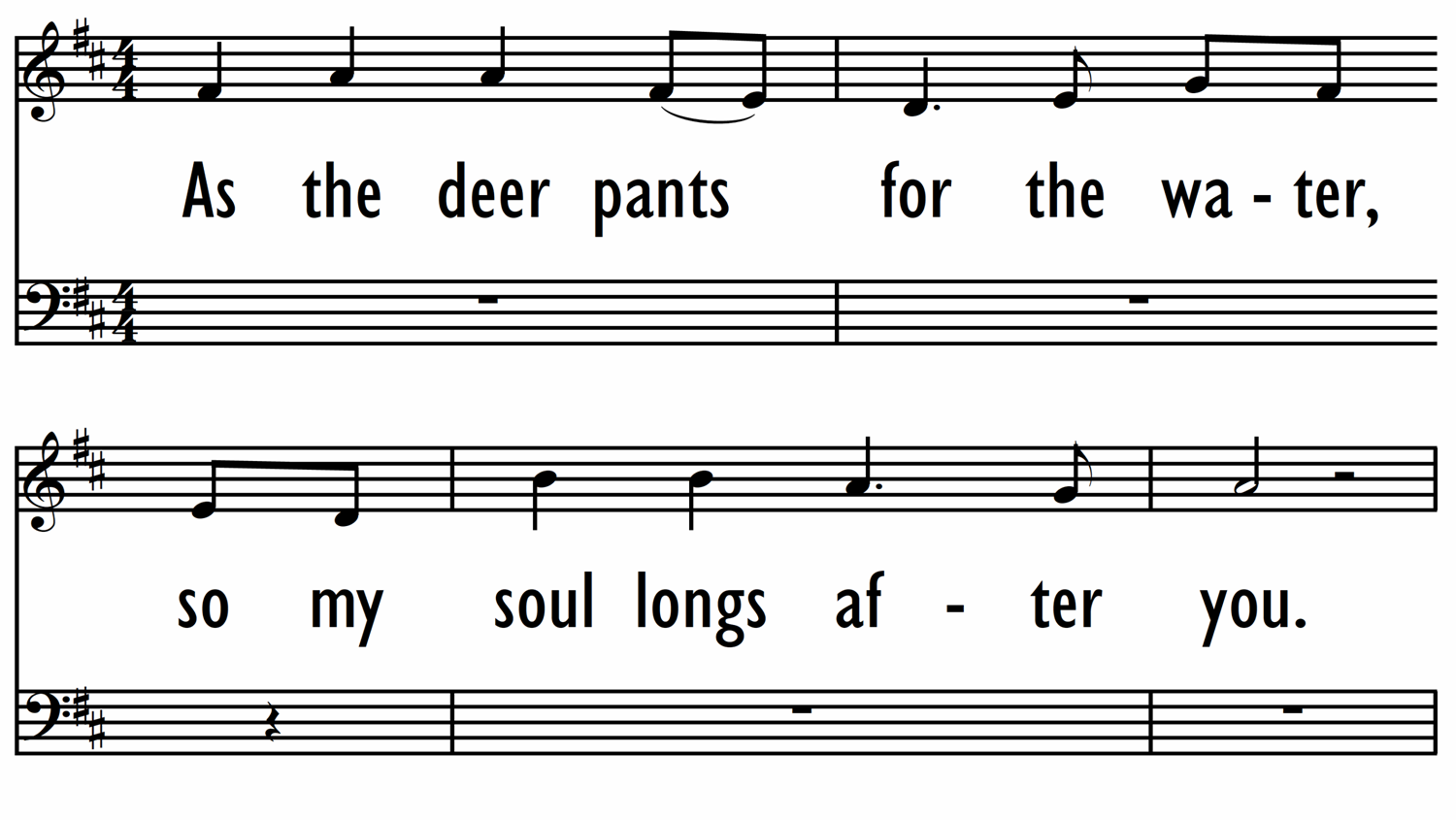
Hymn History: As The Deer

“As the Deer” by Martin Nystrom,
The Faith We Sing, No. 2025

The Pender UMC Traditional Service Middle Hymn “As the Deer” on Sunday September 18, 2022 was played by Liz Eunji Moon on piano, accompanied on guitar by Brian Stevenson and AJ Rios and sung the Pender Sanctuary Choir and congregation.

“As the deer pants for the water brooks,
So pants my soul for You, O God” (Psalm 42:1, NKJV)*

On his website, http://martynystrom.com/, the composer introduces himself in self-effacing terms:

“I am a married father of two sons and live in the Seattle area. My degree is in music education and I have taught music in a wide variety of settings. I have written over 120 songs that have been released by publishers of Christian praise and worship music. My best known song is the worship chorus, ‘As the Deer.’” He notes that, “I seem to write songs when I am not purposefully trying to write one.”

“As the deer,” written in 1981, is one of the most popular songs in the contemporary Christian musical (CCM) genre written in the latter twentieth century. Martin J. Nystrom (b. 1956) is a native of Seattle, Washington. After graduating from Oral Roberts University, Tulsa, Oklahoma (BME, 1979), he served as musical evangelist with Christ for the Nations, Dallas, Texas [www.cfni.org] and produced five praise and worship albums for Hosanna! Music, Mobile, Alabama.

Lindsay Terry, in his book The Sacrifice of Praise: The Stories Behind the Greatest Praise and Worship Songs of All Time(2002), describes the circumstances surrounding the creation of this song:

“Marty was a schoolteacher in Seattle, and since he had the summer off, he decided to go to the summer term of Christ for the Nations Institute in Dallas, Texas. Little did he know what was about to happen to him, especially with all that he would be exposed to and the worship emphasis of the school. . .

He had graduated from Oral Roberts University and, frankly, was a little overwhelmed in ministry. He had been involved in many things at the school, not the least of which was the television ministry of ORU. All of his studies combined with many other activities had caused stress to take its toll on Marty’s spiritual life. . . .

Marty’s roommate at CFNI was a vibrant Christian who challenged Marty to go on a fast, thinking it would help him recover his joy. Marty took up the challenge, and on the nineteenth day of the fast, he found himself sitting at the piano in a room of the school, trying to write a song. He was simply playing chord progressions when he noticed a Bible on the music stand of the piano, open to Psalm 42. His eyes fell on the first verse of that chapter. After reading the verse he began to sing its message, right off the page. He wrote the first verse and the chorus of a song, practically straight through. The entire song was completed in a matter of minutes.”

Though Mr. Nystrom had not intended to perform the song publically, he shared it with a friend at Christ for the Nations before returning to Seattle. His friend introduced it to the others at the Institute, and it became a favorite. Contrary to his website, the composer appears to have written closer to 250 songs. He travels extensively in the United States and Asia, participating in conferences and retreats.

After paraphrasing the first verse of Psalm 42, the song reflects on this passage, continuing in the first person perspective of the psalm:

You alone are my heart’s desire
and I long to worship you.

The second section draws upon the familiar biblical images of “strength and shield,” concluding with the sentence cited above.

Most of Mr. Nystrom’s songs are composed as a single stanza. The compilers of the Canadian United Church hymnal Voices United (1995) asked Lydia Pederson to write two additional stanzas to paraphrase the remainder of the psalm. Pedersen is former music director at Royal York Road United Church in Toronto, and an active member of the Hymn Society in the United States and Canada. An additional attempt at two stanzas appears in the Covenant Hymnal: A Worshipbook(1996).

The editors of the two hymnals that requested additional stanzas noted that the original song felt incomplete when viewed in the context of the entire psalm. Selections of Psalm 42 follow:
“My soul thirsteth for God, for the living God: when shall I come and appear before God? My tears have been my meat day and night, while they continually say unto me, Where is thy God? (verses 2, 3, KJV) . . .

“I will say unto God my rock, Why hast thou forgotten me? Why go I mourning because of the oppression of the enemy? As with a sword in my bones, mine enemies reproach me; while they say daily unto me, Where is thy God? Why art thou cast down, O my soul? And why art thou disquieted within me? Hope thou in God: for I shall yet praise him, who is the health of my countenance, and my God” (verses 9, 10, 11, KJV).

On the one hand, the effectiveness of the original song is found in its simplicity; the singer can internalize and memorize the song, offering this sung prayer directly to God. On the other hand, the poignant questions of the remainder of the psalm echo the questions of many worshipers in their lives. Singing additional stanzas, however, changes the experience from a simple prayer to God to the experience similar to singing a multi-stanza hymn. One solution is to retain Mr. Nystrom’s original stanza and insert it between spoken sections of the psalm as a refrain.

Regardless of the approach to incorporating the song into worship, one cannot deny the effectiveness of “As the deer” as sung prayer in myriad settings around the world. Mr. Nystrom attended a conference in Korea in the 1990s that began with 100,000 Korean Christians singing his song – a dramatic witness of its power.

*Scripture taken from the New King James Version®. Copyright © 1982 by Thomas Nelson, Inc. Used by permission. All rights reserved.

C. Michael Hawn is University Distinguished Professor of Church Music, Perkins School of Theology, SMU.

Adapted from https://www.umcdiscipleship.org/resources/history-of-hymns-as-the-deer

 
Leave a comment

Posted by on November 10, 2022 in Hymn History, hymns, Posts of Interest, Videos


Tags: , , , , , , , , , , ,

Hymn History: When in Our Music God Is Glorified

“When in Our Music God Is Glorified”
Fred Pratt Green
UM Hymnal, No. 68


“When in Our Music God Is Glorified” was played by Pender’s pianist-organist, Liz Eunji Moon at the Traditional Service Postlude on September 11, 2022

Sometimes a great tune can keep a hymn text alive. Sometimes a great text can revive a neglected tune. The latter is true in this case.

Noted British hymnologist John Wilson (1905-1992) suggested that the Methodist poet and hymn writer Fred Pratt Green write a text to the tune ENGELBERG, composed in 1904 by the famous British composer Charles Villiers Stanford (1852-1924).

Stanford’s tune had been well-known in the earlier 20th century until Ralph Vaughan Williams (1872-1958) composed the immensely popular SINE NOMINE in the same metre (sung to “For All the Saints”) for the English Hymnal (1906).

Hymnologist J.R. Watson records that “Wilson urged Pratt Green to write a text for a Festival of Praise . . . which could be sung to Stanford’s neglected tune.” Pratt Green based his text on Psalm 150 but alluded to Mark 14:26 in stanza four of the hymn, a stanza recalling the hymn sung by the disciples at the Last Supper.

The hymn, composed in 1972, first appeared in New Church Praise (1975) and in the single-author collection The Hymns and Ballads of Fred Pratt Green (1982) with the title, “Let the People Sing!”

The opening line (called the incipit) originally read, “When in man’s music, God is glorified. . . .” Pratt Green reluctantly altered this to the current title for the Lutheran Book of Worship (1978) and this change has universally been accepted in North American hymnals.

The Rev. Carlton Young, editor of the UM Hymnal, notes that the change in text, though an important “social witness” in the area of inclusive language, weakens the theological and aesthetic qualities of the hymn: 1) Theologically, “the change tends to weaken the affirmation that mere mortal musicians and their music may and often do glorify God”; 2) aesthetically, the wonderful alliteration between “man’s” and “music” paralleled by “God’s” and “glorified” is lost.

Dr. Young speculates that this “text has probably been set in anthem form more than any other of the late twentieth century.”

Ministry of music

This hymn is groundbreaking in many ways.

There are numerous examples in the history of hymnody where music is a metaphor for some theological theme or experience. In Babcock’s “This Is My Father’s World,” for example, “all nature sings and round me rings the music of the spheres.” Charles Wesley speaks of “the music of the heart” in his paraphrase of Psalm 150, “Praise the Lord Who Reigns Above.”

However, Pratt Green uses music not just as a metaphor that points us to another idea, but explores music-making as a phenomenon in the Christian’s experience in its own right. The second stanza concludes with the marvelous thought that “making music . . . move[s] us to a more profound Alleluia!”

In this way, Pratt Green seems to agree with Martin Luther who said, “Next to the Word of God, the noble art of music is the greatest treasure in the world.” Luther and Pratt Green seem to ascribe a quasi-sacramental quality to music—music as a means of revelation and grace.

Pratt Green (1903-2000) was born in Roby just outside of Liverpool, England. Following his education, he was ordained in 1924 as a Methodist minister and served in various parishes throughout England well into the 1940s. Although he had a long interest in poetry, he did not focus on hymn writing until his retirement from active ministry.

Eminent British hymnologist Erik Routley (1917-1982) suggested that in Fred Pratt Green, Methodists finally had a successor to Charles Wesley.

* Words by Fred Pratt Green © 1972 Hope Publishing Company; Carol Stream, IL 60188. All rights reserved. Used by permission.

Dr. Hawn is professor of sacred music at Perkins School of Theology, SMU.

Adapted from https://www.umcdiscipleship.org/resources/history-of-hymns-when-in-our-music-god-is-glorified

 
Leave a comment

Posted by on October 27, 2022 in Hymn History, hymns, Posts of Interest, Videos


Tags: , , , , , ,

Hymn History: Softly and Tenderly Jesus Is Calling

“Softly and Tenderly Jesus Is Calling”
Will Thompson UM Hymnal, No. 348

The Pender UMC Traditional Service Final Hymn “Softly and Tenderly Jesus Is Calling” on Sunday September 11, 2022 was played by Liz Eunji Moon on piano, accompanied on guitar by Brian Stevenson and sung the Pender Sanctuary Choir and congregation.

Undoubtedly, many readers of this column grew up in a revival tradition that included an extended invitation hymn—a congregational hymn at the conclusion of the service that focused on those attending who may be called by the Holy Spirit to make either a profession of faith or a recommitment of one’s life. In services of this nature, the direction of the entire liturgy points to the sermon and this time of commitment. Our hymn is a classic invitation hymn from the 19th-century revival tradition.

Will Lamartine Thompson (1847-1909) was born in Pennsylvania and died in New York City. He attended Mount Union College in Alliance, Ohio, and the New England Conservatory of Music in Boston, before continuing his musical studies in Leipzig, Germany.

In addition to being a composer of secular, patriotic and gospel songs, Thompson was a music publisher. When his songs were rejected by publishers of his day, he formed his own enterprise, Will L. Thompson & Company, with offices in Chicago and East Liverpool, Ohio. By the 1880s the company expanded beyond publishing music and sold pianos, organs and other instruments and supplies.

The words and music for “Softly and Tenderly Jesus Is Calling” first appeared in Sparkling Gems, Nos. 1 and 2, a collection compiled for Thompson’s company in 1880 by singing-school teacher J. Calvin Bushey.

Other well-known gospel songs by Thompson include “Jesus Is All the World to Me” (UM Hymnal, No. 469), and two with strong eschatological leanings, Lead Me Gently Home, Father” and “There’s a Great Day Coming.”

UM Hymnal editor, the Rev. Carlton R. Young, notes: “This is a typical lullaby in the gospel hymn tradition that characterizes Jesus as a mother, gently rocking and comforting a child. This attribute contributes to the continuing popularity of this genre of religious song that presents Jesus as waiting, caring, and forgiving in intimate—and for many, compelling—metaphors.”

Perhaps Revelation 3:20 captures the spirit of the hymn: “Behold, I stand at the door, and knock: if any man hear my voice, and open the door, I will come in to him, and will sup with him, and he with me.” (KJV) This patient Jesus stands “on the portals . . . waiting and watching . . . for you and for me.”

The second stanza takes a different approach: How can we reject the “pleading” one who offers “pardon”? The third stanza increases in urgency: “Time is now fleeting, the moments are passing . . . shadows are gathering, deathbeds are coming. . . .” The final stanza returns to the theme of Jesus who offers “mercy and pardon” for the sinner.

The genius of a gospel song is usually found in the refrain and this one is no exception. The refrain extends the invitation to “come home” four times in the melody, and an additional two times in the accompanying lower voices.

Interestingly, though “Softly and Tenderly” is the quintessential invitation hymn in the revival tradition, the invitation to “come home” may also be seen as the invitation to join Jesus in heaven. Indeed, two examples attest to this: The hymn was used during the memorial service for assassinated civil rights leader Martin Luther King Jr. at Ebenezer Baptist Church in Atlanta on April 8, 1968. It was also a recurring song in The Trip to Bountiful (1985), an Oscar-winning movie about an older woman in the 1940s who wants to return one last time to her girlhood hometown of Bountiful.

Hymnologist Ernest Emurian told a story associated with this hymn: “When the world-renowned lay preacher, Dwight Lyman Moody, lay on his deathbed in his Northfield, Massachusetts, home, Will Thompson made a special visit to inquire as to his condition. The attending physician refused to admit him to the sickroom, and Moody heard them talking just outside the bedroom door. Recognizing Thompson’s voice, he called for him to come to his bedside. Taking the Ohio poet-composer by the hand, the dying evangelist said, ‘Will, I would rather have written “Softly and Tenderly Jesus Is Calling” than anything I have been able to do in my whole life.’”

Adapted from https://www.umcdiscipleship.org/resources/history-of-hymns-softly-and-tenderly-jesus-is-calling


Tags: , , , , , , , , , ,