RSS

Tag Archives: video

Hymn History: “El Shaddai”

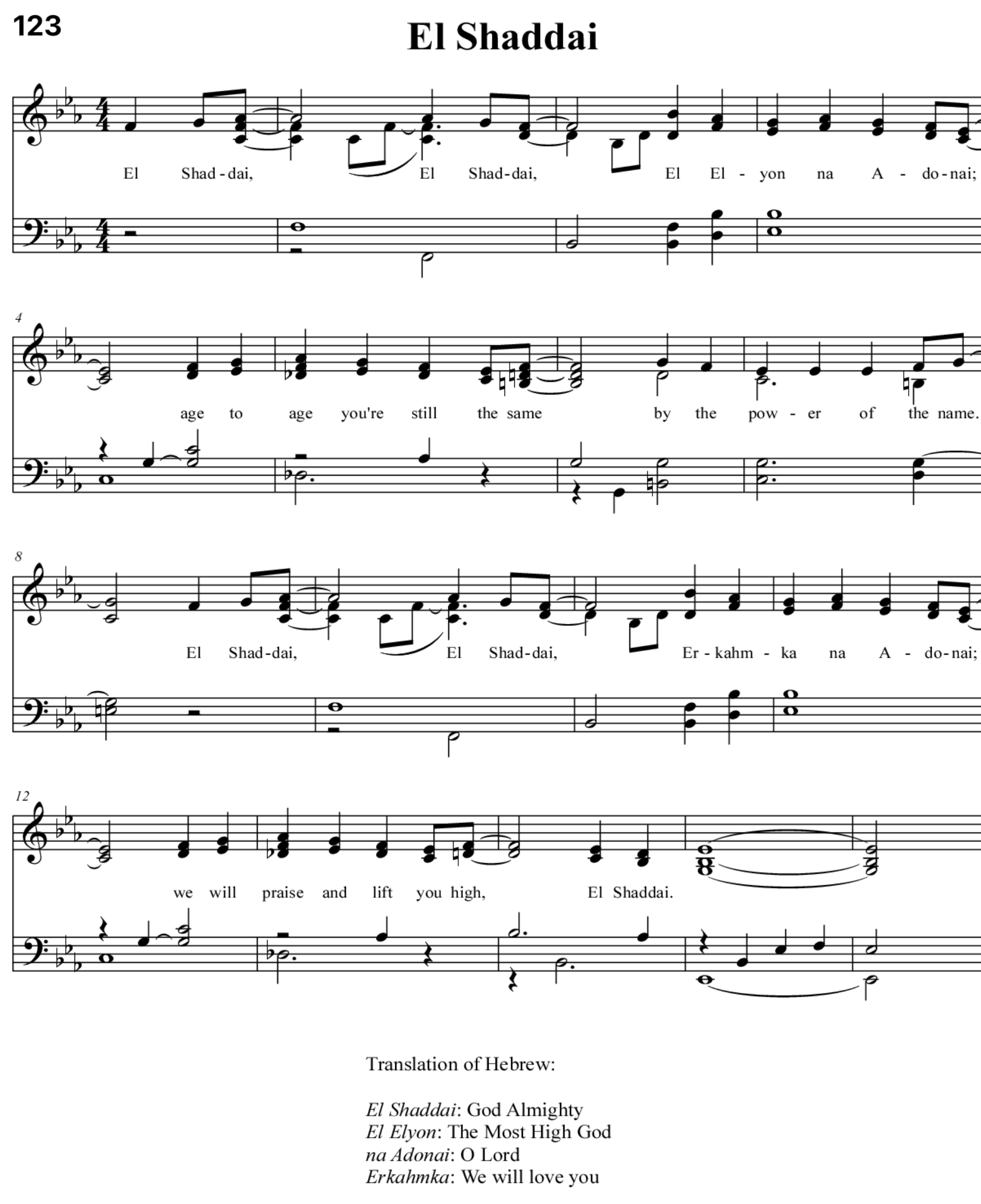
Sunday, February 4, 2024 the Pender Sanctuary Choir sang El Shaddai as arranged by Amy Grant and further arranged by Pender’s Director of Music Ministry, Patrick King.

During the Traditional Service on February 4, 2024, Pender’s sanctuary was imbued with the spiritual tapestry of song as the Sanctuary Choir, under the masterful direction of Patrick King, lifted their voices in a moving rendition of “El Shaddai.” This particular arrangement, a harmonious blend of Amy Grant’s touch and King’s unique vision, filled the sacred space with an aura of reverence and awe.

“El Shaddai,” a melody that draws its powerful lyrics from the scriptural portrayal of God, was first brought to life by Michael Card and John Thompson in the early ’80s. Michael Card, a profound scholar and artist, has woven his faith into over three decades of music, crafting hit after hit, with “El Shaddai” being one of his most renowned works. This song, in its essence, is a quest to capture the enigmatic nature of the divine through the ancient Hebrew names of God, each name a key to the unfathomable relationship between the Creator and His creation.

The Pender Sanctuary Choir’s performance was not just an offertory but a profound homage to the timeless quest of hymn writers throughout the ages—a quest to give voice to the voiceless wonder of the divine. As the choir sang, the congregation was transported through the annals of biblical history, from the covenant with Abraham and Isaac to the deliverance at the Red Sea, and finally to the Messianic prophecies fulfilled in Christ.

Michael Card, whose journey from the halls of Western Kentucky University to the honor of a doctorate from Philadelphia Biblical University, has always emphasized the importance of community and relationships in Christian growth. His storied career, marked by accolades such as the Dove Awards and millions of albums sold, is a testament to his commitment to exploring and expressing faith through music and writing.

As the last notes of “El Shaddai” resonated within the church walls, the profound and enduring impact of this piece, awarded the Dove Song of the Year in 1983, was felt by all present. It was a moment that transcended time, linking the congregation with the faithful of the past and the powerful biblical narratives that continue to inspire and guide. The day was a reminder that through music, the spirit of worship and the stories of sacred texts are ever alive, ever stirring the souls of those who seek to encounter the Almighty, the “El Shaddai.”

Biblical scholar J. Hampton Keathley III has described the context of the song:

“El Shaddai: God Almighty. The derivation is uncertain. Some think it stresses God’s loving supply and comfort; others His power as the Almighty one standing on a mountain and who corrects and chastens (Genesis 17:1; 28:3; 35:11; Exodus 6:31; Psalm 91:1, 2).

“El Elyon: The Most High God. Stresses God’s strength, sovereignty and supremacy (Genesis 14:19; Psalm. 9:2; Daniel 7:18, 22, 25).

“El Olam: The Everlasting God. Emphasizes God’s unchangeableness and is connected with His inexhaustibleness (Genesis 16:13).

“Yahweh (YHWH): Comes from a verb which means “to exist, be.” This, plus its usage, shows that this name stresses God as the independent and self-existent God of revelation and redemption (Genesis 4:3; Exodus 6:3 (cf. 3:14); 3:12).

The UM Hymnal contains only the refrain for the sake of space. The stanzas discuss God’s faithful acts as told in the biblical witness, including Abraham and Isaac, the parting of the waters during the Israelites’ deliverance from Egypt (stanza one) and the prophecies of the coming of the Messiah and the fulfillment of Christ’s mission (stanza two).

 
Leave a comment

Posted by on February 23, 2024 in Posts of Interest


Tags: , , , , , , , , , , , , , , , , , ,

Hymn History: God of Grace and God of Glory

“God of Grace and God of Glory”
Harry Emerson Fosdick
The United Methodist Hymnal, No. 577

God of grace and God of glory,
on thy people pour thy power;
crown thine ancient church’s story;
bring her bud to glorious flower.
Grant us wisdom, grant us courage,
for the facing of this hour.

Pender Opening Hymn “God of Grace and God of Glory” May 22, 2022 accompanied by flute and cello.

“God of grace and God of glory” was written in 1930 by Harry Emerson Fosdick (1878-1969) for the dedication of the famous Riverside Church in New York City.

Fosdick was granted degrees from Colgate University and Union Theological Seminary. He was ordained in 1903 to ministry in the Baptist Church and became pastor of First Baptist Church, Montclair, N.J.

Fosdick served as a chaplain during World War I and then was pastor of First Presbyterian Church in New York City. From this congregation he was called to pastor Park Avenue Baptist Church, which was renamed Riverside Church.

As we sing this hymn, perhaps it is helpful to remind ourselves of the events that shaped the “hour” and the “days” that provide the context for this great hymn.

“God of grace and God of glory” was written while the United States was in the throes of the Great Depression between the two World Wars. Fosdick was a champion of the social gospel, a movement that recognized the plight of the poor, especially in the urban Northeast during the Industrial Revolution.

UM Hymnal editor Carlton Young has noted: “Fosdick’s stirring radio sermons, books, and public pronouncements established Riverside as a forum for the critique of the same wealth and privilege whose gifts had made possible the building of the church.

“Under his leadership Riverside Church was interdenominational, interracial, without a creed, and, astonishingly for Baptists, required no specific mode of baptism. At the center of Fosdick’s ministry was urban social ministry.”

Fosdick was perhaps the most vocal proponent of the social gospel of his time—a position that brought both wide acclaim and broad disdain.

The congregation moved to a $5 million edifice made possible by a gift from John D. Rockefeller Jr. The new building overlooked the Hudson River in what Fosdick called “a less swank district” than Park Avenue, where the congregation had been located near Harlem.

The hymn was written in the summer of 1930. It took shape as he reflected on the construction of the new building, and was first sung as the processional hymn at the opening service on Oct. 5, 1930, and again at the dedication on Feb. 8, 1931.

The language of the hymn is ultimately that of petition. “Grant us wisdom, grant us courage” concludes each stanza with the effect of a refrain. A petition begins stanza three with “Cure thy children’s warring madness,/ bend our pride to thy control.” The final stanza, equally prophetic, begins with “Save us from weak resignation/ to the evils we deplore.”

Fosdick wrote the text to be sung to the stately REGENT SQUARE (usually sung to “Angels from the realms of glory”). Methodist hymnologist and hymnal editor Robert G. McCuthan, however, first paired it with the Welsh tune CWM RHONDDA for the 1935 Methodist Hymnal. It was an immediate success and the new coupling has been almost universally adopted.

Hymnologist William Reynolds says Fosdick disapproved strongly of the new pairing. When Dr. Young asked the poet why he continued to oppose the use of CWM RHONDDA with his text, Fosdick replied, “My views are well known—you Methodists have always been a bunch of wise guys.”

That discussion notwithstanding, I object to the tempo played by many organists who take the hymn much too fast at the beginning, forcing the congregation to race through the prophetic petitions that conclude each stanza. The Welsh tune demands an appropriately stately tempo (think “processional,” not “horse race”) that gives the congregation time to absorb the challenges offered by the poet.

Adapted from https://www.umcdiscipleship.org/resources/history-of-hymns-god-of-grace-and-god-of-glory


Tags: , , , , , , , , , ,

Why is the Easter season 50 days long?


Easter for Christians is not just one day, but rather a 50-day period. The season of Easter, or Eastertide, begins at sunset on the eve of Easter and ends on Pentecost, the day we celebrate the gift of the Holy Spirit and the birth of the Church (see Acts 2).

Easter is also more than just an extended celebration of the resurrection of Jesus. In the early church, Lent was a season for new converts to learn about the faith and prepare for baptism on Easter Sunday. The initial purpose of the 50-day Easter season was to continue the faith formation of new Christians.

Today, this extended season gives us time to rejoice and experience what it means when we say Christ is risen. It’s the season when we remember our baptisms and how through this sacrament we are, according to the liturgy, “incorporated into Christ’s mighty acts of salvation.” As “Easter people,” we also celebrate and ponder the birth of the Church and gifts of the Spirit (Pentecost), and how we are to live as faithful disciples of Christ.

From http://www.umc.org/what-we-believe/why-is-the-easter-season-fifty-days-long


Tags: , , , , ,

Hymn History: ‘It Is Well With My Soul’

The Pender UMC Traditional Service Middle Hymn “It is Well With My Soul” on Sunday November 13, 2022 was played by Liz Eunji Moon on piano, directed by Brian Stevenson and sung the Pender Sanctuary Choir and congregation.

The hymn “It Is Well With My Soul” was written by a successful Christian lawyer called Horatio Spafford.

His only son died at age 4 in 1871. That year, the Great Chicago Fire wiped out his vast estate, made from a successful legal career.

In 1873 he sent his wife Anna and four daughters over to Europe on a summer trip on the ill-fated SS Ville du Havre. Since he had a lot of work to do, he had planned to travel to England with his family on the SS Ville du Havre, to help with D. L. Moody’s upcoming evangelistic campaigns. In a late change of plan, he sent the family ahead while he was delayed on business concerning zoning problems following the Great Chicago Fire.

On November 22 the ship was struck by an iron sailing vessel killing 226 people, including all four of Spafford’s daughters: Annie, age 12; Maggie, 7; Bessie, 4; and an 18-month old baby. His wife survived the tragedy.

Upon arriving in England, she sent a telegram to Spafford that read “Saved alone.”

Shortly afterwards, as Spafford traveled to meet his grieving wife, he was inspired to write these words as his ship passed near where his daughters had died.;Bliss called his tune Ville du Havre, from the name of the stricken vessel.

It is Well With My Soul

  1. When peace, like a river, attendeth my way,
    When sorrows like sea billows roll;
    Whatever my lot, Thou hast taught me to say,
    It is well, it is well with my soul.

    • Refrain:
      It is well with my soul,
      It is well, it is well with my soul.
  2. Though Satan should buffet, though trials should come,
    Let this blest assurance control,
    That Christ hath regarded my helpless estate,
    And hath shed His own blood for my soul.
  3. My sin—oh, the bliss of this glorious thought!—
    My sin, not in part but the whole,
    Is nailed to the cross, and I bear it no more,
    Praise the Lord, praise the Lord, O my soul!
  4. For me, be it Christ, be it Christ hence to live:
    If Jordan above me shall roll,
    No pang shall be mine, for in death as in life
    Thou wilt whisper Thy peace to my soul.
  5. But, Lord, ’tis for Thee, for Thy coming we wait,
    The sky, not the grave, is our goal;
    Oh, trump of the angel! Oh, voice of the Lord!
    Blessed hope, blessed rest of my soul!
  6. And Lord, haste the day when the faith shall be sight,
    The clouds be rolled back as a scroll;
    The trump shall resound, and the Lord shall descend,
    Even so, it is well with my soul.
 

Tags: , , , , , , , , , , , , , , ,

Fun with Music


Step into a world of giggles and song with “Fun “with Music at Pender!  This is not just any music class – it’s a journey through sound and imagination designed especially for preschoolers and their favorite grown-ups. Since 2013, Jim and Roberta Pont have been creating a space where tiny toes tap, and little voices echo with joy, crafting a magical musical experience for children from birth to five years old.

Wave ‘hello’ and join us every Monday morning for a delightful 30-minute musical escapade! Our littlest musicians and their families come together at 10 AM to sing, dance, and make friends with tunes. We dive into a treasure trove of stuffed animals and toys, transforming the room into an enchanting stage for our budding performers. With every stuffed lion’s roar or elephant’s trumpet, your child’s imagination will soar!

After the musical fiesta, it’s time for a yummy snack, followed by playtime where kids can explore and make-believe. Meanwhile, moms, dads, grandparents, and caregivers can relish a homemade brunch prepared with love – a perfect chance to mingle and share stories.

Our box of wonders is always brimming with surprises! One day it’s a car zooming around, another day it’s a train chugging along. Flip it over and voilà, it’s a drum or even a rumbling thunder to match the beat of our songs. From “The Wheels on the Bus” to sparkling new Bible-based rhymes, we have tunes that will make your little one’s heart dance with every beat!

Last week, our pint-sized percussionists marched on bubble wrap to the rhythm of a march, popping and hopping with glee. And guess what’s next? A tunnel adventure awaits their curious little eyes and eager hands!

So, if you’re a parent with a playful tot between zero to five, and Monday mornings are open, come and make a splash in our sea of melodies at “Melody Mornings”. It’s not just fun; it’s a musical hug for the heart and soul. Can’t wait to sing and swing into a new day of joy with you and your little one!

 
Leave a comment

Posted by on February 2, 2024 in Ministries, Pender UMC, Videos


Tags: , , , , , , ,