RSS

Monthly Archives: June 2023

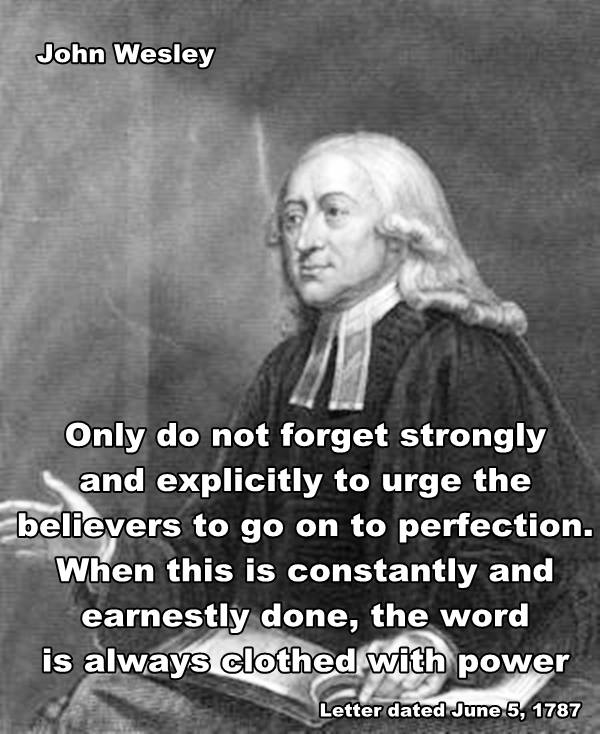
It’s John Wesley’s Birthday!

wesley-quote1787

A UMNS Commentary by the Rev. Robert J. Williams

As John Wesley, the founder of the Methodist movement, grew older, he frequently commented on his birthday how he was still in good health and this was largely due to the way God had blessed him.Wesley was born on June 17, 1703, while England was still using the Julian calendar. England adopted the Gregorian calendar in 1752 and thus Wesley’s birth date became June 28.His birthday reflections give us a glimpse into how he viewed his life, health and ministry. On June 28, 1770, he wrote:I can hardly believe that I am this entered into the sixty-eighth year of my age! How marvelous are the ways of God! How has he kept me, even from a child! From ten to thirteen or fourteen, I had little but bread to eat, and not great plenty of that. I believe this was so far from hurting me that it laid the foundation to lasting health. When I grew up, in consequence of reading Dr. Cheyne, I chose to eat sparingly and drink water. This was another great means of continuing my health, till I was about seven and twenty…; (He then speaks of various ailments.); Since that time, I have known neither pain nor sickness, and am now healthier than I was forty years ago! This hath God wrought!

He started to set a pattern for indicating his age and his good health. One year later, he wrote:

This day I entered the sixty-ninth year of my age. I am still a wonder to myself. My voice and strength are the same as at nine and twenty. This also hath God wrought.

In 1774, he wrote:

This being my birthday, the first day of my seventy-second year, I was considering. How is this, that I find just the same strength as I did thirty years ago? That my sight is considerably better now and my nerves firmer than there were then? That I have none of the infirmities of old age and have lost several I had in my youth? The grand cause is the good pleasure of God, who doth whatsoever pleaseth him. The chief means are: (1) My constantly rising at four, for about fifty years. (2) My generally preaching at five in the morning, one of the most healthy exercises in the world. (3) My never travelling less, by sea or land, than four thousand five hundred miles in a year.

In the intervening 10 years, he repeated these sentiments numerous times, and even in 1784, he wrote:

Today I entered on my eighty-second year and found myself just as strong to labour, and as fit for any exercise of body or mind, as I was forty years ago. I do not impute this to second causes, but to the sovereign Lord of all…; I am as strong at eighty-one, as I was at twenty-one, but abundantly more healthy, being a stranger to the head-ache, tooth-ache, and other bodily disorders which attended me in my youth. We can only say ‘The Lord reigneth’ While we live, let us live to him!

In 1788, after praising God “for a thousand spiritual blessings,” Wesley listed as questions what may be some of the “inferior means” for achieving such good health into old age.

To my constant exercise and change of air? To my never having lost a night’s sleep, sick or well at land or at sea, since I was born? To my having sleep at command, so that whenever I feel myself almost worn out, I call it and it comes, day or night? To my having constantly, for above sixty years, risen at four in the morning? To my constant preaching at five in the morning for above fifty years? To my having had so little pain in my life and so little sorrow or anxious care?

Finally, on June 28, 1790, less than a year before his death, he wrote:

This day I enter into my eighty-eighth year. For above eighty-six years, I found none of the infirmities of old age: my eyes did not wax dim, neither was my natural strength abated. But last August, I found almost a sudden change. My eyes were so dim that no glasses would help me. My strength likewise now quite forsook me and probably will not return in this world. But I feel no pain from head to foot, only it seems nature is exhausted and, humanly speaking, will sink more and more, till ‘The weary springs of life stand still at last.’

As this remarkable man aged, he reflected on God’s blessings and how his lifestyle contributed to his good health. This is but a brief glimpse into his humanity and can call on us to do likewise on our birthdays.

Editor’s Note: This story was first published on June 25, 2012.

*Williams is the top executive of the United Methodist Commission on Archives and History in Madison, N.J.

From http://www.umc.org/news-and-media/marking-john-wesleys-birthday-in-his-words


Leave a comment

Posted by on June 28, 2023 in Posts of Interest


Tags: , ,

All about Liturgical Colors

  • Purple, representing both royalty and penitence, is traditionally used during Advent and Lent.
  • Blue symbolizes hope and may also be used during Advent.
  • White and gold are used at Christmas and Easter to symbolize joy and festivities.
  • Red symbolizes the color of fire to represent the Holy Spirit on the Day of Pentecost and times when the work of the Holy Spirit is emphasized. During Holy Week it represents the blood of Christ. Red is also used for ordinations, church anniversaries and civil observances such as Memorial Day and Thanksgiving.
  • Green represents growth and is used during Ordinary Time (the season after Epiphany and the season after Pentecost.)

Let’s start with a word about liturgical colors. You can see listed here that the official color of the long season of Ordinary Time is green. This makes sense for lots of reasons: Ordinary Time is about growing in our faith, about accepting the gifts that we’ve been given, and producing the fruit not just as individual Christians but as the body of Christ. Green is the color of growth and of fruitfulness. There are other reasons why the season claims the color green. Perhaps you and your team can come up with some more and use them to inform the congregation who may never have given thought to why the green paraments are used throughout this season.

We started here, however, because there are those who get bored with a single color in this long season that runs from Pentecost through Reign of Christ/Christ the King Sunday at the end of November. There are so many colors, so much beauty in worship art and God’s creation, why use only one color for this long season? Isn’t this the season after Pentecost? Why can’t we use red for at least a part of the season?

The season of Ordinary Time (or the Sundays after Pentecost—there is no “Pentecost Season”) calls for creativity and artistry. Even if you are using green as a foundational color, there is no reason why you can’t bring in a host of other colors over the season. Green represents life, and life is colorful. So, use more colors; use both/and; use a whole palette of colors to bring to life the worship in Ordinary Time. Think ahead for changing series or themes and find ways to enhance the liturgy with visual expressions of color, not just in paraments, but in banners, worship centers, projected or posted images, and colors. There are ways to move beyond the plain green altar or pulpit fall. Call on artists of all sorts to enhance the space.

Adapted from https://www.umcdiscipleship.org/worship-planning/living-the-spirit-life/second-sunday-after-pentecost-year-c-lectionary-planning-notes

Chuck Knows Church — Episode 1 – LITURGICAL COLORS. Ever walk into your Sunday morning worship service and realize the colors have changed around the sanctuary? That’s why Chuck is talking about Liturgical Colors on his FIRST SHOW!


Tags: , , , , , , , , , , , , , , , , , , , , , ,

Hymn History: When in Our Music God Is Glorified

“When in Our Music God Is Glorified”
Fred Pratt Green
UM Hymnal, No. 68

“When in Our Music God is Glorified” was the opening hymn at Pender’s Music Appreciation Sunday on June 11, 2023 It was sung by Pender’s congregation, accompanied on piano by Heidi Jacobs and directed by Brian Stevenson.


“When in Our Music God Is Glorified” was played by Pender’s pianist-organist, Liz Eunji Moon at the Traditional Service Postlude on September 11, 2022

Sometimes a great tune can keep a hymn text alive. Sometimes a great text can revive a neglected tune. The latter is true in this case.

Noted British hymnologist John Wilson (1905-1992) suggested that the Methodist poet and hymn writer Fred Pratt Green write a text to the tune ENGELBERG, composed in 1904 by the famous British composer Charles Villiers Stanford (1852-1924).

Stanford’s tune had been well-known in the earlier 20th century until Ralph Vaughan Williams (1872-1958) composed the immensely popular SINE NOMINE in the same metre (sung to “For All the Saints”) for the English Hymnal (1906).

Hymnologist J.R. Watson records that “Wilson urged Pratt Green to write a text for a Festival of Praise . . . which could be sung to Stanford’s neglected tune.” Pratt Green based his text on Psalm 150 but alluded to Mark 14:26 in stanza four of the hymn, a stanza recalling the hymn sung by the disciples at the Last Supper.

The hymn, composed in 1972, first appeared in New Church Praise (1975) and in the single-author collection The Hymns and Ballads of Fred Pratt Green (1982) with the title, “Let the People Sing!”

The opening line (called the incipit) originally read, “When in man’s music, God is glorified. . . .” Pratt Green reluctantly altered this to the current title for the Lutheran Book of Worship (1978) and this change has universally been accepted in North American hymnals.

The Rev. Carlton Young, editor of the UM Hymnal, notes that the change in text, though an important “social witness” in the area of inclusive language, weakens the theological and aesthetic qualities of the hymn: 1) Theologically, “the change tends to weaken the affirmation that mere mortal musicians and their music may and often do glorify God”; 2) aesthetically, the wonderful alliteration between “man’s” and “music” paralleled by “God’s” and “glorified” is lost.

Dr. Young speculates that this “text has probably been set in anthem form more than any other of the late twentieth century.”

Ministry of music

This hymn is groundbreaking in many ways.

There are numerous examples in the history of hymnody where music is a metaphor for some theological theme or experience. In Babcock’s “This Is My Father’s World,” for example, “all nature sings and round me rings the music of the spheres.” Charles Wesley speaks of “the music of the heart” in his paraphrase of Psalm 150, “Praise the Lord Who Reigns Above.”

However, Pratt Green uses music not just as a metaphor that points us to another idea, but explores music-making as a phenomenon in the Christian’s experience in its own right. The second stanza concludes with the marvelous thought that “making music . . . move[s] us to a more profound Alleluia!”

In this way, Pratt Green seems to agree with Martin Luther who said, “Next to the Word of God, the noble art of music is the greatest treasure in the world.” Luther and Pratt Green seem to ascribe a quasi-sacramental quality to music—music as a means of revelation and grace.

Pratt Green (1903-2000) was born in Roby just outside of Liverpool, England. Following his education, he was ordained in 1924 as a Methodist minister and served in various parishes throughout England well into the 1940s. Although he had a long interest in poetry, he did not focus on hymn writing until his retirement from active ministry.

Eminent British hymnologist Erik Routley (1917-1982) suggested that in Fred Pratt Green, Methodists finally had a successor to Charles Wesley.

* Words by Fred Pratt Green © 1972 Hope Publishing Company; Carol Stream, IL 60188. All rights reserved. Used by permission.

Dr. Hawn is professor of sacred music at Perkins School of Theology, SMU.

Adapted from https://www.umcdiscipleship.org/resources/history-of-hymns-when-in-our-music-god-is-glorified

 
Leave a comment

Posted by on June 26, 2023 in Hymn History, hymns, Posts of Interest, Videos


Tags: , , , , , , , , ,

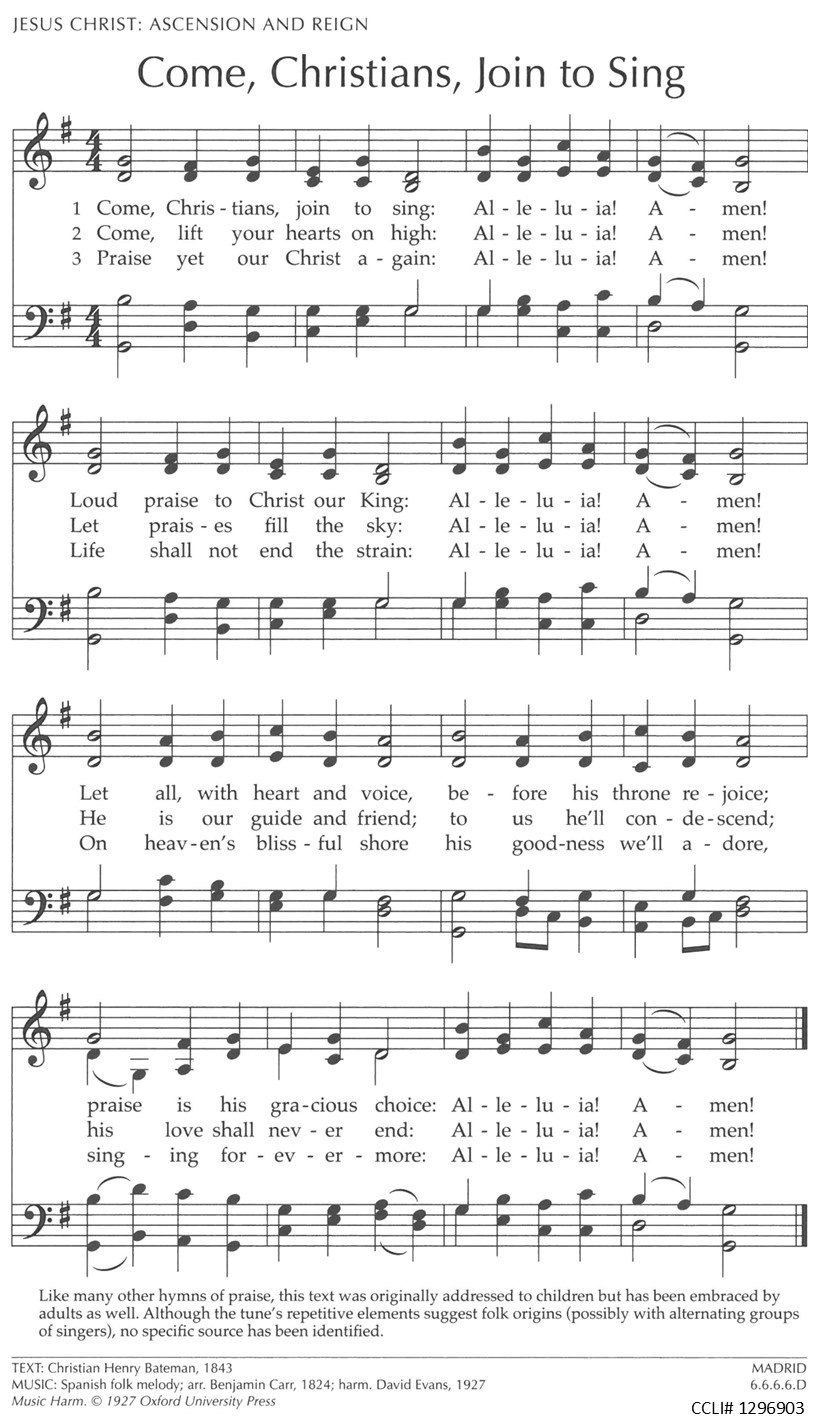
Hymn History: Come, Christians, Join to Sing


“Come, Christians, Join to Sing” was the closing hymn at Pender’s Music Appreciation Sunday on June 11, 2023. It was sung by Pender’s congregation and Sanctuary Choir, accompanied on piano by Heidi Jacobs and combined handbell choirs (Joy and Carillon Ringers) directed by Brian Stevenson.

“Come, Christians, Join to Sing” was the opening hymn at Pender’s Traditional Service on May 29, 2022. It was accompanied by piano (Liz Sellers) and organ (Brian Stevenson).

“Come, Christians, Join to Sing”
Christian Henry Bateman
UM Hymnal, No. 158

Come, Christians, join to sing:
Alleluia! Amen!
loud praise to Christ our King:
Alleluia! Amen!
Let all, with heart and voice,
before his throne rejoice;
praise is his gracious choice.
Alleluia! Amen!

Christian Henry Bateman (1813-1899) was ordained into the Church of England after being a Congregational minister.

His ministerial studies were under the auspices of the Moravian Church, where he served for a time before changing to the Congregational Church at age 30. Following his ministry at Richmond Place Congregational Church in Edinburgh, Scotland, and successive Congregational parishes in Hopton, Yorkshire, and Reading, Berkshire, he took Holy Orders in the Anglican Church at age 56 and served as a curate and vicar in several Anglican parishes.

Australian hymnologist Wesley Milgate (1916-1999) noted that Bateman’s hymn is actually a rewritten version of the hymn “Join Now in Praise, and Sing” by William Edward Hickson (1803-1870). Hickson’s text uses the same melody, MADRID (SPANISH HYMN), and is structured in much the same way. Compare Bateman’s text at the beginning of this article with the first stanza of Hickson’s hymn:

Join now in praise, and sing
Hallelujah, Amen!
Praise to our heavenly King,
Hallelujah, Amen!
By love and gratitude
Still be the song renewed,
And be our hearts subdued,
Hallelujah, Amen!

Bateman probably found the earlier hymn in the collection Hickson published, Singing Master (1836). Hickson’s five stanzas were reduced to three by Bateman and first appeared in a collection published in Edinburgh, Sacred Melodies for Children (1843). The original “Hallelujah, Amen!” was changed by the Presbyterian Church in the U.S.A., in their 1933 hymnal, to “Alleluia! Amen!” It has remained that way ever since.

Each stanza begins with an exhortation—an imperative command to “Come” or “Praise.” In stanza one, Bateman provides the children with the reason for singing: We offer “loud praise to Christ our King . . . before his throne. . . .” Christ desires our praise: “praise is his gracious choice. . . .”The original incipit (opening line of the hymn) was “Come, children, join to sing.” Though changed in the Presbyterian hymnal to include all age groups, Bateman’s text contains direct, uncomplicated language suited for children. Since very few of the words have more than two syllables and “Alleluia! Amen!” is interjected three times in each stanza, the hymn is easy for children to learn and sing.

Stanza two reassures the children (and all of us) that this King is also “our guide and friend” and that “his love shall never end.” This King will “condescend” to be a friend to the children. To condescend surely did not mean to patronize as it tends to mean today, but implies that Christ the King humbles himself to be in a personal relationship with us.

Stanza three ends on an eschatological note. The author reassures children that they need not fear death. Beyond life, our songs will continue on “heaven’s blissful shore . . . singing forevermore: Alleluia! Amen!”

Dr. Hawn is professor of sacred music at Perkins School of Theology.

Adapted from https://www.umcdiscipleship.org/resources/history-of-hymns-come-christians-join-to-sing


Tags: , , , , , , , , , , ,

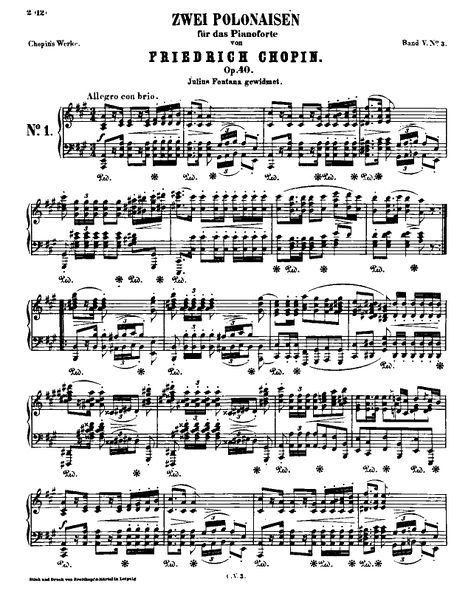
Chopin Military Polonaise Opus 40 No. 1 in A Major

During the Postlude at Pender UMC’s Traditional Service on June 11, 2023, we were treated to “Military Polonaise Op. 40 No. 1 in A Major”  by Frédéric Chopin played by Heidi Jacobs.

The Polonaise no. 1 in A major, often nicknamed Military, has been described as a symbol of ‘Polish Glory’: it is almost entirely played forte or louder, which makes for a bombastic performance.

 
Leave a comment

Posted by on June 21, 2023 in Music, Pender UMC, Videos


Tags: , , ,