“Love Divine All Loves Excelling was the opening hymn at Pender’s 9:00 am Traditional Service on July 23, 2023 It was sung by Pender’s congregation, accompanied on piano by Heidi Jacobs and flute by Brian Stevenson.
The Pender UMC Traditional Service Opening Hymn “Love Divine, All Loves Excelling” on Sunday June 26, 2022 was accompanied by Liz Sellers on piano and sung by the Pender Congregation.
“Love Divine, All Loves Excelling”
Charles Wesley UM Hymnal, No. 384
Love divine, all loves excelling,
joy of heaven to earth come down;
fix in us thy humble dwelling;
all thy faithful mercies crown!
Jesus, thou art all compassion,
pure, unbounded love thou art;
visit us with thy salvation;
enter every trembling heart.
Charles Wesley (1707-1788) was a prolific hymn writer of the 18th century. Coming from a musical family, he left a lasting legacy of congregational song.
The youngest of 18 children, Charles possessed prodigious talents that soon blossomed. Little did he know that “Love Divine, All Loves Excelling,” would rise to become one of the most popular and consistently vocalized Christian songs.
Writing hymn texts that are solidly based on the Scriptures gives them an appeal across denominational lines. It is estimated that during his lifetime, Wesley penned more than 9,000 poems of a spiritual nature, 6,000 of which are hymns. His writings were passionate and well-crafted, conveying the true essence of Christian teaching.
For Pentecost May 28, 2023, Pender’s choir sang Come Thou Fount directed by Brian Stevenson and accompanied on piano by Heidi Jacobs.
The Pender UMC Traditional Service Opening Hymn “Come, Thou Fount of Every Blessing” on Music Appreciation Sunday June 12, 2022 was accompanied by Liz Sellers on piano, Brian Stevenson on Irish whistle, AJ Rios on drums and sung by the Pender Sanctuary Choir and Congregation.
Perhaps all hymns are to some extent autobiographical in that they reveal something of the author’s spiritual experience. In some hymns, the autobiographical thread is stronger and more obvious. Such is the case with British Baptist hymn writer Robert Robinson (1735-1790), who as a barber’s apprentice, fell under the powerful influence of George Whitefield’s preaching.
A favorite line in the last stanza, “Prone to wander, Lord, I feel it, prone to leave the God I love,” is thought to be particularly autobiographical, referring to Robinson’s early life, when his mother sent him to London to be an apprentice. It was during this time, according to hymnologist Kenneth Osbeck, that “he associated with a notorious gang of hoodlums and lived a debauched life” until he came under the spell of Whitefield.
After his conversion in 1755, Robinson first preached at a Calvinistic Methodist chapel at Mildenhall, Suffolk, and then founded his own independent congregation at Norwich. He was re-baptized in 1759 after taking up Baptist theological perspectives.
This led to his nearly 30-year relationship (1761-1790) as pastor of Stone Yard Baptist Church at Cambridge. Baptist hymnologist William Reynolds notes that Robinson “was an unusual man, and, while lacking formal education, he rose to great prominence as a preacher, scholar.” Robinson published A History of Baptism in 1790.
“Come, thou Fount of every blessing,” written in 1758, was the first hymn in A Collection of Hymns for the use of the Church of Christ, Meeting in Angel-Alley, Whitechappel . . . (1759). Martin Madan included the first three stanzas in his Collection of Psalms and Hymns (1760), which established the practice of eliminating the original fourth stanza.
UM Hymnal editor Carlton Young laments the omission, saying it “eliminates the apocalyptic climax of the author’s invitatory prayer to the Holy Spirit.”
The missing stanza follows:
O that Day when freed from sinning,
I shall see thy lovely Face;
Clothed then in blood-washed Linnen [sic]
How I’ll sing thy sovereign grace;
Come, my Lord, no longer tarry,
Take my ransom’d Soul away;
Send thine Angels now to carry
Me to realms of endless Day.
One of the most obvious biblical allusions appears in stanza two: “Here I raise mine Ebenezer/ hither by thy help I’m come.” The Hymnal Revision Committee for the 1989 United Methodist Hymnal received requests to alter this stanza by omitting the term “Ebenezer,” which means “Stone of Help,” a reference to 1 Samuel 7:12: “Then Samuel took a stone and set it up between Mizpah and Jeshanah, and named it Ebenezer; for he said, ‘Thus far the Lord has helped us.’” But not finding a suitable substitute, the Committee chose to maintain the original language.
On this side of the Atlantic, the tune NETTLETON has been the most common but not exclusive musical setting for this famous and well-loved text. NETTLETON first appeared in John Wyeth’s Repository of Sacred Music, Part Second (1813).
“Grace Greater Than Our Sin” was the final hymn at Pender’s 9:00 am Traditional Service on June 18, 2023 It was sung by Pender’s congregation, accompanied on piano by Heidi Jacobs and guitar by Brian Stevenson.
The Pender UMC Traditional Service Closing Hymn “Grace Greater than All my Sin” on Music Appreciation Sunday June 12, 2022 was accompanied by Liz Sellers on piano, Brian Stevenson on Irish whistle, AJ Rios on drums and sung by the Pender Sanctuary Choir and Congregation.
“Grace Greater than Our Sin”
Julia H. Johnston The UM Hymnal, No. 365
Marvelous grace of our loving Lord,
Grace that exceeds our sin and our guilt!
Yonder on Calvary’s mount outpoured,
There where the blood of the Lamb was spilt.
Grace, grace, God’s grace,
Grace that will pardon and cleanse within;
Grace, grace, God’s grace,
Grace that is greater than all our sin!
Julia Harriette Johnston (1849-1919) was the daughter of a Presbyterian minister who served First Presbyterian Church, Peoria, Ill. She lived in Peoria from age 6.
Johnston was faithful to the ministries of the church, serving as a Sunday school superintendent and teacher for 41 years. She was also president for two decades of the Presbyterian Missionary Society, an organization founded by her mother.
She authored several books including Indian and Spanish Neighbors (1905) and Fifty Missionary Heroes (1913). In addition to many Sunday school lessons, she also wrote about 500 hymn texts; today her reputation rests primarily upon the hymn “Grace Greater than Our Sin.”
The writer contrasts the theme of God’s abundant grace—manifest through the sacrifice of Christ on the cross—with “our sin and our guilt” (stanza one), “sin and despair” (stanza two), and a “dark . . . stain” (stanza three).
This “marvelous, infinite, matchless grace, freely bestowed on all who believe,” finds a scriptural basis in Paul’s teaching of justification by faith in Romans 5:1-2: “Therefore being justified by faith, we have peace with God through our Lord Jesus Christ: By whom also we have access by faith into this grace wherein we stand, and rejoice in hope of the glory of God.”
Paul continues in verses 14-16, “Nevertheless death reigned from Adam to Moses, even over them that had not sinned after the similitude of Adam’s transgression, who is the figure of him that was to come. But not as the offence, so also is the free gift of grace. For if through the offence of one many be dead, much more the grace of God, and the gift by grace, which is by one man, Jesus Christ, hath abounded unto many. And not as it was by one that sinned, so is the gift: for the judgment was by one to condemnation, but the free gift is of many offences unto justification.”
The text and tune of the hymn first appeared in Hymns Tried and True, a 1911 collection by composer Daniel B. Towner (1850-1919). According to UM Hymnal editor Carlton Young, Towner was “a distinguished Methodist musician.” He studied first with his father and then with famous gospel song composers such as George Root and George Webb.
Towner then served in Methodist Episcopal churches in New York, Ohio and Kentucky. In 1893 he was named head of the music department at Moody Bible Institute in Chicago, working with the famous evangelist Dwight L. Moody. Dr. Young notes that Towner “composed over 2,000 songs and was associated with the publication of fourteen collections.”
Baptist hymnologist William J. Reynolds noted that the name MOODY was given to this tune in recognition of Towner’s association with and service to Moody Bible Institute and its founder.
Dr. Hawn is professor of sacred music at Perkins School of Theology, SMU.
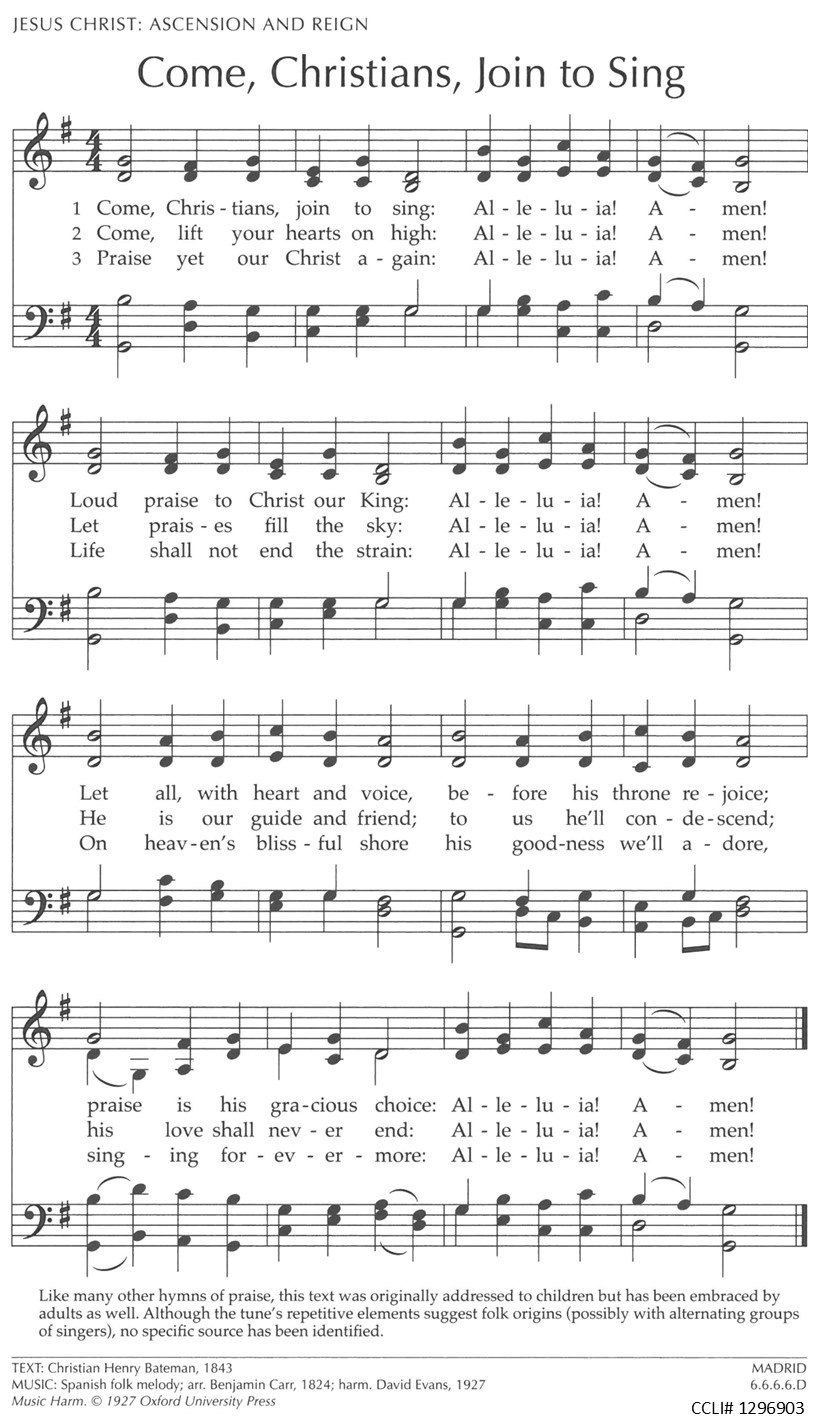
“Come, Christians, Join to Sing” was the closing hymn at Pender’s Music Appreciation Sunday on June 11, 2023. It was sung by Pender’s congregation and Sanctuary Choir, accompanied on piano by Heidi Jacobs and combined handbell choirs (Joy and Carillon Ringers) directed by Brian Stevenson.
“Come, Christians, Join to Sing” was the opening hymn at Pender’s Traditional Service on May 29, 2022. It was accompanied by piano (Liz Sellers) and organ (Brian Stevenson).
“Come, Christians, Join to Sing”
Christian Henry Bateman UM Hymnal, No. 158
Come, Christians, join to sing:
Alleluia! Amen!
loud praise to Christ our King:
Alleluia! Amen!
Let all, with heart and voice,
before his throne rejoice;
praise is his gracious choice.
Alleluia! Amen!
Christian Henry Bateman (1813-1899) was ordained into the Church of England after being a Congregational minister.
His ministerial studies were under the auspices of the Moravian Church, where he served for a time before changing to the Congregational Church at age 30. Following his ministry at Richmond Place Congregational Church in Edinburgh, Scotland, and successive Congregational parishes in Hopton, Yorkshire, and Reading, Berkshire, he took Holy Orders in the Anglican Church at age 56 and served as a curate and vicar in several Anglican parishes.
Australian hymnologist Wesley Milgate (1916-1999) noted that Bateman’s hymn is actually a rewritten version of the hymn “Join Now in Praise, and Sing” by William Edward Hickson (1803-1870). Hickson’s text uses the same melody, MADRID (SPANISH HYMN), and is structured in much the same way. Compare Bateman’s text at the beginning of this article with the first stanza of Hickson’s hymn:
Join now in praise, and sing
Hallelujah, Amen!
Praise to our heavenly King,
Hallelujah, Amen!
By love and gratitude
Still be the song renewed,
And be our hearts subdued,
Hallelujah, Amen!
Bateman probably found the earlier hymn in the collection Hickson published, Singing Master (1836). Hickson’s five stanzas were reduced to three by Bateman and first appeared in a collection published in Edinburgh, Sacred Melodies for Children (1843). The original “Hallelujah, Amen!” was changed by the Presbyterian Church in the U.S.A., in their 1933 hymnal, to “Alleluia! Amen!” It has remained that way ever since.
Each stanza begins with an exhortation—an imperative command to “Come” or “Praise.” In stanza one, Bateman provides the children with the reason for singing: We offer “loud praise to Christ our King . . . before his throne. . . .” Christ desires our praise: “praise is his gracious choice. . . .”The original incipit (opening line of the hymn) was “Come, children, join to sing.” Though changed in the Presbyterian hymnal to include all age groups, Bateman’s text contains direct, uncomplicated language suited for children. Since very few of the words have more than two syllables and “Alleluia! Amen!” is interjected three times in each stanza, the hymn is easy for children to learn and sing.
Stanza two reassures the children (and all of us) that this King is also “our guide and friend” and that “his love shall never end.” This King will “condescend” to be a friend to the children. To condescend surely did not mean to patronize as it tends to mean today, but implies that Christ the King humbles himself to be in a personal relationship with us.
Stanza three ends on an eschatological note. The author reassures children that they need not fear death. Beyond life, our songs will continue on “heaven’s blissful shore . . . singing forevermore: Alleluia! Amen!”
Dr. Hawn is professor of sacred music at Perkins School of Theology.
Pender’s current Doxology is “Praise God, from Whom All Blessings Flow”.
On May 28, 2023, Pender Pianist, Heidi Jacobs played a prelude which incorporated the Doxology into a medley of hymns.
In general usage, the Doxology is a short statement of praise, glory, and thanksgiving to God. It is often a short hymn designed to be sung by the worshiping congregation. Pender sings it to give thanks after the offering.
Chuck Knows Church — Doxology.
Chuck sings! Kinda. Bet you can’t guess the name of the most played piece of music in Protestant churches each Sunday? You looked at the title of this episode, didn’t you?
Chuck sings and explains on this his show!
“Praise God, from Whom All Blessings Flow”
by Thomas Ken The United Methodist Hymnal, 95
Praise God, from whom all blessings flow; Praise him, all creatures here below; Praise him above, ye heav’nly host; Praise Father, Son, and Holy Ghost.
Born in Hertfordshire, Bishop Thomas Ken (1637–1711) was orphaned as a child and raised by his sister Anna and her husband Izaak Walton. They enrolled him in the all-boys school at Winchester College (1651–1656). After his education there, he attended Hart Hall, Oxford, and New College, Oxford (B.A., 1661, M.A., 1664).
Ken was ordained as an Anglican priest in 1662, serving as rector to several parishes and as a chaplain to Princess Mary of Orange (1679–80), King Charles II (1683), and the Tangier Expedition (1683–84). In 1685, he was appointed Bishop of Bath and Wells. During the reign of King James II, he was imprisoned in the Tower of London for refusing to sign the Declaration of Indulgence (1687), a decree designed to promote the king’s Catholic faith. Ken was acquitted of the charge. When, however, King William III ascended to the throne, Ken refused to swear loyalty to him and resigned his office, living the rest of his life at the home of his friend, Lord Weymouth, at Longleat, Wilshire (Doyle, Canterbury Dictionary, n.p.).
The original date of composition by Ken for the text of “Praise God from Whom All Blessings Flow” is unknown. The first mention of the hymn is in 1674 as the presumed final stanza of two longer hymns: “Awake, My Soul and with the Sun” and “Glory to Thee, My God, this Night.” These two hymns were referenced along with a third as Morning, Evening and Midnight Hymns in a later edition of a pamphlet written for his students titled A Manual of Prayers for the Use of the Scholars of Winchester College (1695). The following directive is from the first edition:
. . . be sure to sing the Morning and Evening Hymn in your chamber devoutly, remembering that the Psalmist, upon happy experience, assures you that it is a good thing to tell of the loving kindness of the Lord early in the morning and of his truth in the night season (Ken, 1675, n.p.).
This directive is most often interpreted to mean that the hymns were meant for private devotion, not the gathered assembly, and yet these four lines, often referred to as The Lesser Doxology, have “been sung more often than any other lines ever written” (Gealy, 1993, 200). The hymn texts were published later as an appendix in his 1695 pamphlet as “revised” versions.
Much of the beauty of these four lines lies in its reflection of the joyous outbursts of the psalms. Here we see both the “host” of heaven and the “creatures here below” of earth praising God as in Psalm 96:11-12a and the final jubilant line of Psalm 150:6:
Let the heavens be glad, and let the earth rejoice;
let the sea roar, and all that fills it;
let the field exult, and everything in it. (Psalm 96: 11-12a, NRSV)
Let everything that breathes praise the Lord!
Praise the Lord! (Psalm 150:6, NRSV)
Commonly called “The Doxology,” Ken’s acclamation of praise is actually one of many doxological declarations that appear in many hymns, often in final stanza. See, for example, the last stanzas of the fourth-century hymn “Of the Father’s Love Begotten,” William Draper’s versification (c. 1919) of a thirteenth-century poem by Francis of Assisi, “All Creatures of Our God and King,” and Catherine Winkworth’s translation (1858) of Lutheran pastor Martin Rinkart’s “Now Thank We All Our God” (1647). Though less common now, the pattern for many mainline Protestant congregations has been to sing another doxological acclamation, the “Gloria Patri,” earlier in a worship service, and Ken’s stanza at the time of the offertory. Of note is the cosmic character of Ken’s praise—“all creatures here below” and “above ye heavenly hosts”—calling on the entire cosmos to praise God.
The Trinitarian structure of Ken’s hymn has also led to its common liturgical use. The first line describes the person of God the Father as the source of all blessings (Ephesians 1:3; 2 Corinthians 1:3). The second line, though, speaks to God the Spirit through whom all creatures praise God (Psalm 104:24-30; 1 Corinthians 2:10-13). The third line points to God the Son, who is begotten of the Father, firstborn of heaven and superior to angels and the heavenly host (Hebrews 1:4). The fourth line summarizes the stanza and all of praise in general, since all praise is directed toward God, Father, Son, and Holy Spirit.
The United Methodist Hymnal pairs this text with the hymn tune OLD 100th, which is attributed to John Calvin’s composer, Louis Bourgeois (c. 1510–1559). The first two lines of Ken’s text were later adapted with additional inclusive words by United Methodist pastor Gilbert H. Vieira (b. 1926) to be sung with LASST UNS ERFREUEN from Ausserlesene Catholische, Kirchengesänge (1623), harmonized by Ralph Vaughan Williams. Pastor Vieira’s use of inclusive language reflects his continuing strong stands for inclusive and carefully chosen language (see Vieira, 2020, n.p.).
The hymn tune MORNING HYMN was composed by François Hippolyte Barthélémon (1741–1808) for the text of “Awake, My Soul, and With the Sun.” The appropriateness of the tune works well for this final stanza, where the words of the second phrase, “Praise him, all creatures here below,” are sung by descending stepwise through an entire scale. The third phrase, “Praise him above, ye heav’nly host,” is sung through a similar ascension that returns to the highest note of the tune in the final stanza, acknowledging the Trinitarian nature of God. Sheila Doyle comments on the hymn text saying, “The language is simple and precise, and the opening images of light and rising up, appropriate to morning, pervade the hymn and convey a powerful sense of renewal and aspiration” (Doyle, “Awake, My Soul,” n.p.).
Fred D. Gealy, Research Files for the 1970 Companion to the Hymnal [1966] quoted in Young, Carlton R. Companion to the United Methodist Hymnal (Nashville, TN: Abingdon Press, 1993), 200.
Thomas Ken, A Manual of Prayers for the Use of the Scholars of Winchester College
(London: Printed for John Martyn, 1675), http://anglicanhistory.org/ken/manual.html (accessed September 27, 2020).




 News and Views