RSS

Category Archives: Pender UMC

Hymn History: Savior, Like a Shepherd Lead Us

Savior, Like a Shepherd Lead Us
attributed to Dorothy A. Thrupp;
The United Methodist Hymnal, No. 381

Savior, like a shepherd lead us,
much we need thy tender care;
in thy pleasant pastures feed us,
for our use thy folds prepare.
Blessed Jesus, blessed Jesus!
Thou hast bought us, thine we are.

The Pender UMC Traditional Service Middle Hymn “Savior Like a Shepherd Lead Us” on Sunday September 11, 2022 was played by Liz Eunji Moon on piano, accompanied on guitar by Brian Stevenson and sung the Pender Sanctuary Choir and congregation.

“Savior, Like a Shepherd Lead Us,” attributed to Englishwoman Dorothy A. Thrupp (1779-1847), is found in almost every Christian hymnal. According to the hymnology website, www.hymnary.org, “Savior, Like a Shepherd Lead Us” appears in 1005 hymnals. It is one hymn that most church members can recognize across denominational lines. What may surprise most churchgoers to know, however, is that for such a well-known and loved hymn of the Christian faith, we know little about how it was written or who the true author was. Its past aside, however, we see that whoever penned these words had a deeply theological message to share.

The mystery of the authorship of the words goes back to the 1830s, when the hymn made its first appearances in Thrupp’s Hymns for the Young (c. 1830) and the Fourth Edition in 1836, but without attribution. Rev. William Carus Wilson published a magazine titled The Children’s Friend (June 1838) and ascribed the poem to “Lyte,” possibly Henry Francis Lyte (1793-1847). British hymnologist J. R. Watson notes, “The authorship remains in doubt; all that can be added is that a stylistic analysis of the vocabulary, rhythm and content would suggest that Thrupp, rather than Henry Francis Lyte, was the author” (Canterbury Dictionary).

The penned words were directly applied to children, and the anonymous writer obviously meant to use this four-stanza hymn for teaching. It was more than twenty years later that the tune we presently know was composed by the American musician William Bradbury (1816-1868). His tune, named after himself, has most often been associated with this text, except in the case of the Episcopalian tradition that paired the text with the tune SICIILIAN MARINERS. When Bradbury composed this tune, however, he modified the original words meant for children and broadened the meaning to include all the congregation. Then, with some modernizing of the language, the text was standardized as it appears today. Since about 1830, the hymn has remained largely untouched. In fact, when the Methodist Book of Hymns shortened the refrain in 1966, the publisher received so many complaints, the full Bradbury version was put back into The United Methodist Hymnal (1989).

One has to wonder why this hymn has been so successful for nearly two hundred years. The most likely answer is found in the theology of the hymn. Since the focus of the original composition was for young children, Thrupp would have wanted to encapsulate the essence and message of a caring Christ who loves all his children. In the first stanza, we see Christ portrayed as a shepherd offering care and guidance to his flock as well as preparing for service and Christian life. This is followed by an acknowledgement that we are Christ’s. Thrupp alludes to Psalm 23 – “pleasant pastures” – and draws upon the image of Christ as the Good Shepherd (John 10:1-18).

Likewise, the second stanza picks up with the idea of possession by Christ and the continued picture of Christ as the Good Shepherd. Now, however, the author shows that we are not only possessed by Christ, but we are also in fellowship with Christ. Christ is our defender and guide, and he will hear us when we pray to him and follow in his footsteps. The author also alludes to the lost sheep (Matthew 18:12-14; Luke 15:3-7), especially in the phrase, “seek us when we go astray.”

The third stanza offers a wonderful picture of the salvation message of Christ—that no one is beyond the reach of God’s love and there is no sin too great to keep us separated from God. Underlying this message is an understanding of original sin, the inherent sinful nature of all of God’s children: “Thou hast promised to receive us,/poor and sinful though we be. . .” Although the concept of original sin finds its roots with St. Augustine (354-430), the sixteenth-century reformers Martin Luther and John Calvin assured the continuation of this theological concept among Protestants. The refrain then acknowledges “We will early turn to Thee,” providing an effective segue into the final stanza – a poetic device known as anadiplosis.

Stanza four reminds us that the original focus of the hymn was on children–with references to seeking Christ early in life: “Early let us seek thy favor;/early let us do thy will. . .”. Thrupp advocated for an early and honest following of Christ that leads us to a place of service and following God’s will. There is a plea for the love of God to be shown through us as the body of Christ and that God’s love will always be present, as he has always loved us.

The picture we get from this hymn, and the reason it has been such a defining song of the church, lies in the fact that it presents the fuller theology of Christian life in one song. This picture of the saving love and grace of God, the salvation message of God, God’s fellowship with us, and the continuing service to God gives us the broader perspective of what the Christian life should be. Thrupp attempted to make the hymn accessible to children, and Bradbury has presented it in a way that is applicable to every Christian. Although this song may have had some vague beginnings, it has a certain future in the church because of its message of hope, love, salvation, and Christian living.

Adapted from https://www.umcdiscipleship.org/resources/history-of-hymns-savior-like-a-shepherd-lead-us
 

Tags: , , , , , , , ,

Hymn History: Out of the Depths

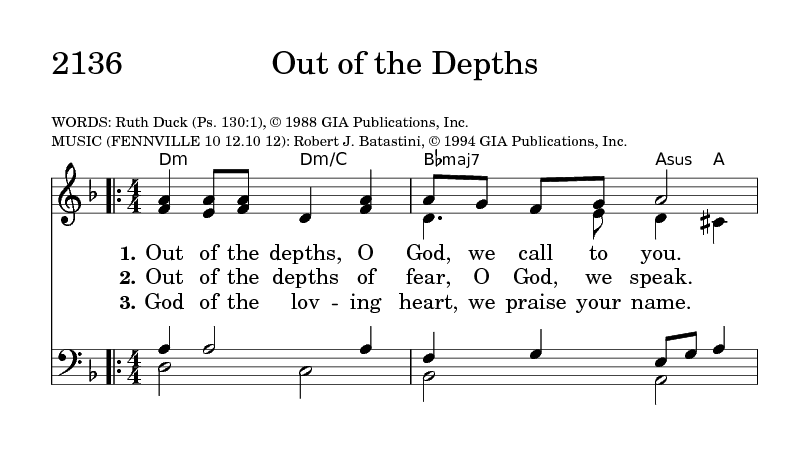
“Out of the Depths”
by Ruth Duck
The Faith We Sing, No. 2136.

The Pender UMC Traditional Service Middle Hymn “Out of the Depths” on Sunday September 4, 2022 was played by Eunji Moon on piano and sung by Brian Stevenson, the Pender Sanctuary Choir and congregation.

Central to biblical models of prayer is the practice of lament: crying out to God in pain, anguish, and grief. While examples of prayers of lament are found throughout the biblical witness and are particularly prevalent in the book of Psalms, too often we neglect lament in our worship.1 Bringing all our wounds to God shapes and forms us in honest relationship with our Creator, who loves us when we are far from perfection and is present with us in times of trouble. Hymns such as Ruth Duck’s “Out of the Depths” can help us reclaim lament in our worship.

“Out of the Depths” uses Psalm 130:1 as a springboard to name the things that plunge us into our own depths. While Psalm 130 is often seen as a confessional psalm, with its focus on redemption from iniquities,2 there are many things we hide away—our wounds, our scars, our traumas, our fears—and hiding these from ourselves and God stifles healing. “Out of the Depths” brings them forward through the practice of naming and lamenting in community. The first verse acknowledges the power of “wounds of the past” to affect our daily lives and the need for God’s love when we look at the full scope of our lives. The second verse leads us toward breaking silences that cloud the truth and keep us living in the fear of that which we have been too afraid to name.

While “Out of the Depths” encourages us to do our own individual work toward bringing our laments to God, it also lifts up the value of community in this healing process. While the first two stanzas both begin with “out of the depths,” all three stanzas end with “here in this community,” ensuring that the words most emphasized by repetition are not words of sorrow and isolation, but words of companionship. The second stanza also speaks to the safety and value of sharing difficult emotions among friends.

Almost all psalms of lament live in the tension between lament and praise. In fact, praise and expressions of confidence in God are seen as essential elements to the form of “lament”;3 many lament psalms end in praise (such as Psalm 13), or move back and forth constantly between lament and praise (Psalm 42).4 “Out of the Depths” leads us into praise in the final verse, painting a picture of a dancing God who moves through our lives as light in our darkness, meeting us with grace. The tune, FENNVILLE, is flexible enough to hold both tones—lament and praise—lending a strength and assurance to our words of praise. A bit of creativity in accompaniment can easily turn the final chord to a brighter tone.

The flexibility of this hymn conjures up possibilities for use outside the traditional context of singing the hymn straight-through in a service. Spoken prayer could easily be interspersed within the stanzas: naming specific kinds of pain present to those gathered, asking for assurance of God’s presence even in the depths, and thanking God for being revealed in community. It could easily be paired not only with Psalm 130, but also Psalm 139, in its assurance that there is no place anyone can go out of God’s reach—not even the depths.

While “Out of the Depths” leads us into lament in a way appropriate for many Sunday mornings, it is also a hymn to keep in mind in the unfortunate reality of times of crisis and tragic circumstances. The line, “Wounds of the past remain, affecting all we do,” acknowledges the impact such events have not only in the immediate aftermath, but throughout our lives. As such, this hymn could be particularly powerful when used in services of remembrance acknowledging anniversaries of events that have shaken communities.

“Out of the Depths” also has strong potential for use outside of a Sunday morning worship service. Ruth Duck has written alternate second lines for the first verse; one for those who are seriously ill (“Free us from fear of death, our faith and hope renew…”), and one for those who have been abused (“Words of abuse remain, affecting all we do…”) These reframe the hymn for more specific situations and could be useful in pastoral care situations as an opening or closing song for grief-sharing and support groups.

This is not surprising given the author’s interest in liturgical healing. A professor of worship at Garrett-Evangelical Theological Seminary, a strong presence in the academic liturgical community, and a prolific hymn text writer, Ruth Duck has written many hymns focused on healing and God’s ability to bring wholeness and restoration (such as “Sacred the Body,” “When We Must Bear Persistent Pain,” and “Womb of Life and Source of Being”). 5 “Out of the Depths” offers a way for us to give voice to our too often unspoken pain, celebrate community, and be assured of God’s grace which meets us wherever we are.


1 Duff, Nancy J. “Recovering Lamentation as a Practice in Church”, in Lament: Reclaiming Practices in Pulpit, Pew, and Public Square, ed. Sally A. Brown and Patrick D. Miller. Louisville: Westminster John Knox, 2005. p 4.

2 ed. Martin Tel, Psalms for All Seasons, Grand Rapids: Faith Alive Christian Resources, 2012. p 848.

3 Miller, Patrick D. They Cried to the Lord: the Form and Theology of Biblical Prayer. Minneapolis: Fortress Press, 1994. p 55-133.

4 Psalm 88 is a notable expression of a lament psalm without praise.


Tags: , , , , , , , , , , ,

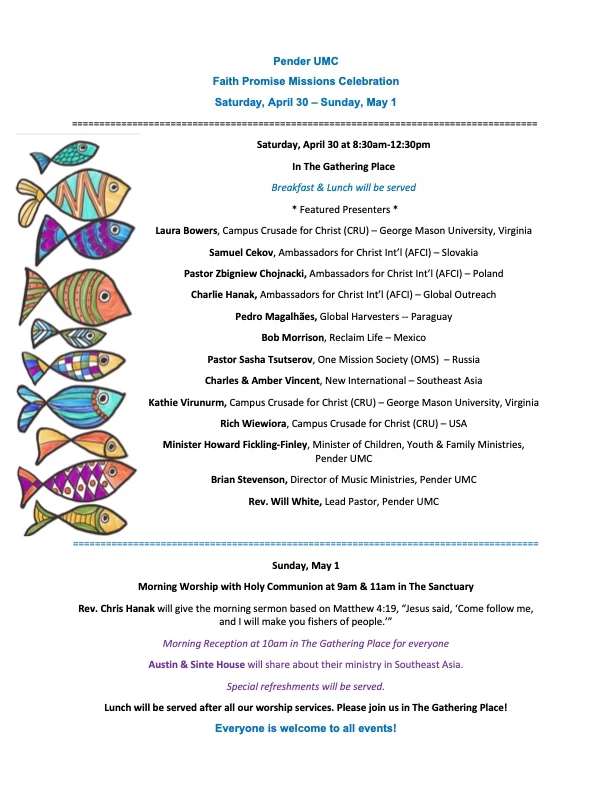
Missions Conference April 30-May 1

Come and attend the Pender Faith Promise Missions Celebration on Sat. Apr 30 at 8:30AM-12:30PM and on Sun. May 1 at 9AM, Sunday School and 11:15AM Services.

Missionaries will share about their ministries in our Fairfax community, in the US, and internationally.

Our keynote speaker is Christine Hanak, an ordained UMC minister, and her husband, Charlie. They serve globally with Ambassadors for Christ International (AFCI). As you know, Chris is an ordained minister with the UMC, and we are thrilled to have her back at her home congregation where her missionary life began.

Austin and Sinte House will update us about their ministry in Thailand. Members from Campus Crusade (Cru) on the George Mason University campus will come share their testimonies. Enjoy inspirational music and songs!

Come and be refreshed in the Lord! Share some hospitality with our missionary visitors. Breakfast, lunch and refreshments with an international flair will be served in the Gathering Place.

We look forward to seeing you!

For more information, please contact Greg or Maya Berry, or the church office.


Pender United Methodist Church supports 150 missionaries in 32 countries around the world. Each year, Pender sends teams on short-term mission trips to Central and South America, Europe, Africa, and we’re always researching other trips.


Leave a comment

Posted by on April 29, 2022 in Ministries, Missions, Pender UMC


Tags: , , , , ,

Pender Offering on January 9, 2022: Beethoven’s Piano Sonata No. 8 in C minor, Op. 13


During the Offering at Pender UMC’s Traditional Service on January 9, 2022, we were treated to Ludwig van Beethoven’s Piano Sonata No. 8 in C minor, Op. 13, commonly known as Sonata Pathétique played by Liz Eunji Sellers .


View the entire service

Ludwig van Beethoven’s Piano Sonata No. 8 in C minor, Op. 13, commonly known as Sonata Pathétique, was written in 1798 when the composer was 27 years old, and was published in 1799. It has remained one of his most celebrated compositions.Beethoven dedicated the work to his friend Prince Karl von Lichnowsky. Although commonly thought to be one of the few works to be named by the composer himself, it was actually named Grande sonate pathétique (to Beethoven’s liking) by the publisher, who was impressed by the sonata’s tragic sonorities.


Liz played the second movement – Adagio cantabile (above)

This movement exemplifies the expressive Adagio style of many slow movements in the classical period. The famous cantabile melody is played three times, always in A♭ major, separated by two modulating episodes; the movement is thus a simple rondo rather than the sonata form more common for movements of this seriousness. The first episode is set in F minor (the relative minor of A♭ major), further modulating to E♭ major before returning to the main theme. The second episode begins in A♭ minor and modulates to E major. With the final return of the main theme, the accompaniment becomes richer and takes on the triplet rhythm of the second episode. There is a brief coda.

 
Leave a comment

Posted by on January 16, 2022 in Ministries, Music, Music Ministry, Pender UMC, Videos


Tags: , , , ,

Pender Christmas Cantata – and more!

Sunday, December 19, 2021

The PUMC Sanctuary Choir and members of the American Youth Philharmonic Orchestra will provide a music cantata during traditional worship service.

Rev Will White will preach on
Ready for Different Kind of Birthday Bash?
based on Micah 5:2-5 and Luke 1:39-45.

Micah may be a minor prophet, but he’s a heavy hitter. Through him we know that God chose a no place like Bethlehem Ephrathah to be a significant someplace. Luke reminds us that, a young woman, a little girl really, from a backwater town became exceptional. Mary was her name. Her obedience to God makes possible a birth like none other. Come join us as we respond to this miracle.

Mission Focus: Hygiene Kits through UMCOR

There will also be a Christmas Social between the services on December 19 at 10 am in our Fellowship Hall.

Join us for carols, cookies, and wear your tacky Christmas sweaters and ties. There will be a tacky Christmas outfit contest. You may win a prize!

Bring the children as St. Nick will be on hand for photo opportunities.

See the calendar for more events.


Tags: , , , , , ,