I spoke to people getting food at a food bank and here are some things I learned from those in need:
1. Everyone donates Kraft Mac and Cheese in the box. They can rarely use it because it needs milk and butter which is hard to get from regular food banks.
2. Boxed milk is a treasure, as kids need it for cereal which they also get a lot of.
3. Everyone donates pasta sauce and spaghetti noodles.
4. They cannot eat all the awesome canned veggies and soup unless you put a can opener in too or buy pop tops.
5. Oil is a luxury but needed for Rice a-Roni which they also get a lot of.
6. Spices or salt and pepper would be a real Christmas gift.
7. Tea bags and coffee make them feel like you care.
8. Sugar and flour are treats.
9. They fawn over fresh produce donated by farmers and grocery stores.
10. Seeds are cool in Spring and Summer because growing can be easy for some.
11. They rarely get fresh meat.
12. Tuna and crackers make a good lunch.
13. Hamburger Helper goes nowhere without ground beef.
14. They get lots of peanut butter and jelly but usually not sandwich bread.
15. Butter or margarine is nice too.
16. Eggs are a real commodity.
17. Cake mix and frosting makes it possible to make a child’s birthday cake.
18. Dishwashing detergent is very expensive and is always appreciated.
19. Feminine hygiene products are a luxury and women will cry over that.
20. Everyone loves Stove Top Stuffing.
In all the years I have donated food at the Holidays, I bought what I thought they wanted, but have never asked. I am glad I did.
November 1 is All Saints Day, a sometimes-overlooked holy day in United Methodist congregations. It is not nearly as well known as the day before, All Hallows’ (Saints’) Eve, better known as Halloween, but is far more important in the life of the church.
John Wesley, founder of the Methodist movement, enjoyed and celebrated All Saints Day. In a journal entry from November 1, 1767, Wesley calls it “a festival I truly love.” On the same day in 1788, he writes, “I always find this a comfortable day.” The following year he calls it “a day that I peculiarly love.”
This may sound odd. United Methodists don’t believe in saints. Right?
Well, yes… and no.
Wesley cautioned against holding saints in too high regard.The Articles of Religion that he sent to the Methodists in America in 1784, include a statement against “invocation of saints” (Article XIV—Of Purgatory, Book of Discipline ¶104). Wesley did not see biblical evidence for the practice and discouraged Methodists from participating.
However, he also advised against disregarding the saints altogether.
In an All Saints Day journal entry dated Monday, November 1, 1756, Wesley writes, “How superstitious are they who scruple giving God solemn thanks for the lives and deaths of his saints!” If your 18th century English is as rusty as mine, it might help to know that the word scruple means, “to be unwilling to do something because you think it is improper, morally wrong, etc.” (Merriam-Webster.com).
All Saints Day is an opportunity to give thanks for all those who have gone before us in the faith. It is a time to celebrate our history, what United Methodists call the tradition of the church.
From the early days of Christianity, there is a sense that the Church consists of not only all living believers, but also all who have gone before us. For example, in Hebrews 12 the author encourages Christians to remember that a “great cloud of witnesses” surrounds us encouraging us, cheering us on.
Charles Wesley, John’s brother, picks up on this theme in his hymn that appears in our United Methodist Hymnal as “Come, Let Us Join our Friends Above,” #709. In the first verse, he offers a wonderful image of the Church through the ages:
Let saints on earth unite to sing, with those to glory gone,
for all the servants of our King in earth and heaven, are one.
On All Saints Day we remember all those—famous or obscure—who are part of the “communion of saints” we confess whenever we recite The Apostles’ Creed. We tell the stories of the saints “to glory gone.”
Alongside the likes of Paul from the New Testament, Augustine, Martin Luther, and John and Charles Wesley, we tell stories of the grandmother who took us to church every Sunday. We remember the pastor who prayed with us in the hospital, and the neighbor who changed the oil in the family car. We give thanks for the youth leader who told us Jesus loved us, the kindergarten Sunday school teacher who showered us with that love, and the woman in the church who bought us groceries when we were out of work.
Retelling these stories grounds us in our history. These memories teach us how God has provided for us through the generosity and sacrifice of those who have come before us. The stories of the saints encourage us to be all God has created us to be.
Charles Wesley’s hymn tells us those “to glory gone” are joined by the “saints on earth,” whom we also celebrate on All Saints Day. We think of the inspirational people with whom we worship on Sunday, and those across the world we will never meet. We celebrate fellow United Methodists who inspire us, and those of other denominations whose lives encourage us. We give thanks for those with whom we agree, as well as those whose views we do not share.
Additionally, we remember and pray for our sisters and brothers in Christ who faithfully follow Jesus in places where being labeled a Christian puts them in harm’s way.
On All Saints Day, we recognize that we are part of a giant choir singing the same song. It is the song Jesus taught his disciples; a tune that has resonated for more than 2,000 years; a melody sung in glory and on the earth. Our great privilege is to add our voices to this chorus.
The last verse of “Come, Let Us Join our Friends Above” encourages us to sing faithfully while on earth, so we might join the heavenly chorus one day.
Our spirits too shall quickly join, like theirs with glory crowned,
and shout to see our Captain’s sign, to hear His trumpet sound.
O that we now might grasp our Guide! O that the word were given!
Come, Lord of Hosts, the waves divide, and land us all in heaven.
On All Saints Day, let us give thanks for both the saints in glory and those on earth, who have led us to Jesus. As they have shared the gospel with us, may we add our voices so someone else may hear about the grace and love of our Lord and Savior Jesus Christ.
November 1 is All Saints Day, a sometimes-overlooked holy day in United Methodist congregations. It is not nearly as well known as the day before, All Hallows’ (Saints’) Eve, better known as Halloween, but is far more important in the life of the church.
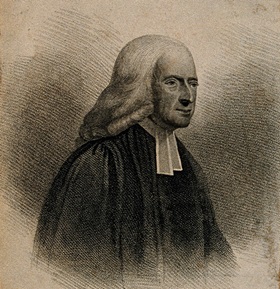
John Wesley was fond of All Saints Day. “John Wesley. Stipple engraving by J. Posselwhite” licensed under CC BY 4.0 via Wikimedia Commons.
John Wesley, founder of the Methodist movement, enjoyed and celebrated All Saints Day. In a journal entry from November 1, 1767, Wesley calls it “a festival I truly love.” On the same day in 1788, he writes, “I always find this a comfortable day.” The following year he calls it “a day that I peculiarly love.”
Wesley cautioned against holding saints in too high regard. The Articles of Religion that he sent to the Methodists in America in 1784, include a statement against “invocation of saints” (Article XIV—Of Purgatory, Book of Discipline ¶104). Wesley did not see biblical evidence for the practice and discouraged Methodists from participating.
However, he also advised against disregarding the saints altogether.
In an All Saints Day journal entry dated Monday, November 1, 1756, Wesley writes, “How superstitious are they who scruple giving God solemn thanks for the lives and deaths of his saints!” If your 18th century English is as rusty as mine, it might help to know that the word scruple means not doing something because you think it’s wrong.
All Saints Day is an opportunity to give thanks for those who have gone before us in the faith. It is a time to celebrate our history, what United Methodists call the tradition of the church.
From the early days of Christianity, there is a sense that the Church consists of not only all living believers, but also all who have gone before us. For example, in Hebrews 12 the author encourages Christians to remember that a “great cloud of witnesses” surrounds us encouraging us, cheering us on.
Charles Wesley, John’s brother, picks up on this theme in his hymn that appears in our United Methodist Hymnal as “Come, Let Us Join our Friends Above,” #709. In the first verse, he offers a wonderful image of the Church through the ages:
Let saints on earth unite to sing, with those to glory gone,
for all the servants of our King in earth and heaven, are one.
On All Saints Day we can remember all those who are part of the “communion of saints” we confess whenever we recite The Apostles’ Creed. We share stories of those “to glory gone.”
Retelling these stories grounds us in our history. These memories teach us how God has provided for us through the generosity and sacrifice of those who have come before us. The stories of the saints encourage us to be all God has created us to be.
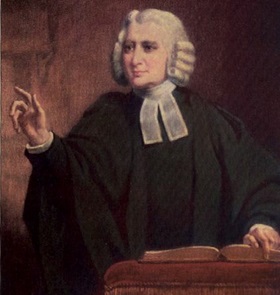
Charles Wesley wrote hymns that express his theology. “Charles-Wesley-preaching” by William Gush, public domain, via Wikimedia Commons.
Saints on earth
Charles Wesley’s hymn tells us those “to glory gone” are joined by the “saints on earth.” We think of the inspirational people with whom we worship on Sunday, and those across the world we will never meet. We celebrate fellow United Methodists who inspire us, and those of other denominations whose lives encourage us. We give thanks for those with whom we agree, as well as those whose views we do not share.
Additionally, we remember and pray for our sisters and brothers in Christ who faithfully follow Jesus in places where being labeled a Christian puts them in harm’s way.
One song
On All Saints Day, we recognize that we are part of a giant choir singing the same song. It is the song Jesus taught his disciples; a tune that has resonated for more than 2,000 years; a melody sung in glory and on the earth. Our great privilege is to add our voices to this chorus.
The last verse of “Come, Let Us Join our Friends Above” encourages us to sing faithfully while on earth, so we might join the heavenly chorus one day.
Our spirits too shall quickly join, like theirs with glory crowned,
and shout to see our Captain’s sign, to hear His trumpet sound.
O that we now might grasp our Guide! O that the word were given!
Come, Lord of Hosts, the waves divide, and land us all in heaven.
On All Saints Day, let us give thanks for both the saints in glory and those on earth, who have led us to Jesus. As they have shared the gospel with us, may we add our voices so someone else may hear about the grace and love of our Lord and Savior Jesus Christ.
Thanks be to God for the lives of his saints.
Q&A with Liturgy Man is a series of 3-5 minute videos in which Taylor Burton-Edwards answers questions about United Methodist Worship that he receives in a variety of ways from United Methodists around the connection.
“Hallows” is an older English way of saying “saints” — so, the Evening of Saints.
But why “the evening?” Many ancient cultures in the Mediterranean world and the Middle East, including Jewish cultures, understood the day as beginning with sunset rather than sunrise. This is why Genesis one says, “And it was evening, and it was morning, day one.” (Genesis 1:5). Because the day began with sunset, the first worship service of a given day would be the evening service.
Put it all together and Halloween refers to the first service of worship for All Saints Day. That day falls on November 1 in the Western Christianity. That’s why All Saints Eve (Halloween) is observed on the evening of Oct. 31.
So where or how did this observance get connected to jack-o-lanterns, ghosts, things that go bump in the night, and trick or treating? That connection comes from popular festivals already happening in many cultures worldwide to celebrate the midpoints between a solstice and an equinox, sometimes referred to as “cross-quarter days.” Some cultures understood these as transition times where the lines between realms may become the thinnest.
The Celtic festival of Samhain fell at the cross-quarter day between autumn and winter, between warmth and cold, between harvest and dormancy for the earth, and so, metaphorically, between life and death.
Christian missionaries and bishops, particularly in England and parts of Western Europe, had concerns that some of these practices and beliefs ran counter to the Christian understanding of the resurrection of the dead. The church, beginning in the eighth century, added prayers to Christian masses remembering the dead and anticipating their resurrection. These were some of the first prayers connected to celebrations later known as All Saints Day (November 1) and All Souls Day (November 2).
All Saints included prayers for those the church had specifically designated as saints because of their particularly holy lives pointing dramatically to Christ at work in them. All Souls included prayers for all within the church who had died within the past year.
United Methodists and most Protestants have no “official saints.” Thus, we usually combine All Saints and All Souls into a single observance. This celebration in the church accents our understanding of holiness in this life and our hope for resurrection in the age to come.
Cultural Halloween celebrations in the communities in which many of us live have continued to evolve alongside the church celebrations. Many local churches offer safe alternatives to traditional door-to-door trick-or-treating. Others focus more on giving than receiving. Collecting for UNICEF or giving Fair Trade chocolate are ideas for using the occasion to “treat” or give to others.
These activities need not be seen as either defining or limiting the Christian observance of All Saints. Our role in the church is to proclaim our own witness to what makes for holiness (becoming one of the “hallows”) in this life, and our hope for the resurrection of the dead and the fullness of life in the new creation in the age to come.
Our God Reigns, World Communion Sunday, October 5, 2025
On this special Sunday at Pender United Methodist Church, the opening hymn was “Our God Reigns” by Leonard Smith. It was joyfully sung by the Pender Sanctuary Choir and congregation under the direction of Patrick King, Director of Music Ministries, accompanied by Wenru Yang on piano.
This uplifting hymn reminds us of God’s sovereignty and grace that unites believers around the world. On this 17th Sunday after Pentecost, we join Christians everywhere in proclaiming: Our God reigns!
“How lovely on the mountains are the feet of him who brings good news, who proclaims peace, who brings glad tidings, who proclaims salvation, who says to Zion, ‘Your God reigns!’” — Isaiah 52:7
May this song inspire gratitude and unity as we remember that God reigns over all nations, all people, and all hearts.
“Our God Reigns” | Offertory at Pender UMC | January 5, 2025
On January 5, 2025, during a special Epiphany service at Pender United Methodist Church, the offertory featured a moving performance of “Our God Reigns” by Leonard Smith.
The anthem was beautifully sung by the Pender UMC Sanctuary Choir, under the direction of Patrick King, Pender’s Director of Music Ministries, accompanied by Abe Garver on cello and Heidi Jacobs on piano. This heartfelt rendition reminded us of the power and majesty of God’s reign, adding a deeply spiritual element to the worship service.
We are grateful to our singers, Patrick, Abe, and Heidi for sharing their incredible talents and inspiring us through this timeless anthem.
Pender UMC Sanctuary Choir Presented “Our God Reigns”
On August 25, 2024, the Pender UMC Sanctuary Choir, under the direction of Patrick King, delivered a powerful performance of “Our God Reigns” by Leonard E. Smith, Jr., inspired by Isaiah 52:7. This uplifting song, celebrating the message of salvation and God’s sovereignty, was beautifully accompanied by Mark Severeniuk on tuba and Heidi Jacobs on piano.
Isaiah 52:7 speaks of “good news,” originally referring to Israel’s delivery from captivity and return to Jerusalem. Today, Christians sing these words to celebrate our delivery from sin through Christ (Romans 10:15-16), who brings salvation and a restoration of God’s rule, resulting in peace and happiness. The song text skillfully combines Isaiah’s message with the timeless theme from the Psalms: Our God reigns!
Join us in this celebration of faith and let the music remind you of the everlasting reign of our God.
How lovely on the mountains are the feet of him
who brings good news, good news;
Announcing peace, proclaiming news of happiness:
our God reigns, our God reigns!
Refrain:
Our God reigns, our God reigns, our God reigns,
our God reigns, our God reigns!
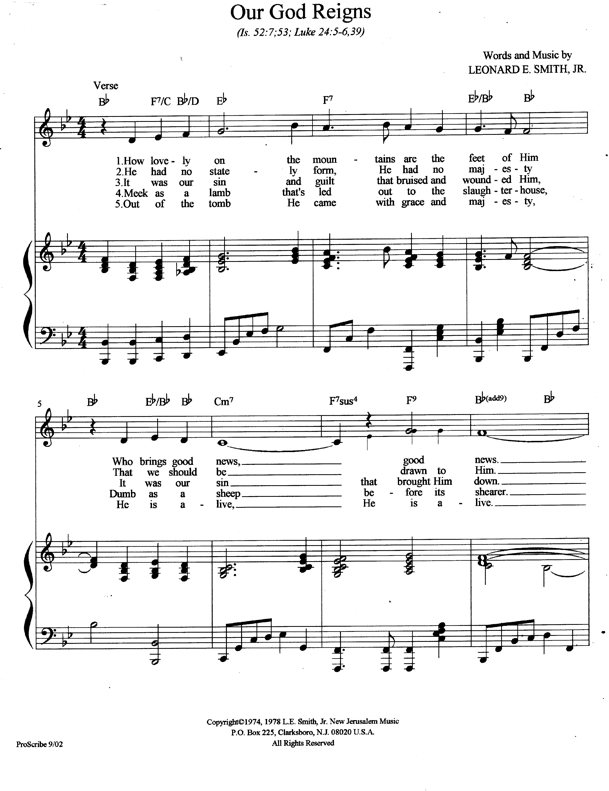
Leonard E. Smith, Jr., (b. Philadelphia, PA, 1942) composed this song in 1973 in Riverton, New Jersey. Educated at Mount St. Mary’s Seminary in Emmitsburg, Maryland, where he received a BA in philosophy, Smith first taught in public high schools, but his evangelical efforts in the schools created problems, resulting in his dismissal. He then began painting houses to support his family.
One night as he was reading Isaiah 52 he was overwhelmed by the conviction that God was in control of his life and of all creation; he wrote this song that night in just five minutes. The song was first sung at New Covenant Community Church, where Smith served as worship leader. Though not published for some time, it became known internationally when evangelist Bob Mumford included it in his crusades. It was first published in a Servant Publications hymnal, Songs of Praise (vol. 2, 1977). In 1978 Smith added four additional verses. He has published over 130 Scripture songs with New Jerusalem Music Co.
Sometimes you have to reach bottom before you look up to see God at work. Back in 1973, I was out of work again and depressed — actually very depressed. My wife and I had a son, an apartment, a car, and lots of bills to pay. I had also made myself unemployable as a high school teacher with just too much Jesus talk in class. I guess I was naive to think that talking about Jesus was more important than teaching Latin or English literature.
One morning I was reading the Bible and came to Isaiah 52:7: “How lovely on the mountains are the feet of Him Who brings good news, announcing peace, proclaiming news of happiness: your God reigns.” My heart began pounding in my chest because, through what I read, God spoke to me: “You’re going to get through this, and you will be fine. In fact, you’ll do very well.” I just felt the dark cloud lift off me. I picked up my guitar and, in a few minutes, Our God Reigns was born! I had one verse and the chorus. It wasn’t so much that I wrote it as I received it!
How lovely on the mountains are the feet of Him Who brings good news, good news Announcing peace, proclaiming new of happiness Our God reigns, Our God reigns! Our God reigns! Our God reigns! Our God reigns!
A couple of months later, a traveling evangelist visited our church, heard the song, and taught it as he went from church to church. It took me three more years to complete the other verses that made this Scripture chorus into a hymn that went around the world.
After the three big Christian music publishers passed on publishing my song in the late ’70s, I decided to keep the copyright and establish New Jerusalem Music to manage my songs, as well as the songs of our friends and my son, Daniel C. Smith, of the group Danielson Family. The decision to create my own music company worked out incredibly well over the decades. This was the fulfillment of His promise all those years ago when He told me that I would do very well. I know we really do have a Good Shepherd who is guiding us, closing doors, and opening doors.
Every one of us has experienced disappointment and failure and had our hearts broken. But we don’t need to be bitter about it. If we look closely, we’ll see how God worked it out for our good. Over time, we become more understanding, more patient, and kinder to others who have been overlooked and forgotten. We must not forget that suffering is the very thing God uses to refine and strengthen us. Jesus set the pattern that crucifixion comes before resurrection.
I would never have taken up learning how to play the guitar in seminary in the ‘60s if I hadn’t been so desperately lonely for so long. And I would never have started writing Scripture songs if I hadn’t so deeply needed the comfort of the Psalms of David, who also knew something of loss and pain and heartbreak.
Looking back, I’m grateful I was fired from that last teaching job. It proved to be the door God closed before He opened a new door for me. That open door has allowed me to enter into a wonderful new world. Thank you, Lord, for being such a good, loving, kind, faithful Shepherd. I know I’m in Your good hands and that will never change.



 News and Views