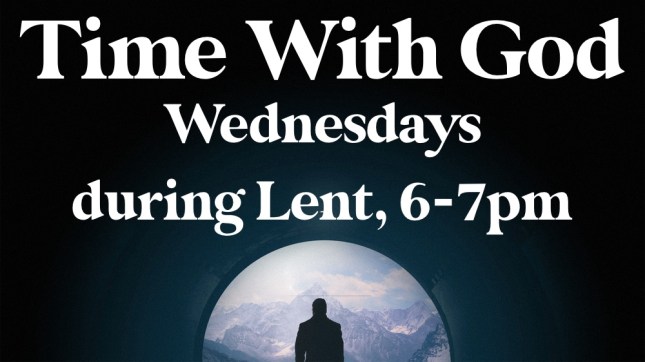
In addition to being a time to remember the mercy and forgiveness of Jesus, the early church used Lent to prepare converts for baptism, and to offer opportunities for those who had been separated from the church to be reconciled.
Today Lent remains an ideal time to remember our baptism and to reconcile relationships with those we may have harmed. All of this signifies to us our sinfulness and the sacrifice of Jesus which makes our forgiveness possible.
Lent is a season of forty days, not counting Sundays, which begins on Ash Wednesday and ends on Holy Saturday. Lent comes from the Anglo Saxon word lencten, meaning “lengthen” and refers to the lengthening days of spring. The forty days represents the time Jesus spent in the wilderness, enduring the temptation of Satan and preparing to begin his ministry.
Lent is a time of repentance, fasting and preparation for the coming of Easter. It is a time of self-examination and reflection. In the early church, Lent began as a period of fasting and preparation for baptism by new converts and then became a time of penance by all Christians. Today, Christians focus on relationship with God, growing as disciples and extending ourselves, often choosing to give up something or to volunteer and give of ourselves for others.
Sundays in Lent are not counted in the forty days because each Sunday represents a “mini-Easter.” This is why you will see the designation “Sunday in Lent” rather than “Sunday of Lent” in the naming of these Sundays. On each Lord’s Day in Lent, while Lenten fasts continue, the reverent spirit of Lent is tempered with joyful anticipation of the Resurrection.
Ash Wednesday marks the beginning of the season of Lent. It derives its name from the practice of placing ashes on the foreheads of adherents as a sign of mourning and repentance to God.
And Chuck Knows Church says…
Ever seen a little smudge mark on someone’s forehead as they walk out of church? That’s a sign of the cross and it means it’s Ash Wednesday during Lent. Chuck tells you about this important worship service:
The Pender UMC Traditional Service Final Hymn “Since Jesus Came into My Heart”, Sunday March 17, 2024 was played by Hetty Jacobs on piano and sung by the Sanctuary Choir and congregation. This was the fifth Sunday in Lent.
Rufus Henry McDaniel, ordained in 1873, turned his profound grief into a timeless hymn after losing his son Herschel in 1913. In 1914, he crafted “Since Jesus Came into My Heart,” a gospel hymn that beautifully encapsulates the transformative journey of faith, resonating with personal salvation experiences. McDaniel’s choice of repeating the impactful phrase “since Jesus came into my heart” throughout the hymn emphasizes the deep-seated change brought by faith.
Scriptural Foundation:
The hymn’s message is deeply rooted in scripture, particularly in 2 Corinthians 5:17, which declares, “Therefore, if anyone is in Christ, the new creation has come: The old has gone, the new is here!” This verse perfectly encapsulates the transformative journey that McDaniel illustrates through his hymn.
Experiencing Transformation:
Each verse of the hymn narrates the significant shift from a life of wandering to one of purpose and direction, akin to the lost son’s return in Luke 15:24. This parable and the hymn alike celebrate the restoration and new life found in coming home to the Father through Jesus Christ.
Joy in Salvation:
The hymn exudes a joy that resonates with 1 Peter 1:8-9, which speaks of “an inexpressible and glorious joy, for you are receiving the end result of your faith, the salvation of your souls.” McDaniel’s lyrics mirror this joy, reflecting the profound inner peace and satisfaction that accompany salvation.
Navigating Life’s Journey:
In “Since Jesus Came into My Heart,” there’s a clear narrative of moving from life’s aimless wandering to walking a path illuminated by Christ’s love, reminiscent of Psalm 119:105: “Your word is a lamp for my feet, a light on my path.” The hymn emphasizes the guidance and clarity Jesus brings to our lives.
Eternal Perspective:
The hymn concludes with a forward-looking view, expressing hope and assurance in the eternal life promised in John 14:2-3, where Jesus assures, “In my Father’s house are many rooms… I am going there to prepare a place for you.” McDaniel’s lyrics affirm the believer’s hope of dwelling with Christ forever.
“Since Jesus Came into My Heart” is not just a hymn but a profound testament to the enduring power of faith and the unifying journey of believers. It continues to inspire and resonate within the global Christian community, proving the timeless nature of McDaniel’s heartfelt composition.
In sum, “Since Jesus Came into My Heart” is a vibrant declaration of the radical change and boundless joy that come with a life surrendered to Christ, offering a blueprint for the Christian walk that is guided by faith, illuminated by divine love, and anchored in eternal hope.
Closing Prayer:
Dear Lord, we thank You for the profound changes You instigate in our lives. Like the joyful declarations in “Since Jesus Came into My Heart,” we too celebrate the new life, direction, and hope You have gifted us. May our lives continue to reflect the transformative power of Your love and grace. Amen.
“Standing on the Promises”
R. Kelso Carter UM Hymnal, No. 374
The Pender UMC Traditional Service Middle Hymn “Standing on the Promises”, Sunday February 25, 2024 was played by Hetty Jacobs on piano and sung by the Sanctuary Choir and congregation. This was the second Sunday in Lent.
“Standing on the Promises” was the middle hymn at Pender’s 9:00 am Traditional Service on June 18, 2023 It was sung by Pender’s congregation, accompanied on piano by Heidi Jacobs and guitar by Brian Stevenson.
The Pender UMC Traditional Service Opening Hymn “Standing on the Promises” on Sunday November 6, 2022 was played by Liz Eunji Moon on piano, accompanied on guitar by Brian Stevenson and sung the Pender Sanctuary Choir and congregation.
Standing on the promises of Christ my King,
Through eternal ages let his praises ring;
Glory in the highest, I will shout and sing,
Standing on the promises of God.
Russell Kelso Carter (1849-1928) was a man of diverse interests and abilities. A native of Baltimore, Md., Carter was known as an outstanding athlete in his younger days. The Methodist Holiness camp meeting movement had a profound impact on his life and he was ordained into ministry in 1887.
Carter held a number of teaching posts at the Pennsylvania Military Academy including professor of chemistry, natural science, civil engineering and mathematics. Not only did he teach, but he also published text books in his various disciplines and even authored several novels. Other interests included sheep-raising and practicing medicine.
If this were not enough, Carter also edited hymnals. He assisted A.B. Simpson in the compilation of a hymnal for the Christian and Missionary Alliance Church, Hymns of the Christian Life (1891), a collection that contained 68 of his tunes and 52 of his texts.
“Standing on the Promises” was composed in 1886 while Carter was teaching at the military academy. He was a member of the first graduating class in 1867 and had a strong affinity for the school. Author Phil Kerr makes a connection between the music and the military academy in his book, Music in Evangelism, stating that Carter’s military experience was reflected in the martial musical style of the hymn.
Published the year it was written in the collection, Songs of Perfect Love, edited by John K. Sweeny and Carter, the original text had five stanzas. The missing stanza reads:
Standing on the promises I now can see
Perfect, present cleansing in the blood for me;
Standing in the liberty where Christ makes free,
Standing on the promises of God.
The second line of this stanza has a particular Wesleyan tone with its focus on perfection and cleansing blood. The Rev. Carlton Young, editor of the UM Hymnal, notes: “As in other single-theme evangelical hymns and songs of this period, the biblical source of the hymn is not clear. ‘Stand firm’ from Ephesians 6:14 has often been cited as the theme of the hymn, although the word ‘promise’ tends to be reinforced as well.”
Thus, two passages of Scripture seem to undergird the central premise of this gospel song: “Stand firm then, with the belt of truth buckled around your waist, with the breastplate of righteousness in place. . . .” (Ephesians 6:14). Several passages relate to the promises of God including 2 Samuel 22:31: “As for God, his way is perfect; the word of the LORD is tried; he is a buckler to all them that trust in him.”
Dr. Young points out that this hymn was not included in authorized hymnals for Methodists (or in the 1957 hymnal of the Evangelical United Brethren Church) until the current hymnal. He states, “Its place in our hymnal came from its inclusion in a list of hymns determined to be widely used by evangelical United Methodists.”
As is the case of many gospel songs, this song revolves around its refrain. The stanzas, rather than serving to develop a sequential train of thought, are more like the spokes of a bicycle—all serving as an entry point to the refrain from various perspectives. One could reorder the stanzas and not lose any train of thought.
Hymnologist Kenneth Osbeck places the hymn in its context: “The hymn has been widely used in the great evangelistic crusades throughout the past century.” It is in this context that its single focus and rousing, martial music may be best suited.