“Sanctuary” was the offertory anthem at Pender’s 9:00 am Traditional Service on September 10, 2023 It was sung by Pender’s Sanctuary choir, directed by Jane McKee and accompanied on piano by Heidi Jacobs.
This popular praise chorus is paired with original words and music by Lloyd Larson. The prayerful message calls for each worshiper to come before God in devotion and thanksgiving.
The Scriptural Reference is Romans 12:1-2.
Sanctuary was written by Randy Scruggs and John W. Thompson. Randy Scruggs was born in 1953 and died 62 years later. He was named CMA Musician of the Year in 1999, 2003 and 2006. He was first recorded when he was four years old, his dad was a well known banjo player. He wrote hits for several individuals throughout his life.
John’s co-authorship of the song was close to the time when he wrote another song – El Shaddai (with Michael Card) – that has gone on to various accolades.
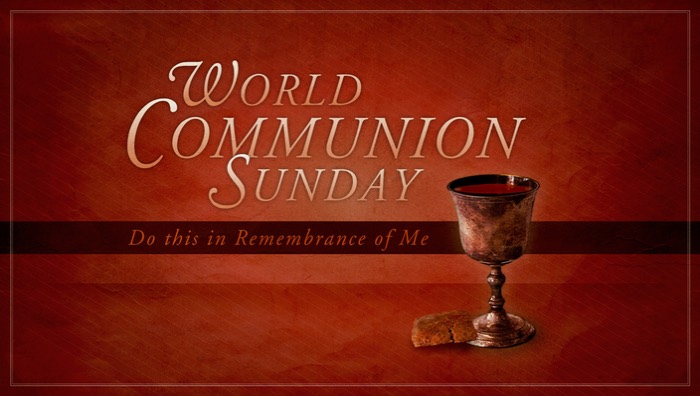
World Communion Sunday offers us an opportunity to experience Holy Communion in the context of the global community of faith.
The first Sunday of October has become a time when Christians in every culture break bread and pour the cup to remember and affirm Christ as the Head of the Church.
On that day, we remember that we are part of the whole body of believers.
Christians celebrate the communion liturgy in as many ways as there are congregations. World Communion Sunday can be both a profound worship experience and a time for learning more about our wider community of faith.
Because Pastor Bruce is away, we will celebrate at Pender next Sunday.
It’s the second half of the bestselling book the world has ever known. But this episode will test your knowledge about the 27 books in the New Testament.
“When Jesus the Healer Passed through Galilee”
Peter D. Smith
The United Methodist Hymnal, No. 263
“When Jesus the Healer Passed Through Galilee” was the closing hymn at Pender’s 9:00 am Traditional Service on September 10, 2023 It was sung by Pender’s Sanctuary choir, congregation and accompanied on piano by Heidi Jacobs.
The Pender UMC Traditional Service Closing Hymn “When Jesus the Healer Passed Through Galilee” on Sunday June 19, 2022 was accompanied by Liz Sellers on piano, Brian Stevenson on guitar and sung by Brian and the Pender Congregation.
During the season of Epiphany, we recall those actions of Jesus, especially the miracles, that demonstrate that he was indeed the Christ, the Son of God. “When Jesus the healer” provides a compendium of many of Christ’s miraculous healing activities.
Peter David Smith was born in Weybridge, Surrey, England, in 1938. After working for a time in the aircraft industry, he became a Methodist minister. A hallmark of his ministry was his gift as a folksinger. Though trained as a classical pianist, the folk guitar became his instrument of choice. He edited several popular song collections including Faith, Folk, and Charity (1968), Faith, Folk and Nativity (1969), Faith, Folk, and Festivity (1969), and New Orbit (1972). These collections appeared during the height of the popularity of the folk music idiom.
The folk idiom in the service of the church provides an immediacy and accessibility to great biblical truths. While classical hymnody often engages through the depth of metaphors and symbolic use of language, the more colloquial language of the folk idiom captures us with its earthiness—what you see is what you get. The music of a successful folksong must be easily learned—captured immediately—or it works against the directness of the language.
Folk Songs often tell stories, or have a narrative quality. The guitar is the preferred instrument of the folksinger. Its portability and accessibility invite participation. An organ or even a piano might separate the singer and the people, both in physical and psychological space, but not the guitar.
In many ways, Christian folk singers of the 1960s and 1970s find their roots in the songs of Woody Guthrie (1912-1967), Pete Seeger (b. 1919) and Bob Dylan (b. 1941), to name a few. However, the prototype of the Christian folksong may be found in Sydney Carter (1915-2004) and his famous “Lord of the Dance” (1963). Carter shocked the faithful and endeared himself to the prophets in the church. While he is known primarily for “Lord of the Dance” in the United States, many more of his songs are commonly sung in England.
The overarching narrative of Jesus as healer guides this hymn. In a mere 22 syllables and a brief refrain, the author opens up an entire healing narrative in each stanza: stanza 1, Luke 4:31-41; stanza 2, Mark 2:3-12; stanza 3, Mark 5:22-24, 35-43; stanza 4, Mark 10:46-52; stanzas 5 and 6, Matthew 10:5-15. A soloist carries the weight of the narrative in the third person while the people respond from the perspective of those needing healing in the first person plural: “Heal us, heal us today!”
Mr. Smith composed this song during a course he was teaching on contemporary worship for the Iona Community in 1975. Later, he served on the editorial committee for the hymnal, Partners in Praise (1979), and this was one of ten contributions by the composer included in its contents.
One stanza was omitted due to sensitivity to discriminatory language and a slight alteration to one line in stanza five was made for the same reason. Other than that, the hymn comes to us as originally composed.
The composer skillfully draws the people into the narrative in the final stanza by pointing out that the need for Christ’s healing power is still with us today: “There’s still so much sickness and suffering today. . . . We gather together for healing and pray: Heal us, Lord Jesus!”
I’m sure that many would think that this is a semi-odd choice for all-time favorite hymn.
My dad was a Congregational (now United Church of Christ) minister so I was pretty regular in church attendance in my younger years.
Some Sunday evenings, he would preach on a circuit and I’d go with him to some of these tiny churches. The people there, mostly older folks, liked the old hymns best – Fanny Crosby and so on.
So, some of my “favorite hymns” are going to be those that I sang when I was out with my Dad. Fond memories from long ago.
In 1986 I was finally diagnosed with Cushing’s after struggling with doctors and trying to get them to test for about 5 years. I was going to go into the NIH (National Institutes of Health) in Bethesda, MD for final testing and then-experimental pituitary surgery.
I was terrified and sure that I wouldn’t survive the surgery.
Somehow, I found a 3-tape set of Readers Digest Hymns and songs of Inspiration and ordered that. The set came just before I went to NIH and I had it with me.
At NIH I set up a daily “routine” of sorts and listening to these tapes was a very important part of my day and helped me get through the ordeal of more testing, surgery, post-op and more.
When I had my kidney cancer surgery, the tapes were long broken, but I had replaced all the songs – this time on my iPod.
Abide With Me was on this tape set and it remains a favorite to this day. Whenever we have an opportunity in church to pick a favorite, my hand always shoots up and I request page 700. When someone in one of my handbell groups moves away, we always sign a hymnbook and give it to them. I sign page 700.
I think that many people would probably think that this hymn is depressing. Maybe it is but to me it signifies times in my life when I thought I might die and I was so comforted by the sentiments here.
This hymn is often associated with funeral services and has given hope and comfort to so many over the years – me included.
If you abide in Me, and My words abide in you, you will ask what you desire, and it shall be done for you.
~John 15:7
Abide With Me
Words: Henry F. Lyte, 1847.
Music: Eventide, William H. Monk, 1861. Mrs. Monk described the setting:
This tune was written at a time of great sorrow—when together we watched, as we did daily, the glories of the setting sun. As the last golden ray faded, he took some paper and penciled that tune which has gone all over the earth.
Lyte was inspired to write this hymn as he was dying of tuberculosis; he finished it the Sunday he gave his farewell sermon in the parish he served so many years. The next day, he left for Italy to regain his health. He didn’t make it, though—he died in Nice, France, three weeks after writing these words. Here is an excerpt from his farewell sermon:
O brethren, I stand here among you today, as alive from the dead, if I may hope to impress it upon you, and induce you to prepare for that solemn hour which must come to all, by a timely acquaintance with the death of Christ.
For over a century, the bells of his church at All Saints in Lower Brixham, Devonshire, have rung out “Abide with Me” daily. The hymn was sung at the wedding of King George VI, at the wedding of his daughter, the future Queen Elizabeth II, and at the funeral of Nobel peace prize winner Mother Teresa of Calcutta in 1997.
Abide with me; fast falls the eventide;
The darkness deepens; Lord with me abide.
When other helpers fail and comforts flee,
Help of the helpless, O abide with me.
Swift to its close ebbs out life’s little day;
Earth’s joys grow dim; its glories pass away;
Change and decay in all around I see;
O Thou who changest not, abide with me.
Not a brief glance I beg, a passing word;
But as Thou dwell’st with Thy disciples, Lord,
Familiar, condescending, patient, free.
Come not to sojourn, but abide with me.
Come not in terrors, as the King of kings,
But kind and good, with healing in Thy wings,
Tears for all woes, a heart for every plea—
Come, Friend of sinners, and thus bide with me.
Thou on my head in early youth didst smile;
And, though rebellious and perverse meanwhile,
Thou hast not left me, oft as I left Thee,
On to the close, O Lord, abide with me.
I need Thy presence every passing hour.
What but Thy grace can foil the tempter’s power?
Who, like Thyself, my guide and stay can be?
Through cloud and sunshine, Lord, abide with me.
I fear no foe, with Thee at hand to bless;
Ills have no weight, and tears no bitterness.
Where is death’s sting? Where, grave, thy victory?
I triumph still, if Thou abide with me.
Hold Thou Thy cross before my closing eyes;
Shine through the gloom and point me to the skies.
Heaven’s morning breaks, and earth’s vain shadows flee;
In life, in death, O Lord, abide with me.




 News and Views