RSS

Tag Archives: Charles Wesley

Christmas Music, Part 21: “Above All Sing Spiritually”

Nativity set and sheet music for "Away in a Manger" are part of a photo illustration by Kathryn Price, United Methodist Communications.
Nativity set and sheet music for “Away in a Manger” are part of a photo illustration by Kathryn Price, United Methodist Communications.

As you turn the pages of The United Methodist Hymnal during December, often you will end up singing some of the most popular Christmas carols ever composed. Two favorites, “Hark, the Herald Angels Sing” and “Come, Thou Long-Expected Jesus,” were written by Charles Wesley, one of the founders of Methodism.

United Methodist Discipleship Ministries provides an extensive History of Hymns, but here is a short compilation of some of the songs we love the most in this holy season.

“Hark! The Herald Angels Sing”
Written by Charles Wesley within a year of his conversion, this song was first published under the title “Hymn for Christmas Day” in Hymns and Sacred Poems (1739). There is no gentle warmup for this song; it jumps right into the action when the angels appear to the shepherds and herald the birth of Jesus. Much of the text in the first stanza is an adaptation of Luke 2:14. Wesley does inject his own theological interpretation of this grand event with the statement “God and sinners reconciled.” Read more.

“Come, Thou Long-Expected Jesus”
First published in 1744, Charles Wesley also wrote this popular Advent hymn. The song uses imperative verbs like “come,” “rule” and “raise” to enhance our longing for the Savior. The hymn was included in the small collection of hymns Hymns for the Nativity of the Our Lord. Like others published by the Wesley brothers, these collections produced a way to spread Methodist theology, enhance the prayer life of those in the Society, and give them a body of songs to sing when they gathered. Read more.

“O Little Town of Bethlehem”
Phillips Brooks (1835-1893), an Episcopal priest and rector of the Church of the Holy Trinity in Philadelphia, wrote this popular carol. Brooks was inspired when he visited Bethlehem and Jerusalem in 1865. Three years later Brooks wrote the poem/lyrics and Lewis Redner, the organist of the church, added the music. Most renditions of this carol uses Redner’s tune, simply titled “St. Louis.” However, there are at least three other tunes used with Brooks’ lyrics, such as the version often performed during “Nine Lessons and Carols” at Kings College, Cambridge. Read more.

“Angels We Have Heard on High”
The French roots of this carol can be found in the 1700s in “Les Anges dans nos Campagnes,” which means “the angels in the countryside.” The French verses were coupled with a refrain taken from Luke 2:14 in the Latin version of the Bible: “Gloria, in excelsis Deo,” which means “Glory to God in the highest.” The carol was translated to English by Bishop James Chadwick and first published in his 1860 Holy Family Hymns. The traditional tune is attributed to Edward Shippen Barnes, an American organist who studied Yale University from 1910-11 and then briefly at Schola Cantorum in Paris. Read more.

“O Come, O Come Emmanuel”
The roots of this carol date back to the 800s and a series of Latin hymns sung during Advent Vespers. These Great Antiphons (meaning psalm or anthem) were rediscovered by English minister John Mason Neale and published in 1710. He wove together parts of the antiphons to create this song, first published in 1851. The first draft of his song began with “Draw nigh, draw nigh, Emmanuel,” but a later revision restored the tradition of these antiphons by starting the song with “O Come, O Come Emmanuel.” Read more.

“Silent Night”
The original German lyrics “Stille Nacht! Heilige Nacht!” were written in 1816 by Josef Mohr, a Catholic priest from Austria. Tradition holds that two years later, faced with a rusty, broken organ (some say damaged by mice) on Christmas Eve, Mohr gave the lyrics to Austrian headmaster Franz Gruber and asked him to compose the melody on guitar. At first Gruber declined because the guitar was popularly used for drinking songs, but finally agreed and created a Christmas song loved throughout the world. “Silent Night” is said to be one of the songs both English and German soldiers sang together in the great Christmas truce of 1914 during World War I. Read more.

“What Child is This?”
The words to this carol were adapted from a longer poem written by William Chatterton Dix in 1865. Born into a literary family, Dix’s father was a surgeon who also wrote a book about English poet Thomas Chatterton, after whom he named his son. William did not follow his father’s footsteps to medical school; instead he sold insurance and wrote poetry. The melody of this carol comes from the 16th century British melody “Greensleeves,” originally a ballad of a man pining for his lost love. The carol was published in 1871 in Christmas Carols, New and Old. Dix wrote many other hymns, most notably “Alleluia, Sing to Jesus” and “As With Gladness, Men of Old.” Read more.

“Away in a Manger”
Also known as “Luther’s Cradle Hymn,” a popular belief in the early 1900s held that Martin Luther composed this hymn in the 16th century. One published version of the song in 1887 stated that Luther composed it for his children, though it does not appear in his works or in German church history. It is more likely that the carol was written by German Lutherans in Pennsylvania. The first two verses were published in the 1885 Little Children’s Book without an attribution to an author. The author of the third verse (“Be near me, Lord Jesus”) is also unknown. Read more.

“We Three Kings”
John H. Hopkins, Jr. wrote this hymn about the Magi in 1857 for a Christmas pageant at New York City’s General Theological Seminary. Hopkins was a graduate from the Episcopalian seminary and the school’s first instructor of church music. The seminary, located in the wooded, undeveloped northern area of Manhattan, was founded in part through a land gift from Clement Clarke Moore. The son of New York’s Episcopal bishop, Moore’s income and fame were the result of a famous poem he wrote: “Twas the night before Christmas, when all through the house…” Read more.

As you reflect on their meaning and sing these beloved carols during Advent and Christmas, remember the words of John Wesley: “Above all sing spiritually. Have an eye to God in every word you sing… so shall your singing be such as the Lord will approve here, and reward you when he cometh in the clouds of heaven.” (Select Hymns, 1761)

If you’d like to learn more about how Christmas carols can enhance your Advent preparations, take a look at Rev. James Howell’s new book “Why This Jubilee?”

This feature was first published on December 16, 2015.

*Christopher Fenoglio works for UMC.org at United Methodist Communications. Contact him by email or at (615) 312-3734.

Adapted from https://www.umc.org/en/content/christmas-carols-above-all-sing-spiritually


Tags: , , , , ,

Hymn History: Jesus United by Thy Grace


“Jesus, United by Thy Grace”
by Charles Wesley
The United Methodist Hymnal, 561

Jesus [Jesu], united by thy grace
and each to each endeared,
with confidence we seek thy face
and know our prayer is heard.

“Jesus, United by Thy Grace” was the closing hymn at Pender’s 9:00 am Traditional Service on September 3, 2023 It was sung by Pender’s congregation and accompanied on piano by Heidi Jacobs.

The Pender UMC Traditional Service Closing Hymn “Jesus United by Thy Grace” on Sunday July 24, 2022 was played by Liz Sellers on piano and sung by Brian Stevenson and the Pender Congregation.


This hymn appeared first in the collection titled Hymns and Sacred Poems (1742), one of a series of collections published by the Wesley brothers bearing this title. This hymn must have been prominent in the Wesley canon, since all nine of the original stanzas were included nearly forty years later in the monumental A Collection of Hymns for the Use of the People called Methodists (1780) in the section “For the Society, Praying.” Published initially as a long four-part hymn with twenty-nine stanzas titled “A Prayer for Persons Joined in Fellowship,” most of six stanzas in The United Methodist Hymnal come from Part IV. Though appearing as a unified theological whole in the hymnal, this is an excellent example of careful editing. Stanza 1 comes from Part IV (stanza 1). Stanza 2 is taken from Part 1 (stanza 3). Stanza 3 was first cited in Part I (stanza 5). The remaining stanzas (4, 5, and 6) are from Part IV (stanzas 4-6) (Young, 1993, p. 449).

The preface to the collection (most likely by John Wesley) focuses on the Christian perfection doctrine. A misunderstanding at that time was that Christians could achieve perfection in this life. This misinterpretation of Christian perfection was causing disunity in the Methodist fellowship (See J. Wesley, “Christian Perfection,” 1741). John Wesley states his position in the Preface of this collection in unequivocal terms:

First, we not only allow, but earnestly contend. . . that there is no Perfection in this life which implies any dispensation from attending all the ordinances of God; or from doing good unto all men, while we have time, though especially unto the household of faith. And whosoever they are who have taught otherwise, we are convinced are not taught of God. We dare not receive them, neither bid them Godspeed, lest we be partakers of their evil deeds (Wesleys, 1742, pp. i-ii).

Nourishing Christian unity was a part of the process of Christian perfection. The preface to the earlier 1739 collection offers an expansion of the strong message of Christian unity conveyed by the hymn text. Citing Ephesians 4:15-16, the Wesleys emphasize that “we are knit together [my emphasis], that we have nourishment from him, and increase with the increase of God” (J. Wesley, 1739, p. vii).

Each of the stanzas chosen for The United Methodist Hymnal emphasizes unity in some way:

Stanza 1: “united by thy grace”
Stanza 2: “Help us to help each other, Lord, / each other’s cross to bear”
Stanza 3: “Up unto thee, our living Head, / let us in all things grow”
Stanza 4: “let all our hearts agree, / and ever toward each other move”
Stanza 5: “To thee, inseparably joined, / let all our spirit’s cleave”
Stanza 6: “This is the bond of perfectness, / thy spotless charity”

Charles Wesley employs a particularly original metaphor in stanza 4—“Touched by the loadstone of thy love, / let all our hearts agree. . .”. British Wesley scholar, J.R. Watson, notes that this stanza “has proved very attractive to hymnbook editors” (Watson, Canterbury Dictionary, n.p.). A loadstone has strong magnetic qualities. Thus, the sonorous alliterative pairing—loadstone/love—is also a theological truth that stresses the magnetic (attractive) quality of God’s love—a love that draws us to God. This magnetic quality underscores the reality that God takes the initiative in God’s relationship with humanity.

The final two of the three omitted stanzas employ soaring language that moves us toward eschatological truth, a common destination in Charles Wesley’s hymns, and beyond the present-day text’s focus on Christian living while on earth:

With ease our souls through death shall glide
Into their paradise,
And thence on wings of angels ride
Triumphant through the skies.

Yet when the fullest joy is given,
The same delight we prove,
In earth, in paradise, in heaven
Our all in all is love.

The published text remains grounded in Christian unity only possible through the grace of Jesus, rather than on the commonality of opinion or politics. Given these times in which we live and the state of disunity in the church, these words serve as a reminder that we are joined with one another through our determination to be one in mind with Jesus. According to the hymn, the commitment to be one in Christ results in “the bond of perfectness,” while acknowledging continuing need to pray that we “possess the mind that was in thee” (stanza 6).

S T Kimbrough Jr. refers to Charles Wesley as a lyrical theologian, defining Charles’ theology as one “couched in poetry, song, and liturgy, characterized by rhythm and expressive of emotion and sentiment” (Kimbrough, 2014, p. 3). Kimbrough points out that some Wesley hymns (such as this one) demonstrate Wesley’s “way of working through theological issues, thought and concepts, and of shaping theological ideas,” through the use of poetry (Kimbrough, 2014, p. 54). This compelling text provides a thorough “working through” of this theme for a service focused on unity. As lyrical theology, the hymn might be sung in a variety of worship contexts. The Common Meter (C.M.) text allows for a variety of tune options in addition to ST. AGNES printed in The United Methodist Hymnal. In the more than 150 hymnals in which this hymn appears in Hymnary.org, hymnal editors pair eleven tunes with this text. Common Meter presents an opportunity to consider which tune would be the most appropriate contextually. In a lament-focused worship service, the slower, more somber ST. AGNES may be a reflective choice. If the focus on unity intends a more firm and declamatory statement of faith and unity, AZMON could be a compelling expression of the words in the opening stanza, “with confidence we seek thy face and know our prayer is heard.”

This hymn, with its focus on unity through Christ, articulates a lyrical theology that may prove helpful when considering the complex and divisive issues present today in church and society.

Adapted from https://www.umcdiscipleship.org/articles/history-of-hymns-jesus-united-by-thy-grace


Tags: , , , , , , , , , , , , , , , , , , , , , , , , , , ,

Hymn History: Love Divine, All Loves Excelling

“Love Divine All Loves Excelling was the opening hymn at Pender’s 9:00 am Traditional Service on July 23, 2023 It was sung by Pender’s congregation, accompanied on piano by Heidi Jacobs and flute by Brian Stevenson.

The Pender UMC Traditional Service Opening Hymn “Love Divine, All Loves Excelling” on Sunday June 26, 2022 was accompanied by Liz Sellers on piano and sung by the Pender Congregation.

Watch the entire service here


Love Divine, All Loves Excelling was the opening hymn sung by Pender’s Choir and Congregation on September 19, 2021 at the Traditional Service.

The clarinet was played by Brian Stevenson

The flute was played by Jane McKee

The organ was played by Liz Eunji Sellers

Watch the entire service here


“Love Divine, All Loves Excelling”
Charles Wesley
UM Hymnal, No. 384

Love divine, all loves excelling,
joy of heaven to earth come down;
fix in us thy humble dwelling;
all thy faithful mercies crown!

Jesus, thou art all compassion,
pure, unbounded love thou art;
visit us with thy salvation;
enter every trembling heart.

Charles Wesley (1707-1788) was a prolific hymn writer of the 18th century. Coming from a musical family, he left a lasting legacy of congregational song.

The youngest of 18 children, Charles possessed prodigious talents that soon blossomed. Little did he know that “Love Divine, All Loves Excelling,” would rise to become one of the most popular and consistently vocalized Christian songs.

Writing hymn texts that are solidly based on the Scriptures gives them an appeal across denominational lines. It is estimated that during his lifetime, Wesley penned more than 9,000 poems of a spiritual nature, 6,000 of which are hymns. His writings were passionate and well-crafted, conveying the true essence of Christian teaching.


Tags: , , , , , , , , , , , , , ,

Hymn History: Jesus, Thine All-Victorious Love

The Pender UMC Traditional Service Opening Hymn “Jesus, Thine All-Victorious Love” on Sunday May 14, 2023 was played by Heidi Jacobs on piano and Brian Stevenson on organ.

This was Heidi’s first Sunday as Pender’s Pianist.

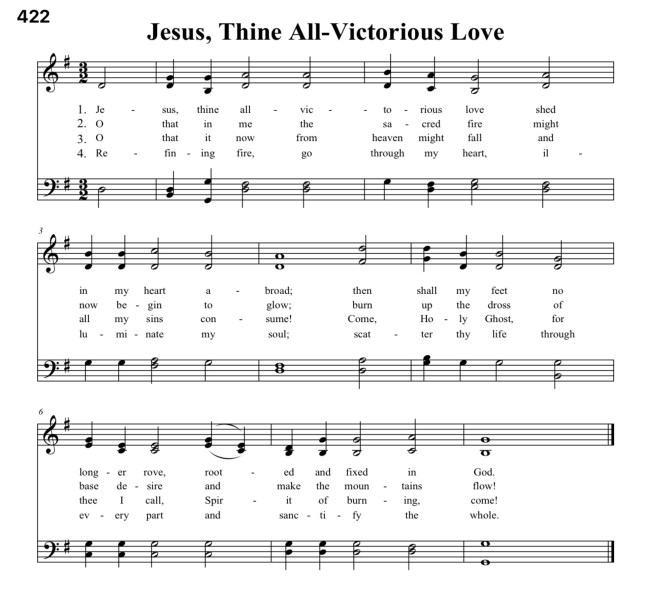
“Jesus, Thine All-Victorious Love,”
by Charles Wesley
The United Methodist Hymnal, No. 422.

Methodists need no introduction to Charles Wesley. For that matter, neither do most singing Christians! Perhaps no other hymn writer except Isaac Watts is so well loved as Charles Wesley. Few were as prolific, at least, or as wide-ranging with regard to the theological topics they addressed….

“Jesus, Thine All Victorious Love” is found in the United Methodist Hymnal at No. 422. As with many Wesley hymns that we sing today, the four stanzas given in the UMH are but part of a much longer hymn called “My God! I know, I feel thee mine.” The complete hymn is found in Collection of Hymns for the Use of the People Called Methodists in the section, “For Believers, Groaning for Full Redemption.” Atop the hymn text in the early editions sits a scripture reference to Romans 4:13, which speaks of the promise God made to Abraham and the righteousness of his faith. The full hymn has twelve stanzas, which can be divided thematically into four groups. Stanzas 1 to 3 articulate an individual’s desire for intimate communion with God the Father using physical, even visceral, images. Stanza 2 is particularly beautiful and connects to the passage from Romans 4, using the language of faith:

I hold Thee with a trembling hand,
But will not let Thee go,
Till steadfastly by faith I stand,
And all Thy goodness know.

This opening group of stanzas speaks of how such an intimate relationship with God not only sustains us, but gives us “health, and life, and power, and perfect liberty.” The use of superlatives such as “all Thy goodness” and “perfect liberty” highlights well the Wesleyan idea of Christian perfection.

The second section focuses on the love of Jesus and that love’s redemptive power. There are several scriptural images at play, and as one might expect from Wesley, or indeed from most anyone writing about love, conversion of the heart is central to this section. The United Methodist Hymnal version begins with this stanza, which is number 4 in the original.

Jesus, thine all victorious love
shed in my heart abroad;
then shall my feet no longer rove,
rooted and fixed in God.

The third section of the text focuses on the Holy Spirit; its three stanzas are all included in The United Methodist Hymnal. One particularly potent stanza speaks of the sanctifying power of the Spirit, highlighting another key tenet of Wesleyanism.

Refining fire, go through my heart,
Illuminate my soul;
Scatter Thy life through every part,
And sanctify the whole.

The fourth section brings to completion the sanctification of the believer and the experience of Christian perfection. The poetry of Wesley’s final stanza is both beautiful and unequivocal in its theological witness:

My steadfast soul from falling free,
Shall then no longer move;
But Christ be all the world to me,
And all my heart be love.

Those who might bravely choose to sing all twelve stanzas of this hymn would experience a beautiful, thoroughly trinitarian witness to the redemptive power of God’s love in Jesus Christ through the sanctification of the Holy Spirit. However, most congregations will probably opt to sing a subset of stanzas. The four stanzas found in the United Methodist hymnal are well suited to the Easter season. Beginning with a stanza about the “victorious love” of Jesus Christ reminds us of Jesus’s resurrection and victory over death, that is, of Easter. Following that stanza, then, the next three stanzas about the working of the Spirit seem to suggest the kind of liturgical flow that the Church experiences in the transition from Easter to Pentecost. That liturgical flow is made especially apparent in Year C of the Sunday lectionary, when the gospel of Luke is read.

“Jesus, Thine All Victorious Love” is a common meter text (8.6.8.6.) and could be sung to a great many tunes. It is often paired with Lowell Mason’s version of AZMON, which is ideal for most stanzas of the text. The iambic structure of the hymn aligns well with the fact that AZMON begins with a pickup note. However, because two lines of the stanza “Jesus, thine all victorious love” begin with a stressed syllable (“Je-sus” and “root-ed”), using AZMON, which has both a pickup and fast note values on the downbeat of each measure, could be awkward. One might consider singing the hymn to a common meter tune that begins without a pickup, such as ST. AGNES. Regardless of the tune chosen, though, or the number of stanzas one endeavors to sing, “Jesus, Thine All Victorious Love” is an exemplary Wesleyan hymn. Consider it the next time you sing during Eastertide.

Adapted from https://www.umcdiscipleship.org/resources/history-of-hymns-jesus-thine-all-victorious-love-wesley


Tags: , , , , , , , ,

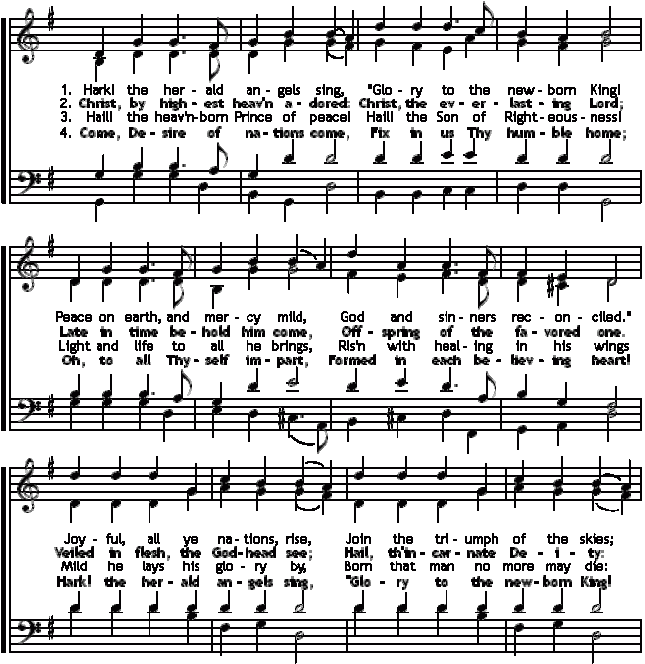
Charles Wesley: Hark the Herald Angels Sing

Hark the Herald Angels Sing
In Honor of Charles Wesley ‘s birthday today.   Wesley (1707-1788),  the younger brother of John Wesley wrote the words to this Christmas Carol.

Charles was a hymn writer and a poet, also known as one of the people who began the Methodist movement in the Church of England. Hark the Herald Angels Sing appeared in 1739 in a book called Hymns and Sacred Poems.

Wesley envisioned this being sung to the same tune as his hymn, Christ the Lord Is Risen Today,  and in some hymnals it is included along with the more popular version.

This hymn was regarded as one of the Great Four Anglican Hymns and published as number 403 in “The Church Hymn Book” (New York and Chicago, USA, 1872).

To celebrate the invention of the printing press, Felix Mendelssohn composed a cantata in 1840 called Festgesang or “Festival Song”. The melody of Mendelssohn’s cantata was then used by William H. Cummings and adapted it to the lyrics of Wesley’s “Hark the Herald Angels Sing”.

Hark the herald angels sing
“Glory to the newborn King!
Peace on earth and mercy mild
God and sinners reconciled”
Joyful, all ye nations rise
Join the triumph of the skies
With the angelic host proclaim:
“Christ is born in Bethlehem”
Hark! The herald angels sing
“Glory to the newborn King!”

And, of course, no one can do it better than The Mormon Tabernacle Choir.

 
Leave a comment

Posted by on December 18, 2020 in Christmas Music, Holidays, Posts of Interest


Tags: , , , , , , , , , , , , , , ,