RSS

Tag Archives: congregation

Hymn History: All Hail the Power of Jesus’ Name


“All hail the power of Jesus’ name!
Let angels prostrate fall,
bring forth the royal diadem,
and crown him Lord of all.”

“All Hail the Power of Jesus Name” was the opening hymn at Pender’s 9:00 am Traditional Service on July 30, 2023 It was sung by Pender’s congregation, accompanied on piano by Heidi Jacobs and violin by Sean Wittmer.

The Pender UMC Traditional Service Opening Hymn “All Hail the Power of Jesus’ Name” on Sunday July 3, 2022 was played by Liz Sellers on piano and sung by the Pender Congregation.

The popularity of this late-18th-century hymn may be attested by the fact it appears in hymnals with as many as three different tunes: CORONATION, DIADEM and MILES’ LANE. Each tune reflects a different cultural and denominational context in which this text is sung.

Another unusual aspect of “All Hail the Power of Jesus’ Name” is the number of modifications that have been made from the original text.

The original hymn text dates from 1779 and 1780, and was first printed in November 1779 in the Gospel Magazine, a publication by “Rock of Ages” composer Augustus M. Toplady. An eight-stanza version appeared just a year later in the same magazine titled, “On the Resurrection. The Lord is King.”

Massive alterations began as early as 1787 when the text was included in John Rippon’s Selection of Hymns with the title “The Spiritual Coronation, Canticles 3:11”—a reference to the Song of Songs: “Go forth, O ye daughters of Zion, and behold King Solomon with the crown wherewith his mother crowned him in the day of his espousals, and in the day of the gladness of his heart.”

British hymnologist and literary scholar J.R. Watson notes, “By applying Solomon’s crowning to this hymn, the Old Testament reference is seen as Solomon’s prefiguring of Christ.”

Among the most notable changes made by Rippon was the final stanza. Perronet originally wrote:

“Let every tribe and every tongue
That bound creation’s call,
Now shout in universal song
The crowned Lord of all.”

Rippon’s version, which took hold in the early 19th century and remains in constant use today, is:

“O that with yonder sacred throng
We at his feet may fall,
We’ll join the everlasting song,
And crown him Lord of all.”

Perronet (1726-1792) was born in Sundridge, England, and died in Canterbury. His family came from the Huguenots of Switzerland, and according to The UM Hymnal editor Carlton Young, “was closely associated with and esteemed by the Wesleys.”

Against the desires of John Wesley, Perronet promoted the idea that Methodist preachers should be able to administer the sacrament of the Lord’s Supper. In another controversial act, Perronet published a satire on the Church of England, The Mitre, angering the Countess of Huntingdon in whose chapel he served. As a result, he left to become a minister in the independent chapel in Canterbury.

Working together for a time, Wesley encouraged Perronet to preach, but Perronet preferred to defer to Wesley. The Methodism founder persisted, however, and announced that, “Brother Perronet will now speak.” Perronet stood before a large crowd and declared, “I will now deliver the greatest sermon ever preached on earth.” He then read the Sermon on the Mount and promptly sat down.

The tunes commonly associated with this famous text reveal much about this joyful expression of the 18th-century evangelical revival movement. CORONATION is a tune by American Oliver Holden (1792) and was first published in Boston in 1793. A stately tune in duple meter, it has the character of a coronation march.

DIADEM was composed by James Ellor in 1838 at the age of 19 for the anniversary of a Wesleyan Sunday school in his hometown of Droylsden, Manchester. This tune, in triple rhythm, has the feel of a stately minuet and suggests an anthem to be sung by a choir, especially with the independent parts of the refrain. It is indeed thrilling to hear congregations or church musicians sing this version in four parts.

The tune originally paired with this text, MILES’ LANE, does not appear in The United Methodist Hymnal. Written by William Shrubsole (1760-1806), it is less favored, in light of the other more buoyant tune options.

Regardless of the tune, the version we sing today leaves no doubt that the entire earth—from the “chosen seed of Israel’s race” and “sinners” and “martyrs” to “every kindred, every tribe on this terrestrial ball”—will sing the “everlasting song” at Jesus’ feet. Now that will be a song to hear!

Dr. Hawn is professor of sacred music at Perkins School of Theology.

Adapted from https://www.umcdiscipleship.org/resources/history-of-hymns-all-hail-the-power-of-jesus-name


Tags: , , , , , , , , , , ,

Hymn History: Love Divine, All Loves Excelling

“Love Divine All Loves Excelling was the opening hymn at Pender’s 9:00 am Traditional Service on July 23, 2023 It was sung by Pender’s congregation, accompanied on piano by Heidi Jacobs and flute by Brian Stevenson.

The Pender UMC Traditional Service Opening Hymn “Love Divine, All Loves Excelling” on Sunday June 26, 2022 was accompanied by Liz Sellers on piano and sung by the Pender Congregation.

Watch the entire service here


Love Divine, All Loves Excelling was the opening hymn sung by Pender’s Choir and Congregation on September 19, 2021 at the Traditional Service.

The clarinet was played by Brian Stevenson

The flute was played by Jane McKee

The organ was played by Liz Eunji Sellers

Watch the entire service here


“Love Divine, All Loves Excelling”
Charles Wesley
UM Hymnal, No. 384

Love divine, all loves excelling,
joy of heaven to earth come down;
fix in us thy humble dwelling;
all thy faithful mercies crown!

Jesus, thou art all compassion,
pure, unbounded love thou art;
visit us with thy salvation;
enter every trembling heart.

Charles Wesley (1707-1788) was a prolific hymn writer of the 18th century. Coming from a musical family, he left a lasting legacy of congregational song.

The youngest of 18 children, Charles possessed prodigious talents that soon blossomed. Little did he know that “Love Divine, All Loves Excelling,” would rise to become one of the most popular and consistently vocalized Christian songs.

Writing hymn texts that are solidly based on the Scriptures gives them an appeal across denominational lines. It is estimated that during his lifetime, Wesley penned more than 9,000 poems of a spiritual nature, 6,000 of which are hymns. His writings were passionate and well-crafted, conveying the true essence of Christian teaching.


Tags: , , , , , , , , , , , , , ,

Hymn History: Come, Thou Fount of Every Blessing

For Pentecost May 28, 2023, Pender’s choir sang Come Thou Fount directed by Brian Stevenson and accompanied on piano by Heidi Jacobs.

The Pender UMC Traditional Service Opening Hymn “Come, Thou Fount of Every Blessing” on Music Appreciation Sunday June 12, 2022 was accompanied by Liz Sellers on piano, Brian Stevenson on Irish whistle, AJ Rios on drums and sung by the Pender Sanctuary Choir and Congregation.

Perhaps all hymns are to some extent autobiographical in that they reveal something of the author’s spiritual experience. In some hymns, the autobiographical thread is stronger and more obvious. Such is the case with British Baptist hymn writer Robert Robinson (1735-1790), who as a barber’s apprentice, fell under the powerful influence of George Whitefield’s preaching.

A favorite line in the last stanza, “Prone to wander, Lord, I feel it, prone to leave the God I love,” is thought to be particularly autobiographical, referring to Robinson’s early life, when his mother sent him to London to be an apprentice. It was during this time, according to hymnologist Kenneth Osbeck, that “he associated with a notorious gang of hoodlums and lived a debauched life” until he came under the spell of Whitefield.

After his conversion in 1755, Robinson first preached at a Calvinistic Methodist chapel at Mildenhall, Suffolk, and then founded his own independent congregation at Norwich. He was re-baptized in 1759 after taking up Baptist theological perspectives.

This led to his nearly 30-year relationship (1761-1790) as pastor of Stone Yard Baptist Church at Cambridge. Baptist hymnologist William Reynolds notes that Robinson “was an unusual man, and, while lacking formal education, he rose to great prominence as a preacher, scholar.” Robinson published A History of Baptism in 1790.

“Come, thou Fount of every blessing,” written in 1758, was the first hymn in A Collection of Hymns for the use of the Church of Christ, Meeting in Angel-Alley, Whitechappel . . . (1759). Martin Madan included the first three stanzas in his Collection of Psalms and Hymns (1760), which established the practice of eliminating the original fourth stanza.

UM Hymnal editor Carlton Young laments the omission, saying it “eliminates the apocalyptic climax of the author’s invitatory prayer to the Holy Spirit.”

The missing stanza follows:

O that Day when freed from sinning,
I shall see thy lovely Face;
Clothed then in blood-washed Linnen [sic]
How I’ll sing thy sovereign grace;
Come, my Lord, no longer tarry,
Take my ransom’d Soul away;
Send thine Angels now to carry
Me to realms of endless Day.

One of the most obvious biblical allusions appears in stanza two: “Here I raise mine Ebenezer/ hither by thy help I’m come.” The Hymnal Revision Committee for the 1989 United Methodist Hymnal received requests to alter this stanza by omitting the term “Ebenezer,” which means “Stone of Help,” a reference to 1 Samuel 7:12: “Then Samuel took a stone and set it up between Mizpah and Jeshanah, and named it Ebenezer; for he said, ‘Thus far the Lord has helped us.’” But not finding a suitable substitute, the Committee chose to maintain the original language.

On this side of the Atlantic, the tune NETTLETON has been the most common but not exclusive musical setting for this famous and well-loved text. NETTLETON first appeared in John Wyeth’s Repository of Sacred Music, Part Second (1813).

Adapted from https://www.umcdiscipleship.org/resources/history-of-hymns-come-thou-fount-of-every-blessing


Tags: , , , , , , , , , , , ,

Hymn History: Grace Greater than All my Sin

“Grace Greater Than Our Sin” was the final hymn at Pender’s 9:00 am Traditional Service on June 18, 2023 It was sung by Pender’s congregation, accompanied on piano by Heidi Jacobs and guitar by Brian Stevenson.

The Pender UMC Traditional Service Closing Hymn “Grace Greater than All my Sin” on Music Appreciation Sunday June 12, 2022 was accompanied by Liz Sellers on piano, Brian Stevenson on Irish whistle, AJ Rios on drums and sung by the Pender Sanctuary Choir and Congregation.

“Grace Greater than Our Sin”
Julia H. Johnston
The UM Hymnal, No. 365

Marvelous grace of our loving Lord,
Grace that exceeds our sin and our guilt!
Yonder on Calvary’s mount outpoured,
There where the blood of the Lamb was spilt.

Grace, grace, God’s grace,
Grace that will pardon and cleanse within;
Grace, grace, God’s grace,
Grace that is greater than all our sin!

Julia Harriette Johnston (1849-1919) was the daughter of a Presbyterian minister who served First Presbyterian Church, Peoria, Ill. She lived in Peoria from age 6.

Johnston was faithful to the ministries of the church, serving as a Sunday school superintendent and teacher for 41 years. She was also president for two decades of the Presbyterian Missionary Society, an organization founded by her mother.

She authored several books including Indian and Spanish Neighbors (1905) and Fifty Missionary Heroes (1913). In addition to many Sunday school lessons, she also wrote about 500 hymn texts; today her reputation rests primarily upon the hymn “Grace Greater than Our Sin.”

The writer contrasts the theme of God’s abundant grace—manifest through the sacrifice of Christ on the cross—with “our sin and our guilt” (stanza one), “sin and despair” (stanza two), and a “dark . . . stain” (stanza three).

This “marvelous, infinite, matchless grace, freely bestowed on all who believe,” finds a scriptural basis in Paul’s teaching of justification by faith in Romans 5:1-2: “Therefore being justified by faith, we have peace with God through our Lord Jesus Christ: By whom also we have access by faith into this grace wherein we stand, and rejoice in hope of the glory of God.”

Paul continues in verses 14-16, “Nevertheless death reigned from Adam to Moses, even over them that had not sinned after the similitude of Adam’s transgression, who is the figure of him that was to come. But not as the offence, so also is the free gift of grace. For if through the offence of one many be dead, much more the grace of God, and the gift by grace, which is by one man, Jesus Christ, hath abounded unto many. And not as it was by one that sinned, so is the gift: for the judgment was by one to condemnation, but the free gift is of many offences unto justification.”

The text and tune of the hymn first appeared in Hymns Tried and True, a 1911 collection by composer Daniel B. Towner (1850-1919). According to UM Hymnal editor Carlton Young, Towner was “a distinguished Methodist musician.” He studied first with his father and then with famous gospel song composers such as George Root and George Webb.

Towner then served in Methodist Episcopal churches in New York, Ohio and Kentucky. In 1893 he was named head of the music department at Moody Bible Institute in Chicago, working with the famous evangelist Dwight L. Moody. Dr. Young notes that Towner “composed over 2,000 songs and was associated with the publication of fourteen collections.”

Baptist hymnologist William J. Reynolds noted that the name MOODY was given to this tune in recognition of Towner’s association with and service to Moody Bible Institute and its founder.

Dr. Hawn is professor of sacred music at Perkins School of Theology, SMU.

Adapted from https://www.umcdiscipleship.org/resources/history-of-hymns-grace-greater-than-our-sin


Tags: , , , , , , , , , , , , , ,

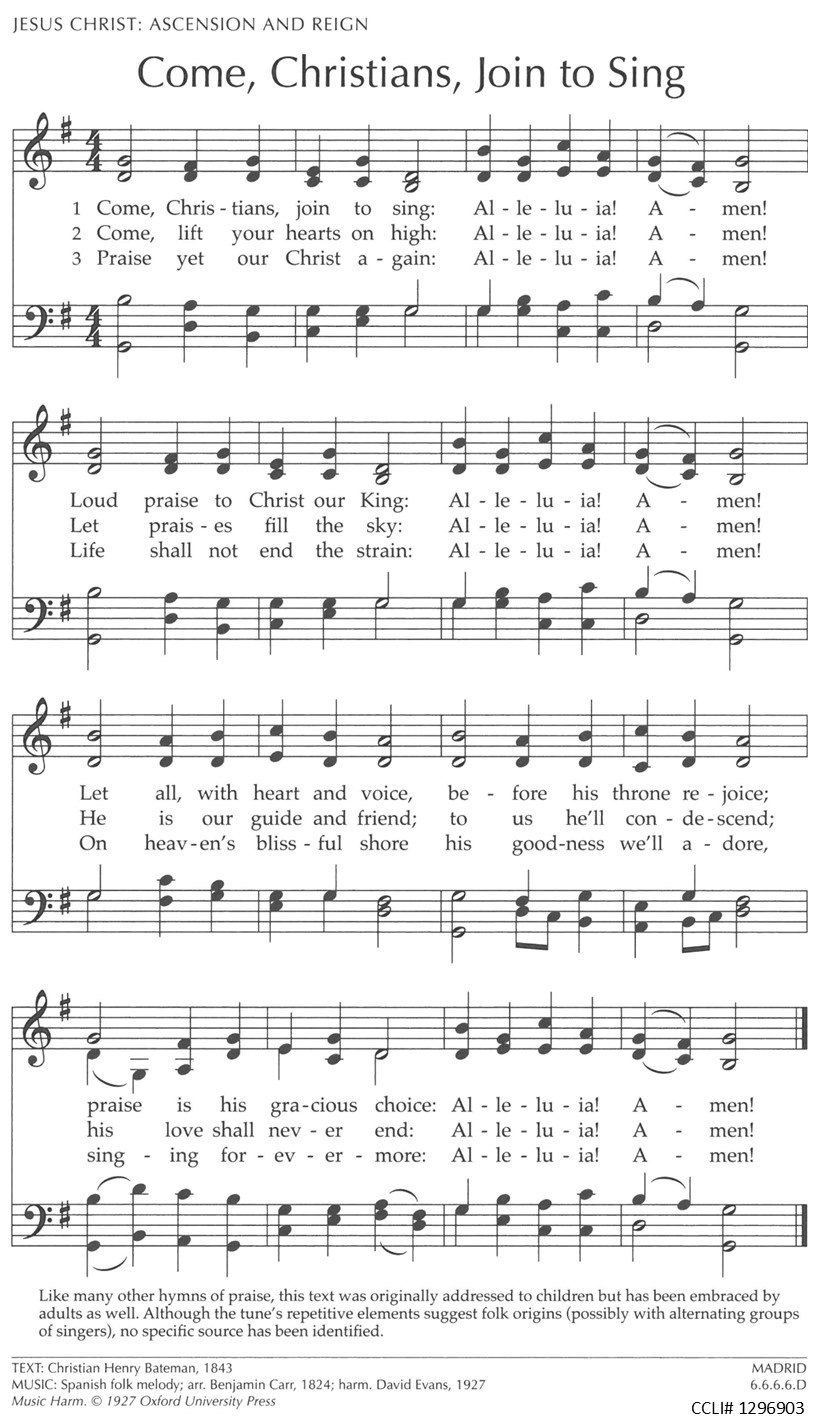
Hymn History: Come, Christians, Join to Sing


“Come, Christians, Join to Sing” was the closing hymn at Pender’s Music Appreciation Sunday on June 11, 2023. It was sung by Pender’s congregation and Sanctuary Choir, accompanied on piano by Heidi Jacobs and combined handbell choirs (Joy and Carillon Ringers) directed by Brian Stevenson.

“Come, Christians, Join to Sing” was the opening hymn at Pender’s Traditional Service on May 29, 2022. It was accompanied by piano (Liz Sellers) and organ (Brian Stevenson).

“Come, Christians, Join to Sing”
Christian Henry Bateman
UM Hymnal, No. 158

Come, Christians, join to sing:
Alleluia! Amen!
loud praise to Christ our King:
Alleluia! Amen!
Let all, with heart and voice,
before his throne rejoice;
praise is his gracious choice.
Alleluia! Amen!

Christian Henry Bateman (1813-1899) was ordained into the Church of England after being a Congregational minister.

His ministerial studies were under the auspices of the Moravian Church, where he served for a time before changing to the Congregational Church at age 30. Following his ministry at Richmond Place Congregational Church in Edinburgh, Scotland, and successive Congregational parishes in Hopton, Yorkshire, and Reading, Berkshire, he took Holy Orders in the Anglican Church at age 56 and served as a curate and vicar in several Anglican parishes.

Australian hymnologist Wesley Milgate (1916-1999) noted that Bateman’s hymn is actually a rewritten version of the hymn “Join Now in Praise, and Sing” by William Edward Hickson (1803-1870). Hickson’s text uses the same melody, MADRID (SPANISH HYMN), and is structured in much the same way. Compare Bateman’s text at the beginning of this article with the first stanza of Hickson’s hymn:

Join now in praise, and sing
Hallelujah, Amen!
Praise to our heavenly King,
Hallelujah, Amen!
By love and gratitude
Still be the song renewed,
And be our hearts subdued,
Hallelujah, Amen!

Bateman probably found the earlier hymn in the collection Hickson published, Singing Master (1836). Hickson’s five stanzas were reduced to three by Bateman and first appeared in a collection published in Edinburgh, Sacred Melodies for Children (1843). The original “Hallelujah, Amen!” was changed by the Presbyterian Church in the U.S.A., in their 1933 hymnal, to “Alleluia! Amen!” It has remained that way ever since.

Each stanza begins with an exhortation—an imperative command to “Come” or “Praise.” In stanza one, Bateman provides the children with the reason for singing: We offer “loud praise to Christ our King . . . before his throne. . . .” Christ desires our praise: “praise is his gracious choice. . . .”The original incipit (opening line of the hymn) was “Come, children, join to sing.” Though changed in the Presbyterian hymnal to include all age groups, Bateman’s text contains direct, uncomplicated language suited for children. Since very few of the words have more than two syllables and “Alleluia! Amen!” is interjected three times in each stanza, the hymn is easy for children to learn and sing.

Stanza two reassures the children (and all of us) that this King is also “our guide and friend” and that “his love shall never end.” This King will “condescend” to be a friend to the children. To condescend surely did not mean to patronize as it tends to mean today, but implies that Christ the King humbles himself to be in a personal relationship with us.

Stanza three ends on an eschatological note. The author reassures children that they need not fear death. Beyond life, our songs will continue on “heaven’s blissful shore . . . singing forevermore: Alleluia! Amen!”

Dr. Hawn is professor of sacred music at Perkins School of Theology.

Adapted from https://www.umcdiscipleship.org/resources/history-of-hymns-come-christians-join-to-sing


Tags: , , , , , , , , , , ,