RSS

Tag Archives: Heidi Jacobs

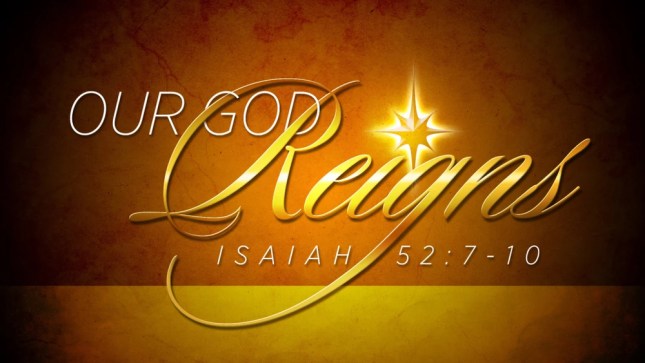
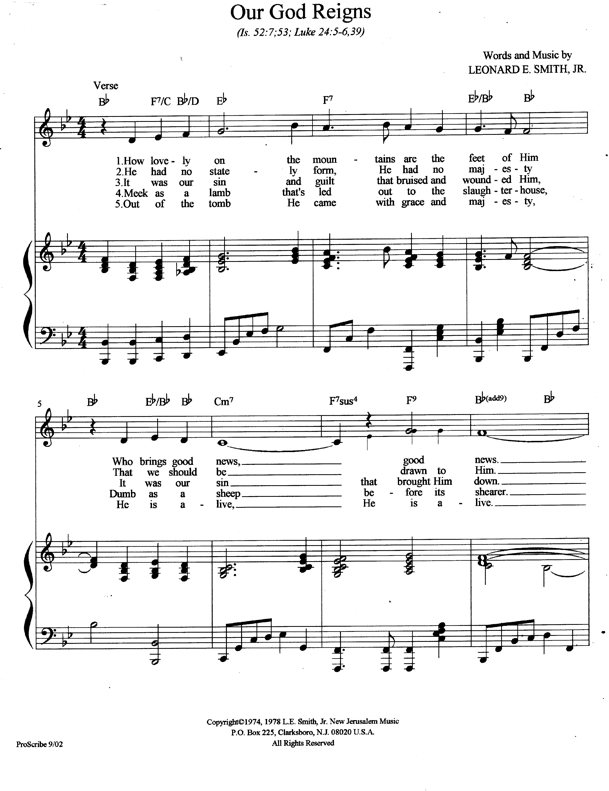
Pender Music: Our God Reigns

Our God Reigns, World Communion Sunday, October 5, 2025

On this special Sunday at Pender United Methodist Church, the opening hymn was “Our God Reigns” by Leonard Smith. It was joyfully sung by the Pender Sanctuary Choir and congregation under the direction of Patrick King, Director of Music Ministries, accompanied by Wenru Yang on piano.

This uplifting hymn reminds us of God’s sovereignty and grace that unites believers around the world. On this 17th Sunday after Pentecost, we join Christians everywhere in proclaiming: Our God reigns!

“How lovely on the mountains are the feet of him who brings good news, who proclaims peace, who brings glad tidings, who proclaims salvation, who says to Zion, ‘Your God reigns!’” — Isaiah 52:7

May this song inspire gratitude and unity as we remember that God reigns over all nations, all people, and all hearts.

“Our God Reigns” | Offertory at Pender UMC | January 5, 2025

On January 5, 2025, during a special Epiphany service at Pender United Methodist Church, the offertory featured a moving performance of “Our God Reigns” by Leonard Smith.

The anthem was beautifully sung by the Pender UMC Sanctuary Choir, under the direction of Patrick King, Pender’s Director of Music Ministries, accompanied by Abe Garver on cello and Heidi Jacobs on piano. This heartfelt rendition reminded us of the power and majesty of God’s reign, adding a deeply spiritual element to the worship service.

We are grateful to our singers, Patrick, Abe, and Heidi for sharing their incredible talents and inspiring us through this timeless anthem.

Pender UMC Sanctuary Choir Presented “Our God Reigns”

On August 25, 2024, the Pender UMC Sanctuary Choir, under the direction of Patrick King, delivered a powerful performance of “Our God Reigns” by Leonard E. Smith, Jr., inspired by Isaiah 52:7. This uplifting song, celebrating the message of salvation and God’s sovereignty, was beautifully accompanied by Mark Severeniuk on tuba and Heidi Jacobs on piano.

Isaiah 52:7 speaks of “good news,” originally referring to Israel’s delivery from captivity and return to Jerusalem. Today, Christians sing these words to celebrate our delivery from sin through Christ (Romans 10:15-16), who brings salvation and a restoration of God’s rule, resulting in peace and happiness. The song text skillfully combines Isaiah’s message with the timeless theme from the Psalms: Our God reigns!

Join us in this celebration of faith and let the music remind you of the everlasting reign of our God.

How lovely on the mountains are the feet of him
who brings good news, good news;
Announcing peace, proclaiming news of happiness:
our God reigns, our God reigns!

Refrain:
Our God reigns, our God reigns, our God reigns,
our God reigns, our God reigns!

Leonard E. Smith, Jr., (b. Philadelphia, PA, 1942) composed this song in 1973 in Riverton, New Jersey. Educated at Mount St. Mary’s Seminary in Emmitsburg, Maryland, where he received a BA in philosophy, Smith first taught in public high schools, but his evangelical efforts in the schools created problems, resulting in his dismissal. He then began painting houses to support his family.

One night as he was reading Isaiah 52 he was overwhelmed by the conviction that God was in control of his life and of all creation; he wrote this song that night in just five minutes. The song was first sung at New Covenant Community Church, where Smith served as worship leader. Though not published for some time, it became known internationally when evangelist Bob Mumford included it in his crusades. It was first published in a Servant Publications hymnal, Songs of Praise (vol. 2, 1977). In 1978 Smith added four additional verses. He has published over 130 Scripture songs with New Jerusalem Music Co.

From Today’s Christian Living: The Story Behind the World-Renowned Song “Our God Reigns”
By Leonard E. Smith

Sometimes you have to reach bottom before you look up to see God at work. Back in 1973, I was out of work again and depressed — actually very depressed. My wife and I had a son, an apartment, a car, and lots of bills to pay. I had also made myself unemployable as a high school teacher with just too much Jesus talk in class. I guess I was naive to think that talking about Jesus was more important than teaching Latin or English literature.

One morning I was reading the Bible and came to Isaiah 52:7: “How lovely on the mountains are the feet of Him Who brings good news, announcing peace, proclaiming news of happiness: your God reigns.” My heart began pounding in my chest because, through what I read, God spoke to me: “You’re going to get through this, and you will be fine. In fact, you’ll do very well.” I just felt the dark cloud lift off me. I picked up my guitar and, in a few minutes, Our God Reigns was born! I had one verse and the chorus. It wasn’t so much that I wrote it as I received it!

How lovely on the mountains are the feet of Him
Who brings good news, good news
Announcing peace, proclaiming new of happiness
Our God reigns, Our God reigns!
Our God reigns! Our God reigns! Our God reigns!

A couple of months later, a traveling evangelist visited our church, heard the song, and taught it as he went from church to church. It took me three more years to complete the other verses that made this Scripture chorus into a hymn that went around the world.

After the three big Christian music publishers passed on publishing my song in the late ’70s, I decided to keep the copyright and establish New Jerusalem Music to manage my songs, as well as the songs of our friends and my son, Daniel C. Smith, of the group Danielson Family. The decision to create my own music company worked out incredibly well over the decades. This was the fulfillment of His promise all those years ago when He told me that I would do very well. I know we really do have a Good Shepherd who is guiding us, closing doors, and opening doors.

Every one of us has experienced disappointment and failure and had our hearts broken. But we don’t need to be bitter about it. If we look closely, we’ll see how God worked it out for our good. Over time, we become more understanding, more patient, and kinder to others who have been overlooked and forgotten. We must not forget that suffering is the very thing God uses to refine and strengthen us. Jesus set the pattern that crucifixion comes before resurrection.

I would never have taken up learning how to play the guitar in seminary in the ‘60s if I hadn’t been so desperately lonely for so long. And I would never have started writing Scripture songs if I hadn’t so deeply needed the comfort of the Psalms of David, who also knew something of loss and pain and heartbreak.

Looking back, I’m grateful I was fired from that last teaching job. It proved to be the door God closed before He opened a new door for me. That open door has allowed me to enter into a wonderful new world. Thank you, Lord, for being such a good, loving, kind, faithful Shepherd. I know I’m in Your good hands and that will never change.
 

Tags: , , , , , , ,

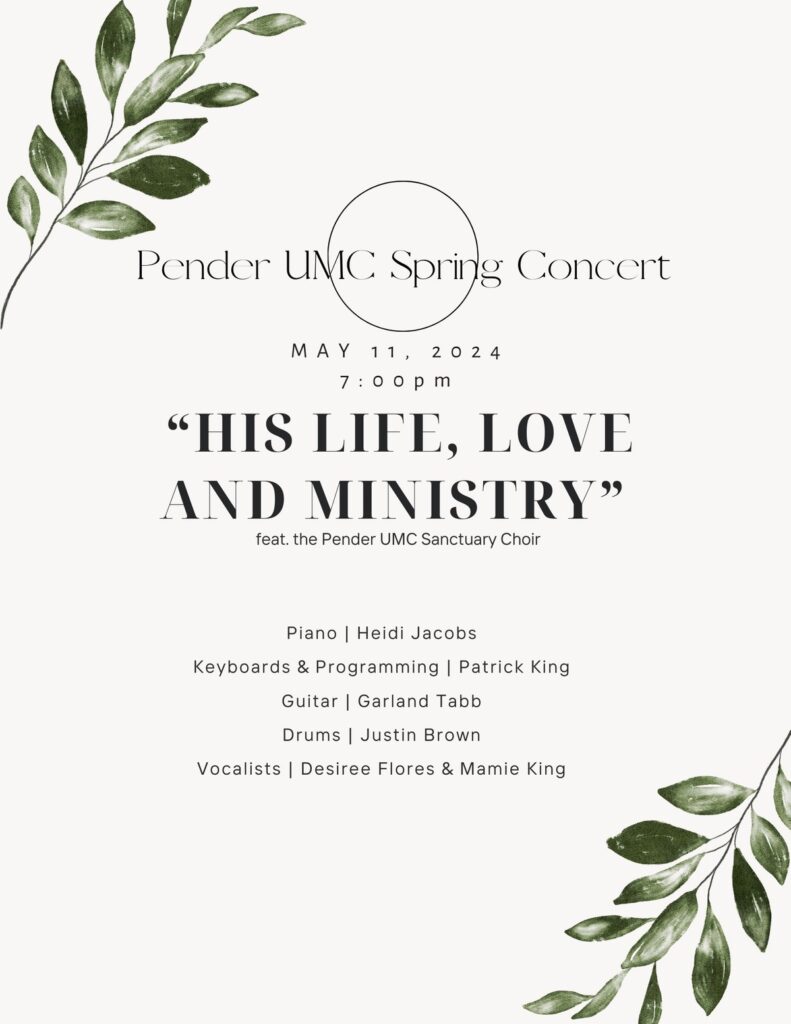
Pender UMC Spring Concert

Pender Spring Concert Series concert in the Sanctuary with a  reception to follow in the Gathering Place.


Tags: , , ,

Hymn History: Standing on the Promises


“Standing on the Promises”
R. Kelso Carter
UM Hymnal, No. 374

The Pender UMC Traditional Service Middle Hymn “Standing on the Promises”, Sunday February 25, 2024 was played by Hetty Jacobs on piano and sung by the Sanctuary Choir and congregation.  This was the second Sunday in Lent.

“Standing on the Promises” was the middle hymn at Pender’s 9:00 am Traditional Service on June 18, 2023 It was sung by Pender’s congregation, accompanied on piano by Heidi Jacobs and guitar by Brian Stevenson.

The Pender UMC Traditional Service Opening Hymn “Standing on the Promises” on Sunday November 6, 2022 was played by Liz Eunji Moon on piano, accompanied on guitar by Brian Stevenson and sung the Pender Sanctuary Choir and congregation.

Standing on the promises of Christ my King,
Through eternal ages let his praises ring;
Glory in the highest, I will shout and sing,
Standing on the promises of God.

Russell Kelso Carter (1849-1928) was a man of diverse interests and abilities. A native of Baltimore, Md., Carter was known as an outstanding athlete in his younger days. The Methodist Holiness camp meeting movement had a profound impact on his life and he was ordained into ministry in 1887.

Carter held a number of teaching posts at the Pennsylvania Military Academy including professor of chemistry, natural science, civil engineering and mathematics. Not only did he teach, but he also published text books in his various disciplines and even authored several novels. Other interests included sheep-raising and practicing medicine.

If this were not enough, Carter also edited hymnals. He assisted A.B. Simpson in the compilation of a hymnal for the Christian and Missionary Alliance Church, Hymns of the Christian Life (1891), a collection that contained 68 of his tunes and 52 of his texts.

“Standing on the Promises” was composed in 1886 while Carter was teaching at the military academy. He was a member of the first graduating class in 1867 and had a strong affinity for the school. Author Phil Kerr makes a connection between the music and the military academy in his book, Music in Evangelism, stating that Carter’s military experience was reflected in the martial musical style of the hymn.

Published the year it was written in the collection, Songs of Perfect Love, edited by John K. Sweeny and Carter, the original text had five stanzas. The missing stanza reads:

Standing on the promises I now can see
Perfect, present cleansing in the blood for me;
Standing in the liberty where Christ makes free,
Standing on the promises of God.

The second line of this stanza has a particular Wesleyan tone with its focus on perfection and cleansing blood. The Rev. Carlton Young, editor of the UM Hymnal, notes: “As in other single-theme evangelical hymns and songs of this period, the biblical source of the hymn is not clear. ‘Stand firm’ from Ephesians 6:14 has often been cited as the theme of the hymn, although the word ‘promise’ tends to be reinforced as well.”

Thus, two passages of Scripture seem to undergird the central premise of this gospel song: “Stand firm then, with the belt of truth buckled around your waist, with the breastplate of righteousness in place. . . .” (Ephesians 6:14). Several passages relate to the promises of God including 2 Samuel 22:31: “As for God, his way is perfect; the word of the LORD is tried; he is a buckler to all them that trust in him.”

Dr. Young points out that this hymn was not included in authorized hymnals for Methodists (or in the 1957 hymnal of the Evangelical United Brethren Church) until the current hymnal. He states, “Its place in our hymnal came from its inclusion in a list of hymns determined to be widely used by evangelical United Methodists.”

As is the case of many gospel songs, this song revolves around its refrain. The stanzas, rather than serving to develop a sequential train of thought, are more like the spokes of a bicycle—all serving as an entry point to the refrain from various perspectives. One could reorder the stanzas and not lose any train of thought.

Hymnologist Kenneth Osbeck places the hymn in its context: “The hymn has been widely used in the great evangelistic crusades throughout the past century.” It is in this context that its single focus and rousing, martial music may be best suited.

Adapted from https://www.umcdiscipleship.org/resources/history-of-hymns-stirring-promises-serves-as-popular-crusade-hymn


Tags: , , , , , , , , , ,

Hymn History: Rejoice, Ye Pure in Heart

“Rejoice, Ye Pure in Heart”
Edward H. Plumptre
The UM Hymnal,  Nos. 160 and 161

Rejoice, ye pure in heart;
rejoice, give thanks, and sing;
your glorious banner wave on high,
the cross of Christ your King.
Rejoice, rejoice, rejoice, give thanks, and sing.

“Rejoice Ye Pure in Heart” was the middle hymn at Pender’s 9:00 am Traditional Service on October 15, 2023 It was sung by Pender’s Sanctuary choir, congregation, directed by Patrick King and accompanied on piano by Heidi Jacobs.

The Pender UMC Traditional Service Closing Hymn “Rejoice, Ye Pure in Heart” on May 29, 2022 was directed by Brian Stevenson and accompanied by Liz Sellers on piano and sung by the Pender Sanctuary Choir and Congregation.

Anglican priest and professor Edward Hayes Plumptre (1821-1891) composed “Rejoice, ye pure in heart” as a processional hymn for a choir festival in one of England’s majestic places of worship, Peterborough Cathedral.

Writing in the mid-20th century with perhaps a hint of condescension, hymnologist Albert Bailey describes the context for this hymn by saying that the “untravelled American can hardly realize the emotional effect of a processional made up of choirs from a dozen different communities, marching with full panoply through ‘long-drawn aisle’ and under ‘fretted vault’ while we hear:

The storm their high-built organs make,
And thunder-music, rolling, shake
The prophets blazoned on the panes.

“The massiveness of the old Norman Peterborough makes a marvelous background and amplifier for such a processional.”

Plumptre was a distinguished scholar of his day. Educated at University College, Oxford, he then became a fellow at Brasenose College, Oxford, receiving his ordination in the Anglican Church in 1846. After serving as a clergyman, he became chaplain and professor of New Testament exegesis at King’s College, London, and dean of Queen’s College, Oxford. His most prominent position as a clergyman was that of dean of Wells Cathedral.

Of the original 11 stanzas, five or six stanzas appear in most hymnals. Stanza one refers (in the original text) to the “festal banner” and “Cross of Christ your King,” symbols of the faith that would be carried at the head of such a procession in the Anglican context.

Omitted stanzas refer to this processional in martial terms as warriors who “march in firm array.” This kind of imagery is not only consonant with the times, but also reflects the theology of the Anglican Communion that views its role on earth as the “Church Militant” while the church in heaven is the “Church Triumphant.”

Of course, the music used for this text must reflect the spirit of a stately processional. American hymnologist Leonard Ellinwood said that the tune MARION was written for this text by Arthur Messiter (1834-1916). Messiter added the refrain drawn from the first two lines of stanza one: “Rejoice, rejoice, rejoice give thanks and sing” echoes Philippians 4:4, “Rejoice in the Lord always; again I will say, Rejoice.”

Hymnologist William Reynolds noted that it “was not unusual for a cathedral processional to take from ten to thirty minutes, and the hymn that was sung by both the choir and the congregation needed to have enough stanzas for this.”

Mr. Bailey’s earlier comments notwithstanding, not all participants in festival worship were enamored by such lengthy processionals. Mr. Reynolds goes on to say that “A review of a hymnal… [commented] that some of the processional hymns were so long that some of the congregation would need to walk about in order to stay awake.”

The United Methodist Hymnal includes a second tune, VINEYARD HAVEN, with this text. Richard W. Dirksen composed this tune in 1974 for the installation of John M. Allin as the presiding bishop of the Episcopal Church in Washington Cathedral.

Carlton Young, editor of The UM Hymnal, found this text less than worthy, and notes: “Dirksen’s setting… [saves] a maudlin hymn from its deserved place in hymnic obscurity.”

Regardless of how one evaluates the quality of this text, we can all be grateful to be spared from 30-minute processionals in worship.

Dr. Hawn is professor of sacred music at Perkins School of Theology.

From https://www.umcdiscipleship.org/resources/history-of-hymns-rejoice-ye-pure-in-heart


Tags: , , , , , , , ,

Pender Music: Badinerie

For Pender’s offertory on June 18, 2023  Brian Stevenson, Director of Music Ministries, played Badinerie BWV 1067 from “Orchestral Suite No. 2 in b minor” by J.S. Bach (1685-1750) on his flute.  He was accompanied by Heidi Jacobs on the piano.

The Badinerie (literally “jesting” in French – in other works Bach used the Italian word with the same meaning, scherzo) has become a showpiece for solo flautists because of its quick pace and difficulty.


Tags: , , , , , , , , , , , , , , , , , , , , , , , ,