RSS

Tag Archives: history

Hymn History: Standing on the Promises


“Standing on the Promises”
R. Kelso Carter
UM Hymnal, No. 374

The Pender UMC Traditional Service Middle Hymn “Standing on the Promises”, Sunday February 25, 2024 was played by Hetty Jacobs on piano and sung by the Sanctuary Choir and congregation.  This was the second Sunday in Lent.

“Standing on the Promises” was the middle hymn at Pender’s 9:00 am Traditional Service on June 18, 2023 It was sung by Pender’s congregation, accompanied on piano by Heidi Jacobs and guitar by Brian Stevenson.

The Pender UMC Traditional Service Opening Hymn “Standing on the Promises” on Sunday November 6, 2022 was played by Liz Eunji Moon on piano, accompanied on guitar by Brian Stevenson and sung the Pender Sanctuary Choir and congregation.

Standing on the promises of Christ my King,
Through eternal ages let his praises ring;
Glory in the highest, I will shout and sing,
Standing on the promises of God.

Russell Kelso Carter (1849-1928) was a man of diverse interests and abilities. A native of Baltimore, Md., Carter was known as an outstanding athlete in his younger days. The Methodist Holiness camp meeting movement had a profound impact on his life and he was ordained into ministry in 1887.

Carter held a number of teaching posts at the Pennsylvania Military Academy including professor of chemistry, natural science, civil engineering and mathematics. Not only did he teach, but he also published text books in his various disciplines and even authored several novels. Other interests included sheep-raising and practicing medicine.

If this were not enough, Carter also edited hymnals. He assisted A.B. Simpson in the compilation of a hymnal for the Christian and Missionary Alliance Church, Hymns of the Christian Life (1891), a collection that contained 68 of his tunes and 52 of his texts.

“Standing on the Promises” was composed in 1886 while Carter was teaching at the military academy. He was a member of the first graduating class in 1867 and had a strong affinity for the school. Author Phil Kerr makes a connection between the music and the military academy in his book, Music in Evangelism, stating that Carter’s military experience was reflected in the martial musical style of the hymn.

Published the year it was written in the collection, Songs of Perfect Love, edited by John K. Sweeny and Carter, the original text had five stanzas. The missing stanza reads:

Standing on the promises I now can see
Perfect, present cleansing in the blood for me;
Standing in the liberty where Christ makes free,
Standing on the promises of God.

The second line of this stanza has a particular Wesleyan tone with its focus on perfection and cleansing blood. The Rev. Carlton Young, editor of the UM Hymnal, notes: “As in other single-theme evangelical hymns and songs of this period, the biblical source of the hymn is not clear. ‘Stand firm’ from Ephesians 6:14 has often been cited as the theme of the hymn, although the word ‘promise’ tends to be reinforced as well.”

Thus, two passages of Scripture seem to undergird the central premise of this gospel song: “Stand firm then, with the belt of truth buckled around your waist, with the breastplate of righteousness in place. . . .” (Ephesians 6:14). Several passages relate to the promises of God including 2 Samuel 22:31: “As for God, his way is perfect; the word of the LORD is tried; he is a buckler to all them that trust in him.”

Dr. Young points out that this hymn was not included in authorized hymnals for Methodists (or in the 1957 hymnal of the Evangelical United Brethren Church) until the current hymnal. He states, “Its place in our hymnal came from its inclusion in a list of hymns determined to be widely used by evangelical United Methodists.”

As is the case of many gospel songs, this song revolves around its refrain. The stanzas, rather than serving to develop a sequential train of thought, are more like the spokes of a bicycle—all serving as an entry point to the refrain from various perspectives. One could reorder the stanzas and not lose any train of thought.

Hymnologist Kenneth Osbeck places the hymn in its context: “The hymn has been widely used in the great evangelistic crusades throughout the past century.” It is in this context that its single focus and rousing, martial music may be best suited.

Adapted from https://www.umcdiscipleship.org/resources/history-of-hymns-stirring-promises-serves-as-popular-crusade-hymn


Tags: , , , , , , , , , ,

Hymn History: God of Grace and God of Glory

“God of Grace and God of Glory”
Harry Emerson Fosdick
The United Methodist Hymnal, No. 577

God of grace and God of glory,
on thy people pour thy power;
crown thine ancient church’s story;
bring her bud to glorious flower.
Grant us wisdom, grant us courage,
for the facing of this hour.

Pender Opening Hymn “God of Grace and God of Glory” May 22, 2022 accompanied by flute and cello.

“God of grace and God of glory” was written in 1930 by Harry Emerson Fosdick (1878-1969) for the dedication of the famous Riverside Church in New York City.

Fosdick was granted degrees from Colgate University and Union Theological Seminary. He was ordained in 1903 to ministry in the Baptist Church and became pastor of First Baptist Church, Montclair, N.J.

Fosdick served as a chaplain during World War I and then was pastor of First Presbyterian Church in New York City. From this congregation he was called to pastor Park Avenue Baptist Church, which was renamed Riverside Church.

As we sing this hymn, perhaps it is helpful to remind ourselves of the events that shaped the “hour” and the “days” that provide the context for this great hymn.

“God of grace and God of glory” was written while the United States was in the throes of the Great Depression between the two World Wars. Fosdick was a champion of the social gospel, a movement that recognized the plight of the poor, especially in the urban Northeast during the Industrial Revolution.

UM Hymnal editor Carlton Young has noted: “Fosdick’s stirring radio sermons, books, and public pronouncements established Riverside as a forum for the critique of the same wealth and privilege whose gifts had made possible the building of the church.

“Under his leadership Riverside Church was interdenominational, interracial, without a creed, and, astonishingly for Baptists, required no specific mode of baptism. At the center of Fosdick’s ministry was urban social ministry.”

Fosdick was perhaps the most vocal proponent of the social gospel of his time—a position that brought both wide acclaim and broad disdain.

The congregation moved to a $5 million edifice made possible by a gift from John D. Rockefeller Jr. The new building overlooked the Hudson River in what Fosdick called “a less swank district” than Park Avenue, where the congregation had been located near Harlem.

The hymn was written in the summer of 1930. It took shape as he reflected on the construction of the new building, and was first sung as the processional hymn at the opening service on Oct. 5, 1930, and again at the dedication on Feb. 8, 1931.

The language of the hymn is ultimately that of petition. “Grant us wisdom, grant us courage” concludes each stanza with the effect of a refrain. A petition begins stanza three with “Cure thy children’s warring madness,/ bend our pride to thy control.” The final stanza, equally prophetic, begins with “Save us from weak resignation/ to the evils we deplore.”

Fosdick wrote the text to be sung to the stately REGENT SQUARE (usually sung to “Angels from the realms of glory”). Methodist hymnologist and hymnal editor Robert G. McCuthan, however, first paired it with the Welsh tune CWM RHONDDA for the 1935 Methodist Hymnal. It was an immediate success and the new coupling has been almost universally adopted.

Hymnologist William Reynolds says Fosdick disapproved strongly of the new pairing. When Dr. Young asked the poet why he continued to oppose the use of CWM RHONDDA with his text, Fosdick replied, “My views are well known—you Methodists have always been a bunch of wise guys.”

That discussion notwithstanding, I object to the tempo played by many organists who take the hymn much too fast at the beginning, forcing the congregation to race through the prophetic petitions that conclude each stanza. The Welsh tune demands an appropriately stately tempo (think “processional,” not “horse race”) that gives the congregation time to absorb the challenges offered by the poet.

Adapted from https://www.umcdiscipleship.org/resources/history-of-hymns-god-of-grace-and-god-of-glory


Tags: , , , , , , , , , ,

Hymn History: ‘It Is Well With My Soul’

The Pender UMC Traditional Service Middle Hymn “It is Well With My Soul” on Sunday November 13, 2022 was played by Liz Eunji Moon on piano, directed by Brian Stevenson and sung the Pender Sanctuary Choir and congregation.

The hymn “It Is Well With My Soul” was written by a successful Christian lawyer called Horatio Spafford.

His only son died at age 4 in 1871. That year, the Great Chicago Fire wiped out his vast estate, made from a successful legal career.

In 1873 he sent his wife Anna and four daughters over to Europe on a summer trip on the ill-fated SS Ville du Havre. Since he had a lot of work to do, he had planned to travel to England with his family on the SS Ville du Havre, to help with D. L. Moody’s upcoming evangelistic campaigns. In a late change of plan, he sent the family ahead while he was delayed on business concerning zoning problems following the Great Chicago Fire.

On November 22 the ship was struck by an iron sailing vessel killing 226 people, including all four of Spafford’s daughters: Annie, age 12; Maggie, 7; Bessie, 4; and an 18-month old baby. His wife survived the tragedy.

Upon arriving in England, she sent a telegram to Spafford that read “Saved alone.”

Shortly afterwards, as Spafford traveled to meet his grieving wife, he was inspired to write these words as his ship passed near where his daughters had died.;Bliss called his tune Ville du Havre, from the name of the stricken vessel.

It is Well With My Soul

  1. When peace, like a river, attendeth my way,
    When sorrows like sea billows roll;
    Whatever my lot, Thou hast taught me to say,
    It is well, it is well with my soul.

    • Refrain:
      It is well with my soul,
      It is well, it is well with my soul.
  2. Though Satan should buffet, though trials should come,
    Let this blest assurance control,
    That Christ hath regarded my helpless estate,
    And hath shed His own blood for my soul.
  3. My sin—oh, the bliss of this glorious thought!—
    My sin, not in part but the whole,
    Is nailed to the cross, and I bear it no more,
    Praise the Lord, praise the Lord, O my soul!
  4. For me, be it Christ, be it Christ hence to live:
    If Jordan above me shall roll,
    No pang shall be mine, for in death as in life
    Thou wilt whisper Thy peace to my soul.
  5. But, Lord, ’tis for Thee, for Thy coming we wait,
    The sky, not the grave, is our goal;
    Oh, trump of the angel! Oh, voice of the Lord!
    Blessed hope, blessed rest of my soul!
  6. And Lord, haste the day when the faith shall be sight,
    The clouds be rolled back as a scroll;
    The trump shall resound, and the Lord shall descend,
    Even so, it is well with my soul.
 

Tags: , , , , , , , , , , , , , , ,

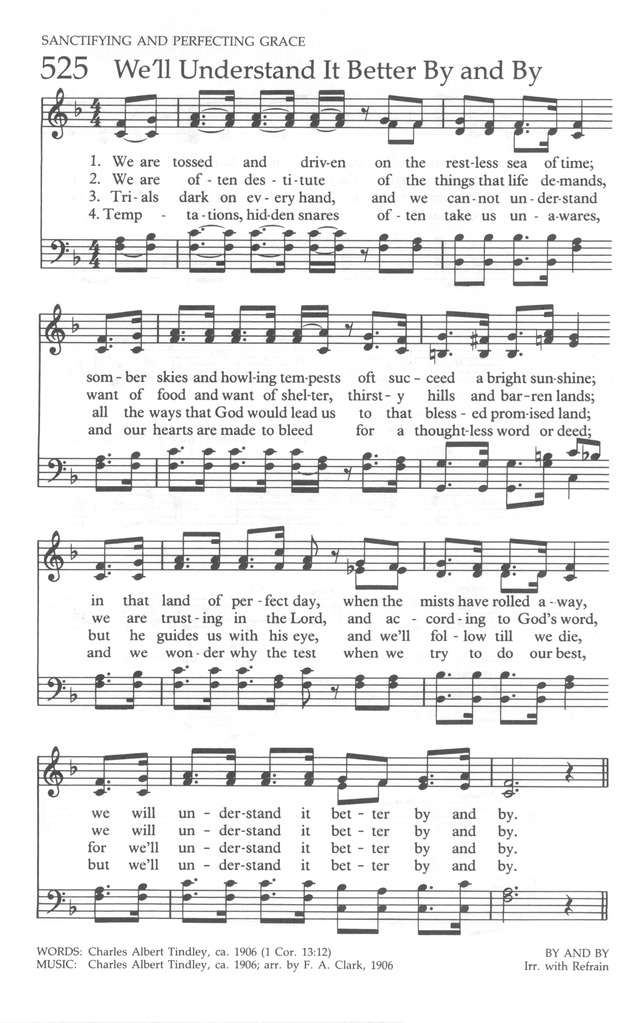
Hymn History: We’ll Understand It Better By and By

bye1 bye2

We are tossed and driven
on the restless sea of time;
somber skies and howling tempests
oft succeed a bright sunshine;
in that land of perfect day,
when the mists have rolled away,
we will understand it better by and by.

Charles Albert Tindley (July 7, 1851 – July 26, 1933) was an American Methodist minister and gospel music composer.

Often referred to as “The Prince of Preachers”, he educated himself, became a minister and founded one of the largest Methodist congregations serving the African-American community on the East Coast of the United States.

He was one of the eminent preachers of Methodism at the turn of the twentieth century. Hymnologist James Abbington has called Tindley a “pastor, orator, poet, writer, theologian, social activist, ‘father of African American Hymnody,’ ‘progenitor of African American gospel music’ and ‘prince of preachers.'”

The Rev. Carlton Young notes “We’ll Understand It Better By and By” was “one of eight hymns . . . written during a difficult period in Tindley’s life.”

One can imagine Tindley using this song to punctuate his sermons, offering hope to those assembled not only through exegesis of the biblical text, but also through a lyrical sung theology.

~~

From “The Lawrence Welk Show,” Gail, Rod, and Michael are featured in this great Gospel song found in the United Methodist Hymnal (page 525). Join with them in song as they encourage every Christian: “WE’LL UNDERSTAND IT BETTER BY AND BY”


Leave a comment

Posted by on January 26, 2024 in Hymn History, hymns, Posts of Interest, Videos


Tags: , , , , , , , ,

Hymn History: I Want to Walk as a Child of the Light

“I Want to Walk as a Child of the Light” by Kathleen Thomerson,
The United Methodist Hymnal, No. 206

The Pender UMC Traditional Service Opening Hymn “I Want to Walk As a Child of the Light” on Sunday September 18, 2022 was played by Liz Eunji Moon on piano, accompanied on guitar by Brian Stevenson and AJ Rios and sung the Pender Sanctuary Choir and congregation.

I want to walk as a child of the light.
I want to follow Jesus.
God set the stars to give light to the world.
The star of my life is Jesus.
Refrain: In him there is no darkness at all.
The night and the day are both alike.
The Lamb is the light of the city of God.
Shine in my heart, Lord Jesus.*

From time to time, a hymn captures our imagination because of its simplicity and transparency. Such a hymn is “I want to walk as a child of the light.” In singing this hymn, we feel the spirit of Epiphany unfold.

Kathleen Armstrong Thomerson (b. 1934) is a native of Tennessee. She wrote the hymn during the summer of 1966 during a visit to the Church of the Redeemer in Houston, Texas, the location providing the origin for the tune name HOUSTON. Her musical education took place at the University of Texas and Syracuse University, with additional studies at the Flemish Royal Conservatory in Antwerp. She has studied with several of the most noted organists of the twentieth century.

Ms. Thomerson directed music at University United Methodist Church in St. Louis and was on the organ faculties of St. Louis Conservatory and Southern Illinois University in Edwardsville. From 2004 through 2013, she served Mt. Olive Lutheran Church in Austin, Texas. In addition to this hymn, she contributed tunes for hymns by Patricia B. Clark in their joint collection, A Taste of Heaven’s Joys: A Collection of Original Hymns (2005).

“I want to walk as a child of the light” comes to The United Methodist Hymnal by way of the Episcopal Hymnal 1940 supplement, Songs for Celebration (1980). A musician with such a distinguished musical pedigree does not usually compose a gospel hymn of such elegant simplicity. A folk-like melody conveys a text based upon a wide range of scriptural allusions and biblical images. United Methodist Hymnal editor, Dr. Carlton Young notes some biblical passages that support the text: Isaiah 42:6c, “I have given you as a covenant to the people, a light to the nations.”; Malachi 4:2, “But for you who revere my name the sun of righteousness shall rise, with healing in its wings”; Revelation 21:25b, “And there will be no night there,” and 22:5b, “They need no light of lamp or sun.”

“I want to walk as a child of the light” communicates deep conviction and personal sincerity, while avoiding any hint of pretence. The first person perspective invites the singer to join Christ, the Light of the World, in discipleship – a journey of faith. The second line of each stanza deepens this commitment:
Stanza 1: “I want to follow Jesus.”
Stanza 2: “I want to look at Jesus.”
Stanza 3: “I want to be with Jesus.”

From a Wesleyan perspective, the theology of this hymn outlines sanctifying grace, the perspective of the Christians as they move toward perfection in the faith, becoming transformed in the image of Christ. Each stanza adds greater luminosity to this walk. In the first stanza, “God set[s] the stars to give light to the world.” Christ in turn becomes the “star of my life.” References to stars support the hymn’s appropriateness for Epiphany. Stanza two expresses the desire to “see the brightness of God.” The “Sun of Righteousness” illumines “the way to the Father.” The final stanza extends the journey toward the “coming of Christ,” an eschatological direction toward our future hope.

As in most gospel hymns, it is the refrain that carries the essence of its meaning; and indeed it is this refrain, with its scriptural allusions that virtually quote from Revelation 21 and 22, that distinguishes this hymn from many earlier expressions of discipleship. While a deeply personal expression of piety, the poet roots her devotional expression firmly in Scripture, avoiding the maudlin and simplistic notions of some gospel songs.

The simplicity of the music and text does not imply a simplistic faith. “I want to walk as a child” reminds us of one of the paradoxes of our faith, that we need to become as a child to fully understand the realm of God (Matthew 18:2-4).

*Text © 1970, 1975 Celebration, P.O. Box 309, Aliquippa, PA 10001, USA. Used by Permission.

Adapted from https://www.umcdiscipleship.org/resources/history-of-hymns-i-want-to-walk-as-a-child-of-the-light


Tags: , , , , , , , ,