RSS

Tag Archives: Hymn History

Hymn History: “El Shaddai”

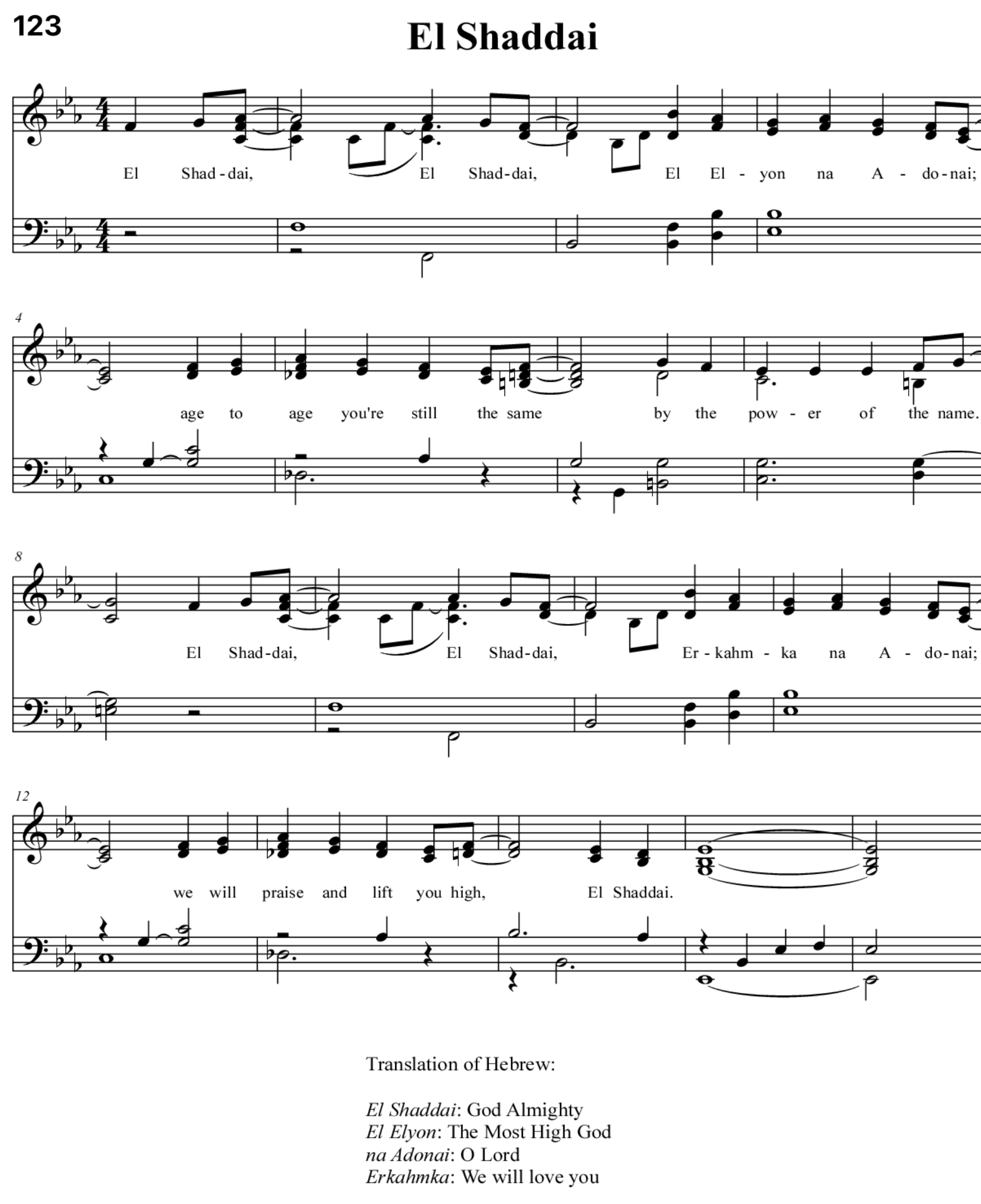
Sunday, February 4, 2024 the Pender Sanctuary Choir sang El Shaddai as arranged by Amy Grant and further arranged by Pender’s Director of Music Ministry, Patrick King.

During the Traditional Service on February 4, 2024, Pender’s sanctuary was imbued with the spiritual tapestry of song as the Sanctuary Choir, under the masterful direction of Patrick King, lifted their voices in a moving rendition of “El Shaddai.” This particular arrangement, a harmonious blend of Amy Grant’s touch and King’s unique vision, filled the sacred space with an aura of reverence and awe.

“El Shaddai,” a melody that draws its powerful lyrics from the scriptural portrayal of God, was first brought to life by Michael Card and John Thompson in the early ’80s. Michael Card, a profound scholar and artist, has woven his faith into over three decades of music, crafting hit after hit, with “El Shaddai” being one of his most renowned works. This song, in its essence, is a quest to capture the enigmatic nature of the divine through the ancient Hebrew names of God, each name a key to the unfathomable relationship between the Creator and His creation.

The Pender Sanctuary Choir’s performance was not just an offertory but a profound homage to the timeless quest of hymn writers throughout the ages—a quest to give voice to the voiceless wonder of the divine. As the choir sang, the congregation was transported through the annals of biblical history, from the covenant with Abraham and Isaac to the deliverance at the Red Sea, and finally to the Messianic prophecies fulfilled in Christ.

Michael Card, whose journey from the halls of Western Kentucky University to the honor of a doctorate from Philadelphia Biblical University, has always emphasized the importance of community and relationships in Christian growth. His storied career, marked by accolades such as the Dove Awards and millions of albums sold, is a testament to his commitment to exploring and expressing faith through music and writing.

As the last notes of “El Shaddai” resonated within the church walls, the profound and enduring impact of this piece, awarded the Dove Song of the Year in 1983, was felt by all present. It was a moment that transcended time, linking the congregation with the faithful of the past and the powerful biblical narratives that continue to inspire and guide. The day was a reminder that through music, the spirit of worship and the stories of sacred texts are ever alive, ever stirring the souls of those who seek to encounter the Almighty, the “El Shaddai.”

Biblical scholar J. Hampton Keathley III has described the context of the song:

“El Shaddai: God Almighty. The derivation is uncertain. Some think it stresses God’s loving supply and comfort; others His power as the Almighty one standing on a mountain and who corrects and chastens (Genesis 17:1; 28:3; 35:11; Exodus 6:31; Psalm 91:1, 2).

“El Elyon: The Most High God. Stresses God’s strength, sovereignty and supremacy (Genesis 14:19; Psalm. 9:2; Daniel 7:18, 22, 25).

“El Olam: The Everlasting God. Emphasizes God’s unchangeableness and is connected with His inexhaustibleness (Genesis 16:13).

“Yahweh (YHWH): Comes from a verb which means “to exist, be.” This, plus its usage, shows that this name stresses God as the independent and self-existent God of revelation and redemption (Genesis 4:3; Exodus 6:3 (cf. 3:14); 3:12).

The UM Hymnal contains only the refrain for the sake of space. The stanzas discuss God’s faithful acts as told in the biblical witness, including Abraham and Isaac, the parting of the waters during the Israelites’ deliverance from Egypt (stanza one) and the prophecies of the coming of the Messiah and the fulfillment of Christ’s mission (stanza two).

 
Leave a comment

Posted by on February 23, 2024 in Posts of Interest


Tags: , , , , , , , , , , , , , , , , , ,

Hymn History: Stand Up, Stand Up for Jesus

“Stand Up, Stand Up for Jesus” was the closing hymn at Pender’s 9:00 am Traditional Service on September 17, 2023 It was sung by Pender’s Sanctuary choir, congregation and accompanied on piano by Heidi Jacobs.

“Stand Up, Stand Up for Jesus”
George Duffield, Jr.
UM Hymnal, No. 514

Stand up, stand up for Jesus,
Ye soldiers of the cross;
Lift high his royal banner,
It must not suffer loss.
From victory unto victory
His army shall he lead,
Till every foe is vanquished,
And Christ is Lord indeed.

George Duffield, Jr. (1818-1888) wrote this hymn out of a tragic accident that resulted in the early death of one of the most stirring preachers in the northeastern United States during the mid-nineteeth-century. Dudley Tyng (1825-1858), an inspiring Episcopalian preacher, was one of several ministers participating in a great citywide revival that swept Philadelphia in 1858. His strong doctrinal preaching and his anti-slavery rhetoric were popular for some and angered others, resulting in his resignation from an Episcopal congregation that he pastored following the retirement of his father. In addition to serving the newly organized Church of the Covenant, his midday services at the YMCA attracted crowds as large as 5,000. On one occasion, March 30, 1858, 1000 men responded to the message by committing their lives to Christ.

During this sermon, Tyng is said to have declared, “I would rather that this right arm were amputated at the trunk than that I should come short of my duty to you in delivering God’s message.” Prophetically and tragically, within a few weeks while visiting the countryside, his arm was caught in the cogs of a corn thrasher and severely lacerated resulting in a great loss of blood and an infection that took his life a few days later. Either in his final sermon or on his deathbed, Tyng is to have said, “Let us stand up for Jesus.” Another account states that the dying Tyng told his father, a retired Episcopal minister, “Stand up for Jesus, father, and tell my brethren of the ministry to stand up for Jesus.”

Duffield, the son of a well-known Presbyterian minister, was educated at Yale University and Union Theological Seminary. He used his independent wealth, according to the Rev. Carlton Young, “to establish small congregations and to support evangelistic endeavors.” Duffield was inspired by the funeral service for Tyng to preach on Ephesians 6:14 in his sermon the following Sunday at Temple Presbyterian Church, the text of which reads, “Stand therefore, having your loins girt about with truth, and having on the breastplate of righteousness.” (KJV) The hymn he wrote was sung at the conclusion of the sermon.

An omitted stanza five alludes to Tyng’s death in lines 5 and 6:
Stand up!—stand up for Jesus!
Each soldier to his post;
Close up the broken column,
And shout through all the host!
Make good the loss so heavy,
In those that still remain,
And prove to all around you
That death itself is gain!

Hymnologist Kenneth W. Osbeck noted that Duffield’s Sunday school superintendent was so impressed by the hymn that he shared it throughout the church’s Sunday school classes. From there, the editor of a Baptist periodical received a copy and promoted it his publication, giving it wider circulation and making it available for publication in hymnals to this day.

The inspiring story of this hymn and the countless singers who have responded to the call of Christ over the last 150 years notwithstanding, the rhetoric of the poem presents problems for Christians living in a religiously pluralistic context in the twenty-first century. Images of soldiers who “lift high [Christ’s] royal banner,” and fight “till every foe is vanquished” recall for many the militant campaigns of the Crusades in the eleventhth through thirteenth centuries. The British counterpart to this hymn is “Onward, Christian Soldiers” (No. 575), written just a few years later in 1864. Many will recall the controversy around the inclusion of this hymn in The United Methodist Hymnal (1989) before its publication. While Ephesians 6 would seem to provide an impetus for both of these hymns, the language employed is so vividly militant that they may be read by those beyond the Christian family as a call to a literal warfare.

Note, by contrast, the language of Charles Wesley’s 1749 exposition of Ephesians 6:13-18, “Soldiers of Christ, Arise” (No. 513), a hymn tied closely with the Scripture. At the conclusion of the third stanza, Wesley entreats us to “pray always, pray and never faint,/pray, without ceasing pray.” Wesley makes it clearer that we are engaged in spiritual warfare, and Christ provides us with spiritual weapons with which to wage our struggle.

While hymns like “Stand up, stand up for Jesus” may have inspired revival and mission efforts in the mid-nineteenth and early twentieth centuries, our rhetoric today needs to match the gospel of compassion and love that we seek to share in the twenty-first century. Let us claim the call to the spiritual warfare in Ephesians 6 and balance this with the God who came in Christ to love a lost and suffering world.

Adapted from https://www.umcdiscipleship.org/resources/history-of-hymns-stand-up-stand-up-for-jesus


Tags: , , , , , , , , , , , , , , , , , , , , , , ,

Hymn History: On Eagle’s Wings

“On Eagle’s Wings” was the prelude at Pender’s 9:00 am Traditional Service on September 17, 2023. It was played on piano by Heidi Jacobs.

“On Eagle’s Wings,” by Michael Joncas;
The United Methodist Hymnal, No. 143

And He will raise you up on eagle’s wings,
bear you on the breath of dawn,
make you to shine like the sun,
and hold you in the palm of His hand.*

“Thus you shall say to the house of Jacob, and tell the Israelites: You have seen what I did to the Egyptians, and how I bore you on eagles’ wings and brought you to myself” (Exodus 19:4, NRSV).

Many recent composers for the church draw from biblical sources, making allusions to specific images. Father Jan Michael Joncas (b. 1951) uses the providential image of “eagle’s wings” as the anchor metaphor for his widely sung refrain. This refrain is a response for Psalm 91, usually sung by a cantor.

In a presentation for the National Association of Pastoral Musicians (NPM) convention in Long Beach in 1989, Joncas stated, “Scripture grounds my life as a Christian, a preacher, and a priest” (Joncas, GIA Publications, Inc. website). “On Eagles’ Wings” is an example of the high scriptural content of Fr. Joncas’s compositions. The composition appeared first in the liturgical music collection On Eagles’ Wings in 1979.

Dr. Joncas is one of the most prominent liturgical scholars and musicians in Catholic music today. He was granted the BA (English) magna cum laude from St. Thomas College, St. Paul, Minnesota (1975), the MA (Liturgical Studies) summa cum laude from University of Notre Dame, Notre Dame, Indiana (1978), and the SLL and SLD summa cum laude from the Pontificio Istituto Liturgico at the Collegio Sant’Anselmo (Roma, Italia) in 1989 and 1991, respectively.

Fr. Joncas has published widely in liturgical journals, written books, and composed and recorded numerous collections of liturgical music. He served as co-editor of Gather, one of the most widely used collections of liturgical music in Catholic parishes. He has served in parish ministry and is currently serving as University Artist-in-Residence and Fellow, Center for Catholic Studies, in the Department of Catholic Studies, University of St. Thomas.

The United Methodist Hymnal (1989) was the first major Protestant hymnal to include the refrain, “On Eagle’s Wings.” The only changes were the substitution of “God” and “God’s” for “He” and “His” for inclusive language purposes. Many Protestant congregations might view this song as a chorus or praise song. The roots are, in fact, much different. The song was written in 1978 as Joncas was concluding his MA in liturgy from Notre Dame. He was ordained in 1980 as a priest for the archdiocese of St. Paul/Minneapolis.

While serving in Minnesota, Fr. Joncas collaborated with two of his colleagues, Marty Haugen (b. 1950) and David Haas (b. 1957), in producing some of the most effective music for the church’s worship that has appeared in the days following the Second Vatican Council (1962-1965). This music written for the Catholic liturgy should not be confused with shorter choruses composed by contemporary Christian artists whose roots are in evangelical Christianity. At the National Pastoral Musicians conference in Long Beach, Fr. Joncas noted, “We pastoral musicians do not sing to entertain bored worshipers or to seduce them into brainless ecstasy; we may sing in the Spirit, but we also sing with our minds” (Joncas, GIA Publications, Inc. website).

In the Catholic liturgy, “On Eagle’s Wings” would be used most often on Sundays when the lectionary calls for Psalm 91. Joncas’s solo setting of the psalm for cantor is not included in The United Methodist Hymnal. The refrain allows the congregation to participate more fully in the singing of the psalm.

Most Protestant congregations know only the refrain. The beautiful, soaring melodic line and the rich, providential images of the text allow it to stand on its own. “On Eagle’s Wings” is often used in United Methodist worship as a congregational response to the benediction at the conclusion of the service. It also has a broader use, being sung at many 9/11 memorial services and at the memorial service for those who died in the bombing of the Alfred P. Murrah Federal Building in Oklahoma City in 1995.

How music will be used once it is published may be much different from what the composer intended. In correspondence with this writer, Fr. Joncas noted, “I wasn’t aware that by printing only the refrain in [The UnitedMethodist Hymnal, members of that denomination treat it more as a detachable benediction than a verse/refrain setting of Psalm 91.”

Adapted from https://www.umcdiscipleship.org/resources/history-of-hymns-on-eagles-wings


Tags: , , , , , , , , , , , , , , , , , , , , , , , ,

Hymn History: Standing on the Promises


“Standing on the Promises”
R. Kelso Carter
UM Hymnal, No. 374

“Standing on the Promises” was the middle hymn at Pender’s 9:00 am Traditional Service on June 18, 2023 It was sung by Pender’s congregation, accompanied on piano by Heidi Jacobs and guitar by Brian Stevenson.

The Pender UMC Traditional Service Opening Hymn “Standing on the Promises” on Sunday November 6, 2022 was played by Liz Eunji Moon on piano, accompanied on guitar by Brian Stevenson and sung the Pender Sanctuary Choir and congregation.

Standing on the promises of Christ my King,
Through eternal ages let his praises ring;
Glory in the highest, I will shout and sing,
Standing on the promises of God.

Russell Kelso Carter (1849-1928) was a man of diverse interests and abilities. A native of Baltimore, Md., Carter was known as an outstanding athlete in his younger days. The Methodist Holiness camp meeting movement had a profound impact on his life and he was ordained into ministry in 1887.

Carter held a number of teaching posts at the Pennsylvania Military Academy including professor of chemistry, natural science, civil engineering and mathematics. Not only did he teach, but he also published text books in his various disciplines and even authored several novels. Other interests included sheep-raising and practicing medicine.

If this were not enough, Carter also edited hymnals. He assisted A.B. Simpson in the compilation of a hymnal for the Christian and Missionary Alliance Church, Hymns of the Christian Life (1891), a collection that contained 68 of his tunes and 52 of his texts.

“Standing on the Promises” was composed in 1886 while Carter was teaching at the military academy. He was a member of the first graduating class in 1867 and had a strong affinity for the school. Author Phil Kerr makes a connection between the music and the military academy in his book, Music in Evangelism, stating that Carter’s military experience was reflected in the martial musical style of the hymn.

Published the year it was written in the collection, Songs of Perfect Love, edited by John K. Sweeny and Carter, the original text had five stanzas. The missing stanza reads:

Standing on the promises I now can see
Perfect, present cleansing in the blood for me;
Standing in the liberty where Christ makes free,
Standing on the promises of God.

The second line of this stanza has a particular Wesleyan tone with its focus on perfection and cleansing blood. The Rev. Carlton Young, editor of the UM Hymnal, notes: “As in other single-theme evangelical hymns and songs of this period, the biblical source of the hymn is not clear. ‘Stand firm’ from Ephesians 6:14 has often been cited as the theme of the hymn, although the word ‘promise’ tends to be reinforced as well.”

Thus, two passages of Scripture seem to undergird the central premise of this gospel song: “Stand firm then, with the belt of truth buckled around your waist, with the breastplate of righteousness in place. . . .” (Ephesians 6:14). Several passages relate to the promises of God including 2 Samuel 22:31: “As for God, his way is perfect; the word of the LORD is tried; he is a buckler to all them that trust in him.”

Dr. Young points out that this hymn was not included in authorized hymnals for Methodists (or in the 1957 hymnal of the Evangelical United Brethren Church) until the current hymnal. He states, “Its place in our hymnal came from its inclusion in a list of hymns determined to be widely used by evangelical United Methodists.”

As is the case of many gospel songs, this song revolves around its refrain. The stanzas, rather than serving to develop a sequential train of thought, are more like the spokes of a bicycle—all serving as an entry point to the refrain from various perspectives. One could reorder the stanzas and not lose any train of thought.

Hymnologist Kenneth Osbeck places the hymn in its context: “The hymn has been widely used in the great evangelistic crusades throughout the past century.” It is in this context that its single focus and rousing, martial music may be best suited.

Adapted from https://www.umcdiscipleship.org/resources/history-of-hymns-stirring-promises-serves-as-popular-crusade-hymn


Tags: , , , , , ,

Hymn History: Jesus, Thine All-Victorious Love

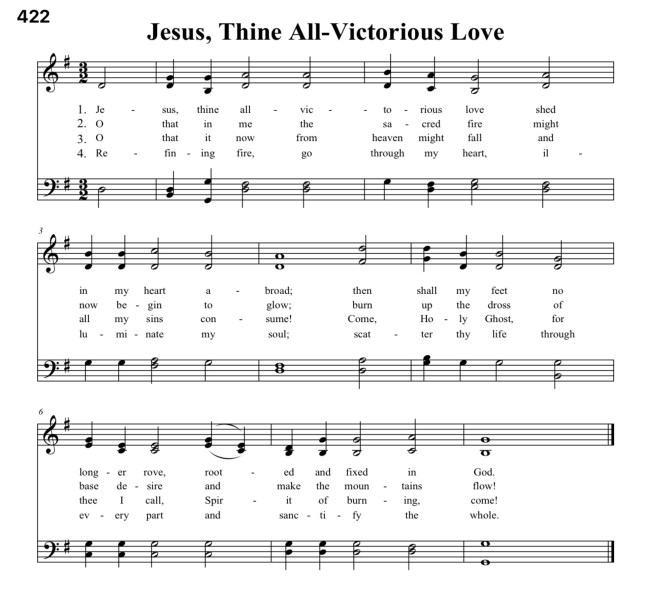
The Pender UMC Traditional Service Opening Hymn “Jesus, Thine All-Victorious Love” on Sunday May 14, 2023 was played by Heidi Jacobs on piano and Brian Stevenson on organ.

This was Heidi’s first Sunday as Pender’s Pianist.

“Jesus, Thine All-Victorious Love,”
by Charles Wesley
The United Methodist Hymnal, No. 422.

Methodists need no introduction to Charles Wesley. For that matter, neither do most singing Christians! Perhaps no other hymn writer except Isaac Watts is so well loved as Charles Wesley. Few were as prolific, at least, or as wide-ranging with regard to the theological topics they addressed….

“Jesus, Thine All Victorious Love” is found in the United Methodist Hymnal at No. 422. As with many Wesley hymns that we sing today, the four stanzas given in the UMH are but part of a much longer hymn called “My God! I know, I feel thee mine.” The complete hymn is found in Collection of Hymns for the Use of the People Called Methodists in the section, “For Believers, Groaning for Full Redemption.” Atop the hymn text in the early editions sits a scripture reference to Romans 4:13, which speaks of the promise God made to Abraham and the righteousness of his faith. The full hymn has twelve stanzas, which can be divided thematically into four groups. Stanzas 1 to 3 articulate an individual’s desire for intimate communion with God the Father using physical, even visceral, images. Stanza 2 is particularly beautiful and connects to the passage from Romans 4, using the language of faith:

I hold Thee with a trembling hand,
But will not let Thee go,
Till steadfastly by faith I stand,
And all Thy goodness know.

This opening group of stanzas speaks of how such an intimate relationship with God not only sustains us, but gives us “health, and life, and power, and perfect liberty.” The use of superlatives such as “all Thy goodness” and “perfect liberty” highlights well the Wesleyan idea of Christian perfection.

The second section focuses on the love of Jesus and that love’s redemptive power. There are several scriptural images at play, and as one might expect from Wesley, or indeed from most anyone writing about love, conversion of the heart is central to this section. The United Methodist Hymnal version begins with this stanza, which is number 4 in the original.

Jesus, thine all victorious love
shed in my heart abroad;
then shall my feet no longer rove,
rooted and fixed in God.

The third section of the text focuses on the Holy Spirit; its three stanzas are all included in The United Methodist Hymnal. One particularly potent stanza speaks of the sanctifying power of the Spirit, highlighting another key tenet of Wesleyanism.

Refining fire, go through my heart,
Illuminate my soul;
Scatter Thy life through every part,
And sanctify the whole.

The fourth section brings to completion the sanctification of the believer and the experience of Christian perfection. The poetry of Wesley’s final stanza is both beautiful and unequivocal in its theological witness:

My steadfast soul from falling free,
Shall then no longer move;
But Christ be all the world to me,
And all my heart be love.

Those who might bravely choose to sing all twelve stanzas of this hymn would experience a beautiful, thoroughly trinitarian witness to the redemptive power of God’s love in Jesus Christ through the sanctification of the Holy Spirit. However, most congregations will probably opt to sing a subset of stanzas. The four stanzas found in the United Methodist hymnal are well suited to the Easter season. Beginning with a stanza about the “victorious love” of Jesus Christ reminds us of Jesus’s resurrection and victory over death, that is, of Easter. Following that stanza, then, the next three stanzas about the working of the Spirit seem to suggest the kind of liturgical flow that the Church experiences in the transition from Easter to Pentecost. That liturgical flow is made especially apparent in Year C of the Sunday lectionary, when the gospel of Luke is read.

“Jesus, Thine All Victorious Love” is a common meter text (8.6.8.6.) and could be sung to a great many tunes. It is often paired with Lowell Mason’s version of AZMON, which is ideal for most stanzas of the text. The iambic structure of the hymn aligns well with the fact that AZMON begins with a pickup note. However, because two lines of the stanza “Jesus, thine all victorious love” begin with a stressed syllable (“Je-sus” and “root-ed”), using AZMON, which has both a pickup and fast note values on the downbeat of each measure, could be awkward. One might consider singing the hymn to a common meter tune that begins without a pickup, such as ST. AGNES. Regardless of the tune chosen, though, or the number of stanzas one endeavors to sing, “Jesus, Thine All Victorious Love” is an exemplary Wesleyan hymn. Consider it the next time you sing during Eastertide.

Adapted from https://www.umcdiscipleship.org/resources/history-of-hymns-jesus-thine-all-victorious-love-wesley


Tags: , , , , , , , ,