Charles Wesley (1707-1788), the younger brother of John Wesley wrote the words to this Christmas Carol.
Charles was a hymn writer and a poet, also known as one of the people who began the Methodist movement in the Church of England. Hark the Herald Angels Sing appeared in 1739 in a book called Hymns and Sacred Poems.
Wesley envisioned this being sung to the same tune as his hymn, Christ the Lord Is Risen Today, and in some hymnals it is included along with the more popular version.
This hymn was regarded as one of the Great Four Anglican Hymns and published as number 403 in “The Church Hymn Book” (New York and Chicago, USA, 1872).
To celebrate the invention of the printing press, Felix Mendelssohn composed a cantata in 1840 called Festgesang or “Festival Song”. The melody of Mendelssohn’s cantata was then used by William H. Cummings and adapted it to the lyrics of Wesley’s “Hark the Herald Angels Sing”.
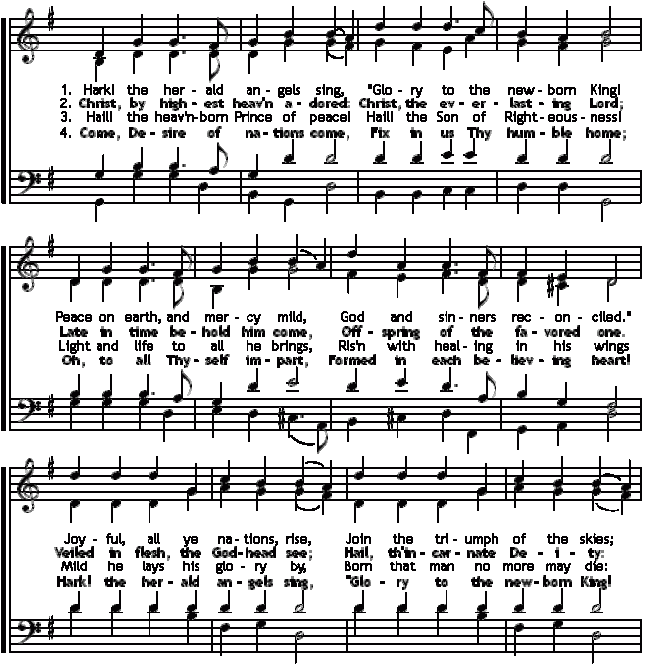
Hark the herald angels sing
“Glory to the newborn King!
Peace on earth and mercy mild
God and sinners reconciled”
Joyful, all ye nations rise
Join the triumph of the skies
With the angelic host proclaim:
“Christ is born in Bethlehem”
Hark! The herald angels sing
“Glory to the newborn King!”
And, of course, no one can do it better than The Mormon Tabernacle Choir.
Isaac Watts wrote the words to “Joy to the World” in 1719, based on Psalm 98 in the Bible. The hymn originally glorified Christ’s triumphant return at the end of the age, rather than a song celebrating His first coming. Only the second half of Watts’ lyrics are still used today.
The music was adapted and arranged to Watts’ lyrics by Lowell Mason in 1839 from an older melody which was then believed to have originated from Handel. The name “Antioch” is generally used for the hymn tune.
As of the late 20th century, “Joy to the World” was the most-published Christmas hymn in North America.
November 1 is All Saints Day, a sometimes-overlooked holy day in United Methodist congregations. It is not nearly as well known as the day before, All Hallows’ (Saints’) Eve, better known as Halloween, but is far more important in the life of the church.
John Wesley, founder of the Methodist movement, enjoyed and celebrated All Saints Day. In a journal entry from November 1, 1767, Wesley calls it “a festival I truly love.” On the same day in 1788, he writes, “I always find this a comfortable day.” The following year he calls it “a day that I peculiarly love.”
This may sound odd. United Methodists don’t believe in saints. Right?
Well, yes… and no.
Wesley cautioned against holding saints in too high regard.The Articles of Religion that he sent to the Methodists in America in 1784, include a statement against “invocation of saints” (Article XIV—Of Purgatory, Book of Discipline ¶104). Wesley did not see biblical evidence for the practice and discouraged Methodists from participating.
However, he also advised against disregarding the saints altogether.
In an All Saints Day journal entry dated Monday, November 1, 1756, Wesley writes, “How superstitious are they who scruple giving God solemn thanks for the lives and deaths of his saints!” If your 18th century English is as rusty as mine, it might help to know that the word scruple means, “to be unwilling to do something because you think it is improper, morally wrong, etc.” (Merriam-Webster.com).
All Saints Day is an opportunity to give thanks for all those who have gone before us in the faith. It is a time to celebrate our history, what United Methodists call the tradition of the church.
From the early days of Christianity, there is a sense that the Church consists of not only all living believers, but also all who have gone before us. For example, in Hebrews 12 the author encourages Christians to remember that a “great cloud of witnesses” surrounds us encouraging us, cheering us on.
Charles Wesley, John’s brother, picks up on this theme in his hymn that appears in our United Methodist Hymnal as “Come, Let Us Join our Friends Above,” #709. In the first verse, he offers a wonderful image of the Church through the ages:
Let saints on earth unite to sing, with those to glory gone,
for all the servants of our King in earth and heaven, are one.
On All Saints Day we remember all those—famous or obscure—who are part of the “communion of saints” we confess whenever we recite The Apostles’ Creed. We tell the stories of the saints “to glory gone.”
Alongside the likes of Paul from the New Testament, Augustine, Martin Luther, and John and Charles Wesley, we tell stories of the grandmother who took us to church every Sunday. We remember the pastor who prayed with us in the hospital, and the neighbor who changed the oil in the family car. We give thanks for the youth leader who told us Jesus loved us, the kindergarten Sunday school teacher who showered us with that love, and the woman in the church who bought us groceries when we were out of work.
Retelling these stories grounds us in our history. These memories teach us how God has provided for us through the generosity and sacrifice of those who have come before us. The stories of the saints encourage us to be all God has created us to be.
Charles Wesley’s hymn tells us those “to glory gone” are joined by the “saints on earth,” whom we also celebrate on All Saints Day. We think of the inspirational people with whom we worship on Sunday, and those across the world we will never meet. We celebrate fellow United Methodists who inspire us, and those of other denominations whose lives encourage us. We give thanks for those with whom we agree, as well as those whose views we do not share.
Additionally, we remember and pray for our sisters and brothers in Christ who faithfully follow Jesus in places where being labeled a Christian puts them in harm’s way.
On All Saints Day, we recognize that we are part of a giant choir singing the same song. It is the song Jesus taught his disciples; a tune that has resonated for more than 2,000 years; a melody sung in glory and on the earth. Our great privilege is to add our voices to this chorus.
The last verse of “Come, Let Us Join our Friends Above” encourages us to sing faithfully while on earth, so we might join the heavenly chorus one day.
Our spirits too shall quickly join, like theirs with glory crowned,
and shout to see our Captain’s sign, to hear His trumpet sound.
O that we now might grasp our Guide! O that the word were given!
Come, Lord of Hosts, the waves divide, and land us all in heaven.
On All Saints Day, let us give thanks for both the saints in glory and those on earth, who have led us to Jesus. As they have shared the gospel with us, may we add our voices so someone else may hear about the grace and love of our Lord and Savior Jesus Christ.
On Sunday, September 7, 2025, Pender’s choir and congregation sang “Abide With Me,” a heartfelt congregational request. The hymn was accompanied by Heidi Jacobs on piano, Patrick King on keyboards, and Kenneth Carr on percussion. For generations, this beloved hymn has offered hope and comfort to countless people across the world.
MaryO’Note: I’m sure that many would think that this is a semi-odd choice for all-time favorite hymn.
My dad was a Congregational (now United Church of Christ) minister so I was pretty regular in church attendance in my younger years.
Some Sunday evenings, he would preach on a circuit and I’d go with him to some of these tiny churches. The people there, mostly older folks, liked the old hymns best – Fanny Crosby and so on.
So, some of my “favorite hymns” are going to be those that I sang when I was out with my Dad. Fond memories from long ago.
In 1986 I was finally diagnosed with Cushing’s Disease after struggling with doctors and trying to get them to test for about 5 years. I was going to go into the NIH (National Institutes of Health) in Bethesda, MD for final testing and then-experimental pituitary surgery.
I was terrified and sure that I wouldn’t survive the surgery.
Somehow, I found a 3-tape set of Readers Digest Hymns and songs of Inspiration and ordered that. The set came just before I went to NIH and I had it with me.
At NIH I set up a daily “routine” of sorts and listening to these tapes was a very important part of my day and helped me get through the ordeal of more testing, surgery, post-op and more.
When I had my kidney cancer surgery, the tapes were long broken, but I had replaced all the songs – this time on my iPod.
Abide With Me was on this tape set and it remains a favorite to this day. Whenever we have an opportunity in church to pick a favorite, my hand always shoots up and I request page 700. When someone in one of my handbell groups moves away, we always sign a hymnbook and give it to them. I sign page 700.
I think that many people would probably think that this hymn is depressing. Maybe it is but to me it signifies times in my life when I thought I might die and I was so comforted by the sentiments here.
This hymn is often associated with funeral services and has given hope and comfort to so many over the years – me included.
If you abide in Me, and My words abide in you, you will ask what you desire, and it shall be done for you.
~John 15:7
Abide With Me
Words: Henry F. Lyte, 1847.
Music: Eventide, William H. Monk, 1861. Mrs. Monk described the setting:
This tune was written at a time of great sorrow—when together we watched, as we did daily, the glories of the setting sun. As the last golden ray faded, he took some paper and penciled that tune which has gone all over the earth.
Lyte was inspired to write this hymn as he was dying of tuberculosis; he finished it the Sunday he gave his farewell sermon in the parish he served so many years. The next day, he left for Italy to regain his health. He didn’t make it, though—he died in Nice, France, three weeks after writing these words. Here is an excerpt from his farewell sermon:
O brethren, I stand here among you today, as alive from the dead, if I may hope to impress it upon you, and induce you to prepare for that solemn hour which must come to all, by a timely acquaintance with the death of Christ.
For over a century, the bells of his church at All Saints in Lower Brixham, Devonshire, have rung out “Abide with Me” daily. The hymn was sung at the wedding of King George VI, at the wedding of his daughter, the future Queen Elizabeth II, and at the funeral of Nobel peace prize winner Mother Teresa of Calcutta in 1997.
Abide with me; fast falls the eventide;
The darkness deepens; Lord with me abide.
When other helpers fail and comforts flee,
Help of the helpless, O abide with me.
Swift to its close ebbs out life’s little day;
Earth’s joys grow dim; its glories pass away;
Change and decay in all around I see;
O Thou who changest not, abide with me.
Not a brief glance I beg, a passing word;
But as Thou dwell’st with Thy disciples, Lord,
Familiar, condescending, patient, free.
Come not to sojourn, but abide with me.
Come not in terrors, as the King of kings,
But kind and good, with healing in Thy wings,
Tears for all woes, a heart for every plea—
Come, Friend of sinners, and thus bide with me.
Thou on my head in early youth didst smile;
And, though rebellious and perverse meanwhile,
Thou hast not left me, oft as I left Thee,
On to the close, O Lord, abide with me.
I need Thy presence every passing hour.
What but Thy grace can foil the tempter’s power?
Who, like Thyself, my guide and stay can be?
Through cloud and sunshine, Lord, abide with me.
I fear no foe, with Thee at hand to bless;
Ills have no weight, and tears no bitterness.
Where is death’s sting? Where, grave, thy victory?
I triumph still, if Thou abide with me.
Hold Thou Thy cross before my closing eyes;
Shine through the gloom and point me to the skies.
Heaven’s morning breaks, and earth’s vain shadows flee;
In life, in death, O Lord, abide with me.
“Standing on the Promises”
R. Kelso Carter UM Hymnal, No. 374
The Pender UMC Traditional Service Middle Hymn “Standing on the Promises”, Sunday February 25, 2024 was played by Hetty Jacobs on piano and sung by the Sanctuary Choir and congregation. This was the second Sunday in Lent.
“Standing on the Promises” was the middle hymn at Pender’s 9:00 am Traditional Service on June 18, 2023 It was sung by Pender’s congregation, accompanied on piano by Heidi Jacobs and guitar by Brian Stevenson.
The Pender UMC Traditional Service Opening Hymn “Standing on the Promises” on Sunday November 6, 2022 was played by Liz Eunji Moon on piano, accompanied on guitar by Brian Stevenson and sung the Pender Sanctuary Choir and congregation.
Standing on the promises of Christ my King,
Through eternal ages let his praises ring;
Glory in the highest, I will shout and sing,
Standing on the promises of God.
Russell Kelso Carter (1849-1928) was a man of diverse interests and abilities. A native of Baltimore, Md., Carter was known as an outstanding athlete in his younger days. The Methodist Holiness camp meeting movement had a profound impact on his life and he was ordained into ministry in 1887.
Carter held a number of teaching posts at the Pennsylvania Military Academy including professor of chemistry, natural science, civil engineering and mathematics. Not only did he teach, but he also published text books in his various disciplines and even authored several novels. Other interests included sheep-raising and practicing medicine.
If this were not enough, Carter also edited hymnals. He assisted A.B. Simpson in the compilation of a hymnal for the Christian and Missionary Alliance Church, Hymns of the Christian Life (1891), a collection that contained 68 of his tunes and 52 of his texts.
“Standing on the Promises” was composed in 1886 while Carter was teaching at the military academy. He was a member of the first graduating class in 1867 and had a strong affinity for the school. Author Phil Kerr makes a connection between the music and the military academy in his book, Music in Evangelism, stating that Carter’s military experience was reflected in the martial musical style of the hymn.
Published the year it was written in the collection, Songs of Perfect Love, edited by John K. Sweeny and Carter, the original text had five stanzas. The missing stanza reads:
Standing on the promises I now can see
Perfect, present cleansing in the blood for me;
Standing in the liberty where Christ makes free,
Standing on the promises of God.
The second line of this stanza has a particular Wesleyan tone with its focus on perfection and cleansing blood. The Rev. Carlton Young, editor of the UM Hymnal, notes: “As in other single-theme evangelical hymns and songs of this period, the biblical source of the hymn is not clear. ‘Stand firm’ from Ephesians 6:14 has often been cited as the theme of the hymn, although the word ‘promise’ tends to be reinforced as well.”
Thus, two passages of Scripture seem to undergird the central premise of this gospel song: “Stand firm then, with the belt of truth buckled around your waist, with the breastplate of righteousness in place. . . .” (Ephesians 6:14). Several passages relate to the promises of God including 2 Samuel 22:31: “As for God, his way is perfect; the word of the LORD is tried; he is a buckler to all them that trust in him.”
Dr. Young points out that this hymn was not included in authorized hymnals for Methodists (or in the 1957 hymnal of the Evangelical United Brethren Church) until the current hymnal. He states, “Its place in our hymnal came from its inclusion in a list of hymns determined to be widely used by evangelical United Methodists.”
As is the case of many gospel songs, this song revolves around its refrain. The stanzas, rather than serving to develop a sequential train of thought, are more like the spokes of a bicycle—all serving as an entry point to the refrain from various perspectives. One could reorder the stanzas and not lose any train of thought.
Hymnologist Kenneth Osbeck places the hymn in its context: “The hymn has been widely used in the great evangelistic crusades throughout the past century.” It is in this context that its single focus and rousing, martial music may be best suited.


 News and Views