RSS

Tag Archives: hymn

Hymn History: Grace Greater than All my Sin

“Grace Greater Than Our Sin” was the final hymn at Pender’s 9:00 am Traditional Service on June 18, 2023 It was sung by Pender’s congregation, accompanied on piano by Heidi Jacobs and guitar by Brian Stevenson.

The Pender UMC Traditional Service Closing Hymn “Grace Greater than All my Sin” on Music Appreciation Sunday June 12, 2022 was accompanied by Liz Sellers on piano, Brian Stevenson on Irish whistle, AJ Rios on drums and sung by the Pender Sanctuary Choir and Congregation.

“Grace Greater than Our Sin”
Julia H. Johnston
The UM Hymnal, No. 365

Marvelous grace of our loving Lord,
Grace that exceeds our sin and our guilt!
Yonder on Calvary’s mount outpoured,
There where the blood of the Lamb was spilt.

Grace, grace, God’s grace,
Grace that will pardon and cleanse within;
Grace, grace, God’s grace,
Grace that is greater than all our sin!

Julia Harriette Johnston (1849-1919) was the daughter of a Presbyterian minister who served First Presbyterian Church, Peoria, Ill. She lived in Peoria from age 6.

Johnston was faithful to the ministries of the church, serving as a Sunday school superintendent and teacher for 41 years. She was also president for two decades of the Presbyterian Missionary Society, an organization founded by her mother.

She authored several books including Indian and Spanish Neighbors (1905) and Fifty Missionary Heroes (1913). In addition to many Sunday school lessons, she also wrote about 500 hymn texts; today her reputation rests primarily upon the hymn “Grace Greater than Our Sin.”

The writer contrasts the theme of God’s abundant grace—manifest through the sacrifice of Christ on the cross—with “our sin and our guilt” (stanza one), “sin and despair” (stanza two), and a “dark . . . stain” (stanza three).

This “marvelous, infinite, matchless grace, freely bestowed on all who believe,” finds a scriptural basis in Paul’s teaching of justification by faith in Romans 5:1-2: “Therefore being justified by faith, we have peace with God through our Lord Jesus Christ: By whom also we have access by faith into this grace wherein we stand, and rejoice in hope of the glory of God.”

Paul continues in verses 14-16, “Nevertheless death reigned from Adam to Moses, even over them that had not sinned after the similitude of Adam’s transgression, who is the figure of him that was to come. But not as the offence, so also is the free gift of grace. For if through the offence of one many be dead, much more the grace of God, and the gift by grace, which is by one man, Jesus Christ, hath abounded unto many. And not as it was by one that sinned, so is the gift: for the judgment was by one to condemnation, but the free gift is of many offences unto justification.”

The text and tune of the hymn first appeared in Hymns Tried and True, a 1911 collection by composer Daniel B. Towner (1850-1919). According to UM Hymnal editor Carlton Young, Towner was “a distinguished Methodist musician.” He studied first with his father and then with famous gospel song composers such as George Root and George Webb.

Towner then served in Methodist Episcopal churches in New York, Ohio and Kentucky. In 1893 he was named head of the music department at Moody Bible Institute in Chicago, working with the famous evangelist Dwight L. Moody. Dr. Young notes that Towner “composed over 2,000 songs and was associated with the publication of fourteen collections.”

Baptist hymnologist William J. Reynolds noted that the name MOODY was given to this tune in recognition of Towner’s association with and service to Moody Bible Institute and its founder.

Dr. Hawn is professor of sacred music at Perkins School of Theology, SMU.

Adapted from https://www.umcdiscipleship.org/resources/history-of-hymns-grace-greater-than-our-sin


Tags: , , , , , , , , , , , , , ,

Hymn History: When in Our Music God Is Glorified

“When in Our Music God Is Glorified”
Fred Pratt Green
UM Hymnal, No. 68

“When in Our Music God is Glorified” was the opening hymn at Pender’s Music Appreciation Sunday on June 11, 2023 It was sung by Pender’s congregation, accompanied on piano by Heidi Jacobs and directed by Brian Stevenson.


“When in Our Music God Is Glorified” was played by Pender’s pianist-organist, Liz Eunji Moon at the Traditional Service Postlude on September 11, 2022

Sometimes a great tune can keep a hymn text alive. Sometimes a great text can revive a neglected tune. The latter is true in this case.

Noted British hymnologist John Wilson (1905-1992) suggested that the Methodist poet and hymn writer Fred Pratt Green write a text to the tune ENGELBERG, composed in 1904 by the famous British composer Charles Villiers Stanford (1852-1924).

Stanford’s tune had been well-known in the earlier 20th century until Ralph Vaughan Williams (1872-1958) composed the immensely popular SINE NOMINE in the same metre (sung to “For All the Saints”) for the English Hymnal (1906).

Hymnologist J.R. Watson records that “Wilson urged Pratt Green to write a text for a Festival of Praise . . . which could be sung to Stanford’s neglected tune.” Pratt Green based his text on Psalm 150 but alluded to Mark 14:26 in stanza four of the hymn, a stanza recalling the hymn sung by the disciples at the Last Supper.

The hymn, composed in 1972, first appeared in New Church Praise (1975) and in the single-author collection The Hymns and Ballads of Fred Pratt Green (1982) with the title, “Let the People Sing!”

The opening line (called the incipit) originally read, “When in man’s music, God is glorified. . . .” Pratt Green reluctantly altered this to the current title for the Lutheran Book of Worship (1978) and this change has universally been accepted in North American hymnals.

The Rev. Carlton Young, editor of the UM Hymnal, notes that the change in text, though an important “social witness” in the area of inclusive language, weakens the theological and aesthetic qualities of the hymn: 1) Theologically, “the change tends to weaken the affirmation that mere mortal musicians and their music may and often do glorify God”; 2) aesthetically, the wonderful alliteration between “man’s” and “music” paralleled by “God’s” and “glorified” is lost.

Dr. Young speculates that this “text has probably been set in anthem form more than any other of the late twentieth century.”

Ministry of music

This hymn is groundbreaking in many ways.

There are numerous examples in the history of hymnody where music is a metaphor for some theological theme or experience. In Babcock’s “This Is My Father’s World,” for example, “all nature sings and round me rings the music of the spheres.” Charles Wesley speaks of “the music of the heart” in his paraphrase of Psalm 150, “Praise the Lord Who Reigns Above.”

However, Pratt Green uses music not just as a metaphor that points us to another idea, but explores music-making as a phenomenon in the Christian’s experience in its own right. The second stanza concludes with the marvelous thought that “making music . . . move[s] us to a more profound Alleluia!”

In this way, Pratt Green seems to agree with Martin Luther who said, “Next to the Word of God, the noble art of music is the greatest treasure in the world.” Luther and Pratt Green seem to ascribe a quasi-sacramental quality to music—music as a means of revelation and grace.

Pratt Green (1903-2000) was born in Roby just outside of Liverpool, England. Following his education, he was ordained in 1924 as a Methodist minister and served in various parishes throughout England well into the 1940s. Although he had a long interest in poetry, he did not focus on hymn writing until his retirement from active ministry.

Eminent British hymnologist Erik Routley (1917-1982) suggested that in Fred Pratt Green, Methodists finally had a successor to Charles Wesley.

* Words by Fred Pratt Green © 1972 Hope Publishing Company; Carol Stream, IL 60188. All rights reserved. Used by permission.

Dr. Hawn is professor of sacred music at Perkins School of Theology, SMU.

Adapted from https://www.umcdiscipleship.org/resources/history-of-hymns-when-in-our-music-god-is-glorified

 
Leave a comment

Posted by on June 26, 2023 in Hymn History, hymns, Posts of Interest, Videos


Tags: , , , , , , , , ,

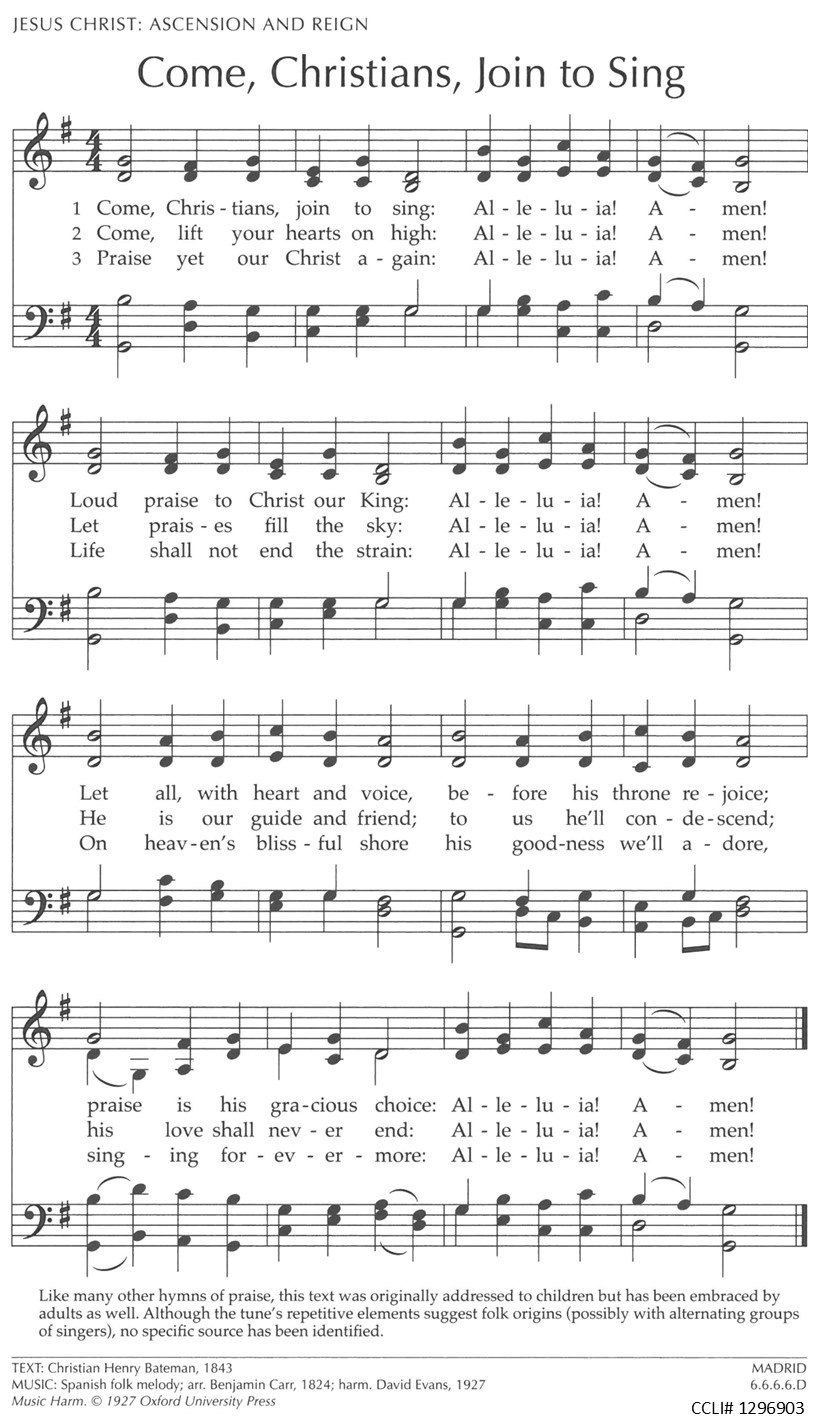
Hymn History: Come, Christians, Join to Sing


“Come, Christians, Join to Sing” was the closing hymn at Pender’s Music Appreciation Sunday on June 11, 2023. It was sung by Pender’s congregation and Sanctuary Choir, accompanied on piano by Heidi Jacobs and combined handbell choirs (Joy and Carillon Ringers) directed by Brian Stevenson.

“Come, Christians, Join to Sing” was the opening hymn at Pender’s Traditional Service on May 29, 2022. It was accompanied by piano (Liz Sellers) and organ (Brian Stevenson).

“Come, Christians, Join to Sing”
Christian Henry Bateman
UM Hymnal, No. 158

Come, Christians, join to sing:
Alleluia! Amen!
loud praise to Christ our King:
Alleluia! Amen!
Let all, with heart and voice,
before his throne rejoice;
praise is his gracious choice.
Alleluia! Amen!

Christian Henry Bateman (1813-1899) was ordained into the Church of England after being a Congregational minister.

His ministerial studies were under the auspices of the Moravian Church, where he served for a time before changing to the Congregational Church at age 30. Following his ministry at Richmond Place Congregational Church in Edinburgh, Scotland, and successive Congregational parishes in Hopton, Yorkshire, and Reading, Berkshire, he took Holy Orders in the Anglican Church at age 56 and served as a curate and vicar in several Anglican parishes.

Australian hymnologist Wesley Milgate (1916-1999) noted that Bateman’s hymn is actually a rewritten version of the hymn “Join Now in Praise, and Sing” by William Edward Hickson (1803-1870). Hickson’s text uses the same melody, MADRID (SPANISH HYMN), and is structured in much the same way. Compare Bateman’s text at the beginning of this article with the first stanza of Hickson’s hymn:

Join now in praise, and sing
Hallelujah, Amen!
Praise to our heavenly King,
Hallelujah, Amen!
By love and gratitude
Still be the song renewed,
And be our hearts subdued,
Hallelujah, Amen!

Bateman probably found the earlier hymn in the collection Hickson published, Singing Master (1836). Hickson’s five stanzas were reduced to three by Bateman and first appeared in a collection published in Edinburgh, Sacred Melodies for Children (1843). The original “Hallelujah, Amen!” was changed by the Presbyterian Church in the U.S.A., in their 1933 hymnal, to “Alleluia! Amen!” It has remained that way ever since.

Each stanza begins with an exhortation—an imperative command to “Come” or “Praise.” In stanza one, Bateman provides the children with the reason for singing: We offer “loud praise to Christ our King . . . before his throne. . . .” Christ desires our praise: “praise is his gracious choice. . . .”The original incipit (opening line of the hymn) was “Come, children, join to sing.” Though changed in the Presbyterian hymnal to include all age groups, Bateman’s text contains direct, uncomplicated language suited for children. Since very few of the words have more than two syllables and “Alleluia! Amen!” is interjected three times in each stanza, the hymn is easy for children to learn and sing.

Stanza two reassures the children (and all of us) that this King is also “our guide and friend” and that “his love shall never end.” This King will “condescend” to be a friend to the children. To condescend surely did not mean to patronize as it tends to mean today, but implies that Christ the King humbles himself to be in a personal relationship with us.

Stanza three ends on an eschatological note. The author reassures children that they need not fear death. Beyond life, our songs will continue on “heaven’s blissful shore . . . singing forevermore: Alleluia! Amen!”

Dr. Hawn is professor of sacred music at Perkins School of Theology.

Adapted from https://www.umcdiscipleship.org/resources/history-of-hymns-come-christians-join-to-sing


Tags: , , , , , , , , , , ,

Hymn History: ‘Doxology’

Pender’s current Doxology is “Praise God, from Whom All Blessings Flow”.

On May 28, 2023, Pender Pianist, Heidi Jacobs played a prelude which incorporated the Doxology into a medley of hymns.

In general usage, the Doxology is a short statement of praise, glory, and thanksgiving to God. It is often a short hymn designed to be sung by the worshiping congregation. Pender sings it to give thanks after the offering.

Chuck Knows Church — Doxology.

Chuck sings! Kinda. Bet you can’t guess the name of the most played piece of music in Protestant churches each Sunday? You looked at the title of this episode, didn’t you?

Chuck sings and explains on this his show!

“Praise God, from Whom All Blessings Flow”
by Thomas Ken
The United Methodist Hymnal, 95

Praise God, from whom all blessings flow;
Praise him, all creatures here below;
Praise him above, ye heav’nly host;
Praise Father, Son, and Holy Ghost.

Born in Hertfordshire, Bishop Thomas Ken (1637–1711) was orphaned as a child and raised by his sister Anna and her husband Izaak Walton. They enrolled him in the all-boys school at Winchester College (1651–1656). After his education there, he attended Hart Hall, Oxford, and New College, Oxford (B.A., 1661, M.A., 1664).

Ken was ordained as an Anglican priest in 1662, serving as rector to several parishes and as a chaplain to Princess Mary of Orange (1679–80), King Charles II (1683), and the Tangier Expedition (1683–84). In 1685, he was appointed Bishop of Bath and Wells. During the reign of King James II, he was imprisoned in the Tower of London for refusing to sign the Declaration of Indulgence (1687), a decree designed to promote the king’s Catholic faith. Ken was acquitted of the charge. When, however, King William III ascended to the throne, Ken refused to swear loyalty to him and resigned his office, living the rest of his life at the home of his friend, Lord Weymouth, at Longleat, Wilshire (Doyle, Canterbury Dictionary, n.p.).

The original date of composition by Ken for the text of “Praise God from Whom All Blessings Flow” is unknown. The first mention of the hymn is in 1674 as the presumed final stanza of two longer hymns: “Awake, My Soul and with the Sun” and “Glory to Thee, My God, this Night.” These two hymns were referenced along with a third as Morning, Evening and Midnight Hymns in a later edition of a pamphlet written for his students titled A Manual of Prayers for the Use of the Scholars of Winchester College (1695). The following directive is from the first edition:

. . . be sure to sing the Morning and Evening Hymn in your chamber devoutly, remembering that the Psalmist, upon happy experience, assures you that it is a good thing to tell of the loving kindness of the Lord early in the morning and of his truth in the night season (Ken, 1675, n.p.).

This directive is most often interpreted to mean that the hymns were meant for private devotion, not the gathered assembly, and yet these four lines, often referred to as The Lesser Doxology, have “been sung more often than any other lines ever written” (Gealy, 1993, 200). The hymn texts were published later as an appendix in his 1695 pamphlet as “revised” versions.

Much of the beauty of these four lines lies in its reflection of the joyous outbursts of the psalms. Here we see both the “host” of heaven and the “creatures here below” of earth praising God as in Psalm 96:11-12a and the final jubilant line of Psalm 150:6:

Let the heavens be glad, and let the earth rejoice;
let the sea roar, and all that fills it;
let the field exult, and everything in it. (Psalm 96: 11-12a, NRSV)
Let everything that breathes praise the Lord!
Praise the Lord! (Psalm 150:6, NRSV)

Commonly called “The Doxology,” Ken’s acclamation of praise is actually one of many doxological declarations that appear in many hymns, often in final stanza. See, for example, the last stanzas of the fourth-century hymn “Of the Father’s Love Begotten,” William Draper’s versification (c. 1919) of a thirteenth-century poem by Francis of Assisi, “All Creatures of Our God and King,” and Catherine Winkworth’s translation (1858) of Lutheran pastor Martin Rinkart’s “Now Thank We All Our God” (1647). Though less common now, the pattern for many mainline Protestant congregations has been to sing another doxological acclamation, the “Gloria Patri,” earlier in a worship service, and Ken’s stanza at the time of the offertory. Of note is the cosmic character of Ken’s praise—“all creatures here below” and “above ye heavenly hosts”—calling on the entire cosmos to praise God.

The Trinitarian structure of Ken’s hymn has also led to its common liturgical use. The first line describes the person of God the Father as the source of all blessings (Ephesians 1:3; 2 Corinthians 1:3). The second line, though, speaks to God the Spirit through whom all creatures praise God (Psalm 104:24-30; 1 Corinthians 2:10-13). The third line points to God the Son, who is begotten of the Father, firstborn of heaven and superior to angels and the heavenly host (Hebrews 1:4). The fourth line summarizes the stanza and all of praise in general, since all praise is directed toward God, Father, Son, and Holy Spirit.

The United Methodist Hymnal pairs this text with the hymn tune OLD 100th, which is attributed to John Calvin’s composer, Louis Bourgeois (c. 1510–1559). The first two lines of Ken’s text were later adapted with additional inclusive words by United Methodist pastor Gilbert H. Vieira (b. 1926) to be sung with LASST UNS ERFREUEN from Ausserlesene Catholische, Kirchengesänge (1623), harmonized by Ralph Vaughan Williams. Pastor Vieira’s use of inclusive language reflects his continuing strong stands for inclusive and carefully chosen language (see Vieira, 2020, n.p.).

The hymn tune MORNING HYMN was composed by François Hippolyte Barthélémon (1741–1808) for the text of “Awake, My Soul, and With the Sun.” The appropriateness of the tune works well for this final stanza, where the words of the second phrase, “Praise him, all creatures here below,” are sung by descending stepwise through an entire scale. The third phrase, “Praise him above, ye heav’nly host,” is sung through a similar ascension that returns to the highest note of the tune in the final stanza, acknowledging the Trinitarian nature of God. Sheila Doyle comments on the hymn text saying, “The language is simple and precise, and the opening images of light and rising up, appropriate to morning, pervade the hymn and convey a powerful sense of renewal and aspiration” (Doyle, “Awake, My Soul,” n.p.).

SOURCES:

Sheila Doyle, “Awake, My Soul, and with the Sun,” The Canterbury Dictionary of Hymnology. Canterbury Press, https://hymnology.hymnsam.co.uk/a/awake,-my-soul,-and-with-the-sun (accessed September 27, 2020).

_____, “Thomas Ken,” The Canterbury Dictionary of Hymnology. Canterbury Press, http://www.hymnology.co.uk/t/thomas-ken (accessed September 27, 2020).

Fred D. Gealy, Research Files for the 1970 Companion to the Hymnal [1966] quoted in Young, Carlton R. Companion to the United Methodist Hymnal (Nashville, TN: Abingdon Press, 1993), 200.

Thomas Ken, A Manual of Prayers for the Use of the Scholars of Winchester College
(London: Printed for John Martyn, 1675), http://anglicanhistory.org/ken/manual.html (accessed September 27, 2020).

Gilbert H. Viera, “Let’s Watch Our Language,” United Methodist Insight (February 24, 2020), https://um-insight.net/perspectives/let-s-watch-our-language (accessed September 27, 2020).


From https://www.umcdiscipleship.org/articles/history-of-hymns-praise-god-from-whom-all-blessings-flow


Tags: , , , ,

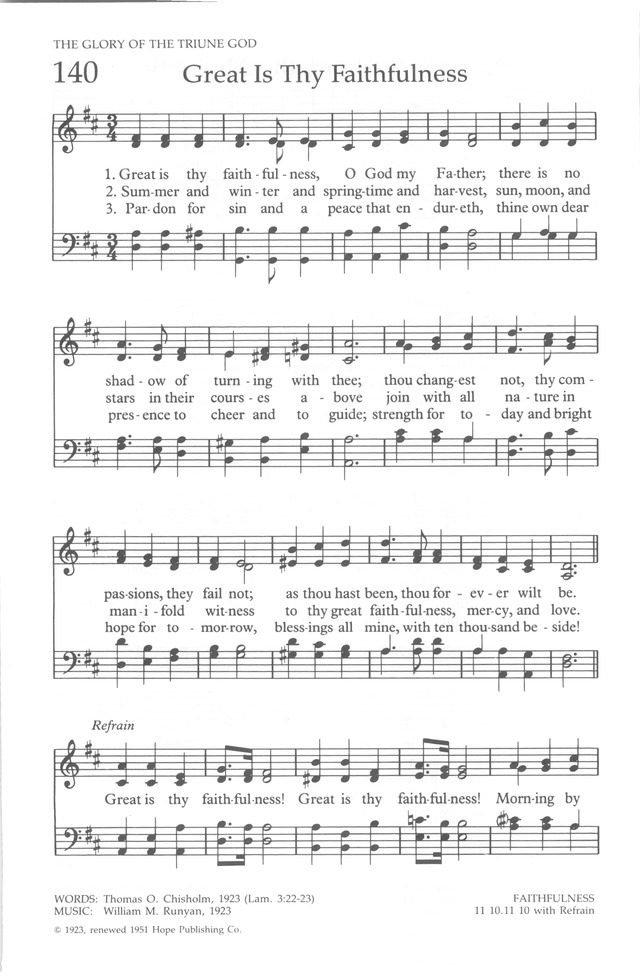
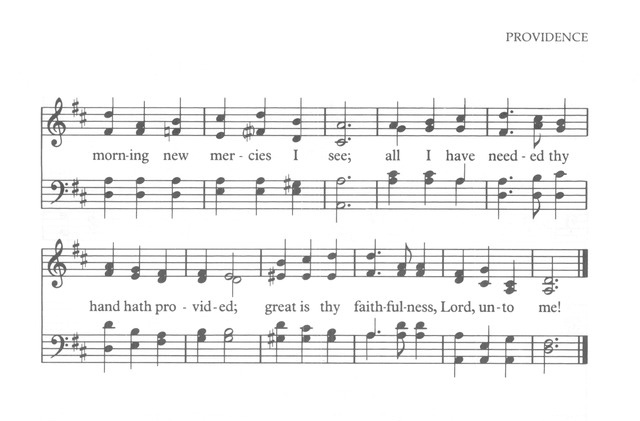
Hymn History: Great is Thy Faithfulness

The Pender UMC Traditional Service Prelude “Great is Thy Faithfulness” on Sunday May 14, 2023 was played by Hetty Jacobs on piano.  This was Hetty’s first Sunday as Pender’s Pianist.


The Pender UMC Traditional Service Opening Hymn “Great is Thy Faithfulness” on Sunday July 10, 2022 was played by Liz Sellers on piano and sung by the Pender Congregation.


“Great Is Thy Faithfulness”
Thomas O. Chisholm
The United Methodist Hymnal, No. 140

A native of the small Kentucky town of Franklin, Thomas Obediah Chisholm (1866-1960) was born in a log cabin. He lacked formal education. Nevertheless, he became a teacher at age sixteen and the associate editor of his hometown weekly newspaper, the Franklin Advocate, at age twenty-one.

In 1893 Chisholm became a Christian through the ministry of Henry Clay Morrison, the founder of Asbury College and Seminary in Wilmore, Kentucky. Morrison persuaded Chisholm to move to Louisville where he became editor of the Pentecostal Herald. Though he was ordained a Methodist minister in 1903, he served only a single, brief appointment at Scottsville, Kentucky, due to ill health. Chisholm relocated his family to Winona Lake, Indiana, to recover, and then to Vineland, New Jersey, in 1916 where he sold insurance. He retired in 1953 and spent his remaining years in a Methodist retirement community in Ocean Grove, New Jersey.

By the time of his retirement, he had written more than 1200 poems, 800 of which were published. They often appeared in religious periodicals such as the Sunday School TimesMoody Monthly, and Alliance Weekly. Many of these were set to music.

Hymnologist Kenneth Osbeck provides the background for “Great Is Thy Faithfulness.” Chisholm had sent a number of his poems to the Rev. William H. Runyan (1870-1957), a musician with the Moody Bible Institute and one of the editors of Hope Publishing Company in Chicago. Runyan wrote of the hymn: “This particular poem held such an appeal that I prayed most earnestly that my tune might carry over its message in a worthy way, and the subsequent history of its use indicates that God answered prayer. It was written in Baldwin, Kansas, in 1923, and was first published in my private song pamphlets.”

George Beverly Shea (1909-2013), the famous Canadian-born singer of the Billy Graham Crusades, introduced this hymn to those attending the evangelistic meetings in Great Britain in 1954. It immediately became a favorite.

A phrase in Lamentations 3:22-23 provides a basis for the refrain: “The steadfast love of the Lord never ceases, his mercies never come to an end; they are new every morning; great is your faithfulness.” Stanza one emphasizes God’s unchanging nature: ” . . . there is no shadow of turning with thee;/thou changest not, thy compassions they fail not.” Perhaps James 1:17 provides the scriptural basis for this concept: “Every good and perfect gift is from above, coming down from the Father of the heavenly lights, who does not change like shifting shadows.”

In stanza two, the natural created order, including the cycle of the seasons, bears witness to the faithfulness of God. The final stanza brings the eternal, unchanging God into contact with humanity. We receive from the presence of God “Pardon for sin and a peace that endures.” Indeed, William Runyan’s tune was the ideal musical complement to the warmth of the text. The subtle changes in harmony and the solemnity of the melody amplify the text, bringing the climax on the word “faithfulness” perfectly at the end of the refrain.

This hymn appeared in many evangelical hymnals and song collections, but was not chosen for an official Methodist hymnal until the current United Methodist Hymnal (1989), even though the author was a Methodist. It was a very popular hymn of the former Evangelical United Brethren Church and had been included in their hymnals.

According to Carlton Young, “Great is thy faithfulness” was second only to “In the garden” as the most requested hymn for inclusion in The United Methodist Hymnal. A survey conducted in 2000 by Dean McIntyre, Director of Music Resources, Discipleship Ministries, revealed that “Great is thy faithfulness” remains one of the favorite hymns among United Methodists.

Dr. Hawn is distinguished professor of church music at Perkins School of Theology. He is also director of the seminary’s sacred music program.

Adapted from https://www.umcdiscipleship.org/resources/history-of-hymns-great-is-thy-faithfulness


Tags: , , , , , , , , , , , ,