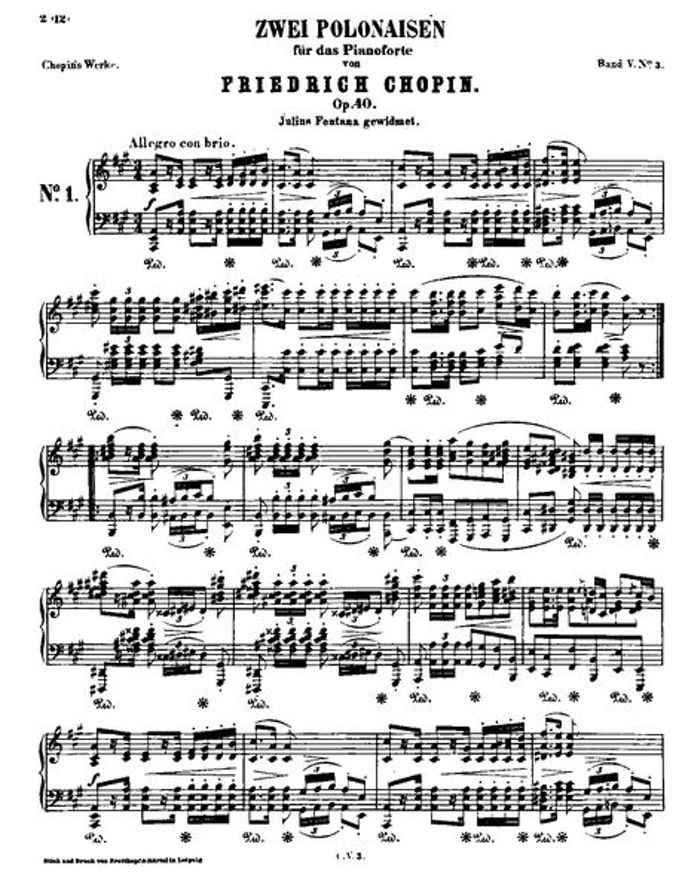
During the Postlude at Pender UMC’s Traditional Service on June 11, 2023, we were treated to “Military Polonaise Op. 40 No. 1 in A Major” by Frédéric Chopin played by Heidi Jacobs.
The Polonaise no. 1 in A major, often nicknamed Military, has been described as a symbol of ‘Polish Glory’: it is almost entirely played forte or louder, which makes for a bombastic performance.
“Said to be a favourite of King Charles’, ‘Be Thou my Vision’ is one of the oldest hymns in the world. Its text has its origins in 6th-century Ireland, in a poem attributed to early Christian Irish poet Dallán Forgaill. In the early 20th century, Forgaill’s Gaelic words were translated into English by Mary Elizabeth Byrne, and soon after adapted into verse by Eleanor Hull.
“Today, the text is usually sung to an Irish folk tune known as ‘Slane’, an ever-rising and deeply satisfying melody which gradually opens up through the verse, before resolving on the tonic on the final three notes.”
from The 15 greatest, most rousing hymns of all time
“Be Thou My Vision” was the middle hymn at Pender’s Music Appreciation Sunday on June 11, 2023 It was sung by Pender’s congregation, accompanied on piano by Heidi Jacobs and guitar by Brian Stevenson.
“Be Thou My Vision”
Versified by Eleanor Hull The United Methodist Hymnal, No. 451
Be thou my vision, O Lord of my heart;
Naught be all else to me save that thou art.
Thou my best thought, by day and by night,
Waking or sleeping, thy presence my light.
Sometimes hymn singing invites us to connect with the saints who have gone before. Such is the case with the famous Irish hymn, “Be Thou my vision.” The original poem, found in two Irish manuscripts in the library of the Royal Irish Academy, may be dated as early as the 8th century.
Quite often, older hymns come to us as a collaborative effort before we are able to sing them from our hymnals. The Irish text, beginning “Rob tu mo bhoile, a Comdi cride,” was translated into literal prose by Irish scholar Mary Byrne (1880-1931), a Dublin native, and then published in Eriú, the journal of the School of Irish Learning, in 1905. Byrne was also known for her academic publications, including Old and Mid-Irish Dictionary, Dictionary of the Irish Language, and a treatise, England in the Age of Chaucer.
The original prose translation comes to us in 16 couplets.
The first is: Be thou my vision, O Lord of my heart. None other is aught but the King of the seven heavens.
And the last is: O heart of my heat, whate’er befall me, O ruler of all, be thou my vision.
It is at this point that Eleanor Hull (1860-1935) enters the story. Born in Manchester, England, she was the founder of the Irish Text Society and president of the Irish Literary Society of London. Hull versified the text and it was published in her Poem Book of the Gael (1912).
Following the original publication in Ireland, the hymn was included in a number of British hymnals. After World War II, the hymn came to the attention of hymnal editors in the U.S. and it has become a standard hymn in most hymnals today.
Irish liturgy and ritual scholar Helen Phelan, a lecturer at the University of Limerick, points out how the language of this hymn is drawn from traditional Irish culture: “One of the essential characteristics of the text is the use of ‘heroic’ imagery to describe God. This was very typical of medieval Irish poetry, which cast God as the ‘chieftain’ or ‘High King’ (Ard Ri) who provided protection to his people or clan. The lorica is one of the most popular forms of this kind of protection prayer and is very prevalent in texts of this period.” The original chieftain language of the “High King of heaven” has given way to the more inclusive “Great God” in the UM Hymnal.
When Hull’s versification was paired with the lovely traditional Irish tune SLANE in The Irish Church Hymnal in 1919, its popularity was sealed. The folk melody was taken from a non-liturgical source, Patrick Weston Joyce’s Old Irish Folk Music and Songs: A Collection of 842 Airs and Songs hitherto unpublished (1909).
“Most ‘traditional’ Irish religious songs are non-liturgical,” says Dr. Phelan. “There is a longstanding practice of ‘editorial weddings’ in Irish liturgical music, where traditional tunes were wedded to more liturgically appropriate texts. This is a very good example of this practice.”
It was on Slane Hill in County Meath around 433 CE that St. Patrick lit candles on Easter Eve, defying a decree by High King Logaire of Tara that no one could light a fire before the king signaled the beginning of the pagan spring festival by lighting a fire on Tara Hill. King Logaire was so impressed by Patrick’s devotion that, despite his defiance, he was permitted to continue his work as Ireland’s first Christian missionary.
Dr. Hawn is director of the sacred music program at Perkins School of Theology.
“When in Our Music God Is Glorified”
Fred Pratt Green
UM Hymnal, No. 68
“When in Our Music God is Glorified” was the opening hymn at Pender’s Music Appreciation Sunday on June 11, 2023 It was sung by Pender’s congregation, accompanied on piano by Heidi Jacobs and directed by Brian Stevenson.
“When in Our Music God Is Glorified” was played by Pender’s pianist-organist, Liz Eunji Moon at the Traditional Service Postlude on September 11, 2022
Sometimes a great tune can keep a hymn text alive. Sometimes a great text can revive a neglected tune. The latter is true in this case.
Noted British hymnologist John Wilson (1905-1992) suggested that the Methodist poet and hymn writer Fred Pratt Green write a text to the tune ENGELBERG, composed in 1904 by the famous British composer Charles Villiers Stanford (1852-1924).
Stanford’s tune had been well-known in the earlier 20th century until Ralph Vaughan Williams (1872-1958) composed the immensely popular SINE NOMINE in the same metre (sung to “For All the Saints”) for the English Hymnal (1906).
Hymnologist J.R. Watson records that “Wilson urged Pratt Green to write a text for a Festival of Praise . . . which could be sung to Stanford’s neglected tune.” Pratt Green based his text on Psalm 150 but alluded to Mark 14:26 in stanza four of the hymn, a stanza recalling the hymn sung by the disciples at the Last Supper.
The hymn, composed in 1972, first appeared in New Church Praise (1975) and in the single-author collection The Hymns and Ballads of Fred Pratt Green (1982) with the title, “Let the People Sing!”
The opening line (called the incipit) originally read, “When in man’s music, God is glorified. . . .” Pratt Green reluctantly altered this to the current title for the Lutheran Book of Worship (1978) and this change has universally been accepted in North American hymnals.
The Rev. Carlton Young, editor of the UM Hymnal, notes that the change in text, though an important “social witness” in the area of inclusive language, weakens the theological and aesthetic qualities of the hymn: 1) Theologically, “the change tends to weaken the affirmation that mere mortal musicians and their music may and often do glorify God”; 2) aesthetically, the wonderful alliteration between “man’s” and “music” paralleled by “God’s” and “glorified” is lost.
Dr. Young speculates that this “text has probably been set in anthem form more than any other of the late twentieth century.”
Ministry of music
This hymn is groundbreaking in many ways.
There are numerous examples in the history of hymnody where music is a metaphor for some theological theme or experience. In Babcock’s “This Is My Father’s World,” for example, “all nature sings and round me rings the music of the spheres.” Charles Wesley speaks of “the music of the heart” in his paraphrase of Psalm 150, “Praise the Lord Who Reigns Above.”
However, Pratt Green uses music not just as a metaphor that points us to another idea, but explores music-making as a phenomenon in the Christian’s experience in its own right. The second stanza concludes with the marvelous thought that “making music . . . move[s] us to a more profound Alleluia!”
In this way, Pratt Green seems to agree with Martin Luther who said, “Next to the Word of God, the noble art of music is the greatest treasure in the world.” Luther and Pratt Green seem to ascribe a quasi-sacramental quality to music—music as a means of revelation and grace.
Pratt Green (1903-2000) was born in Roby just outside of Liverpool, England. Following his education, he was ordained in 1924 as a Methodist minister and served in various parishes throughout England well into the 1940s. Although he had a long interest in poetry, he did not focus on hymn writing until his retirement from active ministry.
Eminent British hymnologist Erik Routley (1917-1982) suggested that in Fred Pratt Green, Methodists finally had a successor to Charles Wesley.
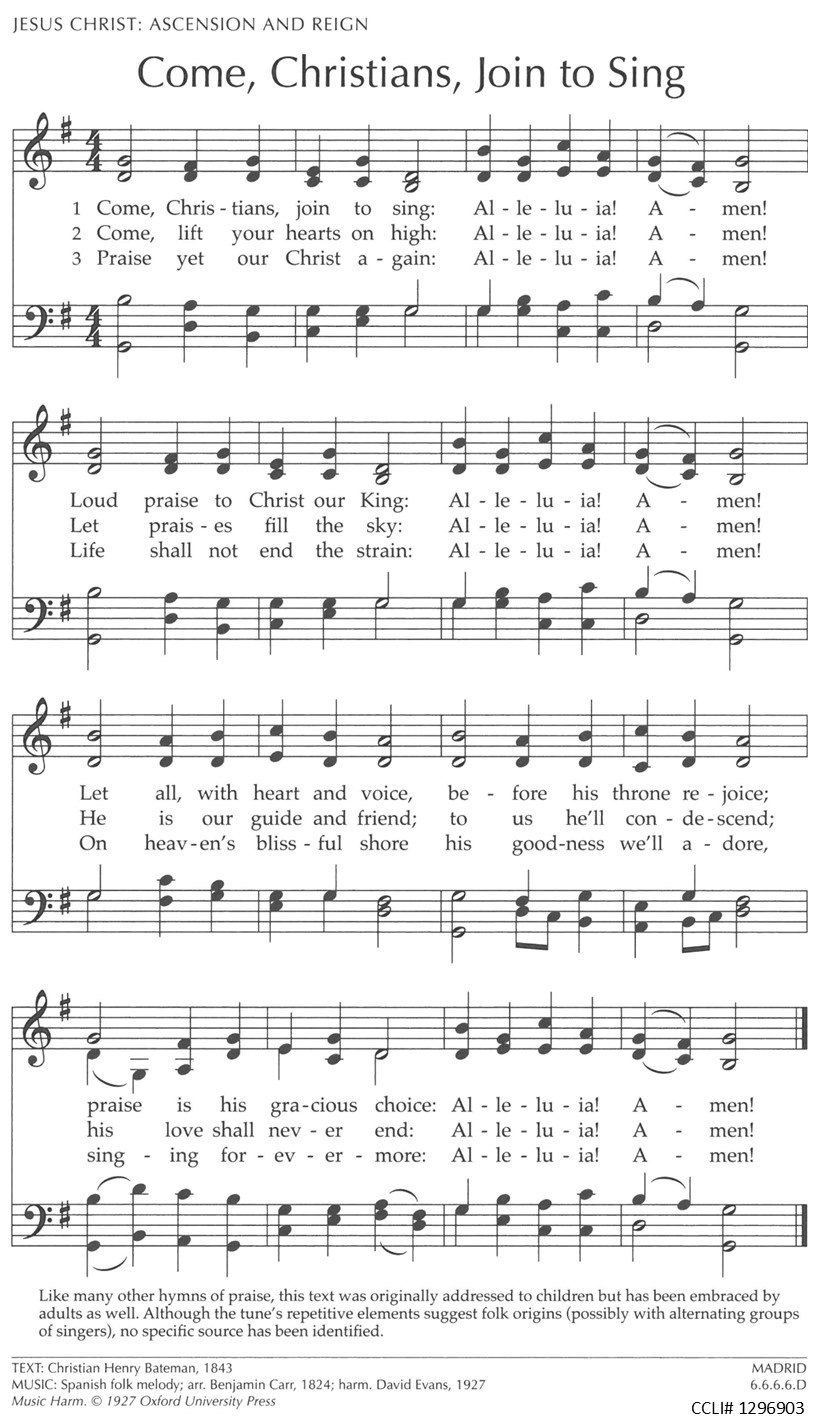
“Come, Christians, Join to Sing” was the closing hymn at Pender’s Music Appreciation Sunday on June 11, 2023. It was sung by Pender’s congregation and Sanctuary Choir, accompanied on piano by Heidi Jacobs and combined handbell choirs (Joy and Carillon Ringers) directed by Brian Stevenson.
“Come, Christians, Join to Sing” was the opening hymn at Pender’s Traditional Service on May 29, 2022. It was accompanied by piano (Liz Sellers) and organ (Brian Stevenson).
“Come, Christians, Join to Sing”
Christian Henry Bateman UM Hymnal, No. 158
Come, Christians, join to sing:
Alleluia! Amen!
loud praise to Christ our King:
Alleluia! Amen!
Let all, with heart and voice,
before his throne rejoice;
praise is his gracious choice.
Alleluia! Amen!
Christian Henry Bateman (1813-1899) was ordained into the Church of England after being a Congregational minister.
His ministerial studies were under the auspices of the Moravian Church, where he served for a time before changing to the Congregational Church at age 30. Following his ministry at Richmond Place Congregational Church in Edinburgh, Scotland, and successive Congregational parishes in Hopton, Yorkshire, and Reading, Berkshire, he took Holy Orders in the Anglican Church at age 56 and served as a curate and vicar in several Anglican parishes.
Australian hymnologist Wesley Milgate (1916-1999) noted that Bateman’s hymn is actually a rewritten version of the hymn “Join Now in Praise, and Sing” by William Edward Hickson (1803-1870). Hickson’s text uses the same melody, MADRID (SPANISH HYMN), and is structured in much the same way. Compare Bateman’s text at the beginning of this article with the first stanza of Hickson’s hymn:
Join now in praise, and sing
Hallelujah, Amen!
Praise to our heavenly King,
Hallelujah, Amen!
By love and gratitude
Still be the song renewed,
And be our hearts subdued,
Hallelujah, Amen!
Bateman probably found the earlier hymn in the collection Hickson published, Singing Master (1836). Hickson’s five stanzas were reduced to three by Bateman and first appeared in a collection published in Edinburgh, Sacred Melodies for Children (1843). The original “Hallelujah, Amen!” was changed by the Presbyterian Church in the U.S.A., in their 1933 hymnal, to “Alleluia! Amen!” It has remained that way ever since.
Each stanza begins with an exhortation—an imperative command to “Come” or “Praise.” In stanza one, Bateman provides the children with the reason for singing: We offer “loud praise to Christ our King . . . before his throne. . . .” Christ desires our praise: “praise is his gracious choice. . . .”The original incipit (opening line of the hymn) was “Come, children, join to sing.” Though changed in the Presbyterian hymnal to include all age groups, Bateman’s text contains direct, uncomplicated language suited for children. Since very few of the words have more than two syllables and “Alleluia! Amen!” is interjected three times in each stanza, the hymn is easy for children to learn and sing.
Stanza two reassures the children (and all of us) that this King is also “our guide and friend” and that “his love shall never end.” This King will “condescend” to be a friend to the children. To condescend surely did not mean to patronize as it tends to mean today, but implies that Christ the King humbles himself to be in a personal relationship with us.
Stanza three ends on an eschatological note. The author reassures children that they need not fear death. Beyond life, our songs will continue on “heaven’s blissful shore . . . singing forevermore: Alleluia! Amen!”
Dr. Hawn is professor of sacred music at Perkins School of Theology.




 News and Views