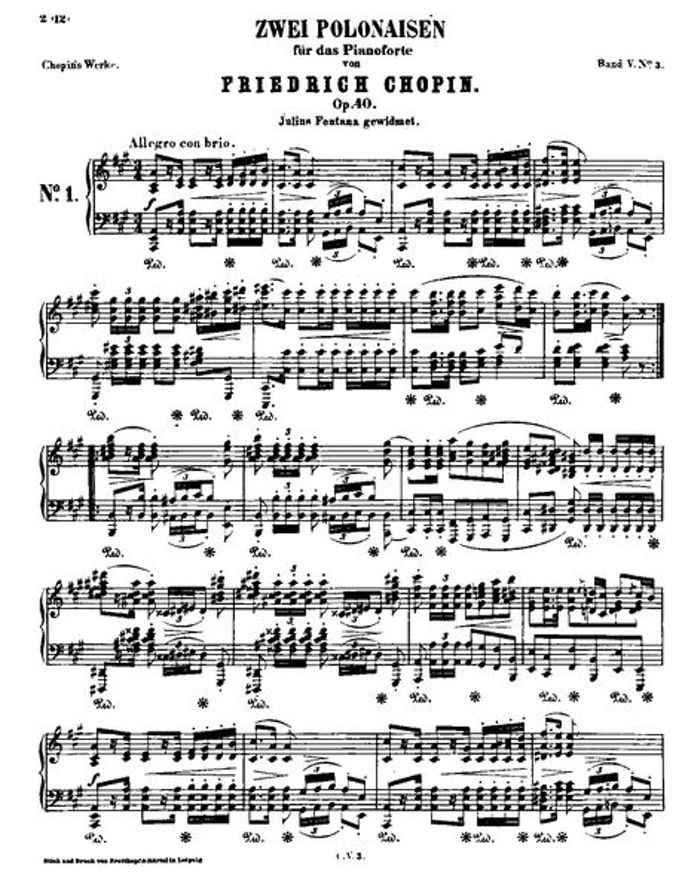
During the Postlude at Pender UMC’s Traditional Service on June 11, 2023, we were treated to “Military Polonaise Op. 40 No. 1 in A Major” by Frédéric Chopin played by Heidi Jacobs.
The Polonaise no. 1 in A major, often nicknamed Military, has been described as a symbol of ‘Polish Glory’: it is almost entirely played forte or louder, which makes for a bombastic performance.
“His Eye Is On The Sparrow” was the postlude at Pender’s 9:00 am Traditional Service on September 3, 2023. It was played on piano by Heidi Jacobs.
His Eye Is on the Sparrow
Civilla Martin The Faith We Sing, page No. 2146
“Why should I feel discouraged?
Why should the shadows come?
Why should my heart be lonely
and long for heaven and home?
When Jesus is my portion?
My constant friend is he;
His eye is on the sparrow,
and I know he watches me.”
Civilla Durfee Martin (1866-1948) was born in Nova Scotia and died in Atlanta, Ga. In “His eye is on the sparrow” (1905), she has provided one of the most influential and often-recorded gospel hymns of the 20th century.
Notable versions include recordings by Shirley Ceasar, Marvin Gaye, Kirk Franklin & the Family, Mahalia Jackson, Sister Rosetta Tharpe, Dottie West and Barbara Mandrell.
Jessica Simpson included this song in her album Irresistible (2001). The most stirring renditions of this song are associated for many with actress-singer Ethel Waters, who loved this it so much that it became the title of her autobiography (1950).
Martin was the daughter of James N. and Irene Harding Holden, and was a schoolteacher with modest musical training. Together with her husband, Walter (1862-1935), they often wrote gospel songs for revival meetings. “Be not dismayed” (UM Hymnal, No. 130) is an example of their collaboration.
Walter Stillman Martin was a Baptist minister who received his education at Harvard. He later became a member of the Disciples of Christ, teaching at Atlantic Christian College (now Barton College) in Wilson, N.C., before moving to Atlanta in 1919, a location that became the base for revivals that he held throughout the U.S.
The song was obviously inspired by Matthew 6:26: “Look at the birds of the air; they neither sow nor reap nor gather into barns, and yet your heavenly Father feeds them. Are you not of more value than they?”
Later in Matthew (10:29-31), the Gospel writer continues on this theme: “Are not two sparrows sold for a farthing? And one of them shall not fall on the ground without your Father. But the very hairs of your head are all numbered. Fear ye not therefore, ye are of more value than many sparrows.” Similar thoughts are cited in Luke 12:6-7. Stanza two quotes part of John 14:1 directly, “Let not your heart be troubled…”
Civilla Martin describes the context out of which the hymn was born: “Early in the spring of 1905, my husband and I were sojourning in Elmira, New York. We contracted a deep friendship for a couple by the name of Mr. and Mrs. Doolittle—true saints of God. Mrs. Doolittle had been bedridden for nigh twenty years. Her husband was an incurable cripple who had to propel himself to and from his business in a wheelchair. Despite their afflictions, they lived happy Christian lives, bringing inspiration and comfort to all who knew them. One day while we were visiting with the Doolittles, my husband commented on their bright hopefulness and asked them for the secret of it. Mrs. Doolittle’s response was simple: ‘His eye is on the sparrow, and I know He watches me.’ The beauty of this simple expression of boundless faith gripped the hearts and fired the imagination of Dr. Martin and me. The hymn ‘His Eye Is on the Sparrow’ was the outcome of that experience.”
The next day she mailed the poem to Charles Gabriel, a famous composer of gospel songs, who wrote a tune for it.
The themes of solace in spite of sorrow, and a profound sense of being under the watch-care of Jesus, who is a “constant friend,” offered the African-American community comfort during the Civil Rights movement. The refrain seals the theme by offering an apology for singing—“I sing because I’m happy, I sing because I’m free”—words that would speak to everyone, but especially African Americans.
There is no doubt that African American gospel artist Kirk Franklin was influenced by Martin’s song when he composed “Why we sing” (The Faith We Sing, No. 2144).
“Love Divine All Loves Excelling was the opening hymn at Pender’s 9:00 am Traditional Service on July 23, 2023 It was sung by Pender’s congregation, accompanied on piano by Heidi Jacobs and flute by Brian Stevenson.
The Pender UMC Traditional Service Opening Hymn “Love Divine, All Loves Excelling” on Sunday June 26, 2022 was accompanied by Liz Sellers on piano and sung by the Pender Congregation.
“Love Divine, All Loves Excelling”
Charles Wesley UM Hymnal, No. 384
Love divine, all loves excelling,
joy of heaven to earth come down;
fix in us thy humble dwelling;
all thy faithful mercies crown!
Jesus, thou art all compassion,
pure, unbounded love thou art;
visit us with thy salvation;
enter every trembling heart.
Charles Wesley (1707-1788) was a prolific hymn writer of the 18th century. Coming from a musical family, he left a lasting legacy of congregational song.
The youngest of 18 children, Charles possessed prodigious talents that soon blossomed. Little did he know that “Love Divine, All Loves Excelling,” would rise to become one of the most popular and consistently vocalized Christian songs.
Writing hymn texts that are solidly based on the Scriptures gives them an appeal across denominational lines. It is estimated that during his lifetime, Wesley penned more than 9,000 poems of a spiritual nature, 6,000 of which are hymns. His writings were passionate and well-crafted, conveying the true essence of Christian teaching.
At Pender’s 9:00 am Traditional and 11:15 am Common Ground Contemporary Services, Pastor Will White, continues the Lenten series “Rend Your Hearts: Claiming the Promise”.
The Message will be “This is the Sign” based on Genesis 9:8-17, 1 Peter 3:18-22 and Mark 1:9-15.
Lent began on Ash Wednesday; we admit that. But this first Sunday is when many people become aware of the season. If there are rituals to be adopted, they will often begin today. So, we are on the brink again, or still, or even for the first time, of the journey. That’s why we begin with promise; we begin with covenant.
Today we will also celebrate Scout Sunday and have a Blessing of the Bibles for First Grades
Watch the 9:00 Traditional Service
Attend the 11:15 Common Ground Contemporary Worship
How do we convince people that following Jesus is not simply about a state of being, but a call to doing? Certainly, there is a need for training, for preparation, for growing as disciples; but the end is always an outward focus, always looking for ways to connect, to widen the net.
If you know someone unable to watch or listen to the Traditional service on a computer or device, they may use any phone to listen to the audio at 1-571-200-7103
Each Sunday service is available for about a week, then the latest takes its place.





 News and Views