Chuck Knows Church — Lectionary.
“Today’s reading is from the Old Testament. . .” Ever heard that said in church? Did you know there is a calendar of readings?
Yep, and Chuck will tell you about “The Lectionary”
Chuck Knows Church — Lectionary.
“Today’s reading is from the Old Testament. . .” Ever heard that said in church? Did you know there is a calendar of readings?
Yep, and Chuck will tell you about “The Lectionary”

“Joyful, Joyful, We Adore Thee”
Henry Van Dyke
The UM Hymnal, No. 89
“Joyful, Joyful, We Adore Thee”, set to the famous “Ode to Joy” melody of the final movement of Ludwig van Beethoven’s final symphony, Symphony No. 9, was the opening hymn at Pender’s 9:00 am Traditional Service on September 10, 2023. It was sung by Pender’s Sanctuary choir, congregation and accompanied on piano by Heidi Jacobs.
“Ode to Joy” was the postlude at Pender’s 9:00 am Traditional Service on July 9, 2023, played by Heidi Jacobs on the piano.
On June 20, 2022, a Memorial Concert was held for long-time choir member, Diane Martini. The Pender Sanctuary Choir and The Choral Arts Society of Washington sang several of Diane’s favorites.
“The Hymn of Joy” (often called “Joyful, Joyful We Adore Thee” after the first line) is a poem written by Henry van Dyke in 1907 with the intention of musically setting it to the famous “Ode to Joy” melody of the final movement of Ludwig van Beethoven’s final symphony, Symphony No. 9.
Former Pender UMC Music Director, Ann Rollins, directed the combined choirs and congregation in singing Joyful, Joyful We Adore Thee with organ accompaniment.
Joyful, joyful, we adore thee,
God of glory, Lord of love;
Hearts unfold like flowers before thee,
Opening to the sun above.
Melt the clouds of sin and sadness,
Drive the dark of doubt away.
Giver of immortal gladness,
Fill us with the light of day.
This joyful ode is one of the best-known hymns in the English language. Henry Van Dyke (1852-1933) was inspired in 1907 by the beauty of the Berkshire mountains where he was serving as a guest preacher at Williams College, Williamstown, Mass.
It has been said that Van Dyke handed the poem to the president of the college, saying: “Here is a hymn for you. Your mountains were my inspiration. It must be sung to the music of Beethoven’s ‘Hymn to Joy.’” The hymn appeared in the 3rd edition of Van Dyke’s Book of Poems (1911).
While this story may be true, Methodist hymnologist Fred Gealy commented on this hymn from a different perspective (as cited by UM Hymnal editor Carlton Young):
“Van Dyke countered [the doom prior to World War I] by speaking a gay cheery all’s-right-with-the-world note which was in complete harmony with the widely held belief in an easy if not inevitable progress. . . . The daintiness of phrase and the lilt of rhythm suggest Elysium or Eden before the Fall.”
The adaptation of Ludwig van Beethoven’s (1770-1827) stirring melody from the final movement of his Ninth Symphony is the perfect companion to this exuberant text. Beethoven never wrote a hymn tune, per se, though a number of texts have been adapted to this melody. Van Dyke’s is by far the most closely associated hymn text with this tune.
The metaphor of light, the antithesis of darkness—a common theme in Romantic poetry—provides the overarching vehicle for expressing joy in stanza one. “Flowers . . . [open] to the sun above.” “Clouds of sin and sadness” disperse. “Dark and doubt” are driven away. The final line of stanza one petitions the “Giver of immortal gladness” to “fill us with the light of day.”
The second stanza paints a vivid picture of God manifest in the beauty of nature, also a common theme of the Romantic era. The third stanza extends to the human creation and the brotherhood of humanity. Since God is the Father of humanity, Christ is our brother.
The belief that ultimately humanity is progressing culminates in the final stanza, “Ever singing, march we onward,/ Victors in the midst of strife.”
Beethoven’s “joyful music” was adapted by British composer Edward Hodges (1796-1867). The United Methodist Hymnal restores Beethoven’s original syncopation that begins the final line of each stanza.
Dr. Young comments on this bold move with a combination of humor and irony: “Its restoration in our hymnal has spawned complaints from those for whom congregational song is devoid of surprises—and resurrection!”
Van Dyke was a Presbyterian minister. Most of his career (1899-1922) was spent as a professor of English literature at Princeton University.
He also served in civil posts, including his appointment to the Netherlands and Luxembourg by Woodrow Wilson, a personal friend, and was a lieutenant-commander in the U.S. Navy Chaplain Corps during World War I. Van Dyke wrote some 25 books and chaired the committee that in 1905 prepared the Book of Common Worship for the Presbyterian Church.
Given Van Dyke’s experience in Europe and service as a military chaplain, it is unlikely that this famous hymn, written during the bleak days before the World War I, was composed with a Pollyanna worldview of denial. Rather this poem, composed by a minister and English professor, reflects the Romantic poetic themes of its day while imbued with a Christian sense of ultimate hope.
Dr. Hawn is professor of sacred music at Perkins School of Theology.
Adapted from https://www.umcdiscipleship.org/resources/history-of-hymns-joyful-joyful-we-adore-thee
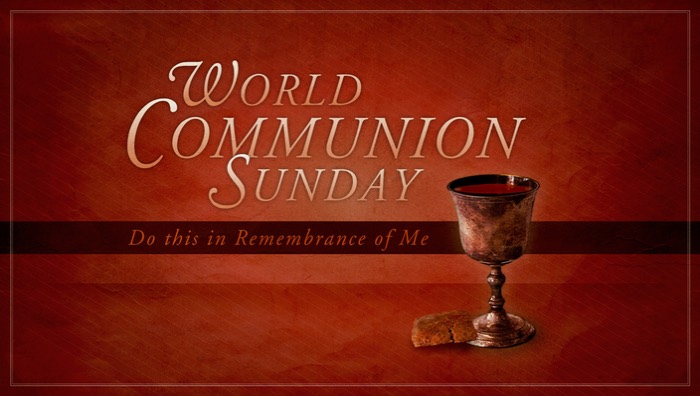
World Communion Sunday offers us an opportunity to experience Holy Communion in the context of the global community of faith.
The first Sunday of October has become a time when Christians in every culture break bread and pour the cup to remember and affirm Christ as the Head of the Church.
On that day, we remember that we are part of the whole body of believers.
Christians celebrate the communion liturgy in as many ways as there are congregations. World Communion Sunday can be both a profound worship experience and a time for learning more about our wider community of faith.
Because Pastor Bruce is away, we will celebrate at Pender next Sunday.
It’s the second half of the bestselling book the world has ever known. But this episode will test your knowledge about the 27 books in the New Testament.

“When Jesus the Healer Passed through Galilee”
Peter D. Smith
The United Methodist Hymnal, No. 263
“When Jesus the Healer Passed Through Galilee” was the closing hymn at Pender’s 9:00 am Traditional Service on September 10, 2023 It was sung by Pender’s Sanctuary choir, congregation and accompanied on piano by Heidi Jacobs.
The Pender UMC Traditional Service Closing Hymn “When Jesus the Healer Passed Through Galilee” on Sunday June 19, 2022 was accompanied by Liz Sellers on piano, Brian Stevenson on guitar and sung by Brian and the Pender Congregation.
During the season of Epiphany, we recall those actions of Jesus, especially the miracles, that demonstrate that he was indeed the Christ, the Son of God. “When Jesus the healer” provides a compendium of many of Christ’s miraculous healing activities.
Peter David Smith was born in Weybridge, Surrey, England, in 1938. After working for a time in the aircraft industry, he became a Methodist minister. A hallmark of his ministry was his gift as a folksinger. Though trained as a classical pianist, the folk guitar became his instrument of choice. He edited several popular song collections including Faith, Folk, and Charity (1968), Faith, Folk and Nativity (1969), Faith, Folk, and Festivity (1969), and New Orbit (1972). These collections appeared during the height of the popularity of the folk music idiom.
The folk idiom in the service of the church provides an immediacy and accessibility to great biblical truths. While classical hymnody often engages through the depth of metaphors and symbolic use of language, the more colloquial language of the folk idiom captures us with its earthiness—what you see is what you get. The music of a successful folksong must be easily learned—captured immediately—or it works against the directness of the language.
Folk Songs often tell stories, or have a narrative quality. The guitar is the preferred instrument of the folksinger. Its portability and accessibility invite participation. An organ or even a piano might separate the singer and the people, both in physical and psychological space, but not the guitar.
In many ways, Christian folk singers of the 1960s and 1970s find their roots in the songs of Woody Guthrie (1912-1967), Pete Seeger (b. 1919) and Bob Dylan (b. 1941), to name a few. However, the prototype of the Christian folksong may be found in Sydney Carter (1915-2004) and his famous “Lord of the Dance” (1963). Carter shocked the faithful and endeared himself to the prophets in the church. While he is known primarily for “Lord of the Dance” in the United States, many more of his songs are commonly sung in England.
The overarching narrative of Jesus as healer guides this hymn. In a mere 22 syllables and a brief refrain, the author opens up an entire healing narrative in each stanza: stanza 1, Luke 4:31-41; stanza 2, Mark 2:3-12; stanza 3, Mark 5:22-24, 35-43; stanza 4, Mark 10:46-52; stanzas 5 and 6, Matthew 10:5-15. A soloist carries the weight of the narrative in the third person while the people respond from the perspective of those needing healing in the first person plural: “Heal us, heal us today!”
Mr. Smith composed this song during a course he was teaching on contemporary worship for the Iona Community in 1975. Later, he served on the editorial committee for the hymnal, Partners in Praise (1979), and this was one of ten contributions by the composer included in its contents.
One stanza was omitted due to sensitivity to discriminatory language and a slight alteration to one line in stanza five was made for the same reason. Other than that, the hymn comes to us as originally composed.
The composer skillfully draws the people into the narrative in the final stanza by pointing out that the need for Christ’s healing power is still with us today: “There’s still so much sickness and suffering today. . . . We gather together for healing and pray: Heal us, Lord Jesus!”
*© 1979 Stainer & Bell, Ltd. Used by permission. All rights reserved.
Dr. Hawn is professor of sacred music at Perkins School of Theology.
Adapted from https://www.umcdiscipleship.org/resources/history-of-hymns-when-jesus-the-healer-passed-through-galilee


 News and Views