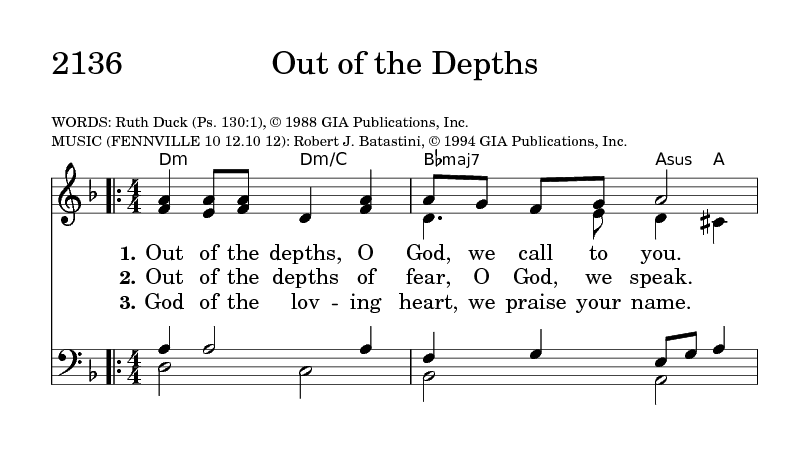
“Out of the Depths”
by Ruth Duck
The Faith We Sing, No. 2136.
The Pender UMC Traditional Service Middle Hymn “Out of the Depths” on Sunday September 4, 2022 was played by Eunji Moon on piano and sung by Brian Stevenson, the Pender Sanctuary Choir and congregation.
Central to biblical models of prayer is the practice of lament: crying out to God in pain, anguish, and grief. While examples of prayers of lament are found throughout the biblical witness and are particularly prevalent in the book of Psalms, too often we neglect lament in our worship.1 Bringing all our wounds to God shapes and forms us in honest relationship with our Creator, who loves us when we are far from perfection and is present with us in times of trouble. Hymns such as Ruth Duck’s “Out of the Depths” can help us reclaim lament in our worship.
“Out of the Depths” uses Psalm 130:1 as a springboard to name the things that plunge us into our own depths. While Psalm 130 is often seen as a confessional psalm, with its focus on redemption from iniquities,2 there are many things we hide away—our wounds, our scars, our traumas, our fears—and hiding these from ourselves and God stifles healing. “Out of the Depths” brings them forward through the practice of naming and lamenting in community. The first verse acknowledges the power of “wounds of the past” to affect our daily lives and the need for God’s love when we look at the full scope of our lives. The second verse leads us toward breaking silences that cloud the truth and keep us living in the fear of that which we have been too afraid to name.
While “Out of the Depths” encourages us to do our own individual work toward bringing our laments to God, it also lifts up the value of community in this healing process. While the first two stanzas both begin with “out of the depths,” all three stanzas end with “here in this community,” ensuring that the words most emphasized by repetition are not words of sorrow and isolation, but words of companionship. The second stanza also speaks to the safety and value of sharing difficult emotions among friends.
Almost all psalms of lament live in the tension between lament and praise. In fact, praise and expressions of confidence in God are seen as essential elements to the form of “lament”;3 many lament psalms end in praise (such as Psalm 13), or move back and forth constantly between lament and praise (Psalm 42).4 “Out of the Depths” leads us into praise in the final verse, painting a picture of a dancing God who moves through our lives as light in our darkness, meeting us with grace. The tune, FENNVILLE, is flexible enough to hold both tones—lament and praise—lending a strength and assurance to our words of praise. A bit of creativity in accompaniment can easily turn the final chord to a brighter tone.
The flexibility of this hymn conjures up possibilities for use outside the traditional context of singing the hymn straight-through in a service. Spoken prayer could easily be interspersed within the stanzas: naming specific kinds of pain present to those gathered, asking for assurance of God’s presence even in the depths, and thanking God for being revealed in community. It could easily be paired not only with Psalm 130, but also Psalm 139, in its assurance that there is no place anyone can go out of God’s reach—not even the depths.
While “Out of the Depths” leads us into lament in a way appropriate for many Sunday mornings, it is also a hymn to keep in mind in the unfortunate reality of times of crisis and tragic circumstances. The line, “Wounds of the past remain, affecting all we do,” acknowledges the impact such events have not only in the immediate aftermath, but throughout our lives. As such, this hymn could be particularly powerful when used in services of remembrance acknowledging anniversaries of events that have shaken communities.
“Out of the Depths” also has strong potential for use outside of a Sunday morning worship service. Ruth Duck has written alternate second lines for the first verse; one for those who are seriously ill (“Free us from fear of death, our faith and hope renew…”), and one for those who have been abused (“Words of abuse remain, affecting all we do…”) These reframe the hymn for more specific situations and could be useful in pastoral care situations as an opening or closing song for grief-sharing and support groups.
This is not surprising given the author’s interest in liturgical healing. A professor of worship at Garrett-Evangelical Theological Seminary, a strong presence in the academic liturgical community, and a prolific hymn text writer, Ruth Duck has written many hymns focused on healing and God’s ability to bring wholeness and restoration (such as “Sacred the Body,” “When We Must Bear Persistent Pain,” and “Womb of Life and Source of Being”). 5 “Out of the Depths” offers a way for us to give voice to our too often unspoken pain, celebrate community, and be assured of God’s grace which meets us wherever we are.
1 Duff, Nancy J. “Recovering Lamentation as a Practice in Church”, in Lament: Reclaiming Practices in Pulpit, Pew, and Public Square, ed. Sally A. Brown and Patrick D. Miller. Louisville: Westminster John Knox, 2005. p 4.
2 ed. Martin Tel, Psalms for All Seasons, Grand Rapids: Faith Alive Christian Resources, 2012. p 848.
3 Miller, Patrick D. They Cried to the Lord: the Form and Theology of Biblical Prayer. Minneapolis: Fortress Press, 1994. p 55-133.
4 Psalm 88 is a notable expression of a lament psalm without praise.
5 Ruth Duck’s person page, Hymary.org: http://www.hymnary.org/person/Duck_RC
From https://www.umcdiscipleship.org/resources/history-of-hymns-out-of-the-depths-by-ruth-duck-1






 News and Views