RSS

Category Archives: Music

Hymn History: Standing on the Promises


“Standing on the Promises”
R. Kelso Carter
UM Hymnal, No. 374

“Standing on the Promises” was the middle hymn at Pender’s 9:00 am Traditional Service on June 18, 2023 It was sung by Pender’s congregation, accompanied on piano by Heidi Jacobs and guitar by Brian Stevenson.

The Pender UMC Traditional Service Opening Hymn “Standing on the Promises” on Sunday November 6, 2022 was played by Liz Eunji Moon on piano, accompanied on guitar by Brian Stevenson and sung the Pender Sanctuary Choir and congregation.

Standing on the promises of Christ my King,
Through eternal ages let his praises ring;
Glory in the highest, I will shout and sing,
Standing on the promises of God.

Russell Kelso Carter (1849-1928) was a man of diverse interests and abilities. A native of Baltimore, Md., Carter was known as an outstanding athlete in his younger days. The Methodist Holiness camp meeting movement had a profound impact on his life and he was ordained into ministry in 1887.

Carter held a number of teaching posts at the Pennsylvania Military Academy including professor of chemistry, natural science, civil engineering and mathematics. Not only did he teach, but he also published text books in his various disciplines and even authored several novels. Other interests included sheep-raising and practicing medicine.

If this were not enough, Carter also edited hymnals. He assisted A.B. Simpson in the compilation of a hymnal for the Christian and Missionary Alliance Church, Hymns of the Christian Life (1891), a collection that contained 68 of his tunes and 52 of his texts.

“Standing on the Promises” was composed in 1886 while Carter was teaching at the military academy. He was a member of the first graduating class in 1867 and had a strong affinity for the school. Author Phil Kerr makes a connection between the music and the military academy in his book, Music in Evangelism, stating that Carter’s military experience was reflected in the martial musical style of the hymn.

Published the year it was written in the collection, Songs of Perfect Love, edited by John K. Sweeny and Carter, the original text had five stanzas. The missing stanza reads:

Standing on the promises I now can see
Perfect, present cleansing in the blood for me;
Standing in the liberty where Christ makes free,
Standing on the promises of God.

The second line of this stanza has a particular Wesleyan tone with its focus on perfection and cleansing blood. The Rev. Carlton Young, editor of the UM Hymnal, notes: “As in other single-theme evangelical hymns and songs of this period, the biblical source of the hymn is not clear. ‘Stand firm’ from Ephesians 6:14 has often been cited as the theme of the hymn, although the word ‘promise’ tends to be reinforced as well.”

Thus, two passages of Scripture seem to undergird the central premise of this gospel song: “Stand firm then, with the belt of truth buckled around your waist, with the breastplate of righteousness in place. . . .” (Ephesians 6:14). Several passages relate to the promises of God including 2 Samuel 22:31: “As for God, his way is perfect; the word of the LORD is tried; he is a buckler to all them that trust in him.”

Dr. Young points out that this hymn was not included in authorized hymnals for Methodists (or in the 1957 hymnal of the Evangelical United Brethren Church) until the current hymnal. He states, “Its place in our hymnal came from its inclusion in a list of hymns determined to be widely used by evangelical United Methodists.”

As is the case of many gospel songs, this song revolves around its refrain. The stanzas, rather than serving to develop a sequential train of thought, are more like the spokes of a bicycle—all serving as an entry point to the refrain from various perspectives. One could reorder the stanzas and not lose any train of thought.

Hymnologist Kenneth Osbeck places the hymn in its context: “The hymn has been widely used in the great evangelistic crusades throughout the past century.” It is in this context that its single focus and rousing, martial music may be best suited.

Adapted from https://www.umcdiscipleship.org/resources/history-of-hymns-stirring-promises-serves-as-popular-crusade-hymn


Tags: , , , , , ,

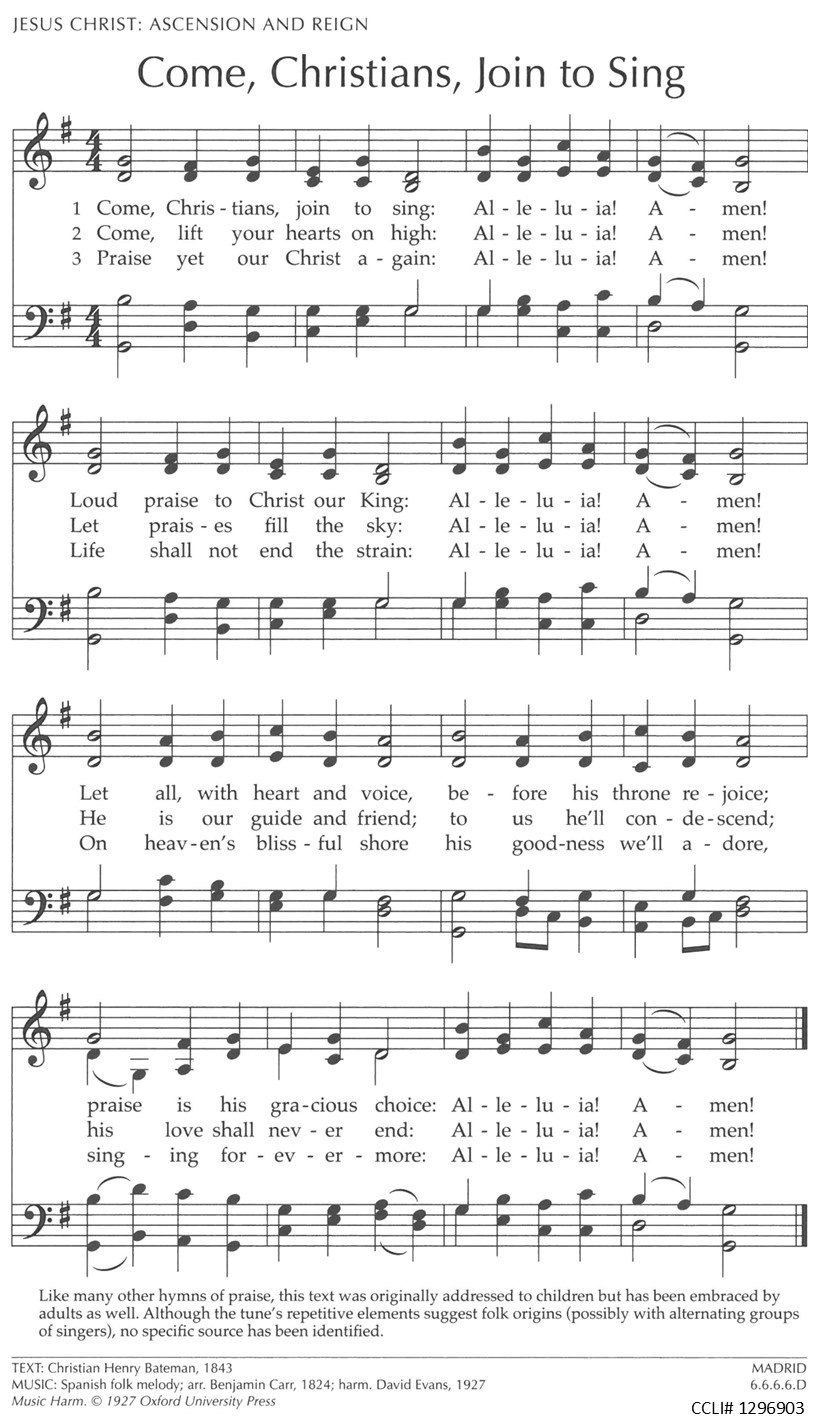
Hymn History: Come, Christians, Join to Sing


“Come, Christians, Join to Sing” was the closing hymn at Pender’s Music Appreciation Sunday on June 11, 2023. It was sung by Pender’s congregation and Sanctuary Choir, accompanied on piano by Heidi Jacobs and combined handbell choirs (Joy and Carillon Ringers) directed by Brian Stevenson.

“Come, Christians, Join to Sing” was the opening hymn at Pender’s Traditional Service on May 29, 2022. It was accompanied by piano (Liz Sellers) and organ (Brian Stevenson).

“Come, Christians, Join to Sing”
Christian Henry Bateman
UM Hymnal, No. 158

Come, Christians, join to sing:
Alleluia! Amen!
loud praise to Christ our King:
Alleluia! Amen!
Let all, with heart and voice,
before his throne rejoice;
praise is his gracious choice.
Alleluia! Amen!

Christian Henry Bateman (1813-1899) was ordained into the Church of England after being a Congregational minister.

His ministerial studies were under the auspices of the Moravian Church, where he served for a time before changing to the Congregational Church at age 30. Following his ministry at Richmond Place Congregational Church in Edinburgh, Scotland, and successive Congregational parishes in Hopton, Yorkshire, and Reading, Berkshire, he took Holy Orders in the Anglican Church at age 56 and served as a curate and vicar in several Anglican parishes.

Australian hymnologist Wesley Milgate (1916-1999) noted that Bateman’s hymn is actually a rewritten version of the hymn “Join Now in Praise, and Sing” by William Edward Hickson (1803-1870). Hickson’s text uses the same melody, MADRID (SPANISH HYMN), and is structured in much the same way. Compare Bateman’s text at the beginning of this article with the first stanza of Hickson’s hymn:

Join now in praise, and sing
Hallelujah, Amen!
Praise to our heavenly King,
Hallelujah, Amen!
By love and gratitude
Still be the song renewed,
And be our hearts subdued,
Hallelujah, Amen!

Bateman probably found the earlier hymn in the collection Hickson published, Singing Master (1836). Hickson’s five stanzas were reduced to three by Bateman and first appeared in a collection published in Edinburgh, Sacred Melodies for Children (1843). The original “Hallelujah, Amen!” was changed by the Presbyterian Church in the U.S.A., in their 1933 hymnal, to “Alleluia! Amen!” It has remained that way ever since.

Each stanza begins with an exhortation—an imperative command to “Come” or “Praise.” In stanza one, Bateman provides the children with the reason for singing: We offer “loud praise to Christ our King . . . before his throne. . . .” Christ desires our praise: “praise is his gracious choice. . . .”The original incipit (opening line of the hymn) was “Come, children, join to sing.” Though changed in the Presbyterian hymnal to include all age groups, Bateman’s text contains direct, uncomplicated language suited for children. Since very few of the words have more than two syllables and “Alleluia! Amen!” is interjected three times in each stanza, the hymn is easy for children to learn and sing.

Stanza two reassures the children (and all of us) that this King is also “our guide and friend” and that “his love shall never end.” This King will “condescend” to be a friend to the children. To condescend surely did not mean to patronize as it tends to mean today, but implies that Christ the King humbles himself to be in a personal relationship with us.

Stanza three ends on an eschatological note. The author reassures children that they need not fear death. Beyond life, our songs will continue on “heaven’s blissful shore . . . singing forevermore: Alleluia! Amen!”

Dr. Hawn is professor of sacred music at Perkins School of Theology.

Adapted from https://www.umcdiscipleship.org/resources/history-of-hymns-come-christians-join-to-sing


Tags: , , , , , , , , , , ,

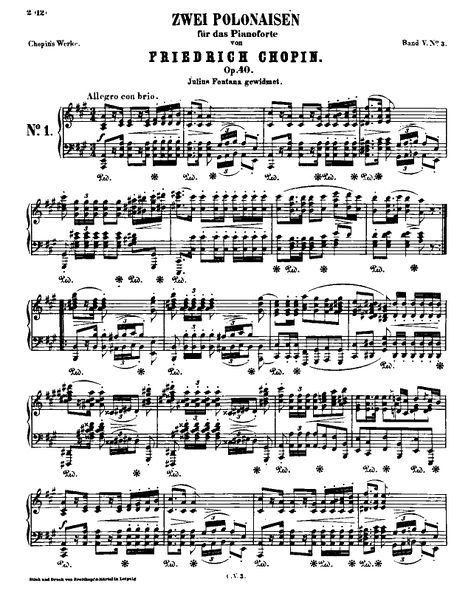
Chopin Military Polonaise Opus 40 No. 1 in A Major

During the Postlude at Pender UMC’s Traditional Service on June 11, 2023, we were treated to “Military Polonaise Op. 40 No. 1 in A Major”  by Frédéric Chopin played by Heidi Jacobs.

The Polonaise no. 1 in A major, often nicknamed Military, has been described as a symbol of ‘Polish Glory’: it is almost entirely played forte or louder, which makes for a bombastic performance.

 
Leave a comment

Posted by on June 21, 2023 in Music, Pender UMC, Videos


Tags: , , ,

Hymn History: ‘Doxology’

Pender’s current Doxology is “Praise God, from Whom All Blessings Flow”.

On May 28, 2023, Pender Pianist, Heidi Jacobs played a prelude which incorporated the Doxology into a medley of hymns.

In general usage, the Doxology is a short statement of praise, glory, and thanksgiving to God. It is often a short hymn designed to be sung by the worshiping congregation. Pender sings it to give thanks after the offering.

Chuck Knows Church — Doxology.

Chuck sings! Kinda. Bet you can’t guess the name of the most played piece of music in Protestant churches each Sunday? You looked at the title of this episode, didn’t you?

Chuck sings and explains on this his show!

“Praise God, from Whom All Blessings Flow”
by Thomas Ken
The United Methodist Hymnal, 95

Praise God, from whom all blessings flow;
Praise him, all creatures here below;
Praise him above, ye heav’nly host;
Praise Father, Son, and Holy Ghost.

Born in Hertfordshire, Bishop Thomas Ken (1637–1711) was orphaned as a child and raised by his sister Anna and her husband Izaak Walton. They enrolled him in the all-boys school at Winchester College (1651–1656). After his education there, he attended Hart Hall, Oxford, and New College, Oxford (B.A., 1661, M.A., 1664).

Ken was ordained as an Anglican priest in 1662, serving as rector to several parishes and as a chaplain to Princess Mary of Orange (1679–80), King Charles II (1683), and the Tangier Expedition (1683–84). In 1685, he was appointed Bishop of Bath and Wells. During the reign of King James II, he was imprisoned in the Tower of London for refusing to sign the Declaration of Indulgence (1687), a decree designed to promote the king’s Catholic faith. Ken was acquitted of the charge. When, however, King William III ascended to the throne, Ken refused to swear loyalty to him and resigned his office, living the rest of his life at the home of his friend, Lord Weymouth, at Longleat, Wilshire (Doyle, Canterbury Dictionary, n.p.).

The original date of composition by Ken for the text of “Praise God from Whom All Blessings Flow” is unknown. The first mention of the hymn is in 1674 as the presumed final stanza of two longer hymns: “Awake, My Soul and with the Sun” and “Glory to Thee, My God, this Night.” These two hymns were referenced along with a third as Morning, Evening and Midnight Hymns in a later edition of a pamphlet written for his students titled A Manual of Prayers for the Use of the Scholars of Winchester College (1695). The following directive is from the first edition:

. . . be sure to sing the Morning and Evening Hymn in your chamber devoutly, remembering that the Psalmist, upon happy experience, assures you that it is a good thing to tell of the loving kindness of the Lord early in the morning and of his truth in the night season (Ken, 1675, n.p.).

This directive is most often interpreted to mean that the hymns were meant for private devotion, not the gathered assembly, and yet these four lines, often referred to as The Lesser Doxology, have “been sung more often than any other lines ever written” (Gealy, 1993, 200). The hymn texts were published later as an appendix in his 1695 pamphlet as “revised” versions.

Much of the beauty of these four lines lies in its reflection of the joyous outbursts of the psalms. Here we see both the “host” of heaven and the “creatures here below” of earth praising God as in Psalm 96:11-12a and the final jubilant line of Psalm 150:6:

Let the heavens be glad, and let the earth rejoice;
let the sea roar, and all that fills it;
let the field exult, and everything in it. (Psalm 96: 11-12a, NRSV)
Let everything that breathes praise the Lord!
Praise the Lord! (Psalm 150:6, NRSV)

Commonly called “The Doxology,” Ken’s acclamation of praise is actually one of many doxological declarations that appear in many hymns, often in final stanza. See, for example, the last stanzas of the fourth-century hymn “Of the Father’s Love Begotten,” William Draper’s versification (c. 1919) of a thirteenth-century poem by Francis of Assisi, “All Creatures of Our God and King,” and Catherine Winkworth’s translation (1858) of Lutheran pastor Martin Rinkart’s “Now Thank We All Our God” (1647). Though less common now, the pattern for many mainline Protestant congregations has been to sing another doxological acclamation, the “Gloria Patri,” earlier in a worship service, and Ken’s stanza at the time of the offertory. Of note is the cosmic character of Ken’s praise—“all creatures here below” and “above ye heavenly hosts”—calling on the entire cosmos to praise God.

The Trinitarian structure of Ken’s hymn has also led to its common liturgical use. The first line describes the person of God the Father as the source of all blessings (Ephesians 1:3; 2 Corinthians 1:3). The second line, though, speaks to God the Spirit through whom all creatures praise God (Psalm 104:24-30; 1 Corinthians 2:10-13). The third line points to God the Son, who is begotten of the Father, firstborn of heaven and superior to angels and the heavenly host (Hebrews 1:4). The fourth line summarizes the stanza and all of praise in general, since all praise is directed toward God, Father, Son, and Holy Spirit.

The United Methodist Hymnal pairs this text with the hymn tune OLD 100th, which is attributed to John Calvin’s composer, Louis Bourgeois (c. 1510–1559). The first two lines of Ken’s text were later adapted with additional inclusive words by United Methodist pastor Gilbert H. Vieira (b. 1926) to be sung with LASST UNS ERFREUEN from Ausserlesene Catholische, Kirchengesänge (1623), harmonized by Ralph Vaughan Williams. Pastor Vieira’s use of inclusive language reflects his continuing strong stands for inclusive and carefully chosen language (see Vieira, 2020, n.p.).

The hymn tune MORNING HYMN was composed by François Hippolyte Barthélémon (1741–1808) for the text of “Awake, My Soul, and With the Sun.” The appropriateness of the tune works well for this final stanza, where the words of the second phrase, “Praise him, all creatures here below,” are sung by descending stepwise through an entire scale. The third phrase, “Praise him above, ye heav’nly host,” is sung through a similar ascension that returns to the highest note of the tune in the final stanza, acknowledging the Trinitarian nature of God. Sheila Doyle comments on the hymn text saying, “The language is simple and precise, and the opening images of light and rising up, appropriate to morning, pervade the hymn and convey a powerful sense of renewal and aspiration” (Doyle, “Awake, My Soul,” n.p.).

SOURCES:

Sheila Doyle, “Awake, My Soul, and with the Sun,” The Canterbury Dictionary of Hymnology. Canterbury Press, https://hymnology.hymnsam.co.uk/a/awake,-my-soul,-and-with-the-sun (accessed September 27, 2020).

_____, “Thomas Ken,” The Canterbury Dictionary of Hymnology. Canterbury Press, http://www.hymnology.co.uk/t/thomas-ken (accessed September 27, 2020).

Fred D. Gealy, Research Files for the 1970 Companion to the Hymnal [1966] quoted in Young, Carlton R. Companion to the United Methodist Hymnal (Nashville, TN: Abingdon Press, 1993), 200.

Thomas Ken, A Manual of Prayers for the Use of the Scholars of Winchester College
(London: Printed for John Martyn, 1675), http://anglicanhistory.org/ken/manual.html (accessed September 27, 2020).

Gilbert H. Viera, “Let’s Watch Our Language,” United Methodist Insight (February 24, 2020), https://um-insight.net/perspectives/let-s-watch-our-language (accessed September 27, 2020).


From https://www.umcdiscipleship.org/articles/history-of-hymns-praise-god-from-whom-all-blessings-flow


Tags: , , , ,

Contemporary Cantata, Does God Hear Me?

A special service of songs and stories led by Worship Leader, Uriah Moore and featuring the Pender Praise Band. This was a contemporary worship experience featuring music from Doe, Elevation Worship, Kari Jobe, Karen Clark Sheard, and more.

In addition to singers, the band consists of guitar, drums, percussion, autoharp, saxophone, trumpet and clarinet.

This group leads worship every Sunday at 11:15 am online and in person at Pender UMC, 12401 Alder Woods Drive, Fairfax, VA US 22033.

 
Leave a comment

Posted by on June 1, 2023 in Music, Pender UMC, Videos


Tags: , , , , , , , , , , , , , , , , , , , ,