RSS

Category Archives: Pender UMC

Hymn History: ‘Doxology’

Pender’s current Doxology is “Praise God, from Whom All Blessings Flow”.

On May 28, 2023, Pender Pianist, Heidi Jacobs played a prelude which incorporated the Doxology into a medley of hymns.

In general usage, the Doxology is a short statement of praise, glory, and thanksgiving to God. It is often a short hymn designed to be sung by the worshiping congregation. Pender sings it to give thanks after the offering.

Chuck Knows Church — Doxology.

Chuck sings! Kinda. Bet you can’t guess the name of the most played piece of music in Protestant churches each Sunday? You looked at the title of this episode, didn’t you?

Chuck sings and explains on this his show!

“Praise God, from Whom All Blessings Flow”
by Thomas Ken
The United Methodist Hymnal, 95

Praise God, from whom all blessings flow;
Praise him, all creatures here below;
Praise him above, ye heav’nly host;
Praise Father, Son, and Holy Ghost.

Born in Hertfordshire, Bishop Thomas Ken (1637–1711) was orphaned as a child and raised by his sister Anna and her husband Izaak Walton. They enrolled him in the all-boys school at Winchester College (1651–1656). After his education there, he attended Hart Hall, Oxford, and New College, Oxford (B.A., 1661, M.A., 1664).

Ken was ordained as an Anglican priest in 1662, serving as rector to several parishes and as a chaplain to Princess Mary of Orange (1679–80), King Charles II (1683), and the Tangier Expedition (1683–84). In 1685, he was appointed Bishop of Bath and Wells. During the reign of King James II, he was imprisoned in the Tower of London for refusing to sign the Declaration of Indulgence (1687), a decree designed to promote the king’s Catholic faith. Ken was acquitted of the charge. When, however, King William III ascended to the throne, Ken refused to swear loyalty to him and resigned his office, living the rest of his life at the home of his friend, Lord Weymouth, at Longleat, Wilshire (Doyle, Canterbury Dictionary, n.p.).

The original date of composition by Ken for the text of “Praise God from Whom All Blessings Flow” is unknown. The first mention of the hymn is in 1674 as the presumed final stanza of two longer hymns: “Awake, My Soul and with the Sun” and “Glory to Thee, My God, this Night.” These two hymns were referenced along with a third as Morning, Evening and Midnight Hymns in a later edition of a pamphlet written for his students titled A Manual of Prayers for the Use of the Scholars of Winchester College (1695). The following directive is from the first edition:

. . . be sure to sing the Morning and Evening Hymn in your chamber devoutly, remembering that the Psalmist, upon happy experience, assures you that it is a good thing to tell of the loving kindness of the Lord early in the morning and of his truth in the night season (Ken, 1675, n.p.).

This directive is most often interpreted to mean that the hymns were meant for private devotion, not the gathered assembly, and yet these four lines, often referred to as The Lesser Doxology, have “been sung more often than any other lines ever written” (Gealy, 1993, 200). The hymn texts were published later as an appendix in his 1695 pamphlet as “revised” versions.

Much of the beauty of these four lines lies in its reflection of the joyous outbursts of the psalms. Here we see both the “host” of heaven and the “creatures here below” of earth praising God as in Psalm 96:11-12a and the final jubilant line of Psalm 150:6:

Let the heavens be glad, and let the earth rejoice;
let the sea roar, and all that fills it;
let the field exult, and everything in it. (Psalm 96: 11-12a, NRSV)
Let everything that breathes praise the Lord!
Praise the Lord! (Psalm 150:6, NRSV)

Commonly called “The Doxology,” Ken’s acclamation of praise is actually one of many doxological declarations that appear in many hymns, often in final stanza. See, for example, the last stanzas of the fourth-century hymn “Of the Father’s Love Begotten,” William Draper’s versification (c. 1919) of a thirteenth-century poem by Francis of Assisi, “All Creatures of Our God and King,” and Catherine Winkworth’s translation (1858) of Lutheran pastor Martin Rinkart’s “Now Thank We All Our God” (1647). Though less common now, the pattern for many mainline Protestant congregations has been to sing another doxological acclamation, the “Gloria Patri,” earlier in a worship service, and Ken’s stanza at the time of the offertory. Of note is the cosmic character of Ken’s praise—“all creatures here below” and “above ye heavenly hosts”—calling on the entire cosmos to praise God.

The Trinitarian structure of Ken’s hymn has also led to its common liturgical use. The first line describes the person of God the Father as the source of all blessings (Ephesians 1:3; 2 Corinthians 1:3). The second line, though, speaks to God the Spirit through whom all creatures praise God (Psalm 104:24-30; 1 Corinthians 2:10-13). The third line points to God the Son, who is begotten of the Father, firstborn of heaven and superior to angels and the heavenly host (Hebrews 1:4). The fourth line summarizes the stanza and all of praise in general, since all praise is directed toward God, Father, Son, and Holy Spirit.

The United Methodist Hymnal pairs this text with the hymn tune OLD 100th, which is attributed to John Calvin’s composer, Louis Bourgeois (c. 1510–1559). The first two lines of Ken’s text were later adapted with additional inclusive words by United Methodist pastor Gilbert H. Vieira (b. 1926) to be sung with LASST UNS ERFREUEN from Ausserlesene Catholische, Kirchengesänge (1623), harmonized by Ralph Vaughan Williams. Pastor Vieira’s use of inclusive language reflects his continuing strong stands for inclusive and carefully chosen language (see Vieira, 2020, n.p.).

The hymn tune MORNING HYMN was composed by François Hippolyte Barthélémon (1741–1808) for the text of “Awake, My Soul, and With the Sun.” The appropriateness of the tune works well for this final stanza, where the words of the second phrase, “Praise him, all creatures here below,” are sung by descending stepwise through an entire scale. The third phrase, “Praise him above, ye heav’nly host,” is sung through a similar ascension that returns to the highest note of the tune in the final stanza, acknowledging the Trinitarian nature of God. Sheila Doyle comments on the hymn text saying, “The language is simple and precise, and the opening images of light and rising up, appropriate to morning, pervade the hymn and convey a powerful sense of renewal and aspiration” (Doyle, “Awake, My Soul,” n.p.).

SOURCES:

Sheila Doyle, “Awake, My Soul, and with the Sun,” The Canterbury Dictionary of Hymnology. Canterbury Press, https://hymnology.hymnsam.co.uk/a/awake,-my-soul,-and-with-the-sun (accessed September 27, 2020).

_____, “Thomas Ken,” The Canterbury Dictionary of Hymnology. Canterbury Press, http://www.hymnology.co.uk/t/thomas-ken (accessed September 27, 2020).

Fred D. Gealy, Research Files for the 1970 Companion to the Hymnal [1966] quoted in Young, Carlton R. Companion to the United Methodist Hymnal (Nashville, TN: Abingdon Press, 1993), 200.

Thomas Ken, A Manual of Prayers for the Use of the Scholars of Winchester College
(London: Printed for John Martyn, 1675), http://anglicanhistory.org/ken/manual.html (accessed September 27, 2020).

Gilbert H. Viera, “Let’s Watch Our Language,” United Methodist Insight (February 24, 2020), https://um-insight.net/perspectives/let-s-watch-our-language (accessed September 27, 2020).


From https://www.umcdiscipleship.org/articles/history-of-hymns-praise-god-from-whom-all-blessings-flow
 

Tags: , , , ,

Note from the Pastor: Pender Youth Group Transition

Dear Families of Pender United Methodist Church,

I want to share with you some information regarding our upcoming pastoral transition. I feel it is important that we communicate with you as fully as we can.

Please know that change is never easy, however, if it is done purposefully and prayerfully it can be good. Over the past year our Staff/Pastor-Parish Relations Committee (S/PPRC) has been prayerfully considering appropriate staffing of the youth pastoral position after Rev. Howard M. Fickling-Finley resigned from his post.  I have served as the interim advisor and minister for our youth. Now that I am entering retirement, Pender’s S/PPRC and myself, have decided to appoint Mark Atwood as the interim youth director with Arlether Williams, Chairperson of Staff/Pastor-Parish Relations Committee, and Jane Mckee, Leader of the Grow in God Cluster to serve as co-leads during this period of transition.

Mark Atwood is the Chairman of the Chris Atwood Foundation, which he co-founded in 2013  after the Atwood family lost their son Christopher to an accidental overdose at age 21. The CAF is a 501(c)3 charitable organization that creates recovery ready communities through free harm reduction and recovery support services, resources, and education. They specialize in providing free training to the community on how to administer naloxone to reverse an opioid overdose; they provide free life-saving naloxone,  recovery housing scholarships, as well as free peer recovery support specialists for individuals.

Mark has taught high school Sunday School class at Pender for the past 15 years and worked with Pender’s youth group for the last twenty years. He is currently serving on Pender’s Nominations Committee, and is active in the Men’s Bible Study Group. Previously he served as co-chairperson of Pender’s S/PPRC.

Jane McKee has been a member of Pender for the past eight years, serving as the Superintendent of Sunday Schools, Chairperson of Children Ministries, and Leader of the Grow in God Cluster. Jane is an active singer and soloist in Pender’s Sanctuary Choir, she plays the autoharp in the Common Ground Praise Band, rings bells with the Joy Ringer Handbell ensemble, and is a member of Pender’s flute and wood recorder music groups. She is a worship leader, and is actively engaged in Pender’s Reaching New People and Common Ground Revision Teams. Jane is an educator, teaching in Fairfax County high schools, specifically Robinson High School, in the math discipline for the past twenty years. Prior to teaching math, she taught music in several communities to include overseas in Japan. Jane received a Master of Digital Learning degree from George Mason University and is a longstanding home owner in the Greenbriar Community.

Arlether “Arlet” Williams has been a member of Pender for the past 27 years, serving as a volunteer in our youth program, singing in the Sanctuary Choir and the Common Ground contemporary praise band. She assists in leading monthly worship services at Fairfax Juvenile Detention Center, serving in Pender’s United Women in Faith, our Reaching New People and Common Ground Revision Programs, and is currently the Chairperson of S/PPRC. Arlet retired after serving 32 years at the Central Intelligence Agency as Chief of Staff in the Talent Center and Office of Security. She has three adult children, whom she and her spouse Victor Ugwu raised at Pender in our children and youth ministries. Arlet is a graduate of Clark University in Worcester, Massachusetts.

Mark, Jane, and Arlet are highly committed to educating and guiding our youth.  Please know that with God’s help, we believe this transition plan will serve our youth, the Pender congregation, and most importantly support our new Lead Pastor Robert “Bruce” Johnson in making disciples for Jesus Christ who will go and transform the world.


Yours in Christ,

Lead Pastor William “Will” White

 
Leave a comment

Posted by on June 12, 2023 in Ministries, Pender UMC, Youth


Tags: , ,

June 4 is Trinity Sunday


Trinity Sunday is celebrated on the Sunday after Pentecost, reminding us of the three different ways we experience the one God whom we worship. We worship God the Creator; we worship Jesus who experienced the life of a human; and we worship the way that God works within us – the Holy Spirit.

Join Pender in celebrating this special Sunday.

 
Leave a comment

Posted by on June 4, 2023 in Holidays, Pender UMC, Posts of Interest


Tags:

Contemporary Cantata, Does God Hear Me?

A special service of songs and stories led by Worship Leader, Uriah Moore and featuring the Pender Praise Band. This was a contemporary worship experience featuring music from Doe, Elevation Worship, Kari Jobe, Karen Clark Sheard, and more.

In addition to singers, the band consists of guitar, drums, percussion, autoharp, saxophone, trumpet and clarinet.

This group leads worship every Sunday at 11:15 am online and in person at Pender UMC, 12401 Alder Woods Drive, Fairfax, VA US 22033.

 
Leave a comment

Posted by on June 1, 2023 in Music, Pender UMC, Videos


Tags: , , , , , , , , , , , , , , , , , , , ,

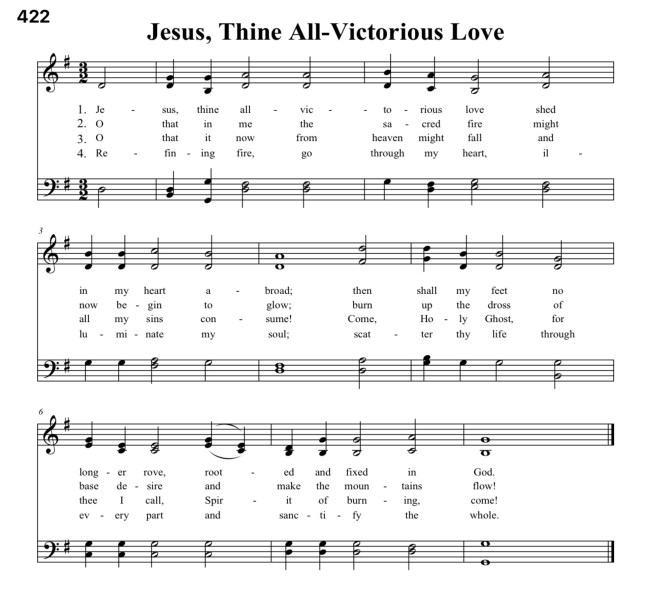
Hymn History: Jesus, Thine All-Victorious Love

The Pender UMC Traditional Service Opening Hymn “Jesus, Thine All-Victorious Love” on Sunday May 14, 2023 was played by Heidi Jacobs on piano and Brian Stevenson on organ.

This was Heidi’s first Sunday as Pender’s Pianist.

“Jesus, Thine All-Victorious Love,”
by Charles Wesley
The United Methodist Hymnal, No. 422.

Methodists need no introduction to Charles Wesley. For that matter, neither do most singing Christians! Perhaps no other hymn writer except Isaac Watts is so well loved as Charles Wesley. Few were as prolific, at least, or as wide-ranging with regard to the theological topics they addressed….

“Jesus, Thine All Victorious Love” is found in the United Methodist Hymnal at No. 422. As with many Wesley hymns that we sing today, the four stanzas given in the UMH are but part of a much longer hymn called “My God! I know, I feel thee mine.” The complete hymn is found in Collection of Hymns for the Use of the People Called Methodists in the section, “For Believers, Groaning for Full Redemption.” Atop the hymn text in the early editions sits a scripture reference to Romans 4:13, which speaks of the promise God made to Abraham and the righteousness of his faith. The full hymn has twelve stanzas, which can be divided thematically into four groups. Stanzas 1 to 3 articulate an individual’s desire for intimate communion with God the Father using physical, even visceral, images. Stanza 2 is particularly beautiful and connects to the passage from Romans 4, using the language of faith:

I hold Thee with a trembling hand,
But will not let Thee go,
Till steadfastly by faith I stand,
And all Thy goodness know.

This opening group of stanzas speaks of how such an intimate relationship with God not only sustains us, but gives us “health, and life, and power, and perfect liberty.” The use of superlatives such as “all Thy goodness” and “perfect liberty” highlights well the Wesleyan idea of Christian perfection.

The second section focuses on the love of Jesus and that love’s redemptive power. There are several scriptural images at play, and as one might expect from Wesley, or indeed from most anyone writing about love, conversion of the heart is central to this section. The United Methodist Hymnal version begins with this stanza, which is number 4 in the original.

Jesus, thine all victorious love
shed in my heart abroad;
then shall my feet no longer rove,
rooted and fixed in God.

The third section of the text focuses on the Holy Spirit; its three stanzas are all included in The United Methodist Hymnal. One particularly potent stanza speaks of the sanctifying power of the Spirit, highlighting another key tenet of Wesleyanism.

Refining fire, go through my heart,
Illuminate my soul;
Scatter Thy life through every part,
And sanctify the whole.

The fourth section brings to completion the sanctification of the believer and the experience of Christian perfection. The poetry of Wesley’s final stanza is both beautiful and unequivocal in its theological witness:

My steadfast soul from falling free,
Shall then no longer move;
But Christ be all the world to me,
And all my heart be love.

Those who might bravely choose to sing all twelve stanzas of this hymn would experience a beautiful, thoroughly trinitarian witness to the redemptive power of God’s love in Jesus Christ through the sanctification of the Holy Spirit. However, most congregations will probably opt to sing a subset of stanzas. The four stanzas found in the United Methodist hymnal are well suited to the Easter season. Beginning with a stanza about the “victorious love” of Jesus Christ reminds us of Jesus’s resurrection and victory over death, that is, of Easter. Following that stanza, then, the next three stanzas about the working of the Spirit seem to suggest the kind of liturgical flow that the Church experiences in the transition from Easter to Pentecost. That liturgical flow is made especially apparent in Year C of the Sunday lectionary, when the gospel of Luke is read.

“Jesus, Thine All Victorious Love” is a common meter text (8.6.8.6.) and could be sung to a great many tunes. It is often paired with Lowell Mason’s version of AZMON, which is ideal for most stanzas of the text. The iambic structure of the hymn aligns well with the fact that AZMON begins with a pickup note. However, because two lines of the stanza “Jesus, thine all victorious love” begin with a stressed syllable (“Je-sus” and “root-ed”), using AZMON, which has both a pickup and fast note values on the downbeat of each measure, could be awkward. One might consider singing the hymn to a common meter tune that begins without a pickup, such as ST. AGNES. Regardless of the tune chosen, though, or the number of stanzas one endeavors to sing, “Jesus, Thine All Victorious Love” is an exemplary Wesleyan hymn. Consider it the next time you sing during Eastertide.

Adapted from https://www.umcdiscipleship.org/resources/history-of-hymns-jesus-thine-all-victorious-love-wesley


Tags: , , , , , , , ,