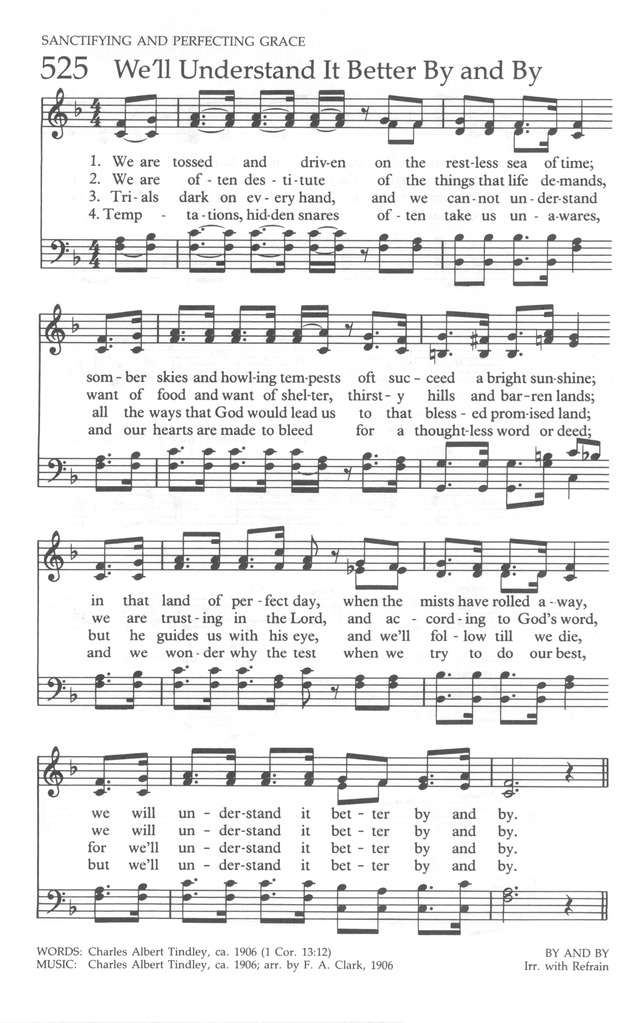
We are tossed and driven
on the restless sea of time;
somber skies and howling tempests
oft succeed a bright sunshine;
in that land of perfect day,
when the mists have rolled away,
we will understand it better by and by.
Charles Albert Tindley (July 7, 1851 – July 26, 1933) was an American Methodist minister and gospel music composer.
Often referred to as “The Prince of Preachers”, he educated himself, became a minister and founded one of the largest Methodist congregations serving the African-American community on the East Coast of the United States.
He was one of the eminent preachers of Methodism at the turn of the twentieth century. Hymnologist James Abbington has called Tindley a “pastor, orator, poet, writer, theologian, social activist, ‘father of African American Hymnody,’ ‘progenitor of African American gospel music’ and ‘prince of preachers.'”
The Rev. Carlton Young notes “We’ll Understand It Better By and By” was “one of eight hymns . . . written during a difficult period in Tindley’s life.”
One can imagine Tindley using this song to punctuate his sermons, offering hope to those assembled not only through exegesis of the biblical text, but also through a lyrical sung theology.
~~
From “The Lawrence Welk Show,” Gail, Rod, and Michael are featured in this great Gospel song found in the United Methodist Hymnal (page 525). Join with them in song as they encourage every Christian: “WE’LL UNDERSTAND IT BETTER BY AND BY”
“Lift Every Voice and Sing”
James Weldon Johnson The United Methodist Hymnal, No. 519
Pender pianist, Liz Eunji Moon played Lift Every Voice and Sing for the postlude on Martin Luther King Holiday weekend. “Lift Every Voice” began as a hastily-written composition for an unassuming school assembly in 1900, but has become the African-American national anthem.
Lift every voice and sing,
Till earth and heaven ring,
Ring with the harmonies of liberty;
Let our rejoicing rise
High as the listening skies,
Let it resound loud as the rolling sea.
Few hymns have the capacity to define the identity of an entire group. “Lift Every Voice” began as a hastily-written composition for an unassuming school assembly in 1900, but has become the African-American national anthem.
James Weldon Johnson (1871-1938) received degrees in literature from Atlanta University in 1894, with a master of arts in 1904. He had a versatile career as a writer, teacher, diplomat and lawyer, becoming the first African-American to pass the bar in the state of Florida. His diplomatic posts took him in 1906 to Puerto Cabello, Venezuela, and in 1909, to Corinto, Nicaragua, where he served as the American consul.
His most prominent leadership role was as the executive secretary of the National Association for the Advancement of Colored People (NAACP), a position that he assumed in 1920.
His most important published works include The Autobiography of an Ex-Colored Man (1920), The Book of American Negro Poetry (1922), God’s Trombones (1927), and Along This Way (1933).
Johnson had been asked to speak by the principal of a school in Jacksonville, Fla., his hometown, for an observance celebrating the birth of Abraham Lincoln. Rather than make a speech, he decided to write a poem. As the time drew near, his plans changed from a poem to a song. James turned to his brother J. Rosamund Johnson (1873-1954) to compose music for his text.
Even though the Johnsons’ New York publisher did not actively promote the song, children throughout the South kept it alive. The song gathered momentum, as it became known around the country.
Though the brothers wrote over 200 songs together, mostly for the stage, “Lift every voice” had an exceptional place in their musical collaborations. James noted in 1935, “The lines of this song repay me in elation, almost of exquisite anguish, whenever I hear them sung by Negro children.”
Gene Logan, a member of Ebenezer UMC in Jacksonville, Florida, connects the Johnson brothers with the Methodist Church: “James and his brother Rosamond became members of Zion Episcopal Methodist Church where their mother served as choir director and the young men served as musicians. The church was renamed Ebenezer United Methodist Church, which is now located at 9114 Norfolk Blvd in Jacksonville, Florida.” According to columnist Sharon Coon in Florida, their mother, Helen, “was the first Black female public school teacher in Florida. She taught at Old Stanton School on Ashley Street in Jacksonville, FL. His mother taught both James and J. Rosamond music and reading.” After receiving his degree from Atlanta University, James returned to the school where his mother taught as Principal in 1894. The brothers’ connections to the Methodist Church and their rearing by a nurturing and courageous mother surely contributed to their accomplishments.
The NAACP adopted “Lift every voice” as its theme song. Julian Bond, former NAACP chairman, stated that the song holds deep meaning for the Civil Rights Movement: “When people stand and sing it, you just feel a connectedness with the song, with all the people who’ve sung it on numerous occasions, happy and sad, over the 100 years before.”
This hymn, often called the “Negro National Anthem” or “Black National Anthem,” gave hope to many during the Civil Rights Era. Its centrality in African-American life may be illustrated by a childhood memory of Vernellia Randall, a law professor at the University of Dayton, who grew up in Texas. She recalls starting each day in her school in the 1950s and 1960s with The Lord’s Prayer, The National Anthem, and the Negro National Anthem.
Wendell Whalum, the late choral director at Atlanta’s Morehouse College, often spoke of the progression of the three stanzas as that of praise, lament, and prayer. The opening stanza is a resounding hymn of praise full of rich metaphors such as the “harmonies of liberty” and rejoicing “loud as the rolling sea.” The second stanza is a lament that recounts the price of liberty:
Stony the road we trod,
bitter the chastening rod,
felt in the day when hope unborn had died.
The sting of these words echoes Psalm 130, “Out of the depths have I cried unto thee.” Yet the poet does not leave us here long. By the end of the stanza, we are singing with hope,
Out of the gloomy past, till now we stand at last where the white gleam of our bright star is cast.
The final stanza is often referred to as a prayer in the African-American community. This prayer culminates with the petitions, “keep us forever in the path, we pray” and “may we forever stand true to our God, true to our native land.”
Is this a hymn just for African-Americans or is it for all people? Dr. James Abbington, Associate Professor of Music and Worship at Emory University’s Candler School of Theology, Atlanta, Georgia, and a scholar in African American hymnody, provides an answer to this question: “Several years ago, I was invited to organize and conduct a 1,000-voice choir for the annual Detroit Branch NAACP Freedom Fund Dinner at Cobo Hall. It was during the time of the Persian Gulf War and tensions were very high between the Jewish and Arab communities in the city.?rel=0″The 1,000 voice choir, accompanied by the Detroit Symphony Orchestra, was made up of Anglo-Americans, Canadians, Native Americans, Koreans, Italians, Jews, Arabs, African-Americans and others, and ‘Lift Every Voice and Sing’ was one of the selections for that occasion. After the first rehearsal Jewish, Korean, and Native American members of the chorus approached me and said, ‘This song isn’t just for African-Americans and people from Africa, it belongs to all of us who are ‘true to our God and true to our Native land.'”?
On May 20, 2018, the National Association for the Advancement of Colored People (NAACP) attended The Tabernacle Choir’s weekly Music and the Spoken Word broadcast. Members of the National Board of Directors of the NAACP and the NAACP Foundation were in Salt Lake City for their board meetings, which were held in Salt Lake City for the first time. They also met with the First Presidency of The Church of Jesus Christ of Latter-day Saints and made a joint statement to the media calling for “greater civility and racial harmony.”
The Pender UMC Traditional Service Closing Hymn “Amazing Grace” on Sunday October 23, 2022 was played by Liz Eunji Moon on piano, Brian Stevenson on organ and sung the Pender Sanctuary Choir and congregation.
On 10/9/2022/postlude not yet uploaded
December 1772 in Olney England John Newton began the writing a hymn that would grow increasingly more popular over the years.
In his hymn, “Amazing Grace,” Newton writes about a grace that is immense and one that saved himself out of his wretchedness. By looking within the hymn “Amazing Grace,” one is able to understand a little bit about Newton’s personal conversion
Newton grew up with both his parents, however, his mother died while his father was away at sea. Newton’s father remarried and the couple had another child. Following in his father’s footsteps, Newton began his life’s career by searching throughout the African coast for slaves to capture and eventually to sell for profit.
On one journey, Newton and his crew encountered a storm that swept some of his men overboard and left others with the likelihood of drowning. With both hands fastened onto the wheel of the boat, Newton cried out to God saying, “Lord, have mercy on us.” After eleven hours of steering, the remainder of the crew found safety with the calming of the storm. From then on, Newton dated March 21 as a day set aside for a time of humiliation, prayer, and praise.
Upon arriving safely home, Newton did not venture out to seek more slaves, instead he began to learn Hebrew and Greek. He occasionally accepted requests to speak about his conversion in front of various congregations. Newton was eventually ordained and began to lead his own church. God changed him from a man who was an advocate for the slave trade to a man actively working towards abolishing it. Newton’s literary work against the slave trade encouraged abolitionist William Wilberforce to continue his legal fight against slavery in England.
In later years, Newton began to lose his memory. Although his thoughts were limited, Newton said he could remember two things, “That I am a great sinner, and that Christ is a great Savior.” With this conviction of newly found life that he found only in Christ, Newton passed from his earthly life in 1807, at the age of 82. Newton did live long enough to see the signing of The Act for the Abolition of the Slave Trade.
The hymn appeared in the colonies later accompanied with a different tune, more commonly known as “New British.” It grew in popularity, but not because it was catchy tune, but because the words that Newton wrote related to every human being who encountered the saving grace of Jesus Christ and touched many people at various stages of their spiritual walks.
Since the day that Newton penned the lyrics to “Amazing Grace,” it has grown in popularity and has been present at numerous key moments in our country’s history. Newton experienced the darkness and hopelessness of his sin and the consequence of following his own corrupt ways. He focused on fulfilling what he wanted to do in his life instead of looking to the direction of God.
“Amazing Grace” speaks of the sweetness found in Christ’s grace for his children. As humans we are lost, blind in sin, and need saving. Jesus’s saving grace is amazing!
In his later years, Newton became the pastor of a larger church in London, where he helped lead many people to the God he had once mocked. He was also active in the movement to abolish the British slave trade. When the prime minister appointed a committee to investigate the slave trade, Newton was a key witness. He explained the horrors of the “industry” from the inside out. His compelling testimony helped make the slave trade—and eventually slavery—illegal.
“Rejoice, Ye Pure in Heart”
Edward H. Plumptre
The UM Hymnal, Nos. 160 and 161
Rejoice, ye pure in heart;
rejoice, give thanks, and sing;
your glorious banner wave on high,
the cross of Christ your King.
Rejoice, rejoice, rejoice, give thanks, and sing.
“Rejoice Ye Pure in Heart” was the middle hymn at Pender’s 9:00 am Traditional Service on October 15, 2023 It was sung by Pender’s Sanctuary choir, congregation, directed by Patrick King and accompanied on piano by Heidi Jacobs.
The Pender UMC Traditional Service Closing Hymn “Rejoice, Ye Pure in Heart” on May 29, 2022 was directed by Brian Stevenson and accompanied by Liz Sellers on piano and sung by the Pender Sanctuary Choir and Congregation.
Anglican priest and professor Edward Hayes Plumptre (1821-1891) composed “Rejoice, ye pure in heart” as a processional hymn for a choir festival in one of England’s majestic places of worship, Peterborough Cathedral.
Writing in the mid-20th century with perhaps a hint of condescension, hymnologist Albert Bailey describes the context for this hymn by saying that the “untravelled American can hardly realize the emotional effect of a processional made up of choirs from a dozen different communities, marching with full panoply through ‘long-drawn aisle’ and under ‘fretted vault’ while we hear:
The storm their high-built organs make,
And thunder-music, rolling, shake
The prophets blazoned on the panes.
“The massiveness of the old Norman Peterborough makes a marvelous background and amplifier for such a processional.”
Plumptre was a distinguished scholar of his day. Educated at University College, Oxford, he then became a fellow at Brasenose College, Oxford, receiving his ordination in the Anglican Church in 1846. After serving as a clergyman, he became chaplain and professor of New Testament exegesis at King’s College, London, and dean of Queen’s College, Oxford. His most prominent position as a clergyman was that of dean of Wells Cathedral.
Of the original 11 stanzas, five or six stanzas appear in most hymnals. Stanza one refers (in the original text) to the “festal banner” and “Cross of Christ your King,” symbols of the faith that would be carried at the head of such a procession in the Anglican context.
Omitted stanzas refer to this processional in martial terms as warriors who “march in firm array.” This kind of imagery is not only consonant with the times, but also reflects the theology of the Anglican Communion that views its role on earth as the “Church Militant” while the church in heaven is the “Church Triumphant.”
Of course, the music used for this text must reflect the spirit of a stately processional. American hymnologist Leonard Ellinwood said that the tune MARION was written for this text by Arthur Messiter (1834-1916). Messiter added the refrain drawn from the first two lines of stanza one: “Rejoice, rejoice, rejoice give thanks and sing” echoes Philippians 4:4, “Rejoice in the Lord always; again I will say, Rejoice.”
Hymnologist William Reynolds noted that it “was not unusual for a cathedral processional to take from ten to thirty minutes, and the hymn that was sung by both the choir and the congregation needed to have enough stanzas for this.”
Mr. Bailey’s earlier comments notwithstanding, not all participants in festival worship were enamored by such lengthy processionals. Mr. Reynolds goes on to say that “A review of a hymnal… [commented] that some of the processional hymns were so long that some of the congregation would need to walk about in order to stay awake.”
The United Methodist Hymnal includes a second tune, VINEYARD HAVEN, with this text. Richard W. Dirksen composed this tune in 1974 for the installation of John M. Allin as the presiding bishop of the Episcopal Church in Washington Cathedral.
Carlton Young, editor of The UM Hymnal, found this text less than worthy, and notes: “Dirksen’s setting… [saves] a maudlin hymn from its deserved place in hymnic obscurity.”
Regardless of how one evaluates the quality of this text, we can all be grateful to be spared from 30-minute processionals in worship.
Dr. Hawn is professor of sacred music at Perkins School of Theology.
“Come, Ye Thankful People, Come”
by Henry Alford The United Methodist Hymnal, 694
Come, ye thankful people, come, Raise the song of harvest home; All is safely gathered in, Ere the winter storms begin. God our Maker doth provide For our wants to be supplied; Come to God’s own temple, come, Raise the song of harvest home.
The Pender UMC Traditional Service Opening Hymn “Come Ye Thankful People, Come” on Thanksgiving Sunday November 20, 2022 was played by Liz Eunji Moon on piano, Teresa Rothschild on clarinet, Brian Stevenson on flute and sung the Pender Sanctuary Choir and congregation.
With the upcoming celebration of Thanksgiving, people in churches, schools, and other events will sing the traditional harvest song, “Come, Ye Thankful People, Come,” by Henry Alford (1810–1871).
Born into a long line of Anglican clergymen, Alford was raised early by his father and later by his uncle, Rev. Samuel Alford, due to his mother’s death during his birth. This instability resulted in his early education being scattered between private tutoring and a variety of schools, but in 1827 he became a scholar at Trinity College where he received all his secondary education (B.A. 1832, M.A. 1835). He was ordained a priest in the Anglican church in 1834, served in the vicarage at Wymeswold in Leicestershire (18 years), at Quebec Street Chapel in Marylebone, London (4 years), and as Dean of the Chapter of the Cathedral of Christ Church, Canterbury, England (14 years).
This hymn first appeared in Alford’s Psalms and Hymns, adapted to the Sundays and Holydays throughout the year (1844). Methodist hymnologist J. Richard Watson details several revisions of the text both by Alford and others, resulting in the author’s final revision in 1868 (Watson, Canterbury Dictionary, n.p.). In this hymn, Alford used traditional language and imagery of the rural community to lend words of thankfulness for God’s provision and to expand upon Matthew 13:24–30:
He put before them another parable: “The kingdom of heaven may be compared to someone who sowed good seed in his field; but while everybody was asleep, an enemy came and sowed weeds among the wheat, and then went away. So when the plants came up and bore grain, then the weeds appeared as well. And the slaves of the householder came and said to him, ‘Master, did you not sow good seed in your field? Where, then, did these weeds come from?’ He answered, ‘An enemy has done this.’ The slaves said to him, ‘Then do you want us to go and gather them?’ But he replied, ‘No; for in gathering the weeds you would uproot the wheat along with them. Let both of them grow together until the harvest; and at harvest time I will tell the reapers, Collect the weeds first and bind them in bundles to be burned, but gather the wheat in my barn.’” (NRSV)
Tom Stewart, in his writing, says:
[The hymn] addresses the common theme of harvest festivals, called in England the Harvest Home, which is celebrated in English churches usually during the month of September. A thanksgiving service would be held in the church, where the bounty of the harvest is collected, displayed with the fall trappings of pumpkins and autumn leaves, and then dispensed to the needy. And, of course, unlike the humanist that is essentially grateful to only himself, a true Harvest Home celebration acknowledges the provision of God, as did the Pilgrims in 1621 and the ancient Hebrews in their Feast of Firstfruits in the spring on the first day after Passover at the time of the barley harvest. (Stewart, 2016, n.p.)
The eminent minister and hymnologist, Erik Routley (1917–1982), took great offense at this hymn in his book, Hymns Today and Tomorrow. For the most part, his criticism concerns the musical setting, ST. GEORGE’S WINDSON, yet Routley feels that it is “extremely doubtful whether the [imagery of the last judgment] makes any impact on congregations at all” (Routley, 1964, p. 126). The hymn is complex, but it is by no means obscure or opaque.
The first stanza focuses directly on the physical harvest, an image used throughout scripture from early in Genesis through Revelation. We give thanks for the physical harvest as we give thanks for our daily bread in the Lord’s Prayer. Thanksgiving begins with the most concrete blessings in our lives. As well as a physical harvest, the first stanza alludes to Jesus’ remark in all three synoptic gospels—the harvest is plentiful but the laborers are few, and the thankful people who are called to come are those who have already been sent by the Lord of the harvest, Jesus Christ.
The second stanza begins Alford’s expansion upon the parable of Jesus concerning the wheat and the tares (weeds) from Matthew 13:24–30. It is a challenging parable, which Alford interprets in this hymn to describe how joy and sorrow grow together in life, and how God does not eliminate sorrow until after the final harvest when God “will wipe every tear from their eyes. Death will be no more; mourning and crying and pain will be no more, for the first things have passed away” (Revelation 21:4. (NRSV).
The third and fourth stanzas move more directly to the apocalyptic reference, “For the Lord our God shall come.” Erik Routley felt this imagery out of place. However, connecting thanksgiving with the coming of Jesus is imagery that is used at every celebration of the Lord’s Supper.
The hymn tune ST. GEORGE’S WINDSOR, composed in 1856 by George J. Elvey (1816–1893) for the hymn “Hark! The Song of Jubilee,” has been associated with “Come, Ye Thankful People, Come” since the publication of Hymns Ancient and Modern (1861). As noted above, some reviewers of the hymn have pointed to the incongruity of this sturdy and joyful tune with these words, but there is some beauty in this pairing as well, especially with text painting at some points. Among others, one such case is the use of a dotted rhythm, balanced throughout the music, as a compelling invitation to sing, notably on the opening “Come.” One might also notice the phrase “all is safely gathered in” where the pitch begins and ends on A, but feels “gathered” by the use of the neighboring tones, Bb and G. Midway through the hymn, the phrases, “first the blade and then the ear, then the full corn shall appear,” are sung in an ascending sequence that seems almost like corn growing in the field. Later, the leap upward for ‘raise the song’ and ‘raise the glorious’ helps to paint the intent of the final phrases in stanzas 1 and 4.
Regardless of Routley’s misgivings, the discerning hymn singer cannot help but appreciate the vibrant eschatological final stanza that amplifies Christ’s parable. It is offered here in the author’s original language and punctuation:
Even so, Lord, quickly come,
Bring Thy final Harvest-home!
Gather Thou Thy people in,
Free from sorrow, free from sin;
There, forever purified,
In Thy garner to abide:
Come with all Thine angels, come,
Raise the glorious Harvest-home!
SOURCES
Erik Routley, Hymns Today and Tomorrow (Nashville, TN: Abingdon Press, 1964).


 News and Views