Ash Wednesday marks the beginning of the season of Lent. It derives its name from the practice of placing ashes on the foreheads of adherents as a sign of mourning and repentance to God.
And Chuck Knows Church says…
Ever seen a little smudge mark on someone’s forehead as they walk out of church? That’s a sign of the cross and it means it’s Ash Wednesday during Lent. Chuck tells you about this important worship service:
Purple, representing both royalty and penitence, is traditionally used during Advent and Lent.
Blue symbolizes hope and may also be used during Advent.
White and gold are used at Christmas and Easter to symbolize joy and festivities.
Red symbolizes the color of fire to represent the Holy Spirit on the Day of Pentecost and times when the work of the Holy Spirit is emphasized. During Holy Week it represents the blood of Christ. Red is also used for ordinations, church anniversaries and civil observances such as Memorial Day and Thanksgiving.
Green represents growth and is used during Ordinary Time (the season after Epiphany and the season after Pentecost.)
Let’s start with a word about liturgical colors. You can see listed here that the official color of the long season of Ordinary Time is green. This makes sense for lots of reasons: Ordinary Time is about growing in our faith, about accepting the gifts that we’ve been given, and producing the fruit not just as individual Christians but as the body of Christ. Green is the color of growth and of fruitfulness. There are other reasons why the season claims the color green. Perhaps you and your team can come up with some more and use them to inform the congregation who may never have given thought to why the green paraments are used throughout this season.
We started here, however, because there are those who get bored with a single color in this long season that runs from Pentecost through Reign of Christ/Christ the King Sunday at the end of November. There are so many colors, so much beauty in worship art and God’s creation, why use only one color for this long season? Isn’t this the season after Pentecost? Why can’t we use red for at least a part of the season?
The season of Ordinary Time (or the Sundays after Pentecost—there is no “Pentecost Season”) calls for creativity and artistry. Even if you are using green as a foundational color, there is no reason why you can’t bring in a host of other colors over the season. Green represents life, and life is colorful. So, use more colors; use both/and; use a whole palette of colors to bring to life the worship in Ordinary Time. Think ahead for changing series or themes and find ways to enhance the liturgy with visual expressions of color, not just in paraments, but in banners, worship centers, projected or posted images, and colors. There are ways to move beyond the plain green altar or pulpit fall. Call on artists of all sorts to enhance the space.
Chuck Knows Church — Episode 1 – LITURGICAL COLORS. Ever walk into your Sunday morning worship service and realize the colors have changed around the sanctuary? That’s why Chuck is talking about Liturgical Colors on his FIRST SHOW!
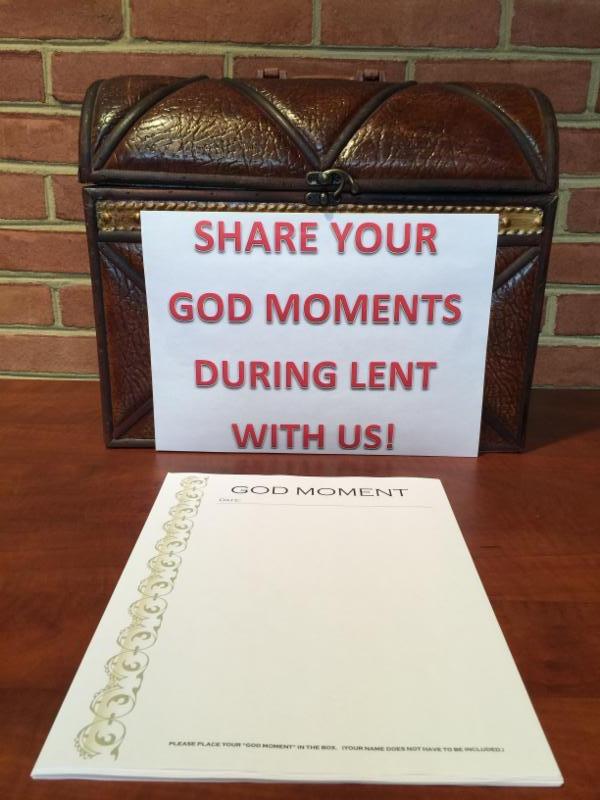
God works in our lives in so many wonderful ways. As we spend time during the Lenten season focused on God’s presence, we would love to hear how you see God working in your lives or in the lives of others. We believe the more you see God, the more you SEE God! Share your God moments with us in the comments below!
“Great is the LORD and most worthy of praise; his greatness no one can fathom. One generation will commend your works to another; they will tell of your mighty acts.They will speak of the glorious splendor of your majesty, and I will meditate on your wonderful works. They will tell of the power of your awesome works, and I will proclaim your great deeds.They will celebrate your abundant goodness and joyfully sing of your righteousness.” (Psalm 145:4-7)
Our name for the Friday before Easter, “Good Friday,” is most likely related to the English and the Dutch, the only two languages that use this term, which etymologists say is likely an alteration of the Germanic word, “Goddes,” meaning “God’s” or “Holy.” That term does not mean “good.” The day is called Holy Friday in nearly all other languages in the world.
A similar process happened with the English word “goodbye,” which was formed over time as a contraction of “God be with ye.”
English speakers are no more saying that “it’s good to see you go” when they say goodbye than they are calling the day of Christ’s crucifixion good when they call it Good Friday. Holy, yes. Good? Not so much.
Good Friday, or Holy Friday as most of the rest of the world calls it in their languages, proclaims God’s purpose of loving and redeeming the world even in the face of human rejection and cruelty through the cross of our Lord, Jesus Christ. It is a day that is holy and makes us holy because God was drawing the world to God’s self in Christ.





 News and Views