Independence Day, commonly known as the Fourth of July, is a federal holiday in the United States commemorating the adoption of the Declaration of Independence on July 4, 1776, declaring independence from Great Britain.
Independence Day fireworks are often accompanied by patriotic songs such as the national anthem “The Star-Spangled Banner”, “God Bless America”, “America the Beautiful”, “My Country, ‘Tis of Thee”, “This Land Is Your Land”, “Stars and Stripes Forever”, and, regionally, “Yankee Doodle” in northeastern states and “Dixie” in southern states. Some of the lyrics recall images of the Revolutionary War or the War of 1812.
A bit of audio for your listening pleasure, as played by Vladimir Horowitz…
“When in Our Music God Is Glorified”
Fred Pratt Green
UM Hymnal, No. 68
“When in Our Music God is Glorified” was the opening hymn at Pender’s Music Appreciation Sunday on June 11, 2023 It was sung by Pender’s congregation, accompanied on piano by Heidi Jacobs and directed by Brian Stevenson.
“When in Our Music God Is Glorified” was played by Pender’s pianist-organist, Liz Eunji Moon at the Traditional Service Postlude on September 11, 2022
Sometimes a great tune can keep a hymn text alive. Sometimes a great text can revive a neglected tune. The latter is true in this case.
Noted British hymnologist John Wilson (1905-1992) suggested that the Methodist poet and hymn writer Fred Pratt Green write a text to the tune ENGELBERG, composed in 1904 by the famous British composer Charles Villiers Stanford (1852-1924).
Stanford’s tune had been well-known in the earlier 20th century until Ralph Vaughan Williams (1872-1958) composed the immensely popular SINE NOMINE in the same metre (sung to “For All the Saints”) for the English Hymnal (1906).
Hymnologist J.R. Watson records that “Wilson urged Pratt Green to write a text for a Festival of Praise . . . which could be sung to Stanford’s neglected tune.” Pratt Green based his text on Psalm 150 but alluded to Mark 14:26 in stanza four of the hymn, a stanza recalling the hymn sung by the disciples at the Last Supper.
The hymn, composed in 1972, first appeared in New Church Praise (1975) and in the single-author collection The Hymns and Ballads of Fred Pratt Green (1982) with the title, “Let the People Sing!”
The opening line (called the incipit) originally read, “When in man’s music, God is glorified. . . .” Pratt Green reluctantly altered this to the current title for the Lutheran Book of Worship (1978) and this change has universally been accepted in North American hymnals.
The Rev. Carlton Young, editor of the UM Hymnal, notes that the change in text, though an important “social witness” in the area of inclusive language, weakens the theological and aesthetic qualities of the hymn: 1) Theologically, “the change tends to weaken the affirmation that mere mortal musicians and their music may and often do glorify God”; 2) aesthetically, the wonderful alliteration between “man’s” and “music” paralleled by “God’s” and “glorified” is lost.
Dr. Young speculates that this “text has probably been set in anthem form more than any other of the late twentieth century.”
Ministry of music
This hymn is groundbreaking in many ways.
There are numerous examples in the history of hymnody where music is a metaphor for some theological theme or experience. In Babcock’s “This Is My Father’s World,” for example, “all nature sings and round me rings the music of the spheres.” Charles Wesley speaks of “the music of the heart” in his paraphrase of Psalm 150, “Praise the Lord Who Reigns Above.”
However, Pratt Green uses music not just as a metaphor that points us to another idea, but explores music-making as a phenomenon in the Christian’s experience in its own right. The second stanza concludes with the marvelous thought that “making music . . . move[s] us to a more profound Alleluia!”
In this way, Pratt Green seems to agree with Martin Luther who said, “Next to the Word of God, the noble art of music is the greatest treasure in the world.” Luther and Pratt Green seem to ascribe a quasi-sacramental quality to music—music as a means of revelation and grace.
Pratt Green (1903-2000) was born in Roby just outside of Liverpool, England. Following his education, he was ordained in 1924 as a Methodist minister and served in various parishes throughout England well into the 1940s. Although he had a long interest in poetry, he did not focus on hymn writing until his retirement from active ministry.
Eminent British hymnologist Erik Routley (1917-1982) suggested that in Fred Pratt Green, Methodists finally had a successor to Charles Wesley.
“Come, Christians, Join to Sing” was the closing hymn at Pender’s Music Appreciation Sunday on June 11, 2023. It was sung by Pender’s congregation and Sanctuary Choir, accompanied on piano by Heidi Jacobs and combined handbell choirs (Joy and Carillon Ringers) directed by Brian Stevenson.
“Come, Christians, Join to Sing” was the opening hymn at Pender’s Traditional Service on May 29, 2022. It was accompanied by piano (Liz Sellers) and organ (Brian Stevenson).
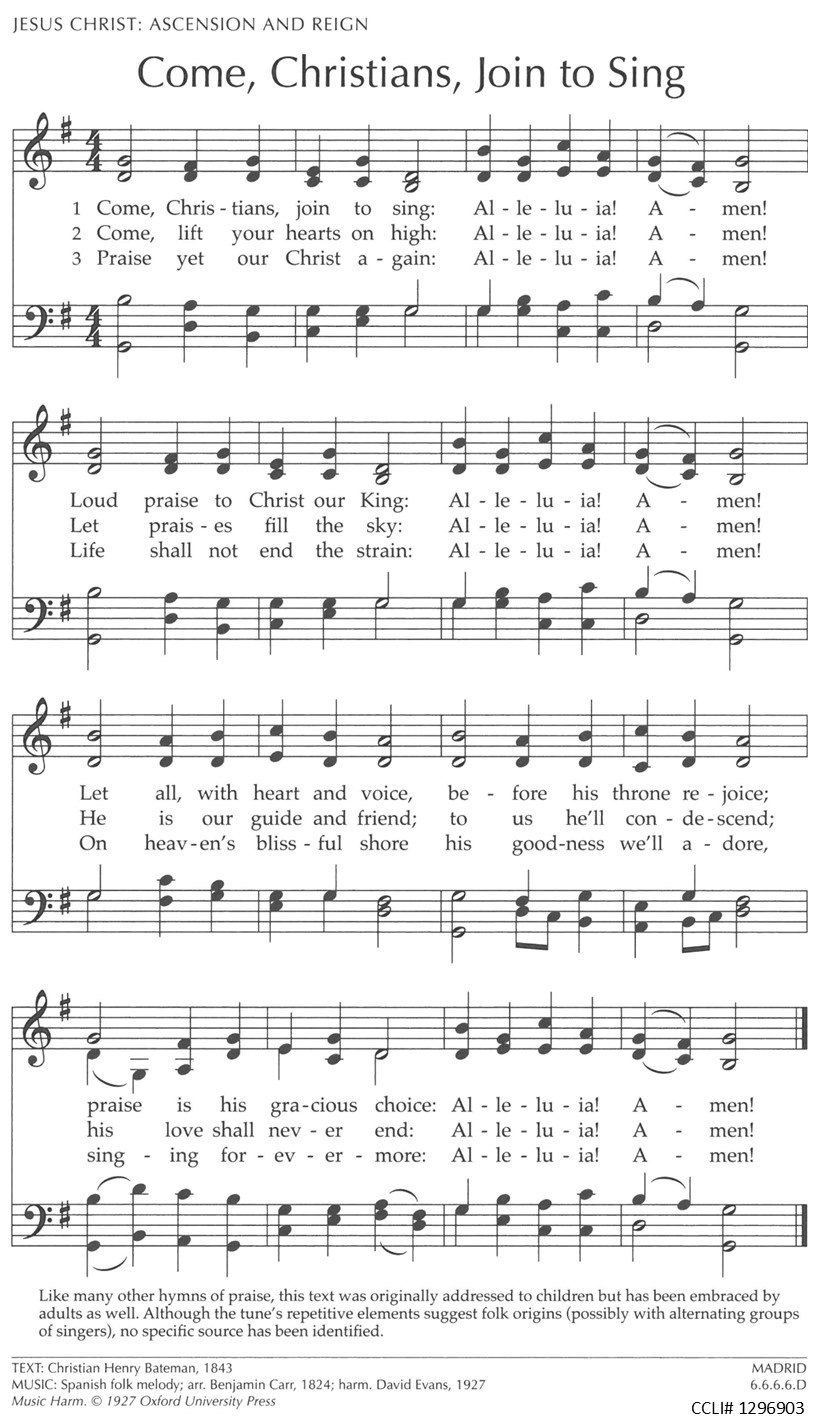
“Come, Christians, Join to Sing”
Christian Henry Bateman UM Hymnal, No. 158
Come, Christians, join to sing:
Alleluia! Amen!
loud praise to Christ our King:
Alleluia! Amen!
Let all, with heart and voice,
before his throne rejoice;
praise is his gracious choice.
Alleluia! Amen!
Christian Henry Bateman (1813-1899) was ordained into the Church of England after being a Congregational minister.
His ministerial studies were under the auspices of the Moravian Church, where he served for a time before changing to the Congregational Church at age 30. Following his ministry at Richmond Place Congregational Church in Edinburgh, Scotland, and successive Congregational parishes in Hopton, Yorkshire, and Reading, Berkshire, he took Holy Orders in the Anglican Church at age 56 and served as a curate and vicar in several Anglican parishes.
Australian hymnologist Wesley Milgate (1916-1999) noted that Bateman’s hymn is actually a rewritten version of the hymn “Join Now in Praise, and Sing” by William Edward Hickson (1803-1870). Hickson’s text uses the same melody, MADRID (SPANISH HYMN), and is structured in much the same way. Compare Bateman’s text at the beginning of this article with the first stanza of Hickson’s hymn:
Join now in praise, and sing
Hallelujah, Amen!
Praise to our heavenly King,
Hallelujah, Amen!
By love and gratitude
Still be the song renewed,
And be our hearts subdued,
Hallelujah, Amen!
Bateman probably found the earlier hymn in the collection Hickson published, Singing Master (1836). Hickson’s five stanzas were reduced to three by Bateman and first appeared in a collection published in Edinburgh, Sacred Melodies for Children (1843). The original “Hallelujah, Amen!” was changed by the Presbyterian Church in the U.S.A., in their 1933 hymnal, to “Alleluia! Amen!” It has remained that way ever since.
Each stanza begins with an exhortation—an imperative command to “Come” or “Praise.” In stanza one, Bateman provides the children with the reason for singing: We offer “loud praise to Christ our King . . . before his throne. . . .” Christ desires our praise: “praise is his gracious choice. . . .”The original incipit (opening line of the hymn) was “Come, children, join to sing.” Though changed in the Presbyterian hymnal to include all age groups, Bateman’s text contains direct, uncomplicated language suited for children. Since very few of the words have more than two syllables and “Alleluia! Amen!” is interjected three times in each stanza, the hymn is easy for children to learn and sing.
Stanza two reassures the children (and all of us) that this King is also “our guide and friend” and that “his love shall never end.” This King will “condescend” to be a friend to the children. To condescend surely did not mean to patronize as it tends to mean today, but implies that Christ the King humbles himself to be in a personal relationship with us.
Stanza three ends on an eschatological note. The author reassures children that they need not fear death. Beyond life, our songs will continue on “heaven’s blissful shore . . . singing forevermore: Alleluia! Amen!”
Dr. Hawn is professor of sacred music at Perkins School of Theology.
From sea to shining sea, United Methodists are finding special ways to observe Memorial Day in the United States. Here is a sampling of ideas.
Pray for all who have given their lives for our freedom. “The major emphasis of the Memorial Day worship time,” said the Rev. Alan Brown, Hayes Memorial United Methodist Church, Fremont, Ohio, “is not on a secular observance; rather, it is the message of the gospels and the sacraments of the church.”
Read the names of fallen veterans, and toll a bell after each name is read. The Rev. Walter L. Graves encourages people to read the names when they see a war memorial. “Remember,” said the pastor of Reelsboro United Methodist Church, New Bern, N.C., “that was a person who had… dreams and desires.”
Provide special worship music with a PowerPoint presentation. “My church has a slide show of friends and family, living and dead, who have served in the military,” reported Leslie Haggs, lay leader at Angelica United Methodist Church in New York.
Offer a candlelight service. Bishop James Swanson of the Holston Annual (regional) Conference will preach at joint services of three congregations — Mount Wesley and New Victory, Telford, Tenn., and Mayberry, Jonesborough, Tenn. A candlelight service for those interred in the church cemetery will be part of worship.
Wave a flag. Youth of First United Methodist Church, Koppel, Pa., raised money to buy an American flag for all 225 residences in the little town. “I’m a flag-waver,” admitted the Rev. Donald A. Anderson. Quoted in the Pittsburgh Post-Gazette, he expressed hope that the flags would “bring Koppel a sense of pride in participating in this great holiday honoring those who fought to protect our freedoms.”
At Arlington (Va.) National Cemetery, flags decorate the tombs of those who died in the service of their country. Photo courtesy of Arlington National Cemetery.
Lay a wreath. In Illinois, Malta United Methodist Church will have a special worship service. The congregation invites veterans of the community to pay tribute to fellow soldiers by marching as a unit from the church to the township library, where a wreath will be dedicated.
Decorate veterans’ graves. “After Sunday service,” said the Rev. Charlie Johnson Jr., a local pastor serving three congregations in the Lynchburg, Va., area, “we go into the church cemetery, remove the old flags placed on the graves of veterans last Memorial Day and replace them with new ones…We remember our active-duty military every Sunday during prayer.”
Do a project for active troops. In Maine, the North Searsport United Methodist Church is recruiting the community to join parishioners in a mission project to benefit soldiers going overseas. Participants will sew small pillows for military personnel. The project is in response to recent articles about soldiers having to pay for pillows on their flights.
Make military care packages. The congregation of First United Methodist Church, Alice, Texas, brought items for military care packages to mail to troops serving overseas. “Many of us have loved ones who are serving in the military,” member Stefany Simmons explained. “Each of us signed cards to include for the troops.”
Be part of a community-service day. Manatee United Methodist Church is one of two Bradenton, Fla., locations for the Journey of Remembrance, an annual community-service day honoring U.S. military veterans and their families for their care and sacrifice.
Parades are one way to honor those who sacrifice daily for our freedom. A web-only photo by Dee Dee Cobb.
Learn about issues affecting veterans. At Christ United Methodist Church, Troy, N.Y., a guest speaker will focus on the history and social justice issues related to military mental illness. “At Christ Church,” said the Rev. Nina Nichols in the Bennington Banner, “we honor those who serve their country, who served with the hope of bringing justice on behalf of our nation. But as a people of faith, we must not fail to call for a better way to peace than war. This Memorial Day we pray for peace for the war-weary.”
Glorify Jesus as the Prince of Peace and reach out to those whom others may forget. On Memorial Day – as he does throughout the year – John Alexander, a member of East Lake United Methodist Church, Birmingham, Ala., will be involved with Kairos Prison Ministries. A Christian, lay-led, ecumenical, volunteer, international prison ministry, Kairos brings Christ’s love and forgiveness to incarcerated individuals and their families.
*Dunlap-Berg is internal content editor for United Methodist Communications.
News media contact: Barbara Dunlap-Berg, Nashville, Tenn., 615-742-5470 ornewsdesk@umcom.org.
Pentecost is a Christian holy day that celebrates the coming of the Holy Spirit 40 days after Easter. Some Christian denominations consider it the birthday of the Christian church and celebrate it as such.
Originally, Pentecost was a Jewish holiday held 50 days after Passover. One of three major feasts during the Jewish year, it celebrated Thanksgiving for harvested crops. However, Pentecost for Christians means something far different.
Before Jesus was crucified, he told his disciples that the Holy Spirit would come after him:
And I will ask the Father, and he will give you another Counselor to be with you forever — the Spirit of truth. The world cannot accept him, because it neither sees him nor knows him. But you know him, for he lives with you and will be in you. I will not leave you as orphans; I will come to you. John 14:16–18
And 40 days after Jesus was resurrected (10 days after he ascended into heaven), that promise was fulfilled when Peter and the early Church were in Jerusalem for Pentecost.
Holy Spirit – Power for the Journey – Acts 2: 1-13
We belive in the Holy Spirit, the 3rd person of the Trinity who came on Pentecost and began the church. What does the Holy Spirit do today? How does the Holy Spirit get and find Power?
The Holy Spirit Comes at Pentecost
2 When the day of Pentecost came, they were all together in one place. 2 Suddenly a sound like the blowing of a violent wind came from heaven and filled the whole house where they were sitting. 3 They saw what seemed to be tongues of fire that separated and came to rest on each of them. 4 All of them were filled with the Holy Spirit and began to speak in other tongues[a] as the Spirit enabled them.
5 Now there were staying in Jerusalem God-fearing Jews from every nation under heaven. 6 When they heard this sound, a crowd came together in bewilderment, because each one heard their own language being spoken. 7 Utterly amazed, they asked: “Aren’t all these who are speaking Galileans? 8 Then how is it that each of us hears them in our native language? 9 Parthians, Medes and Elamites; residents of Mesopotamia, Judea and Cappadocia, Pontus and Asia,[b]10 Phrygia and Pamphylia, Egypt and the parts of Libya near Cyrene; visitors from Rome 11 (both Jews and converts to Judaism); Cretans and Arabs—we hear them declaring the wonders of God in our own tongues!” 12 Amazed and perplexed, they asked one another, “What does this mean?”
13 Some, however, made fun of them and said, “They have had too much wine.”




 News and Views