Sunday, November 27, 2022 is the First Sunday in Advent. I’m skipping a couple of the Chuck Knows Church episodes because this one is so timely. We’ll get back to the others after Christmas.
The first Candle is lit on the first Sunday of Advent. It is called the Prophecy Candle and reminds us that Jesus’ coming was prophesied hundreds of years before He was born. The candle’s purple color represents Christ’s royalty as the King of Kings.
The Advent wreath began as a German and Scandinavian home devotional practice used to mark the four weeks of Advent. Families would light a candle for each past week and the current week at their dinner or evening time of prayer. The configuration of candles, whether in a line or a circle, did not matter. Neither did the color of the candles (all colors are used in homes in Europe). What mattered was the marking of time and the increase of light each week in the face of increasing darkness as the winter solstice approached.
As Advent wreaths began to be used by congregations on Sundays in some places in Europe and America beginning in the late 19th century, several adaptations were made to make them work better in public worship spaces. Candles needed to be larger and more uniform than the “daily candles” handmade or purchased for home use. They also needed to be more uniform in color to fit with other décor in the sanctuary. That is why candles used in the Advent wreath are usually purple or blue, to coordinate with color of the paraments used during this season.
This shift in context from home to public use also made it important in the eyes of some for the candles to be given a meaning more that simply marking time and increasing light. This led to special ceremonies being developed for lighting these special candles each week.
As this practice began to catch on by the mid-twentieth century, several church supply houses who sold Advent wreaths and candles for public worship also developed resources, banners, and bulletin covers assigning a theme to each week, and thus each candle, based on scriptures from the one-year lectionaries used at that time. Those themes were Hope, Love, Joy, and Peace, in that order.
Today, almost no one uses those one-year lectionaries, so those themes may not always fit the scriptures we hear in worship. The one exception is the Third Sunday of Advent, where the current lectionaries have continued to support the centuries old observance of “Gaudete” or “Joy Sunday.” That is why church supply houses often offer rose or pink colored candles for the wreath for use on this day.
So how may we talk about the meaning of the Advent wreath today?
We can reclaim the original home use of marking time with the hope of increasing light as we await the return of Christ, that day when “The city no longer has need of the sun or the moon to shine upon it, because the glory of God illumines it, and its lamp is the lamb.”
And we can develop meanings or themes for each week based on the focus of the scriptures themselves. After all, the candles and the wreath are an accessory, not an end in themselves. Their meaningfulness comes from how we use them to point toward Christ, the world’s true light, who was, and is, and is to come.
This content was produced by Ask The UMC, a ministry of United Methodist Communications.
Suggested Bible Reading: Luke 1:26-38
Chuck Knows Church — ADVENT WREATH. Four candles in a circle with a big one in the middle? Yep, take a moment and learn the basics about the advent wreath. And why is the pink candle…pink?
This simple mandate for cultivating gratitude and thanksgiving is the opening line in the catchy chorus of “Count Your Blessings,” a church music staple first published more than a century ago.
All these years later, the four verses and chorus can be summed up this way: Counting your blessings may be the antidote to feeling disheartened.
The remaining line of the chorus implores you to, after counting and naming the blessings, to “see what God has done.”
The faithful act of assessing blessings and acknowledging what God has provided in your life may give perspective when challenges and conflicts occur, as the four verses detail (see sidebar).
The author of these song lyrics acknowledges that you can feel burdened and life can seem unfair. So can counting your blessings really help when turmoil swirls around you and discouragement weighs heavy on your mind?
Such was the case for Jacob, who, in Genesis 28, is fleeing from his angry brother, Esau. When Jacob stopped for the night at a place he would later name “Bethel,” Jacob was in the midst of a bad situation. He was alone, scared and had nowhere to go. He also had no idea about how his circumstances might turn out. That night in a dream, God reassured Jacob that He was with him, that He had a plan for Jacob’s life and that He would not leave him. Jacob awoke the next morning with a change of heart and life didn’t seem so bad. “Surely the Lord is in this place,” Jacob said, “and I did not know it.” (Genesis 28:16)
Numerous stories in the Bible remind you to look beyond your circumstances to see you are not alone, that “the Lord is in this place,” providing anecdotal evidence of the importance of gratitude.
In addition to the anecdotal proof, the virtues of gratitude have been proven by science.
In a study published in the Journal of Personality and Social Psychology, the test group was asked to daily write down five things for which they were thankful. After doing this every day for one week, the test group reported better sleep patterns and a more positive emotional outlook than the control group.
Members from Perryville United Methodist Church in Perryville, Kentucky, perform “Count Your Blessings.”
Whether the song’s author was battling tough times when he wrote the lyrics is unknown. What we do know is that Johnson Oatman Jr., the lyricist, was a Methodist Episcopal minister who had a penchant for songwriting. “Count Your Blessings,” intended as a song for youth, first appeared in “Songs for Young People,” which was published in 1897 by the Methodist Book Concern, a precursor to The United Methodist Publishing House. Over Oatman’s life, he penned more than 5,000 songs, including the classic hymn “No, Not One.”
For “Count Your Blessings,” Oatman partnered with E.O. Excell, who put Oatman’s words to music. Excell operated a Chicago-based publishing business specializing in Sunday School materials and collaborated with the Methodists for numerous projects. Fun fact about Excell is that he is the same person who wrote the arrangement of “Amazing Grace” that is most often sung throughout the world today.
But back to “Count Your Blessings.”
Once “Songs for Young People” was published, “Count Your Blessings” became a favorite, quickly gaining popularity throughout the world.
One account from a London daily newspaper says that when the famous British evangelist Gipsy Smith presided over a meeting, he announced a hymn, saying, “Let us sing ‘Count Your Blessings.’ Down in South London, the men sing it, the boys whistle to it, and the women rock their babies to sleep to the tune.”
In addition to the upbeat, simple tune that people have found easy to remember, its message has been uplifting folks for generations.
“Like a beam of sunlight,” wrote J.H. Hall, Oatman’s biographer, in “Biography of Gospel Song and Hymn Writers, “(’Count Your Blessings’) has brightened up the dark places of the earth.”
Crystal Caviness works for UMC.org at United Methodist Communications. Contact her by email or at 615-742-5138.
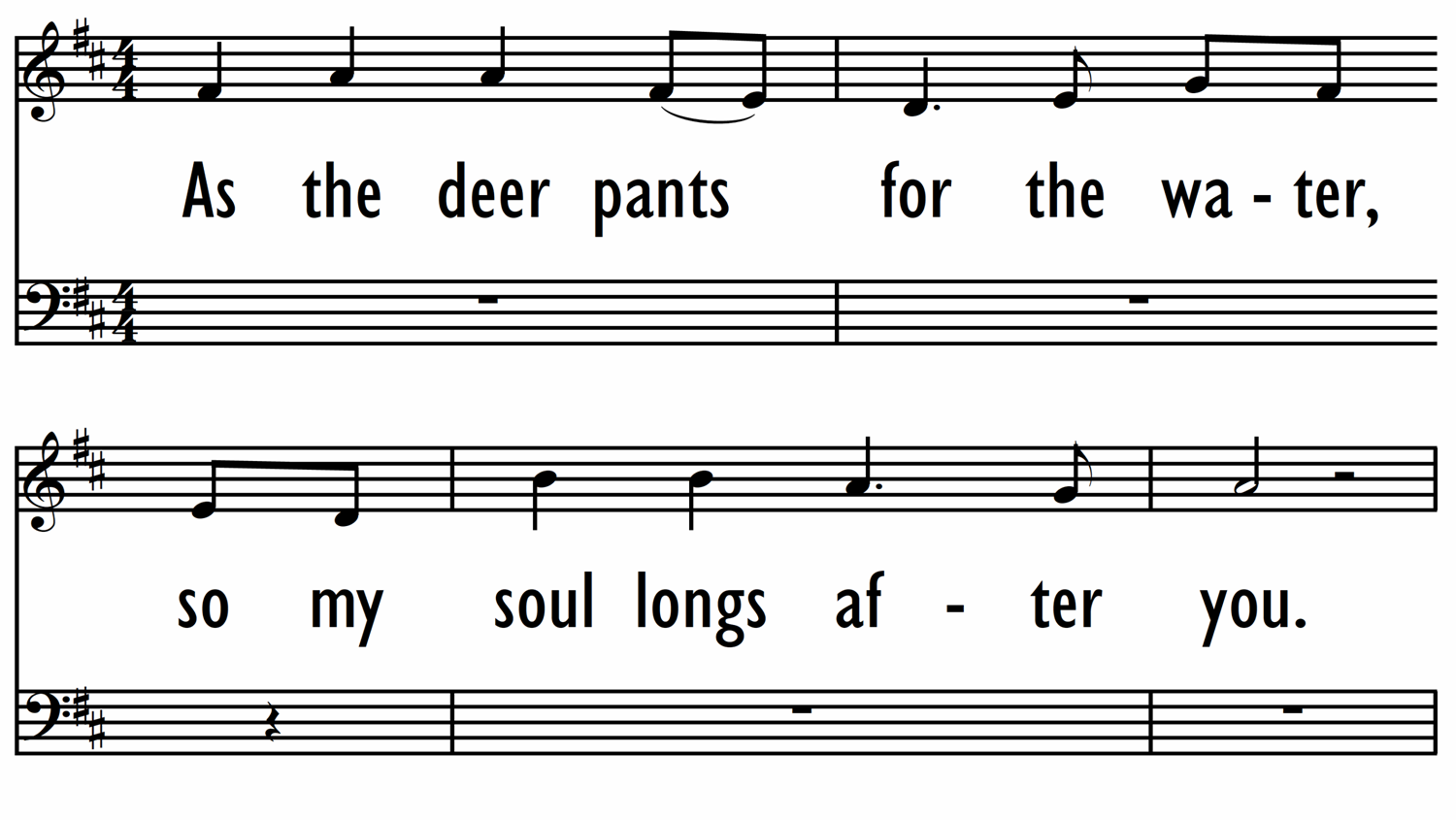
“As the Deer” by Martin Nystrom,
The Faith We Sing, No. 2025
The Pender UMC Traditional Service Middle Hymn “As the Deer” on Sunday September 18, 2022 was played by Liz Eunji Moon on piano, accompanied on guitar by Brian Stevenson and AJ Rios and sung the Pender Sanctuary Choir and congregation.
“As the deer pants for the water brooks,
So pants my soul for You, O God” (Psalm 42:1, NKJV)*
On his website, http://martynystrom.com/, the composer introduces himself in self-effacing terms:
“I am a married father of two sons and live in the Seattle area. My degree is in music education and I have taught music in a wide variety of settings. I have written over 120 songs that have been released by publishers of Christian praise and worship music. My best known song is the worship chorus, ‘As the Deer.’” He notes that, “I seem to write songs when I am not purposefully trying to write one.”
“As the deer,” written in 1981, is one of the most popular songs in the contemporary Christian musical (CCM) genre written in the latter twentieth century. Martin J. Nystrom (b. 1956) is a native of Seattle, Washington. After graduating from Oral Roberts University, Tulsa, Oklahoma (BME, 1979), he served as musical evangelist with Christ for the Nations, Dallas, Texas [www.cfni.org] and produced five praise and worship albums for Hosanna! Music, Mobile, Alabama.
Lindsay Terry, in his book The Sacrifice of Praise: The Stories Behind the Greatest Praise and Worship Songs of All Time(2002), describes the circumstances surrounding the creation of this song:
“Marty was a schoolteacher in Seattle, and since he had the summer off, he decided to go to the summer term of Christ for the Nations Institute in Dallas, Texas. Little did he know what was about to happen to him, especially with all that he would be exposed to and the worship emphasis of the school. . .
He had graduated from Oral Roberts University and, frankly, was a little overwhelmed in ministry. He had been involved in many things at the school, not the least of which was the television ministry of ORU. All of his studies combined with many other activities had caused stress to take its toll on Marty’s spiritual life. . . .
Marty’s roommate at CFNI was a vibrant Christian who challenged Marty to go on a fast, thinking it would help him recover his joy. Marty took up the challenge, and on the nineteenth day of the fast, he found himself sitting at the piano in a room of the school, trying to write a song. He was simply playing chord progressions when he noticed a Bible on the music stand of the piano, open to Psalm 42. His eyes fell on the first verse of that chapter. After reading the verse he began to sing its message, right off the page. He wrote the first verse and the chorus of a song, practically straight through. The entire song was completed in a matter of minutes.”
Though Mr. Nystrom had not intended to perform the song publically, he shared it with a friend at Christ for the Nations before returning to Seattle. His friend introduced it to the others at the Institute, and it became a favorite. Contrary to his website, the composer appears to have written closer to 250 songs. He travels extensively in the United States and Asia, participating in conferences and retreats.
After paraphrasing the first verse of Psalm 42, the song reflects on this passage, continuing in the first person perspective of the psalm:
You alone are my heart’s desire
and I long to worship you.
The second section draws upon the familiar biblical images of “strength and shield,” concluding with the sentence cited above.
Most of Mr. Nystrom’s songs are composed as a single stanza. The compilers of the Canadian United Church hymnal Voices United (1995) asked Lydia Pederson to write two additional stanzas to paraphrase the remainder of the psalm. Pedersen is former music director at Royal York Road United Church in Toronto, and an active member of the Hymn Society in the United States and Canada. An additional attempt at two stanzas appears in the Covenant Hymnal: A Worshipbook(1996).
The editors of the two hymnals that requested additional stanzas noted that the original song felt incomplete when viewed in the context of the entire psalm. Selections of Psalm 42 follow: “My soul thirsteth for God, for the living God: when shall I come and appear before God? My tears have been my meat day and night, while they continually say unto me, Where is thy God? (verses 2, 3, KJV) . . .
“I will say unto God my rock, Why hast thou forgotten me? Why go I mourning because of the oppression of the enemy? As with a sword in my bones, mine enemies reproach me; while they say daily unto me, Where is thy God? Why art thou cast down, O my soul? And why art thou disquieted within me? Hope thou in God: for I shall yet praise him, who is the health of my countenance, and my God” (verses 9, 10, 11, KJV).
On the one hand, the effectiveness of the original song is found in its simplicity; the singer can internalize and memorize the song, offering this sung prayer directly to God. On the other hand, the poignant questions of the remainder of the psalm echo the questions of many worshipers in their lives. Singing additional stanzas, however, changes the experience from a simple prayer to God to the experience similar to singing a multi-stanza hymn. One solution is to retain Mr. Nystrom’s original stanza and insert it between spoken sections of the psalm as a refrain.
Regardless of the approach to incorporating the song into worship, one cannot deny the effectiveness of “As the deer” as sung prayer in myriad settings around the world. Mr. Nystrom attended a conference in Korea in the 1990s that began with 100,000 Korean Christians singing his song – a dramatic witness of its power.





 News and Views