RSS

Tag Archives: organ

Hymn History: ‘My Eternal King’

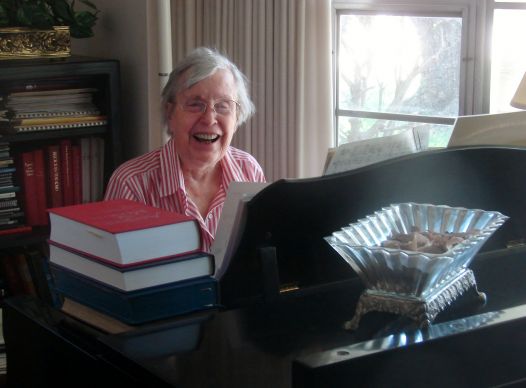
jane-marshall-piano

From 17th Century Latin, translated by Rev. Edward Caswall; set to music by Jane Marshall “My God, I love Thee; not because I hope for heav’n thereby, Nor yet because who love Thee not Must die eternally. Thou, O my Jesus, Thou didst me Upon the cross embrace; For me didst bear the nails, the nails and spear, And manifold disgrace. Why, then why, O blessed Jesus Christ, Should I not love Thee well? Not for the hope of winning heav’n, Or of escaping hell; Not with the hope of gaining aught, Not seeking a reward; But as Thyself hast loved me, O ever-loving Lord! E’en so I love Thee, and will love, And in Thy praise will sing; Solely because Thou art my God, And my Eternal King.”   http://youtu.be/AtvJ4gk9MrM The video above is of My Eternal King as sung by the Reunion Choir of current and former choir members at the celebration of the 10th anniversary of the Reynolds Associates III manual/54 rank pipe organ at Broadway United Methodist Church in Indianapolis. David Morton directs, with Schuyler Brinson at the organ console. ~~~~~

By Sam Hodges July 9, 2014 | DALLAS (UMNS)

Jane Marshall’s name may not be known to people in the pews, but in the choir loft it’s another story.At 89, the Dallas resident is revered by music ministers and choir members for her anthems, hymns and other sacred music compositions.“She’s the consummate Methodist composer of my time,” said the Rev. Carlton Young, editor of The United Methodist Hymnal. One anthem launched Marshall  “My Eternal King.” It was her first, and she wrote it as a 26-year-old homemaker, singing alto in the Highland Park Methodist Church choir. “I just decided to do it,” Marshall recalled at the North Dallas home she shares with husband Elbert Marshall, a retired Texas Instruments engineer. This month (July 2014) marks the 60th anniversary of the anthem’s publication in sheet music. Not only does “My Eternal King” remain in print, it’s a staple for many churches across denominations. “That’s a classic. We’ve done it a million times,” said Sid Davis, director of music and fine arts at St. Luke’s United Methodist Church in Houston. “It’s kind of in our back pocket. … It’s in our DNA.” Meditative at the start, soaring to triple fortissimo at the end, encompassing a range of tone colors and sumptuous harmonies, “My Eternal King” evokes testimonials not just from music ministers, but from fellow composers. “I wish I’d written it,” said Alice Parker, famous in choral circles for her own works as well as collaborations with the legendary choral director Robert Shaw. “It meets my ideal in every way.” While it’s true that Marshall had no record as a sacred music composer when she wrote “My Eternal King,” she didn’t come unprepared. 

Raising the roof

As a small child, attending a Presbyterian church, she stood on the pew and conducted along with the choir director. Marshall’s mother played hymns on the piano and soon had her taking piano with one of Dallas’ top teachers. “Hazel Cobb,” Marshall said. “Boy, was she good. I knew my theory because of her. She encouraged me to practice, which I didn’t want to do because I was lazy, and she said so. But thank goodness I had her.” Marshall was Jane Manton then, and recalls that her family loved words as much as music. She and Elbert met in Latin class at Highland Park Junior High, where she sat one seat ahead of him (“Pulled my hair,” she said); and at Highland Park High School they sang together in Gilbert and Sullivan productions. Also in her teen years, Marshall first tried writing music. She went on scholarship to Dallas’ Southern Methodist University, majoring in music and minoring in organ. She and Elbert married in 1946. By early 1952, they had a toddler daughter, the first of three children, and were singing in the Highland Park Methodist Church Chancel Choir. Neither she nor Elbert recalls many details about her writing of “My Eternal King.” But she chose as its text the Rev. Edward Caswall’s translation of an anonymous 17th century Latin poem. The Caswall translation was in both the Presbyterian and Methodist hymnals of Marshall’s youth. It begins, “My God, I love thee.” Marshall’s music, after establishing the mood with an organ solo, follows the poem’s intensely devotional response to Christ’s sacrifice on the cross. When she took the anthem to the Highland Park Methodist Choir director, Federal Lee Whittlesey, he wanted to do it. But Marshall had no name for it, and Whittlesey himself was perplexed. “Lee didn’t know what the title should be because the normal titles use the first lines, and he didn’t want to call it ‘My God, I love thee,’” Elbert Marshall said. “Thought it was cussing,” Jane said. “Yes, so he called it ‘A Spiritual Contemplation,’” Elbert said. “Sounds like something a banker would come up with,” Jane said. The back page of the March 20, 1952 edition of the Highland Park Methodist newsletter carried a 44-word item noting that the following Sunday, March 23, the Chancel Choir would sing the premiere of “A Spiritual Contemplation.” Raymond Jerome, an 80-year-old retired physician, was then a student singing with the choir. He recalls how surprised everyone was to learn Marshall had written an anthem. That quickly faded. “We were spellbound as we first rehearsed it,” he said. Jerome remembers a gathering excitement, culminating in a first performance — conducted by Jane in which the choir sang with near roof-lifting force at the end.

Getting published

Whittlesey had a contact on the editorial board at Carl Fischer Music company in New York, and sent Marshall’s anthem there. “They didn’t want to publish it because they thought she was just a flash in the pan,” Elbert Marshall recalled. “They said, ‘We’ll publish it if she writes something else.’ So she wrote ‘None Other Lamb.’” Carl Fischer brought out sheet music for “My Eternal King,” renamed for its concluding words, and “None Other Lamb” on July 13, 1954. While the company doesn’t share sales figures, a spokeswoman said “My Eternal King” ranks among its top 15 best-selling anthems of all time. The firm has been going since 1872. A 1976 Dallas Morning News feature on Marshall reported without attribution that “My Eternal King” had sold “hundreds of thousands” of sheet music copies. The Marshalls say they never kept track. While Elbert was the breadwinner, Jane’s royalties on “My Eternal King” didn’t hurt. “It’s paid for a lot of things,” she said.

Long, varied ministry

If Marshall ever lacked confidence, she certainly had it after “My Eternal King.” Philip Baker remembers a story about Whittlesey bringing in a new piece for the Highland Park Methodist choir to try. “It was a light little anthem, kind of a happy thing for church, but a little simplistic,” said Baker, who would later lead the choir. “Jane came up to Whittlesey and said, ‘It’s good to see new stuff, but I can do better than that.’” As the story goes, Marshall went home that night and began to write “Awake My Heart,” perhaps her second-best-known anthem. It won the American Guild of Organists’ 1957 anthem prize. Marshall would compose such enduringly popular works as “He Comes to Us” (inspired by the conclusion of Albert Schweitzer’s book “The Quest for the Historical Jesus”), “Fanfare for Easter” and the hymn, “What Gift Can We Bring,” for which she wrote words and music. She has composed entire books of church music for children, and is one of the best-represented contemporary writers in The United Methodist Hymnal, thanks to her settings of the Psalms. Evidence of Marshall’s breadth of appeal is that she’s been honored by the Southern Baptist Church Music Conference, while also having a work in a British Unitarians’ hymnal. Writing music has been just part of Marshall’s ministry. She served as choir director at Dallas’ Northaven United Methodist Church in its early years. From 1975 to 2010, she led the summer Church Music Summer School at SMU’s Perkins School of Theology. “She was working with conservatory graduates and people who’d never given a downbeat,” said the Rev. John Thornburg, a frequent hymn-writing collaborator of Marshall’s. “You can see her influence on a whole generation of church musicians.” One is Taylor Davis, a popular composer and director of music and worship arts at First United Methodist Church in Fort Worth, Texas. In his early years, he used to take her his compositions-in-progress. “I can hear Jane as I write, asking questions like, ‘Isn’t there a better chord you could use there?’” he said. Throughout Marshall’s long, varied career — which includes writing “Grace, Noted,” a book of sermons and essays on music-making — “My Eternal King” has been the reference point. “Scarcely a month goes by before someone pulls me aside to say, ‘We just sang your mother’s anthem in church last week.’ It’s most often ‘My Eternal King,’” said Peter Marshall, her youngest child and a keyboardist for the Atlanta Symphony. The anthem is sung throughout the year in worship services, and is a favorite at Easter. As people who grew up with it die off, it’s increasingly a choice for funerals and memorial services. Peter Marshall played it on the piano last year for Sue Fowler, his aunt and Jane’s sister, at her request as she spent her last days in hospice care.

‘Gateway anthem’

Some Marshall fans, including son Peter, say that while they admire “My Eternal King,” it is not their favorite of her compositions. “My Eternal King” is, in fact, representative of the big-sound, mid-century Protestant anthem — a style Marshall moved away from. But Sterling Procter sees “My Eternal King” as timeless, and struggles for words to convey its importance to him. He encountered the anthem as a teen singing in a church choir in Dallas. He was so captivated that he learned to play it on the piano, though that wasn’t his instrument. Procter would go on to a long career playing French horn in the Fort Worth Symphony, while also leading brass ensembles and composing and arranging music. He’s still smitten with “My Eternal King.” “I don’t think I write a single piece of music that’s not influenced by something in that brief anthem,” he said. “I would call it a gateway anthem. It’s a portal for musicians and parishioners alike to get drawn in by the power of music.” Told recently of Procter’s endorsement, Marshall did not swell with pride. Whatever vanity she has, she hides. (She also lacks pretension. Carlton Young recalls first meeting her decades ago at SMU, when her star was on the rise. “Howdy!” she greeted him.) But Marshall grows animated when hearing about others’ success in traditional church music. She recently got such a report from Thornburg, who came along to help with an interview. He told her the First United Methodist of Church of Dallas Chancel Choir had sung at the North Texas (annual) Conference, earning ovations. “Hooray!” Marshall cried. Many — if not the composer herself — would say the same about the long life of “My Eternal King.” Hodges, a United Methodist News Service writer, lives in Dallas. Contact him at (615) 742-5470 or newsdesk@umcom.org From http://www.umc.org/news-and-media/my-eternal-king-launched-top-methodist-composer


Leave a comment

Posted by on June 13, 2023 in Hymn History, Posts of Interest


Tags: , , , , , , , , , , , , , , , , , ,

Hymn History: Jesus, Thine All-Victorious Love

The Pender UMC Traditional Service Opening Hymn “Jesus, Thine All-Victorious Love” on Sunday May 14, 2023 was played by Heidi Jacobs on piano and Brian Stevenson on organ.

This was Heidi’s first Sunday as Pender’s Pianist.

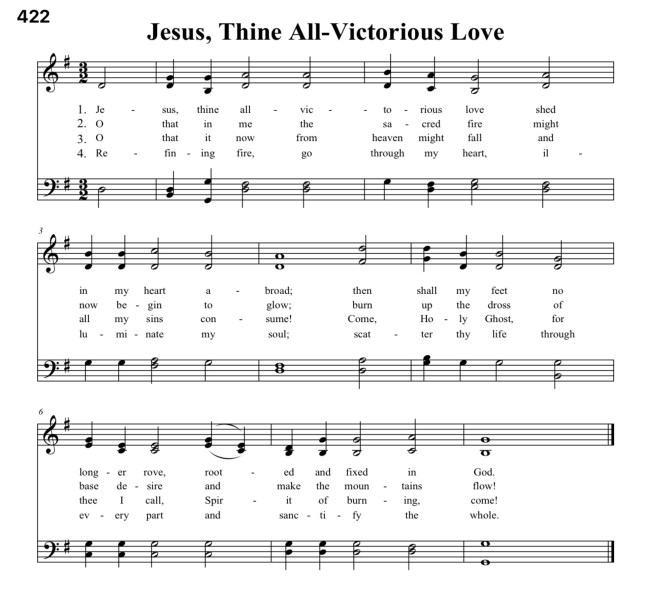
“Jesus, Thine All-Victorious Love,”
by Charles Wesley
The United Methodist Hymnal, No. 422.

Methodists need no introduction to Charles Wesley. For that matter, neither do most singing Christians! Perhaps no other hymn writer except Isaac Watts is so well loved as Charles Wesley. Few were as prolific, at least, or as wide-ranging with regard to the theological topics they addressed….

“Jesus, Thine All Victorious Love” is found in the United Methodist Hymnal at No. 422. As with many Wesley hymns that we sing today, the four stanzas given in the UMH are but part of a much longer hymn called “My God! I know, I feel thee mine.” The complete hymn is found in Collection of Hymns for the Use of the People Called Methodists in the section, “For Believers, Groaning for Full Redemption.” Atop the hymn text in the early editions sits a scripture reference to Romans 4:13, which speaks of the promise God made to Abraham and the righteousness of his faith. The full hymn has twelve stanzas, which can be divided thematically into four groups. Stanzas 1 to 3 articulate an individual’s desire for intimate communion with God the Father using physical, even visceral, images. Stanza 2 is particularly beautiful and connects to the passage from Romans 4, using the language of faith:

I hold Thee with a trembling hand,
But will not let Thee go,
Till steadfastly by faith I stand,
And all Thy goodness know.

This opening group of stanzas speaks of how such an intimate relationship with God not only sustains us, but gives us “health, and life, and power, and perfect liberty.” The use of superlatives such as “all Thy goodness” and “perfect liberty” highlights well the Wesleyan idea of Christian perfection.

The second section focuses on the love of Jesus and that love’s redemptive power. There are several scriptural images at play, and as one might expect from Wesley, or indeed from most anyone writing about love, conversion of the heart is central to this section. The United Methodist Hymnal version begins with this stanza, which is number 4 in the original.

Jesus, thine all victorious love
shed in my heart abroad;
then shall my feet no longer rove,
rooted and fixed in God.

The third section of the text focuses on the Holy Spirit; its three stanzas are all included in The United Methodist Hymnal. One particularly potent stanza speaks of the sanctifying power of the Spirit, highlighting another key tenet of Wesleyanism.

Refining fire, go through my heart,
Illuminate my soul;
Scatter Thy life through every part,
And sanctify the whole.

The fourth section brings to completion the sanctification of the believer and the experience of Christian perfection. The poetry of Wesley’s final stanza is both beautiful and unequivocal in its theological witness:

My steadfast soul from falling free,
Shall then no longer move;
But Christ be all the world to me,
And all my heart be love.

Those who might bravely choose to sing all twelve stanzas of this hymn would experience a beautiful, thoroughly trinitarian witness to the redemptive power of God’s love in Jesus Christ through the sanctification of the Holy Spirit. However, most congregations will probably opt to sing a subset of stanzas. The four stanzas found in the United Methodist hymnal are well suited to the Easter season. Beginning with a stanza about the “victorious love” of Jesus Christ reminds us of Jesus’s resurrection and victory over death, that is, of Easter. Following that stanza, then, the next three stanzas about the working of the Spirit seem to suggest the kind of liturgical flow that the Church experiences in the transition from Easter to Pentecost. That liturgical flow is made especially apparent in Year C of the Sunday lectionary, when the gospel of Luke is read.

“Jesus, Thine All Victorious Love” is a common meter text (8.6.8.6.) and could be sung to a great many tunes. It is often paired with Lowell Mason’s version of AZMON, which is ideal for most stanzas of the text. The iambic structure of the hymn aligns well with the fact that AZMON begins with a pickup note. However, because two lines of the stanza “Jesus, thine all victorious love” begin with a stressed syllable (“Je-sus” and “root-ed”), using AZMON, which has both a pickup and fast note values on the downbeat of each measure, could be awkward. One might consider singing the hymn to a common meter tune that begins without a pickup, such as ST. AGNES. Regardless of the tune chosen, though, or the number of stanzas one endeavors to sing, “Jesus, Thine All Victorious Love” is an exemplary Wesleyan hymn. Consider it the next time you sing during Eastertide.

Adapted from https://www.umcdiscipleship.org/resources/history-of-hymns-jesus-thine-all-victorious-love-wesley


Tags: , , , , , , , ,

“Suite for Woodwind Quintet” by Scott Pender from Concert for Ukraine


The dramatic opening selection of Pender’s Concert Supporting Ukraine was “Suite for Woodwind Quintet” composed by Scott Pender, performed by the Morpheus Chamber Players.

I. Introduction – Moderato

II. Adagio Cantabile

III. Introduction – Con Brio

The Morpheus Chamber Players are Alisha Coleman (clarinet, Gwen Jones (flute), Jeff Kahan (oboe), Wendy Chinn (French horn) and

Lisa Eckstein (bassoon).

We were fortunate to have the composer, Scott Pender, in the audience.


The Pender Concert Supporting Ukraine on April 23 featured Liz Sellers on piano, Brian on harp, and local professional musicians, including woodwind quintet, drums, organ, guitar, flute, penny whistle, singing and violin.

Concert repertoire included: Harp arrangements by Debussy, Piano trio of Jazz/Baroque, Flute Concertino by Chaminade, Woodwind Quintet with music of Duke Ellington, The Widor Toccata Organ Symphony Movement V and an Irish session!

There was no charge for this concert but there was a free will offering taken to support Ukraine through Advance #982450, UMCOR International Disaster Response and Recovery. This fund provides direct assistance to those in Ukraine as well as assistance to Ukrainians fleeing to neighboring countries.

One hundred percent of all Advance contributions go to the designated cause. (The independent charity watchdog, “Charity Watch,” gives UMCOR an “A+” ranking, and includes the UM organization on a highly selective list of charities it recommends when considering how to support the Ukrainian people. Read more)

The United Methodist community in Ukraine, though quite small, is actively engaged in assisting neighbors in need. Global Ministries is in touch with the church’s leadership as well as with church leaders in countries welcoming those who are fleeing from violence in Ukraine.

Click this link and choose UMCOR to send direct aid. In the memo line, put Advance #982450, UMCOR International Disaster Response and Recovery.

Thank you for your support!


Tags: , , , , , , , , , , , , , ,

Violin Sonata No. 5 in F major, Op. 24 by Ludwig van Beethoven from Concert for Ukraine


Liz Sellers, Pianist/Organist at Pender UMC in Fairfax, VA, and violinist Anthony Shields  performed Violin Sonata No. 5 in F major, Op. 24 by Ludwig van Beethoven during Pender’s new Concert Series which began on April 23, 2022.

The Violin Sonata No. 5 in F major, Op. 24, is a four movement work for violin and piano by Ludwig van Beethoven. It was first published in 1801. The work is commonly known as the Spring Sonata (Frühlingssonate), although the name “Spring” was apparently given to it after Beethoven’s death.

Liz and Anthony played the first movement.


The Pender Concert Supporting Ukraine on April 23 featured Liz Sellers on piano, Brian on harp, and local professional musicians, including woodwind quintet, drums, organ, guitar, flute, penny whistle, singing and violin.

Concert repertoire included: Harp arrangements by Debussy, Piano trio of Jazz/Baroque, Flute Concertino by Chaminade, Woodwind Quintet with music of Duke Ellington, The Widor Toccata Organ Symphony Movement V and an Irish session!

There was no charge for this concert but there was a free will offering taken to support Ukraine through Advance #982450, UMCOR International Disaster Response and Recovery. This fund provides direct assistance to those in Ukraine as well as assistance to Ukrainians fleeing to neighboring countries.

One hundred percent of all Advance contributions go to the designated cause. (The independent charity watchdog, “Charity Watch,” gives UMCOR an “A+” ranking, and includes the UM organization on a highly selective list of charities it recommends when considering how to support the Ukrainian people. Read more)

The United Methodist community in Ukraine, though quite small, is actively engaged in assisting neighbors in need. Global Ministries is in touch with the church’s leadership as well as with church leaders in countries welcoming those who are fleeing from violence in Ukraine.

Click this link and choose UMCOR to send direct aid. In the memo line, put Advance #982450, UMCOR International Disaster Response and Recovery.

Thank you for your support!


Tags: , , , , , , , , , , , , , , ,

Harp: En bateau (Sailing) from Concert for Ukraine


Brian Stevenson, Director of Music Ministries at Pender UMC in Fairfax, VA,  performed En bateau (Sailing) from The Petite Suite, L 65, by Claude Debussy on the harp during Pender’s new Concert Series which began on April 23, 2022.

Debussy’s music captures perfectly a mood of water-borne serenity and languor, opening with a kind of musical sigh that made the Petite Suite immediately popular with a wide audience.


The Pender Concert Supporting Ukraine on April 23 featured Liz Sellers on piano, Brian on harp, and local professional musicians, including woodwind quintet, drums, organ, guitar, flute, penny whistle, singing and violin.

Concert repertoire included: Harp arrangements by Debussy, Piano trio of Jazz/Baroque, Flute Concertino by Chaminade, Woodwind Quintet with music of Duke Ellington, The Widor Toccata Organ Symphony Movement V and an Irish session!

There was no charge for this concert but there was a free will offering taken to support Ukraine through Advance #982450, UMCOR International Disaster Response and Recovery. This fund provides direct assistance to those in Ukraine as well as assistance to Ukrainians fleeing to neighboring countries.

One hundred percent of all Advance contributions go to the designated cause. (The independent charity watchdog, “Charity Watch,” gives UMCOR an “A+” ranking, and includes the UM organization on a highly selective list of charities it recommends when considering how to support the Ukrainian people. Read more)

The United Methodist community in Ukraine, though quite small, is actively engaged in assisting neighbors in need. Global Ministries is in touch with the church’s leadership as well as with church leaders in countries welcoming those who are fleeing from violence in Ukraine.

Click this link and choose UMCOR to send direct aid. In the memo line, put Advance #982450, UMCOR International Disaster Response and Recovery.

Thank you for your support!


Tags: , , , , , , , , , , , , , , ,